Market Summary
Executive Summary and Global Market Analysis
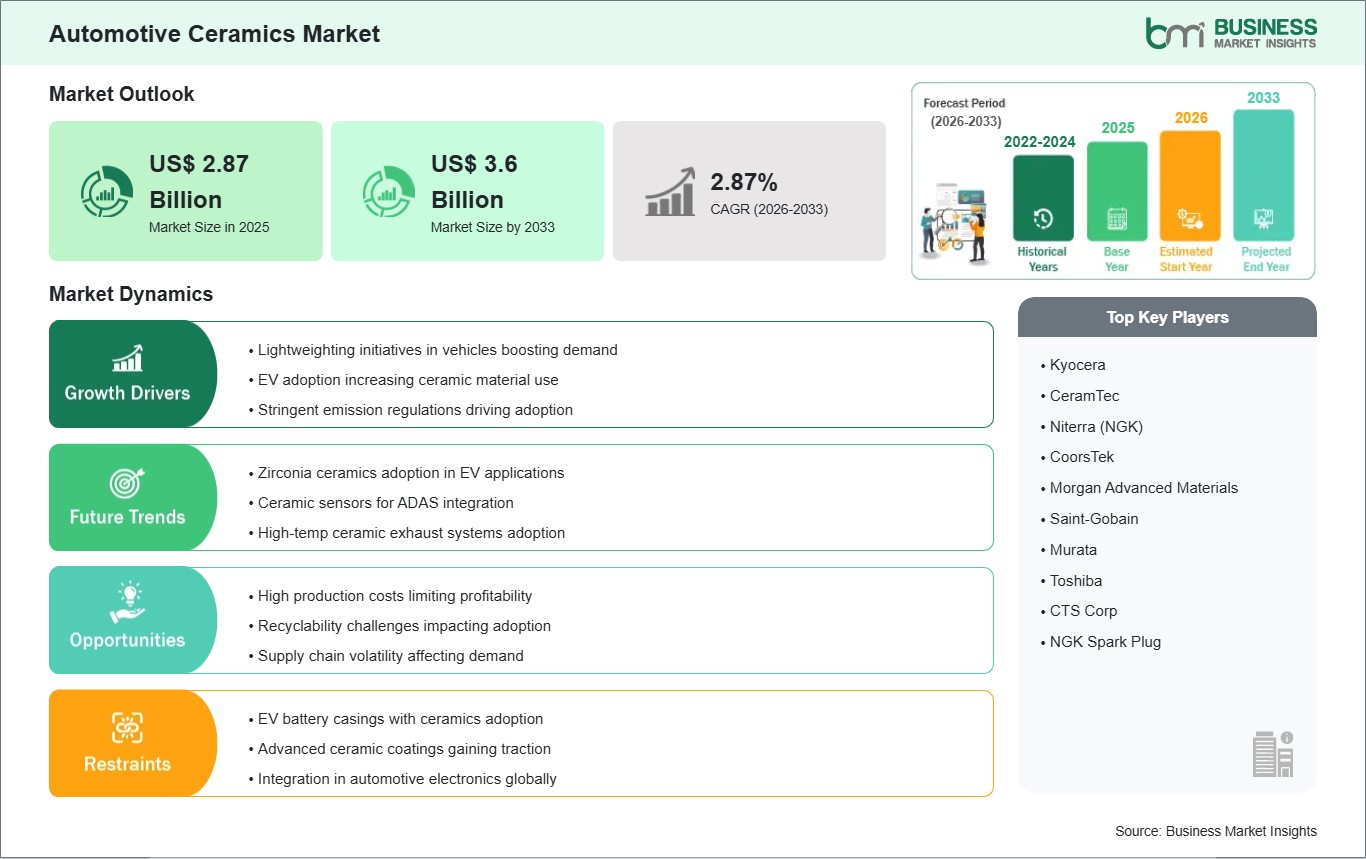
Automotive ceramics are advanced ceramic materials used in vehicles to improve performance, durability, heat resistance, and electrical functionality. These materials include alumina, zirconia, and titanate oxide, which are widely utilized in engine components, exhaust systems, sensors, spark plugs, and automotive electronic systems. Their ability to withstand extreme temperatures, corrosion, wear, and mechanical stress makes them an important material category in modern vehicle manufacturing. The Automotive Ceramics market is gaining attention as automakers focus on fuel efficiency, emission reduction, vehicle reliability, and the integration of advanced electronic systems. Growing demand for lightweight materials that can maintain structural integrity under harsh operating conditions is supporting the adoption of automotive ceramics across multiple vehicle platforms.
Several challenges influence market development. Ceramic materials often involve complex manufacturing processes and higher production costs compared to traditional metals and polymers. Their brittle nature can create design and engineering challenges in certain automotive applications. In addition, maintaining cost competitiveness while meeting increasingly demanding performance requirements remains a key concern for manufacturers. Supply chain complexities related to specialty raw materials and precision manufacturing techniques can also affect production efficiency and product availability in some regions.
Despite these challenges, the Automotive Ceramics market continues to present promising growth opportunities. Increasing adoption of electric and hybrid vehicles is expanding the use of ceramic materials in battery systems, power electronics, and thermal management applications. Continuous advancements in ceramic processing technologies are improving material strength, reliability, and design flexibility. Growing investments in automotive electronics, emission control systems, and high-performance vehicle components are expected to create additional demand. The competitive landscape remains characterized by product innovation, material development, manufacturing efficiency improvements, and efforts to support evolving vehicle technologies across global automotive markets.
Segment Analysis
Automotive Ceramics Market Segmentation
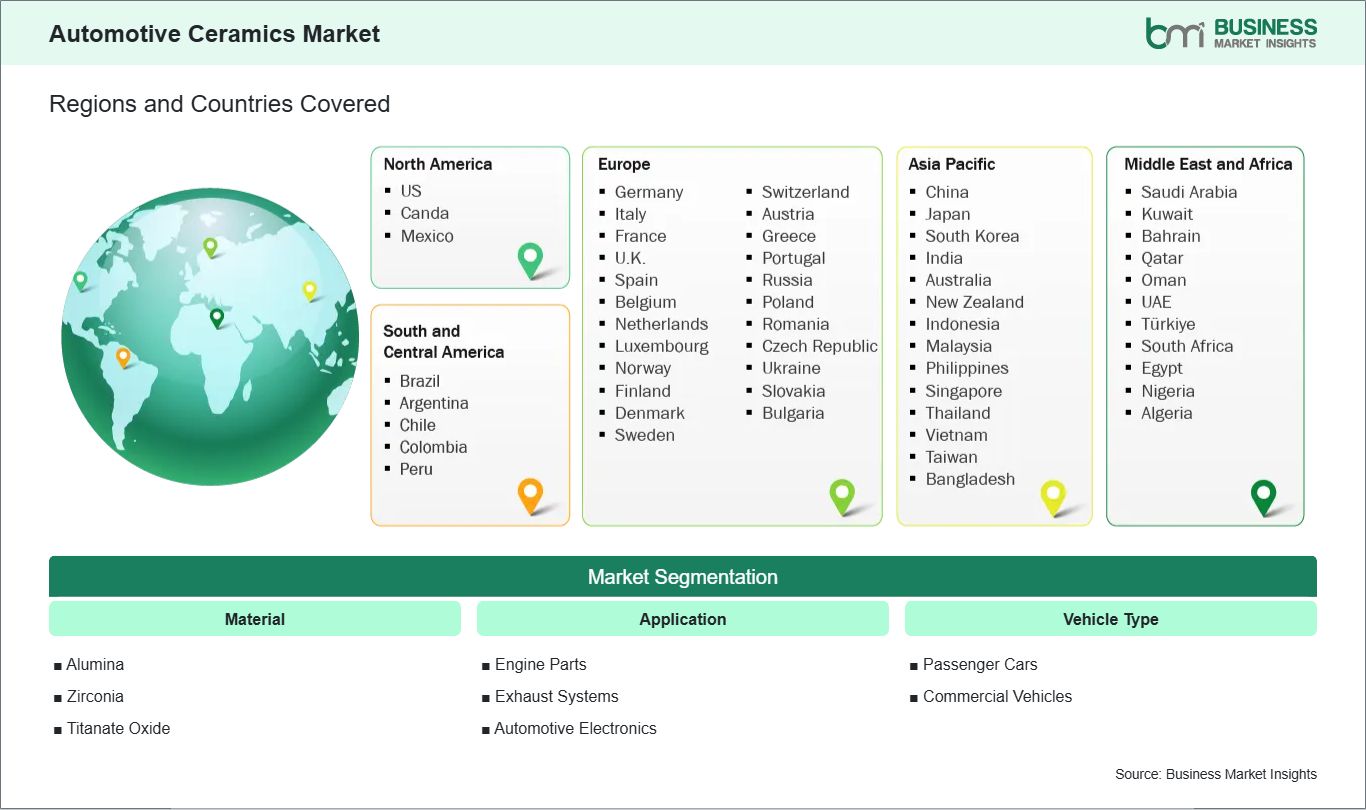
The Automotive Ceramics market is segmented based on material, application, and vehicle type. Each segment contributes to market development through its specific performance characteristics and automotive applications.
By Material
- Alumina: Widely used due to its excellent electrical insulation, wear resistance, and cost-effectiveness in automotive components.
- Zirconia: Preferred for applications requiring high strength, fracture toughness, and thermal stability under demanding operating conditions.
- Titanate Oxide: Utilized in specialized electronic and sensor applications because of its dielectric and functional properties.
By Application
- Engine Parts: Ceramic materials improve durability, heat resistance, and operational efficiency in high-temperature engine environments.
- Exhaust Systems: Used in emission control systems and components exposed to elevated temperatures and corrosive gases.
- Automotive Electronics: Increasingly adopted in sensors, control units, and electronic systems that require reliable electrical performance.
By Vehicle Type
- Passenger Cars: Represent significant demand due to large production volumes and increasing integration of advanced vehicle technologies.
- Commercial Vehicles: Adoption is driven by durability requirements, operational efficiency goals, and emission compliance needs.
Market Forces
Automotive Ceramics Market Drivers and Opportunities
Growing Demand for High-Temperature and Durable Automotive Components
The automotive industry continues to require materials capable of operating under increasingly demanding conditions. Modern engines, emission control systems, and electronic components generate high temperatures and are exposed to significant mechanical stress during operation. Traditional materials may face limitations in maintaining performance and durability under such conditions, creating demand for advanced ceramic materials. Automotive ceramics provide excellent heat resistance, corrosion resistance, and wear performance, making them suitable for critical vehicle applications. Regulatory requirements related to fuel efficiency and emissions have encouraged manufacturers to develop components that can withstand higher operating temperatures while maintaining long-term reliability. As vehicle systems become more sophisticated, the need for materials that support durability and operational efficiency continues to grow.
The increasing use of ceramics in engine components, exhaust systems, and advanced sensors strengthens their relevance across automotive manufacturing. Their ability to contribute to improved vehicle performance and reduced maintenance requirements supports ongoing market adoption. As automakers continue to pursue technological advancements and stricter performance standards, demand for automotive ceramics is expected to remain an important market driver.
Expanding Applications in Electric Vehicles and Automotive Electronics
The transition toward electrification is creating new opportunities for ceramic materials across the automotive industry. Electric and hybrid vehicles require advanced materials capable of supporting thermal management, power electronics, battery systems, and high-voltage applications. Automotive ceramics offer valuable electrical insulation and thermal stability characteristics that align with these requirements. Continuous innovation in automotive electronics is also expanding the range of ceramic applications. Sensors, control systems, communication modules, and power management devices increasingly rely on materials that provide reliable performance under varying environmental conditions. Advanced ceramic technologies are being developed to support smaller, lighter, and more efficient electronic components.
Emerging manufacturing techniques are improving ceramic design flexibility and production efficiency, enabling broader adoption across vehicle platforms. Growing investments in connected vehicles, autonomous technologies, and advanced driver assistance systems are expected to further increase demand for high-performance electronic components. As vehicle electrification and digitalization continue to advance globally, automotive ceramics are positioned to benefit from expanding application opportunities across multiple automotive segments.
Size and Share Analysis
Automotive Ceramics Market Size and Share Analysis
The Automotive Ceramics Market size is expected to reach US$ 3.6 billion by 2033 from US$ 2.87 billion in 2025. The market is estimated to record a CAGR of 2.87% from 2026 to 2033.
By material, alumina accounts for a significant share of the market due to its broad use in electrical insulation components, sensors, and other automotive applications that require durability and cost efficiency. Zirconia continues to gain attention for applications requiring superior strength and thermal performance, while titanate oxide remains important in specialized electronic and sensor-related functions.
By application, engine parts represent a major segment because ceramic materials help improve heat resistance and operational reliability in demanding environments. Exhaust systems maintain strong adoption due to their role in emission control and thermal management. Automotive electronics are experiencing increasing demand as vehicles incorporate more sensors, electronic control units, and advanced connectivity features.
By vehicle type, passenger cars contribute a substantial portion of market demand owing to higher production volumes and growing integration of advanced materials. Commercial vehicles also represent an important segment as fleet operators seek durable components that support long service life, operational efficiency, and compliance with evolving environmental standards.
Report Coverage
Automotive Ceramics Market Report Coverage and Deliverables
The "Automotive Ceramics Market Size and Forecast (2022-2033)" report provides a detailed analysis of the market covering below areas:
- Market size and forecast at global, regional, and country levels for all the key market segments covered under the scope
- Market trends, as well as market dynamics such as drivers, restraints, and key opportunities
- Market analysis covering key market trends, global and regional framework, major players, regulations, and recent market developments
- Industry landscape and competition analysis covering market concentration, heat map analysis, prominent players, and recent developments for the market
- Detailed company profiles, including SWOT analysis
Geographic Insights
Automotive Ceramics Market Geographic Insights
The Automotive Ceramics Market shows diverse regional adoption patterns influenced by vehicle manufacturing activity, technological advancement, regulatory requirements, and investments in automotive innovation.
North America remains an important market due to its established automotive manufacturing sector and strong focus on vehicle performance, emissions compliance, and advanced electronics integration. The United States continues to invest in electric vehicle development, creating opportunities for ceramic materials used in power electronics and thermal management systems. Canada supports adoption through automotive research activities and advanced manufacturing initiatives. The region benefits from mature infrastructure, strong engineering capabilities, and growing interest in high-performance materials.
Asia Pacific represents a major center for automotive ceramics adoption because of extensive vehicle production and rapidly expanding automotive supply chains. Countries such as China, Japan, South Korea, and India play significant roles in both vehicle manufacturing and advanced materials development. China continues to support electric vehicle expansion and automotive electronics production, while Japan and South Korea remain leaders in automotive technology innovation. India is experiencing growing demand for advanced automotive components driven by industrial development and vehicle production growth. The region benefits from strong manufacturing capabilities, expanding infrastructure, and increasing investment in next-generation vehicle technologies.
Industry Activity
Recent Developments
The Automotive Ceramics Market is analyzed using a mix of primary and secondary research sources, including corporate publications, industry associations, and verified databases. This approach ensures accurate tracking of innovation trends and strategic developments influencing the market.
- In January 2025, KYOCERA AVX and Kyocera Corporation executed a collaborative product showcase at CES 2025 in Las Vegas, introducing highly engineered multilayer ceramic capacitors (MLCCs) and component devices tailored for extreme high-voltage electric vehicle (EV) power routing. The technical launch focused on specialized ceramic architectures designed to maximize signal integrity, suppress noise, and manage thermal dissipation within electronic drive units and battery management enclosures. The initiative reflects an intense industry transition toward standardizing automotive-grade ceramic circuitry capable of surviving demanding electric mobility powertrain environments.
- In February 2025, Kyocera Corporation announced the commercial launch of the world's first Camera-LiDAR fusion sensor with perfect optical alignment. The advanced ADAS hardware utilizes specialized, highly durable semiconductor ceramic packaging options that deliver superior thermal management and structural reliability required for parallax-free, long-distance obstacle detection. The product launch highlights a growing market reliance on advanced fine ceramics to pioneer next-generation autonomous driving vehicle sensor suites.
Trust & Transparency
Research Methodology
The market analysis combines proprietary research with secondary data from government agencies, company disclosures, regulatory filings, industry databases and expert interviews. Market estimates are validated through data triangulation, cross-market benchmarking and analyst
review.
View Full Research Methodology
Key Sources Referred:
World Bank - Global Trade IndicatorsWorld Trade Organization (WTO)International Monetary Fund (IMF)International Trade Administration (ITA)Company WebsitesCompany Annual ReportsCompany Investor Presentations