
Automotive Lubricants Market Outlook: Size, Share, Trends, Growth Analysis, Competitive Landscape & Forecast, 2026-2033

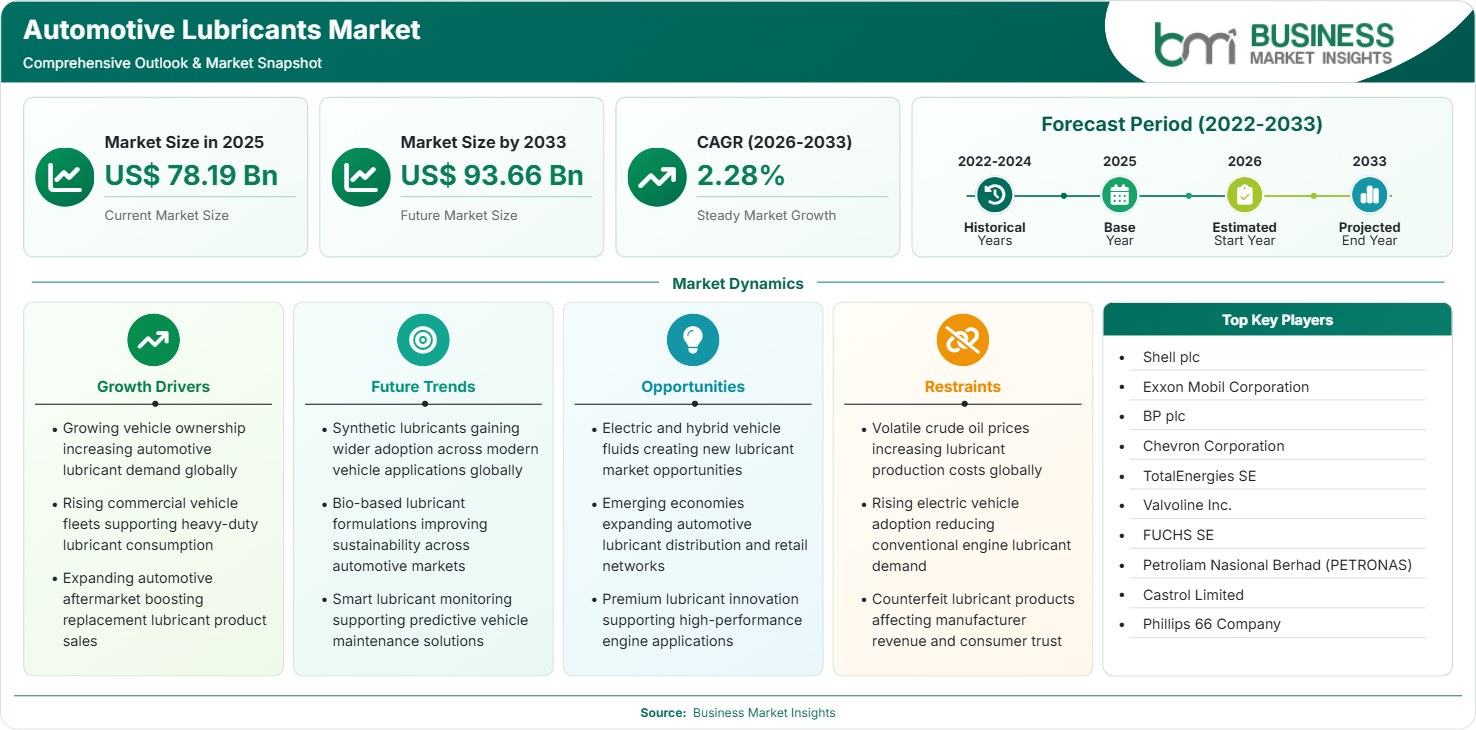
The Automotive Lubricants Market size was valued at US$ 78.19 billion in 2025 and is projected to reach US$ 93.66 billion by 2033, growing at a CAGR of 2.28% during 2026–2033. Growth is driven by rising global vehicle ownership, expanding commercial transportation, increasing demand for premium synthetic lubricants, and continuous growth in automotive aftermarket maintenance services.

Report Coverage
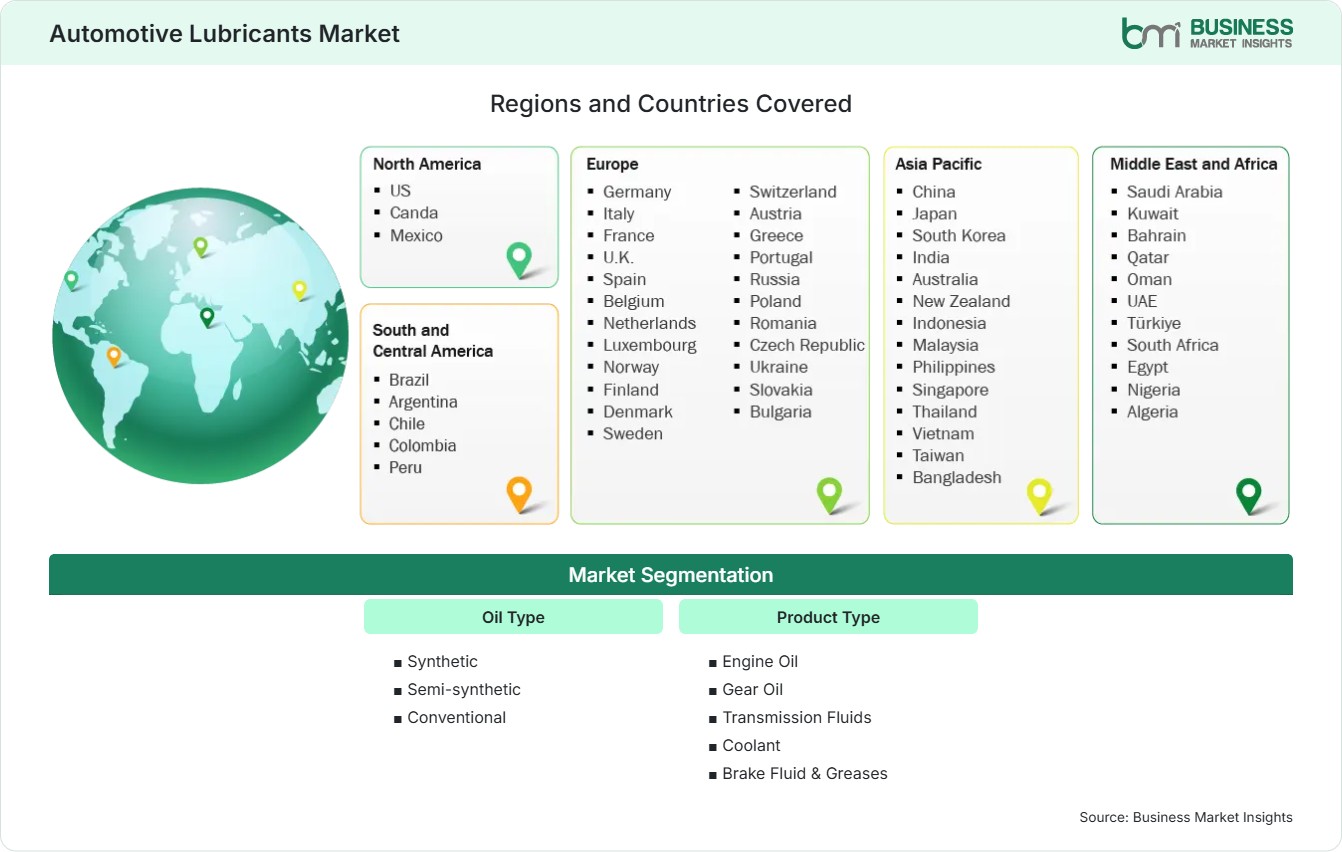
  • Oil Type: Synthetic, Semi-synthetic, Conventional
  • Product Type: Engine Oil, Gear Oil, Transmission Fluids, Coolant, Brake Fluid & Greases
US$ 78.19 Bn Market size in 2025
US$ 93.66 Bn Market Size by 2033
2.28% CAGR, 2026 - 2033
2026-2033 Forecast Period

AI Overview

Automotive Lubricants Market Summary

  • North America Region: North America holds a market share of 19%–21% in 2025, growing with a CAGR of 1.8%–2.2% during 2026–2033. Growth is supported by an aging vehicle fleet, increasing synthetic lubricant penetration, expanding commercial transportation, and higher preventive maintenance spending. The U.S. market benefits from strong aftermarket infrastructure, high vehicle ownership, and increasing adoption of premium lubricants, registering a CAGR between 1.9% and 2.3%.
  • Fastest Growing Region: Asia Pacific accounts for 40%–43% automotive lubricants market share in 2025 and is projected to expand at a CAGR of 2.8%–3.3% during 2026–2033. Rising vehicle production, increasing disposable income, expanding automotive manufacturing, growing industrialization, and rapid urbanization continue creating sustained lubricant demand across emerging economies.
  • Leading Segment: Engine Oil represents 55%–58% of the market share in 2025 and is expected to grow at a CAGR of 2.1%–2.5%. Frequent replacement intervals, expanding passenger vehicle ownership, heavy-duty fleet maintenance requirements, OEM service recommendations, and improved engine performance requirements continue supporting segment dominance globally.
  • High Growth Segment: Synthetic Oil accounts for 34%–37% market share in 2025 and is projected to register a CAGR of 3.2%–3.6%. Higher fuel efficiency requirements, stringent emission regulations, improved thermal stability, extended drain intervals, and premium vehicle adoption continue accelerating synthetic lubricant demand worldwide.
  • Key Market Opportunity: Increasing adoption of hybrid vehicles, premium lubricant formulations, digital maintenance platforms, and expanding automotive service networks create opportunities for manufacturers to strengthen profitability through differentiated, value-added lubricant solutions.
  • Major Market Players: Shell plc, Exxon Mobil Corporation, BP p.l.c., Chevron Corporation, TotalEnergies SE, Valvoline Inc., FUCHS SE, Petroliam Nasional Berhad (PETRONAS), Castrol Limited, and Phillips 66 Company.
Strategic Insights

Automotive Lubricants Market: Strategic Insights

Automotive Lubricants Market Strategic Framework
FREE PDF
Request your free sample
Request free sample
Stakeholder View

Key Takeaways

  • The industry continues to benefit from a highly integrated value chain comprising crude oil refiners, base oil manufacturers, additive suppliers, lubricant blenders, distributors, OEMs, and aftermarket service providers. Strategic collaborations across this ecosystem are improving supply reliability and product innovation.
  • Engine oils remain the largest revenue-generating product category, while synthetic lubricants present the strongest long-term growth opportunity owing to increasing demand for fuel-efficient, low-viscosity, and extended-drain formulations across passenger and commercial vehicles.
  • Ongoing innovations in advanced additive chemistry, bio-lubricants, and low-friction technologies are helping companies comply with emission standards and offer engine protection, heat resistance, and superior performance in challenging conditions.
  • The Asia Pacific region presents the most favorable investment opportunity because of the growing number of vehicles produced, automotive ownership, and rapid industrialization, along with the development of distribution channels in countries such as China, India, Indonesia, and Vietnam.
  • Major lubricant producers are increasingly engaged in acquisitions, partnership agreements, expanding production capabilities, and service solutions in order to secure their positions in the regions and increase their premium offerings.
  • Sustainable practices, such as recycled packaging, more eco-friendly manufacturing processes, renewable base oils, and sustainable lubricants, are playing an increasingly important role as governments and automakers strive for environmental compliance.
Geographic Outlook

Automotive Lubricants Market Regional Highlights

North America Automotive Lubricants Market

North America accounted for 19%–21% of the global market in 2025 and is projected to register a CAGR of 1.8%–2.2% through 2033. Stable vehicle ownership, a mature automotive aftermarket, and increasing adoption of premium synthetic lubricants continue supporting regional demand. Fleet operators increasingly prioritize high-performance lubricants to reduce maintenance costs and improve fuel efficiency.

  • The United States and Canada continue witnessing increasing demand for synthetic lubricants as consumers prioritize extended oil drain intervals, supporting automotive lubricants market growth.
  • Commercial trucking fleets increasingly adopt premium heavy-duty engine oils to improve operational efficiency, reduce equipment downtime.
  • OEM-recommended lubricant formulations continue gaining popularity as vehicle technologies become increasingly sophisticated.
  • Expansion of quick-lube centers, dealership service networks, and digital vehicle maintenance platforms continues strengthening aftermarket lubricant consumption.

US Automotive Lubricants Market

The United States represents nearly 82%–85% of the North American market and is expected to grow at a CAGR of 1.9%–2.3% during the forecast period. High vehicle ownership, an aging vehicle fleet, and robust commercial transportation activities continue driving lubricant consumption.

  • A large population of vehicles operating beyond ten years of age continues generating consistent demand for replacement engine oils, transmission fluids, and specialty lubricants across independent repair workshops.
  • Heavy-duty trucking, construction equipment, agricultural machinery, and logistics fleets remain significant contributors to lubricant consumption due to frequent maintenance schedules and demanding operating environments, promoting automotive lubricants market.
  • Growing adoption of synthetic engine oils supports improved fuel economy, longer service intervals, and enhanced engine performance, encouraging consumers to shift away from conventional lubricant products.
  • Digital fleet management and predictive maintenance technologies increasingly influence lubricant purchasing decisions by enabling optimized service intervals and reduced operating costs.

Europe Automotive Lubricants Market

Europe accounted for approximately 22%–24% of the global market in 2025 and is anticipated to grow at a CAGR of 1.6%–2.0% through 2033. Stringent emission regulations, increasing adoption of low-viscosity synthetic lubricants, and a well-established automotive aftermarket continue supporting market demand. Germany remains the leading regional market, while Eastern European countries are witnessing faster growth owing to expanding vehicle ownership, industrial activity, and improving service infrastructure.

  • Germany continues leading regional lubricant demand due to its strong automotive manufacturing sector, premium passenger vehicle production, and widespread adoption of advanced synthetic lubricants. The country is expected to grow at approximately 1.7%–2.1% CAGR.
  • Poland and Romania are among the fastest-growing markets as increasing vehicle registrations, expanding logistics activities, and investments in automotive servicing infrastructure stimulate lubricant consumption across both passenger and commercial vehicles.
  • European OEMs continue recommending ultra-low-viscosity engine oils that improve fuel economy, reduce emissions, and support compliance with Euro emission standards, encouraging demand for premium lubricant formulations, supporting automotive lubricants market.
  • Sustainability initiatives are driving manufacturers toward biodegradable lubricants, recycled packaging, and environmentally responsible production processes, creating new competitive opportunities throughout the regional value chain.
  • Rising hybrid vehicle sales continue increasing demand for specialized transmission fluids, coolants, and thermal management solutions designed specifically for electrified powertrains.

Asia Pacific Automotive Lubricants Market

Asia Pacific held approximately 40%–43% of the global market in 2025 and is projected to register the fastest CAGR of 2.8%–3.3% during 2026–2033. Rapid urbanization, expanding automotive production, increasing disposable incomes, and rising passenger vehicle ownership continue supporting regional demand. China dominates the regional landscape, while India represents the fastest-growing country due to increasing automotive sales, infrastructure development, and expanding aftermarket service networks.

  • China remains the largest lubricant-consuming country because of its substantial passenger vehicle fleet, commercial transportation sector, and extensive automotive manufacturing ecosystem, supporting consistent lubricant replacement demand.
  • India is expected to record one of the strongest regional growth rates, estimated at 3.4%–3.8% CAGR, driven by increasing vehicle ownership, expanding road infrastructure, and rapid development of organized automotive service centers.
  • Southeast Asian economies, including Indonesia, Vietnam, and Thailand, continue experiencing healthy lubricant demand owing to rising motorcycle ownership, passenger vehicle sales, and industrial expansion in automotive lubricants market.
  • Increasing awareness regarding premium synthetic lubricants encourages consumers to upgrade from conventional products, improving average selling prices and supporting higher manufacturer profitability.
  • Expansion of domestic lubricant production facilities and strategic investments by multinational companies continue strengthening regional supply chains while reducing dependence on imported products.

Rest of World Automotive Lubricants Market

The Rest of World region accounted for approximately 16%–18% of global demand in 2025 and is forecast to expand at a CAGR of 2.3%–2.7% through 2033. Growth is supported by increasing vehicle ownership, expanding mining and construction activities, and improving automotive maintenance infrastructure across South & Central America, the Middle East, and Africa.

South & Central America continues benefiting from expanding automotive aftermarket activities, while the Middle East and Africa experience increasing lubricant demand from commercial transportation, passenger vehicles, and off-road equipment operating under harsh climatic conditions, supporting automotive lubricants market.

  • Brazil leads South & Central America through its large automotive fleet, expanding commercial transportation sector, and well-established lubricant distribution network, supporting stable long-term consumption.
  • Mexico continues strengthening regional demand through increasing automotive manufacturing, vehicle exports, and expansion of organized vehicle servicing facilities supporting premium lubricant adoption.
  • Saudi Arabia and the United Arab Emirates remain major Middle Eastern markets due to high passenger vehicle ownership, growing logistics activities, and increasing demand for premium lubricants capable of operating under extreme temperatures.
  • South Africa continues leading the African market, supported by mining operations, commercial vehicle fleets, agricultural machinery, and expanding automotive aftermarket services.
  • International lubricant manufacturers continue investing in regional blending plants, strategic distributor partnerships, and localized production capabilities to improve supply efficiency and strengthen market penetration.
Global Market Geography
FREE PDF
Request your free sample
Request free sample
Segment Analysis

Automotive Lubricants Market Segmentation

Oil Type

The Oil Type segment accounted for nearly 100% of lubricant formulations across automotive applications in 2025 and is projected to expand at a CAGR of 2.28%–2.80% through the forecast period. The Automotive Lubricants Market scope continues broadening as manufacturers develop advanced base oils that improve fuel efficiency, engine protection, oxidation stability, and compatibility with modern internal combustion engines and hybrid vehicles.

  • Synthetic: Synthetic lubricants are experiencing the strongest demand owing to superior thermal stability, longer drain intervals, reduced engine wear, and increasing adoption across premium passenger vehicles, commercial fleets, and high-performance automotive applications.
  • Semi-synthetic: Semi-synthetic lubricants provide an effective balance between performance and affordability, making them widely preferred by mid-range passenger vehicle owners seeking improved engine protection compared to conventional mineral oils.
  • Conventional: Conventional lubricants continue maintaining significant demand in cost-sensitive markets, older vehicle fleets, agricultural equipment, and commercial vehicles where affordability remains a primary purchasing consideration.

By Product Type

The Product Type segment represents the largest contributor to lubricant demand, with Engine Oil accounting for approximately 55%–58% market share in 2025 and growing at a CAGR of 2.1%–2.5%. Current Automotive Lubricants Market trends indicate increasing preference for premium engine oils, specialized transmission fluids, and advanced thermal management products that improve vehicle reliability while supporting increasingly stringent emission regulations.

  • Engine Oil: Engine oil remains the dominant product category due to frequent replacement cycles, OEM maintenance recommendations, improved fuel efficiency requirements, and increasing passenger and commercial vehicle ownership worldwide.
  • Gear Oil: Gear oils ensure efficient lubrication of manual transmissions, differentials, and axles by minimizing friction, wear, and heat generation under high-load operating conditions encountered by passenger and commercial vehicles.
  • Transmission Fluids: Transmission fluids continue witnessing increasing adoption with the growing penetration of automatic and continuously variable transmissions requiring enhanced lubrication, cooling performance, and smooth gear shifting capabilities.
  • Coolant: Automotive coolants maintain optimal engine operating temperatures, prevent corrosion, and improve thermal efficiency across conventional, hybrid, and electric vehicle cooling systems under diverse climatic conditions.
  • Brake Fluid & Greases: Brake fluids and greases play critical roles in ensuring braking efficiency, corrosion protection, bearing lubrication, and long-term component reliability across passenger vehicles, commercial fleets, and heavy-duty automotive applications.
Market Forces

Automotive Lubricants Market Dynamics

Key Market Drivers

Growing vehicle ownership increasing automotive lubricant demand globally

The number of cars around the world is consistently rising as a result of urbanization, increasing disposable income levels, and larger middle-class communities. Increased car ownership leads to an increased need for lubricant change due to the lifespan of the vehicles. Besides that, aging car populations in developed nations are in greater need of maintenance and oil change compared to newer cars.

Rising commercial vehicle fleets supporting heavy-duty lubricant consumption

Commercial vehicles are expected to grow in number due to developments in logistics, e-commerce, infrastructure development, and international business. The need for more amounts of lubricant and less time periods for its replacement will be necessitated by the operating conditions of such vehicles as heavy duty trucks, buses, mining vehicles, and construction equipment. There is an increased preference for premium lubricants that reduce equipment downtime, provide better fuel economy, and prolong engine life. Growth in freight transport in Asia Pacific, North America, and the Middle East region will drive the need for commercial vehicle lubricants.

Expanding automotive aftermarket boosting replacement lubricant product sales

The rapidly growing automotive aftermarket is increasingly contributing to the lubricant consumption pattern via independent garages, dealership repair shops, quick-lubes, and organized retail distribution channels. Higher consumer awareness concerning preventive maintenance leads to timely replacement of motor oil, coolant, transmission fluid, and brake fluid. Predictive maintenance techniques and electronic diagnostic tools used for vehicles help improve the scheduling of services, thus creating uniform lubricant replacement intervals. The growing number of e-commerce websites helps boost the availability of products and thus help manufacturers reach out to larger customer groups, while boosting their sales of synthetic lubricants.

Key Market Opportunities

Electric and hybrid vehicle fluids creating new lubricant market opportunities

Increasing use of hybrid and battery-powered vehicles is changing the lubricant needs rather than making lubricants obsolete. There is need for specific drive fluids, thermal management fluids, transmission fluids, and greases that can withstand high temperature and protect sensitive electronic parts. Companies are focusing their investments on R&D to provide new generation fluids that are energy efficient and will enhance performance of the vehicle components. As the process of electrification of the automotive industry is gathering momentum all over the world, companies that can come up with lubricant products for EVs will get better revenues.

Emerging economies expanding automotive lubricant distribution and retail networks

The widespread increase in the number of motorized vehicles in Asia Pacific, Africa, Latin America, and certain areas of the Middle East provides continued prospects for lubricants companies to increase their market reach. The rise in investments in plant operations, warehousing, dealership arrangements, and retail operations ensures better product availability and reduces logistics expenses. Additionally, the increase in car ownership and consumer education on preventative vehicle maintenance augments demand. Automotive Lubricants Market Forecasts indicate that manufacturers establishing localized production and stronger distribution partnerships will be better positioned to capture sustained growth in high-potential emerging markets.

Premium lubricant innovation supporting high-performance engine applications

Ongoing innovations in synthetic base oils, additives, and low viscosity fluids have created interesting opportunities in the segments of premium lubricants. There has been an increasing tendency among automobile manufacturers to use high-end lubricants that can help in achieving fuel economy, minimize deposits in the engine, and prolong service intervals. The growing popularity of turbocharged engines, hybrid engines, and advanced transmissions has increased the need for specialty lubricants. Companies focused on environmentally friendly products, bio lubricants, and advanced thermal management products are expected to enjoy competitive advantage and healthy bottom lines.

Market Restraints and Challenges

Volatile crude oil prices increasing lubricant production costs globally

Factor: The manufacture of lubricants continues to be highly associated with the prices of crude oils and base oils, which make manufacturers susceptible to price volatility of raw materials, transportation charges, and refinery margins.

Impact: Price volatility is common, making pricing unstable and eroding margins of profitability, thus making long-term procurement planning difficult. Regional manufacturers are adversely impacted by this factor due to their inability to buy in large volumes and manage stock. Despite the constant demand for high-quality lubricants, rising raw material prices could negatively impact profitability and investments, and cause buyers to consider low-cost conventional lubricants.

Rising electric vehicle adoption reducing conventional engine lubricant demand

Factor: Battery electric cars do not require conventional engine oils while demanding less frequent changes of lubricants in comparison with conventional internal combustion engine cars.

Impact: The gradual increase in the share of electric vehicles lowers the demand for traditional engine lubricants in the long term, especially in mature automotive markets. As a result, companies have to expand their product portfolio to include electric vehicle lubricants and cooling systems to compensate for the falling demand in the conventional engine oil category.

Company Analysis

Competitive Landscape

The Automotive Lubricants Market analysis reflects a competitive environment characterized by global energy companies, specialty lubricant manufacturers, and regional suppliers focusing on premium formulations, strategic partnerships, capacity expansion, sustainability initiatives, and advanced additive technologies.

Company Name

Overview

Products and Services Relevant to this Market

Shell plc

Global energy company with an extensive lubricant portfolio, strong OEM partnerships, and operations across more than 100 countries.

Passenger car engine oils, heavy-duty lubricants, transmission fluids, gear oils, greases, industrial lubricants, and EV fluids.

Exxon Mobil Corporation

Leading integrated energy company recognized for advanced lubricant technologies and significant investments in synthetic formulations.

Mobil engine oils, gear oils, transmission fluids, greases, coolants, and commercial vehicle lubricant solutions.

BP p.l.c.

Global energy major operating premium lubricant brands through extensive retail and distribution networks worldwide.

Engine oils, industrial lubricants, transmission fluids, brake fluids, greases, and specialty automotive fluids.

Chevron Corporation

International energy company offering high-performance lubricants for passenger, commercial, and industrial applications.

Engine oils, gear lubricants, coolants, transmission fluids, heavy-duty lubricants, and greases.

TotalEnergies SE

Diversified energy company focusing on premium lubricants, sustainable mobility solutions, and advanced automotive fluid technologies.

Synthetic engine oils, coolants, transmission fluids, brake fluids, greases, and EV-compatible lubricants.

Valvoline Inc.

Leading automotive lubricant manufacturer with a strong aftermarket service network and premium maintenance solutions.

Engine oils, transmission fluids, coolants, brake fluids, gear oils, and preventive maintenance products.

FUCHS SE

Global specialty lubricant manufacturer emphasizing research-driven formulations for automotive and industrial markets.

Synthetic lubricants, specialty greases, engine oils, transmission fluids, and high-performance automotive lubricants.

Petroliam Nasional Berhad (PETRONAS)

Malaysian energy company supplying premium lubricants through global OEM partnerships and motorsport innovation.

PETRONAS engine oils, transmission fluids, coolants, greases, and commercial vehicle lubricants.

Castrol Limited

Global lubricant brand recognized for premium automotive lubrication technologies and strong OEM approvals.

Passenger vehicle engine oils, gear oils, transmission fluids, greases, coolants, and specialty automotive fluids.

Phillips 66 Company

Integrated downstream company supplying automotive and commercial lubricant products across multiple international markets.

Engine oils, gear oils, transmission fluids, hydraulic fluids, greases, and heavy-duty lubricant products.

Trust & Transparency

Research Methodology

The market analysis combines proprietary research with secondary data from government agencies, company disclosures, regulatory filings, industry databases and expert interviews. Market estimates are validated through data triangulation, cross-market benchmarking and analyst review.

View Full Research Methodology

Questions Answered

Frequently Asked Questions

What does the market Report typically include?

A comprehensive Automotive Lubricants Market Report generally includes market sizing, growth forecasts, competitive landscape, regional analysis, segmentation, emerging trends, technological developments, regulatory outlook, company profiles, and strategic investment opportunities.

How is electric vehicle adoption influencing lubricant demand?

Although battery electric vehicles reduce demand for conventional engine oils, they create new opportunities for specialized transmission fluids, thermal management coolants, greases, and dedicated e-mobility lubricant technologies designed for electrified powertrains.

Which product segment generates the highest revenue?

Engine oil remains the leading product segment because of frequent replacement requirements, OEM maintenance recommendations, extensive passenger vehicle ownership, and substantial demand from commercial transportation fleets worldwide.

Which region dominates the Automotive Lubricants Market?

Asia Pacific is the largest regional market due to its high vehicle production, expanding automotive fleet, growing industrialization, rising disposable incomes, and strong demand from emerging economies such as China and India.

What factors are driving the market?

The market is primarily driven by increasing global vehicle ownership, expanding commercial transportation, rising demand for synthetic lubricants, growth of automotive aftermarket services, and continuous technological advancements in engine and transmission systems.

Access the Full Automotive Lubricants Market Report

Get segment-level forecasts, regional estimates, competitive benchmarking, company profiles and downloadable Excel datasets.

Access the full Automotive Lubricants Market Report
350 pages PDF & Excel | 2026-08-10
Similar Research

Related Market Reports