
Industrial Lubricants Market Outlook: Size, Share, Trends, Growth Analysis, Competitive Landscape & Forecast, 2026-2033

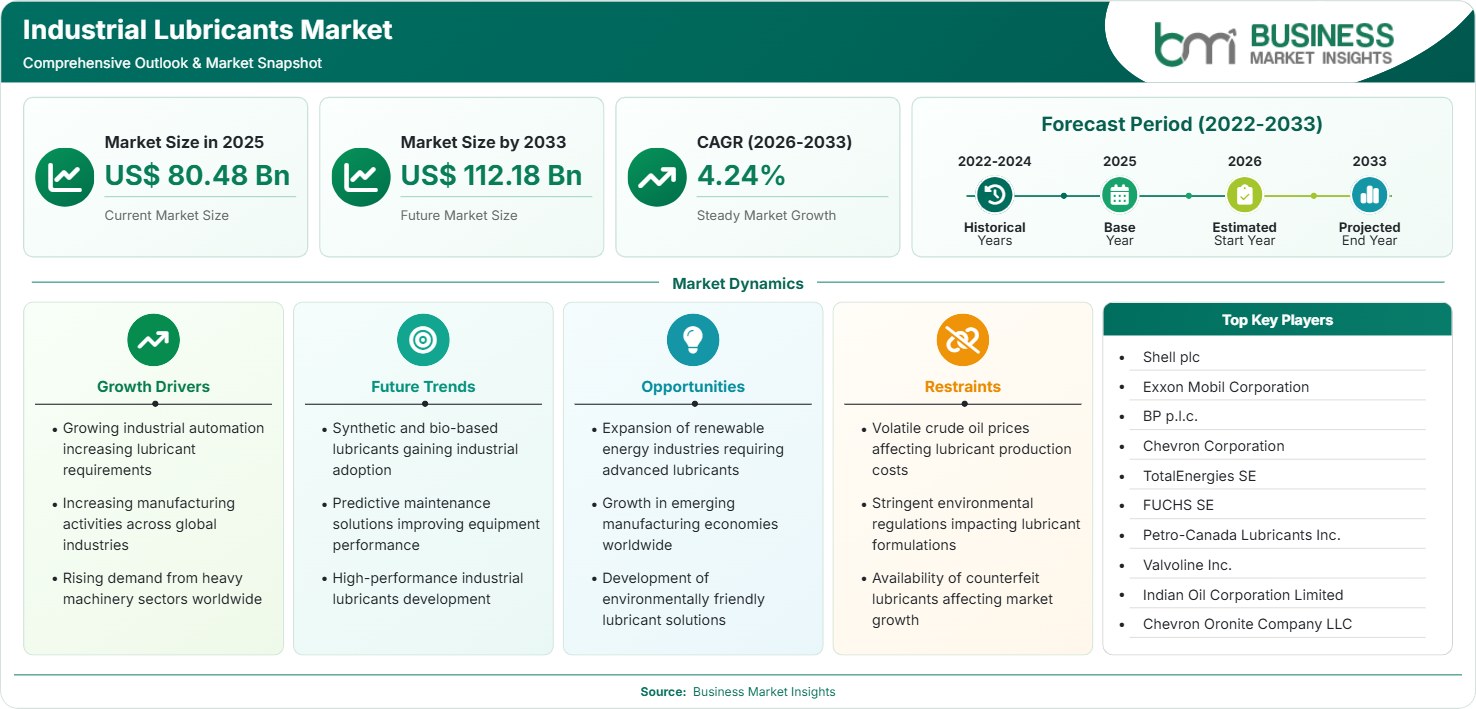
The Industrial Lubricants Market size was valued at US$ 80.48 billion in 2025 and is projected to reach US$ 112.18 billion by 2033, registering a CAGR of 4.24% during 2026–2033. The market is experiencing stable growth driven by growing industrial automation increasing lubricant requirements, increasing manufacturing activities across global industries, and rising demand from heavy machinery sectors worldwide. Industrial lubricants play a critical role in reducing friction, minimizing equipment wear, improving operational efficiency, and extending machinery lifespan across manufacturing, mining, construction, power generation, metal processing, marine, and other industrial applications.

Report Coverage
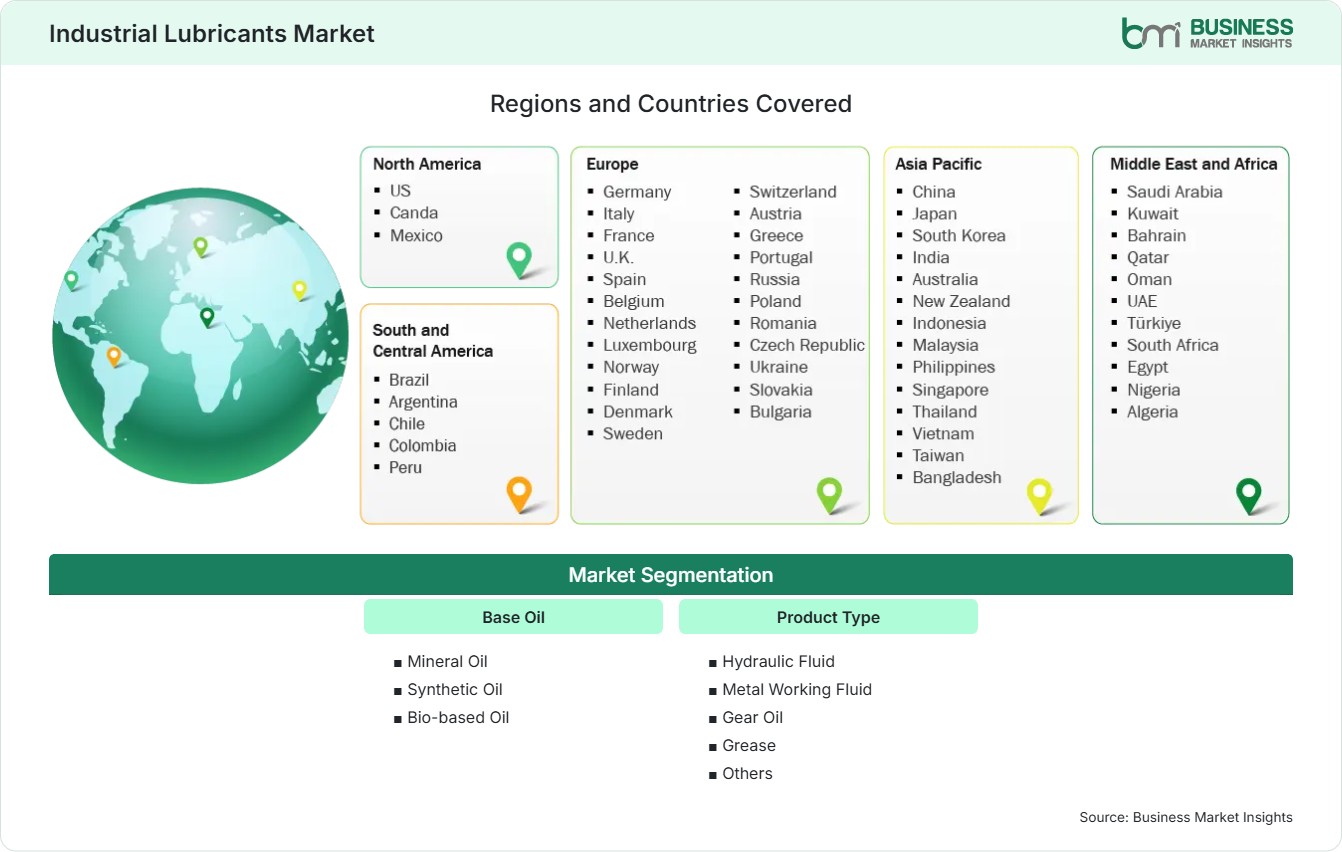
  • Base Oil: Mineral Oil, Synthetic Oil, Bio-based Oil
  • Product Type: Hydraulic Fluid, Metal Working Fluid, Gear Oil, Grease, Others
US$ 80.48 Bn Market size in 2025
US$ 112.18 Bn Market Size by 2033
4.24% CAGR, 2026 - 2033
2026-2033 Forecast Period

AI Overview

Industrial Lubricants Market Summary

  • North America Region: North America accounted for 30%–33% of global revenue in 2025 and is projected to register a CAGR of 4.0%–4.5% during 2026–2033. The region maintains a strong market position due to advanced manufacturing infrastructure, widespread industrial automation, strong mining and construction sectors, and increasing demand for premium synthetic lubricants. The United States contributes approximately 85%–88% of regional revenue and is expected to register a CAGR of 4.1%–4.6% owing to expanding industrial production, machinery modernization, and rising investments in automation technologies.
  • Fastest Growing Region: Asia Pacific represented 37%–40% of global revenue in 2025 and is projected to register the highest CAGR of 4.8%–5.3% during the forecast period. Expanding manufacturing activities, rapid industrialization, increasing infrastructure investments, and growing heavy equipment utilization continue driving regional market growth.
  • Leading Segment: Mineral Oil accounted for 56%–59% of market revenue in 2025 and is projected to register a CAGR of 3.9%–4.4% during the assessment period owing to its cost-effectiveness, widespread industrial availability, and extensive utilization across diverse industrial machinery applications.
  • High Growth Segment: Bio-based Oil is projected to witness significant growth, expanding at a CAGR of 6.3%–6.9% during 2026–2033 due to increasing environmental regulations, sustainability initiatives, and rising demand for biodegradable industrial lubricant solutions.
  • Key Market Opportunity: Expansion of renewable energy industries requiring advanced lubricants, growth in emerging manufacturing economies worldwide, and development of environmentally friendly lubricant solutions continue creating substantial market opportunities.
  • Major Market Players: Shell plc, Exxon Mobil Corporation, BP p.l.c., Chevron Corporation, TotalEnergies SE, FUCHS SE, Petro-Canada Lubricants Inc., Valvoline Inc., Indian Oil Corporation Limited, Chevron Oronite Company LLC.
Strategic Insights

Industrial Lubricants Market: Strategic Insights

Industrial Lubricants Market Strategic Framework
FREE PDF
Request your free sample
Request free sample
Stakeholder View

Key Takeaways

  • The market continues benefiting from growing industrial automation increasing lubricant requirements, increasing manufacturing activities across global industries, and rising demand from heavy machinery sectors worldwide.
  • The strongest Industrial Lubricants Market Growth opportunities continue emerging from expansion of renewable energy industries requiring advanced lubricants, growth in emerging manufacturing economies worldwide, and development of environmentally friendly lubricant solutions.
  • Mineral Oil remains the dominant base oil owing to its cost-effectiveness, broad industrial compatibility, reliable performance, and extensive utilization across manufacturing and heavy equipment applications.
  • Asia Pacific is projected to witness the fastest growth owing to expanding manufacturing capacity, rapid industrialization, increasing infrastructure development, and growing industrial machinery deployment.
  • Lubricant manufacturers are increasingly investing in synthetic lubricant technologies, bio-based formulations, advanced additive packages, and predictive maintenance solutions to strengthen market competitiveness.
  • Companies focusing on sustainable lubrication technologies, industrial automation support, renewable energy applications, and high-performance lubricant innovation are expected to strengthen their competitive positioning.
Geographic Outlook

Industrial Lubricants Market Regional Highlights

North America Industrial Lubricants Market

North America accounted for 30%–33% of global revenue in 2025 and is projected to register a CAGR of 4.0%–4.5% during 2026–2033. The region continues maintaining a strong market position due to advanced manufacturing infrastructure, widespread industrial automation, established mining and construction sectors, and increasing adoption of premium synthetic lubricants. The Industrial Lubricants Market Share remains significant as industries continue investing in predictive maintenance, machinery modernization, and operational efficiency improvements across multiple industrial sectors.

  • The United States remains the largest regional market owing to extensive manufacturing activity, strong industrial automation adoption, expanding mining operations, and increasing investments in industrial equipment modernization.
  • Canada continues supporting regional growth through expanding mining activities, oil & gas operations, renewable energy projects, and industrial maintenance investments.
  • Rising adoption of predictive maintenance technologies continues increasing demand for high-performance industrial lubricants.
  • Growing investments in advanced manufacturing facilities continue strengthening long-term lubricant consumption.

US Industrial Lubricants Market

The United States accounted for approximately 85%–88% of North American revenue in 2025 and is projected to register a CAGR of 4.1%–4.6% during the forecast period. Strong industrial production, increasing machinery modernization, expanding automation technologies, and growing infrastructure investments continue driving domestic market growth.

  • Increasing utilization of hydraulic systems, industrial machinery, and automated manufacturing equipment continues supporting lubricant demand.
  • Growing industrial digitalization continues encouraging adoption of advanced lubrication management solutions.
  • Rising investments in renewable energy equipment and heavy industrial assets continue expanding lubricant applications.
  • Industrial operators continue emphasizing equipment reliability, reduced downtime, and extended maintenance intervals through advanced lubrication technologies.

Europe Industrial Lubricants Market

Europe represented 25%–28% of global revenue in 2025 and is expected to expand at a CAGR of 3.8%–4.3% during 2026–2033. The region continues benefiting from advanced manufacturing industries, increasing sustainability initiatives, stringent environmental regulations, and growing adoption of synthetic and bio-based lubricants. Germany remains the largest regional market, while Poland is projected to register the fastest growth with a CAGR of 4.7%–5.2% owing to expanding manufacturing activities, industrial investments, and machinery modernization.

  • Germany continues leading regional demand through strong automotive manufacturing, industrial machinery production, and advanced engineering industries.
  • Poland continues witnessing rapid growth through increasing industrial production, infrastructure development, and foreign manufacturing investments.
  • France continues supporting market expansion through chemical manufacturing, aerospace industries, and renewable energy investments.
  • European industries continue increasing adoption of environmentally sustainable lubricant formulations to comply with evolving regulatory standards.
  • Rising investments in Industry 4.0 technologies continue supporting demand for premium industrial lubricants.

Asia Pacific Industrial Lubricants Market

Asia Pacific accounted for 37%–40% of global revenue in 2025 and is projected to register the highest CAGR of 4.8%–5.3% during the forecast period. Expanding manufacturing activities, rapid industrialization, increasing infrastructure investments, and growing heavy equipment utilization continue driving regional market growth. China remains the leading regional market, while India is projected to register the fastest growth with a CAGR of 5.5%–6.0% owing to expanding industrial production, manufacturing investments, infrastructure development, and increasing adoption of automation technologies.

  • China continues dominating regional demand through large-scale manufacturing, heavy industrial production, mining operations, and infrastructure expansion.
  • India continues witnessing rapid growth due to increasing manufacturing capacity, government industrial development initiatives, expanding automotive production, and growing heavy machinery utilization.
  • Japan continues supporting premium lubricant demand through advanced manufacturing technologies and industrial automation.
  • South Korea continues contributing through electronics manufacturing, shipbuilding, heavy engineering, and industrial modernization.
  • Southeast Asian countries continue creating substantial opportunities through industrial expansion, foreign direct investment, and growing manufacturing activities.

Rest of World Industrial Lubricants Market

The Rest of World accounted for 8%–10% of global revenue in 2025 and is projected to register a CAGR of 4.2%–4.7% during 2026–2033. Latin America, the Middle East, and Africa continue experiencing increasing demand for industrial lubricants due to expanding mining operations, infrastructure development, oil & gas activities, manufacturing investments, and industrial modernization.

Growing investments in industrial equipment, renewable energy infrastructure, heavy machinery, and manufacturing facilities are creating significant opportunities for lubricant manufacturers across emerging economies.

  • Brazil continues supporting regional demand through mining, agriculture, industrial manufacturing, and infrastructure development.
  • Mexico continues strengthening market growth through expanding automotive manufacturing, industrial exports, and machinery production.
  • Middle Eastern countries continue investing in petrochemical industries, industrial diversification, and renewable energy infrastructure.
  • South Africa continues contributing through mining activities, heavy industrial operations, and manufacturing sector expansion.
  • Emerging economies across Latin America, the Middle East, and Africa continue creating long-term opportunities through increasing industrialization, infrastructure investments, and modernization of manufacturing facilities.
Global Market Geography
FREE PDF
Request your free sample
Request free sample
Segment Analysis

Industrial Lubricants Market Segmentation

Base Oil

The Base Oil segment accounted for 56%–59% of market revenue in 2025 and is projected to register a CAGR of 3.9%–4.4% during the forecast period. Increasing industrial production, expanding machinery utilization, and growing demand for high-performance lubrication continue driving segment growth. The Industrial Lubricants Market Trends indicate rising adoption of advanced lubricant formulations that improve equipment efficiency, reduce maintenance frequency, and extend machinery service life across multiple industrial sectors.

  • Mineral Oil: Mineral Oil remains the dominant base oil owing to its cost-effectiveness, broad industrial compatibility, reliable lubrication performance, and extensive utilization across manufacturing, mining, construction, and heavy industrial machinery applications.
  • Synthetic Oil: Synthetic Oil continues witnessing strong demand due to superior thermal stability, oxidation resistance, extended drain intervals, improved wear protection, and high-performance operation under extreme industrial conditions.
  • Bio-based Oil: Bio-based Oil is projected to witness the fastest growth owing to increasing environmental regulations, sustainability initiatives, demand for biodegradable lubricants, and expanding adoption across environmentally sensitive industrial applications.

Product Type

The Product Type segment continues evolving through increasing demand for specialized lubricants designed to improve machinery performance, operational reliability, and maintenance efficiency. The Industrial Lubricants Market Scope continues expanding through continuous innovation in lubricant chemistry, additive technologies, and industrial equipment requirements.

  • Hydraulic Fluid: Hydraulic Fluid remains the dominant product type owing to extensive utilization in industrial machinery, manufacturing equipment, mining operations, construction machinery, agricultural equipment, and automated production systems requiring efficient hydraulic power transmission.
  • Metal Working Fluid: Metal Working Fluid continues supporting market growth through increasing utilization in machining, cutting, grinding, drilling, forming, and metal fabrication processes where cooling, lubrication, and corrosion protection are essential.
  • Gear Oil: Gear Oil continues witnessing steady demand through widespread application in industrial gearboxes, wind turbines, mining equipment, marine systems, and heavy-duty mechanical power transmission systems.
  • Grease: Grease continues maintaining strong demand due to its ability to provide long-lasting lubrication, corrosion protection, contamination resistance, and reliable performance under heavy loads and harsh operating environments.
  • Others: Other industrial lubricants continue supporting diverse applications including compressor oils, turbine oils, transformer oils, refrigeration oils, slideway oils, and specialty industrial lubrication products used across multiple manufacturing industries.
Market Forces

Industrial Lubricants Market Dynamics

Key Market Drivers

Growing industrial automation increasing lubricant requirements

Growing industrial automation increasing lubricant requirements is significantly driving market growth as automated production lines, robotics, precision manufacturing systems, and digitally controlled industrial equipment require advanced lubrication solutions that ensure continuous operation, minimize wear, and reduce maintenance downtime. Industrial operators continue investing in high-performance lubricants to maximize equipment productivity and operational reliability.

Increasing manufacturing activities across global industries

Increasing manufacturing activities across global industries are accelerating lubricant demand as industrial production expands across automotive, chemicals, food processing, metals, power generation, construction, and heavy engineering sectors. Growing investments in manufacturing capacity continue increasing the need for specialized industrial lubrication products.

Rising demand from heavy machinery sectors worldwide

Rising demand from heavy machinery sectors worldwide is strengthening market expansion as mining, construction, agriculture, marine, oil & gas, and infrastructure industries continue deploying heavy-duty equipment operating under demanding environmental and operational conditions. High-performance lubricants play a critical role in extending equipment life while reducing maintenance costs.

Key Market Opportunities

Expansion of renewable energy industries requiring advanced lubricants

Expansion of renewable energy industries requiring advanced lubricants is creating substantial opportunities as wind turbines, hydroelectric facilities, solar manufacturing equipment, and biomass processing systems increasingly require specialized lubricants capable of operating under demanding environmental conditions while supporting long equipment service life.

Growth in emerging manufacturing economies worldwide

Growth in emerging manufacturing economies worldwide is generating significant opportunities as developing countries continue expanding industrial production, infrastructure development, heavy machinery deployment, and factory automation. Increasing industrial investments continue supporting long-term lubricant consumption.

Development of environmentally friendly lubricant solutions

Development of environmentally friendly lubricant solutions is creating new growth opportunities as industries increasingly adopt biodegradable, low-toxicity, and sustainable lubrication technologies to comply with environmental regulations while reducing ecological impact. Manufacturers continue investing in bio-based formulations and advanced additive technologies that enhance both environmental performance and operational efficiency.

Market Restraints and Challenges

Volatile crude oil prices affecting lubricant production costs

Factor: Industrial lubricant manufacturing is highly dependent on base oils and petrochemical raw materials, the prices of which have a direct connection with global changes in crude oil markets. Factors such as crude oil prices, geopolitics, disruptions in the supply chain, and the amount of oil refined affect industrial lubricant manufacturing cost-wise.

Impact: Volatile crude oil prices may lead to increased manufacturing costs and decreased manufacturer profit margins as well as uncertainties in lubricant pricing for industrial consumers. Lubricant manufacturers keep concentrating on supply chain optimization, diversification of sources, formulation advancements, and alternative feedstocks such as synthetics and biodegradable options.

Stringent environmental regulations impacting lubricant formulations

Factor: Environmental laws and regulations are becoming more stringent in terms of the formulation of the lubricants, their emissions, biodegradability, hazardous chemicals present in the lubricant, and their disposal methods. There is an ongoing need for the lubricant manufacturer to continually modify their products to conform to changing environmental and industry standards.

Impact: Stringent environmental regulations will increase costs such as R&D, product reformulation, regulatory compliance, and time to market of the lubricants. Organizations keep on spending in order to produce environmentally sound products and bio-lubricants.

Company Analysis

Competitive Landscape

Competition within the industrial lubricants industry is driven by formulation technology, product performance, sustainability initiatives, global distribution capabilities, technical service support, and continuous product innovation. The Industrial Lubricants Market Analysis indicates that leading manufacturers are investing in synthetic lubricants, bio-based formulations, advanced additive technologies, predictive maintenance solutions, and industrial digitalization to strengthen their competitive positions.

Company Name

Overview

Products and Services relevant to this market

Shell plc

Global energy company with an extensive portfolio of industrial lubrication solutions.

Hydraulic fluids, gear oils, greases, compressor oils, turbine oils, and industrial lubrication services.

Exxon Mobil Corporation

Global energy and lubricant manufacturer serving diverse industrial sectors.

Industrial lubricants, hydraulic fluids, synthetic lubricants, gear oils, greases, and maintenance solutions.

BP p.l.c.

International energy company providing industrial lubrication technologies.

Industrial lubricants, hydraulic oils, metal working fluids, gear oils, greases, and specialty lubricant solutions.

Chevron Corporation

Global energy company offering industrial lubrication products for heavy industries.

Hydraulic fluids, industrial oils, greases, compressor lubricants, and heavy-duty lubrication solutions.

TotalEnergies SE

Integrated energy company with advanced industrial lubricant product offerings.

Synthetic lubricants, hydraulic fluids, metal working fluids, gear oils, and industrial maintenance products.

FUCHS SE

Global lubricant manufacturer specializing in industrial and specialty lubrication technologies.

Industrial lubricants, greases, metal working fluids, hydraulic oils, and specialty lubrication products.

Petro-Canada Lubricants Inc.

Lubricant manufacturer providing premium industrial lubrication products.

Hydraulic fluids, gear oils, compressor oils, greases, and synthetic industrial lubricants.

Valvoline Inc.

Lubricant company serving industrial and commercial equipment markets.

Industrial lubricants, hydraulic oils, greases, industrial fluids, and equipment maintenance solutions.

Indian Oil Corporation Limited

Integrated energy company supplying industrial lubricants across multiple sectors.

Industrial oils, greases, hydraulic fluids, gear oils, and specialty lubrication products.

Chevron Oronite Company LLC

Specialty additive technology company serving global lubricant manufacturers.

Lubricant additive technologies, industrial lubricant formulations, performance additives, and technical support services.

Trust & Transparency

Research Methodology

The market analysis combines proprietary research with secondary data from government agencies, company disclosures, regulatory filings, industry databases and expert interviews. Market estimates are validated through data triangulation, cross-market benchmarking and analyst review.

View Full Research Methodology

Questions Answered

Frequently Asked Questions

How do market forecasts support strategic planning?

Industrial Lubricants Market Forecasts help lubricant manufacturers, industrial equipment suppliers, manufacturing companies, investors, distributors, and policymakers evaluate future demand, identify emerging opportunities, optimize product strategies, and support long-term business planning.

What does the market report include?

The Industrial Lubricants Market Report provides comprehensive insights covering market size, competitive landscape, segmentation analysis, regional outlook, industry trends, investment opportunities, competitive benchmarking, and future growth prospects.

What factors are driving market expansion?

Growing industrial automation increasing lubricant requirements, increasing manufacturing activities across global industries, rising demand from heavy machinery sectors worldwide, and continuous advancements in high-performance lubrication technologies continue driving market growth.

Which base oil segment is expected to witness significant growth?

Bio-based Oil is expected to witness the fastest growth due to increasing environmental regulations, sustainability initiatives, rising demand for biodegradable lubricant solutions, and growing industrial adoption of environmentally friendly products.

Which base oil dominates market?

Mineral Oil represents the leading base oil owing to its cost-effectiveness, broad industrial compatibility, reliable lubrication performance, and widespread utilization across manufacturing, mining, construction, and heavy industrial equipment.

Access the Full Industrial Lubricants Market Report

Get segment-level forecasts, regional estimates, competitive benchmarking, company profiles and downloadable Excel datasets.

Access the full Industrial Lubricants Market Report
350 pages PDF & Excel | 2026-08-06
Similar Research

Related Market Reports