
Industrial Wax Market Outlook: Size, Share, Trends, Growth Analysis, Competitive Landscape & Forecast, 2026-2033

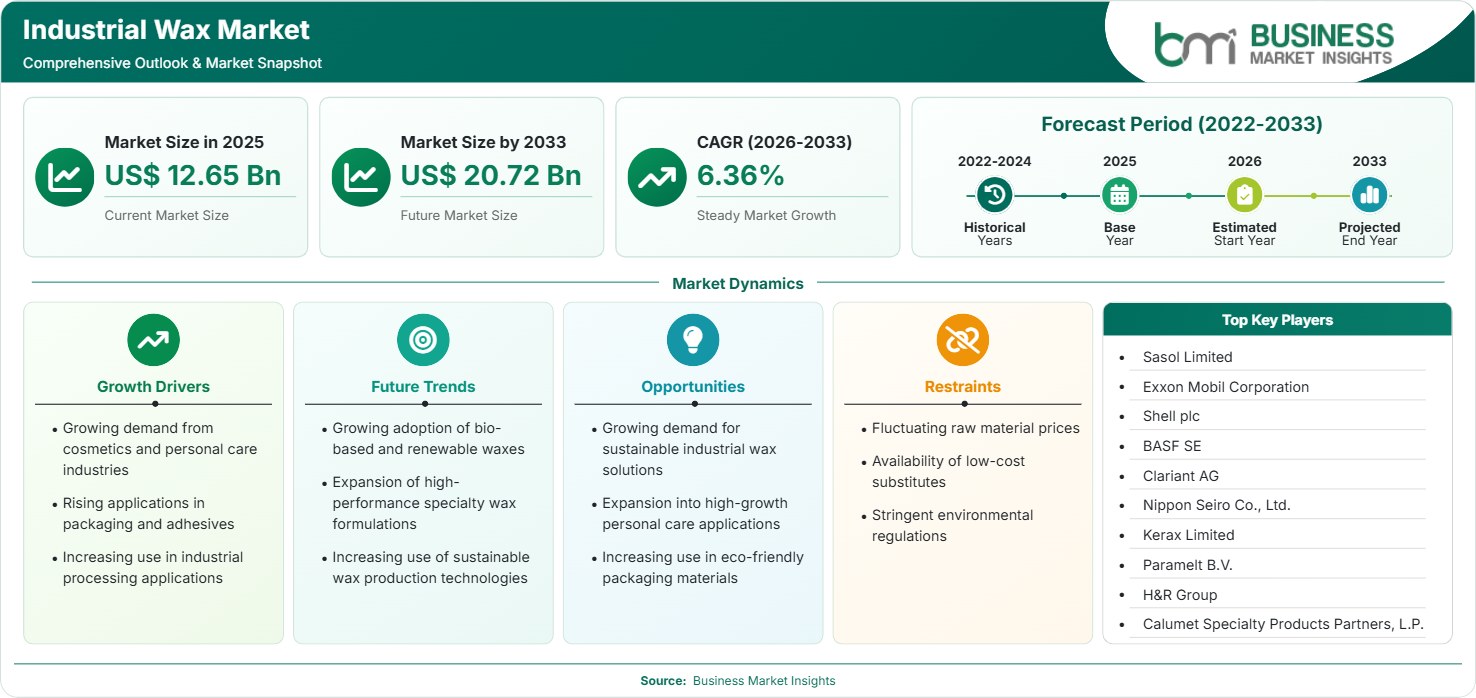
The Industrial Wax Market size was valued at US$ 12.65 Billion in 2025 and is projected to reach US$ 20.72 Billion by 2033, growing at a CAGR of 6.36% from 2026 to 2033, driven by cosmetics demand, packaging applications, adhesive expansion, industrial processing requirements, and sustainable wax adoption.

Report Coverage
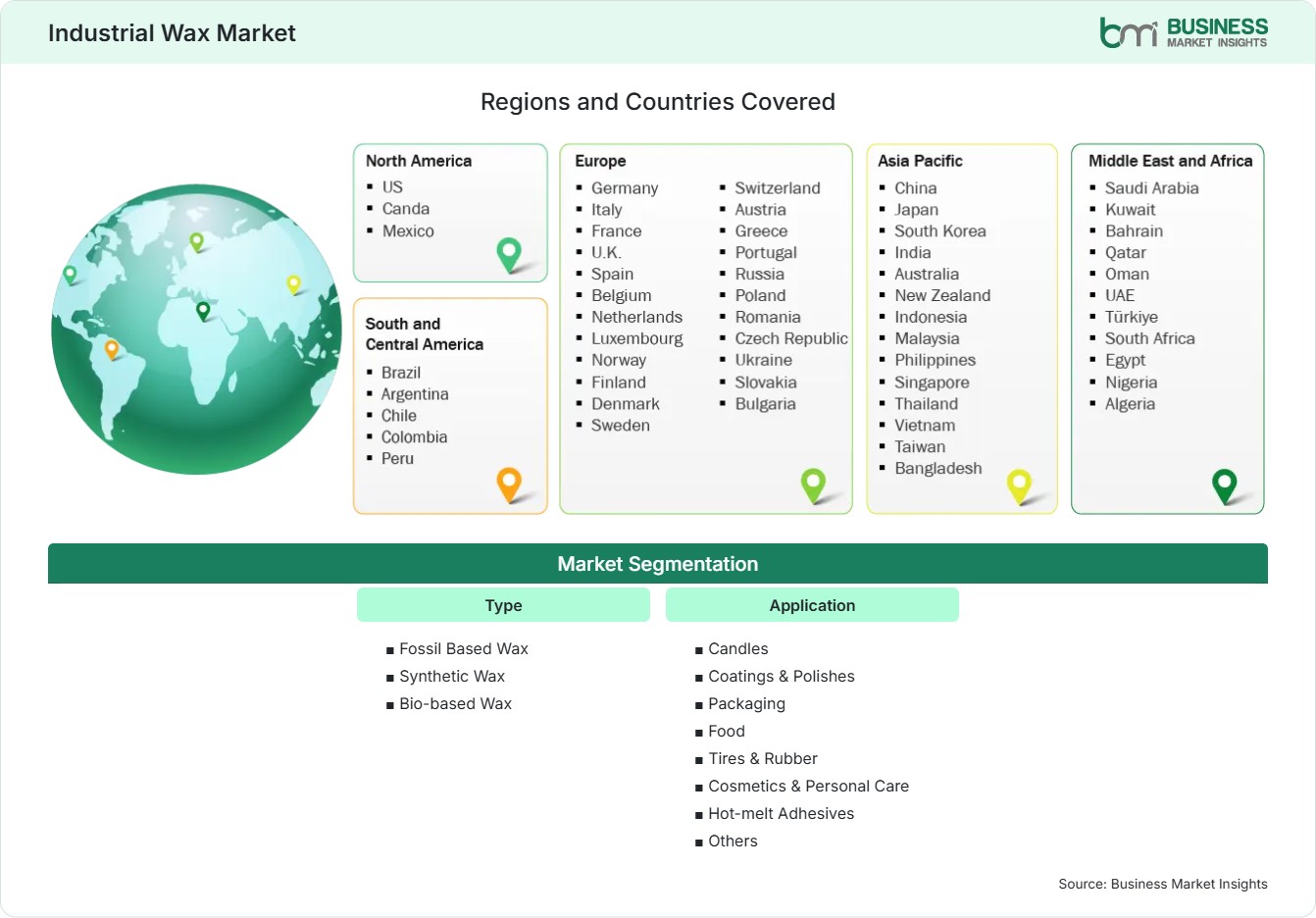
  • Type: Fossil Based Wax, Synthetic Wax, Bio-based Wax
  • Application: Candles, Coatings & Polishes, Packaging, Food, Tires & Rubber, Cosmetics & Personal Care, Hot-melt Adhesives, Others
US$ 12.65 Bn Market size in 2025
US$ 20.72 Bn Market Size by 2033
6.36% CAGR, 2026 - 2033
2026-2033 Forecast Period

AI Overview

Industrial Wax Market Summary

  • North America Region: North America accounted for approximately 27%–30% market share in 2025 and is projected to grow at a 5.8%–6.4% CAGR during 2026–2033. Growth is supported by packaging demand, cosmetic formulations, specialty coatings, and industrial applications. The U.S. market is expanding at a 6.0%–6.6% CAGR from 2026–2033, supported by personal care production, advanced packaging solutions, and specialty wax consumption.
  • Fastest Growing Region: Asia Pacific represented approximately 36%–40% market share in 2025 and is expected to grow at a 7.0%–7.6% CAGR during 2026–2033. Growth is driven by manufacturing expansion, rising consumer goods production, packaging demand, and increasing adoption of industrial wax solutions across China, India, and Southeast Asian economies.
  • Leading Segment: Fossil Based Wax accounted for approximately 48%–52% market share in 2025 and is growing at a 5.7%–6.3% CAGR during 2026–2033. Adoption remains strong due to established supply chains, cost advantages, and widespread use in coatings, packaging, and industrial applications.
  • High Growth Segment: Bio-based Wax represented approximately 15%–19% market share in 2025 and is projected to grow at a 8.0%–8.8% CAGR through 2033. Growth is influenced by sustainability initiatives, renewable material adoption, and increasing demand for environmentally responsible formulations.
  • Key Market Opportunity: Rising demand for sustainable wax alternatives, eco-friendly packaging materials, and specialty personal care formulations is creating opportunities for manufacturers developing renewable and high-performance wax solutions.
  • Major Market Players: Sasol Limited, Exxon Mobil Corporation, Shell plc, BASF SE, Clariant AG, Nippon Seiro Co., Ltd., Kerax Limited, Paramelt B.V., H&R Group, and Calumet Specialty Products Partners, L.P.
Strategic Insights

Industrial Wax Market: Strategic Insights

Industrial Wax Market Strategic Framework
FREE PDF
Request your free sample
Request free sample
Stakeholder View

Key Takeaways

  • Industrial wax demand is supported by a diversified application base across packaging, cosmetics, adhesives, coatings, candles, rubber, and specialty chemicals, allowing manufacturers to reduce dependency on individual end-use industries and maintain stable long-term market growth.
  • Bio-based wax solutions represent a high-potential growth opportunity as companies respond to sustainability requirements, environmental regulations, and increasing consumer preference for renewable, biodegradable, and eco-friendly materials across industrial and consumer applications.
  • Product innovation is shifting toward specialty wax formulations that offer improved performance, durability, processing efficiency, and compatibility for cosmetics, packaging, coatings, adhesives, and other high-value applications.
  • Asia Pacific provides strong investment opportunities due to expanding manufacturing capacity, rapid packaging industry growth, increasing personal care product consumption, and rising industrialization across emerging economies.
  • Strategic collaborations between wax producers, chemical companies, raw material suppliers, and end-use manufacturers are increasing to develop customized, application-specific wax solutions and strengthen market competitiveness.
  • Sustainable sourcing, production efficiency, and the adoption of renewable raw materials are becoming important competitive factors as industries increasingly prioritize lower environmental impact, circular economy practices, and regulatory compliance.
Geographic Outlook

Industrial Wax Market Regional Highlights

North America Industrial Wax Market

North America accounted for approximately 27%–30% of global revenue in 2025 and is projected to expand at a 5.8%–6.4% CAGR during 2026–2033. The region benefits from established chemical manufacturing capabilities, strong packaging demand, and rising consumption of specialty wax products in cosmetics and coatings. The Industrial Wax Market share in North America is supported by the United States, where manufacturers are investing in sustainable formulations and advanced industrial applications.

  • The United States remains the leading regional contributor due to strong demand from packaging, cosmetics, adhesives, and specialty chemical industries. Growth in advanced manufacturing and consumer product sectors continues to support wax consumption.
  • Canada is witnessing increasing wax demand through packaging applications, industrial processing, and sustainable material adoption initiatives. Manufacturers are focusing on efficient and environmentally responsible wax solutions.
  • Cosmetic and personal care companies are increasing demand for refined wax products used in premium formulations, skincare products, and beauty applications.
  • Packaging companies are adopting wax-based coatings to enhance moisture resistance, durability, and product protection across various industries.

US Industrial Wax Market

The United States represented approximately 78%–82% of North American revenue in 2025 and is expected to grow at a 6.0%–6.6% CAGR during 2026–2033. Growth is supported by strong industrial manufacturing, expanding packaging requirements, and increasing demand for specialty wax applications. The country has a mature chemical industry and continues investing in sustainable product development in Industrial Wax Market. Rising demand from cosmetics, adhesives, and coatings manufacturers is strengthening domestic wax consumption.

  • Packaging industries are increasing wax utilization for protective coatings and improved material performance.
  • Personal care manufacturers are adopting specialty waxes for creams, balms, and cosmetic formulations.
  • Industrial processing applications are supporting demand for performance-enhancing wax additives.
  • Sustainable wax alternatives are gaining attention among manufacturers seeking environmentally responsible materials.

Europe Industrial Wax Market

Europe accounted for approximately 25%–28% of global revenue in 2025 and is forecast to register a 5.9%–6.5% CAGR from 2026–2033. The region is supported by strong demand from cosmetics, packaging, automotive-related applications, and specialty chemical industries. Germany represents the leading Industrial Wax market due to advanced manufacturing capabilities, while France, Italy, and the United Kingdom demonstrate growth through personal care production and sustainable material initiatives.

  • Germany leads regional demand due to its strong chemical industry, advanced manufacturing base, and growing use of specialty wax materials across industrial applications. The country’s focus on high-performance coatings, automotive components, packaging solutions, and technical formulations continues to support wax market growth.
  • France is expanding wax consumption through increasing demand from cosmetics, personal care products, and premium formulation development. Rising consumer preference for high-quality beauty and skincare products is encouraging manufacturers to adopt specialized wax solutions with improved performance characteristics.
  • Italy contributes to regional growth through packaging, coatings, and industrial applications that require high-performance wax solutions. The country’s strong manufacturing and consumer goods sectors are supporting demand for functional wax materials.
  • The United Kingdom is increasing adoption of sustainable wax products across consumer and industrial sectors. Growing environmental awareness and demand for eco-friendly materials are encouraging the use of renewable and bio-based wax alternatives.
  • European sustainability regulations are encouraging manufacturers to explore bio-based wax alternatives, improve product sustainability, and reduce dependence on conventional petroleum-based wax materials. These initiatives are creating new opportunities for innovative wax producers and suppliers across the region.

Asia Pacific Industrial Wax Market

Asia Pacific represented approximately 36%–40% of global revenue in 2025 and is projected to achieve the fastest growth at a 7.0%–7.6% CAGR during 2026–2033. The region benefits from rapid industrialization, expanding packaging production, increasing consumer goods manufacturing, and rising personal care consumption. China remains the largest Industrial Wax market, while India and Southeast Asian countries provide strong growth opportunities through manufacturing expansion and increasing demand for specialty wax applications.

  • China dominates regional demand due to its extensive chemical production, large packaging industry, and expanding industrial manufacturing activities. The country's strong manufacturing base and growing consumer goods sector continue to drive significant demand for wax across multiple end-use applications.
  • India is experiencing increased wax consumption through the rapid growth of cosmetics, packaging, pharmaceuticals, and consumer product manufacturing. Rising disposable incomes and expanding industrial activities are supporting market growth.
  • Southeast Asian countries are expanding wax applications through increasing industrial production, export-oriented manufacturing, and growing demand from packaging and personal care industries.
  • Regional personal care manufacturers are increasing demand for specialty wax ingredients and advanced formulations used in skincare, cosmetics, and premium beauty products.
  • Sustainable wax production investments are increasing as companies respond to growing environmental preferences, regulatory requirements, and rising demand for bio-based and eco-friendly wax alternatives across industrial and consumer applications.

Rest of World Industrial Wax Market

The Rest of World region accounted for approximately 6%–9% of global revenue in 2025 and is expected to grow at a 5.5%–6.2% CAGR during 2026–2033. Latin America is supported by packaging, cosmetics, and industrial processing demand, while the Middle East and Africa are developing through manufacturing expansion and consumer product growth in Industrial Wax Market. Brazil, Mexico, Saudi Arabia, and South Africa represent important markets with increasing industrial wax requirements.

Growing investments in manufacturing facilities and consumer goods production are improving market opportunities across developing economies. Companies are focusing on expanding distribution networks to capture emerging demand.

  • Brazil is increasing wax consumption through packaging, cosmetics, and industrial processing applications.
  • Mexico is benefiting from manufacturing growth and rising demand for industrial materials.
  • Saudi Arabia is expanding chemical and industrial production capabilities supporting wax applications.
  • South Africa contributes through consumer goods manufacturing and packaging sector development.
  • Emerging economies are creating opportunities through increasing industrialization and infrastructure expansion.
Global Market Geography
FREE PDF
Request your free sample
Request free sample
Segment Analysis

Industrial Wax Market Segmentation

Type

The type segment defines product selection based on source characteristics, performance requirements, and sustainability preferences across industrial applications. Fossil Based Wax accounted for approximately 48%–52% share in 2025 and is projected to grow at a 5.7%–6.3% CAGR during 2026–2033. The segment maintains dominance due to established production infrastructure, cost competitiveness, and broad usage across coatings, packaging, candles, and industrial processing in Industrial Wax Market. Synthetic and bio-based alternatives are gaining attention as industries seek improved performance and sustainable material solutions.

  • Fossil Based Wax: Fossil based wax remains widely used due to reliable availability, established manufacturing processes, cost efficiency, and extensive applications across industrial coatings, packaging, and consumer products.
  • Synthetic Wax: Synthetic wax demand is increasing through applications requiring customized properties, enhanced durability, controlled melting points, and improved performance in specialized industrial formulations.
  • Bio-based Wax: Bio-based wax adoption is rising due to sustainability goals, renewable sourcing initiatives, and increasing demand for environmentally friendly alternatives in cosmetics and packaging applications.

Application

The application segment reflects diverse industrial utilization across consumer goods, manufacturing, and specialty product categories. Coatings & Polishes accounted for approximately 22%–26% share in 2025 and is expected to grow at a 6.4%–7.0% CAGR during 2026–2033. Growth is supported by demand for surface protection, finishing properties, and improved durability across industrial and consumer applications. Packaging, cosmetics, adhesives, and food-related applications continue expanding due to rising product manufacturing and changing consumer preferences in Industrial Wax Market.

  • Candles: Candle applications continue supporting wax demand through decorative products, premium candles, and increasing consumer interest in scented and specialty candle categories.
  • Coatings & Polishes: Coatings and polishes utilize industrial wax for surface protection, gloss enhancement, water resistance, and improved durability across multiple product categories.
  • Packaging: Packaging applications are increasing due to demand for moisture barriers, protective coatings, and improved performance in food and consumer goods packaging materials.
  • Food: Food applications use specialized waxes for protective coatings, surface treatment, and maintaining product quality in selected food processing applications.
  • Tires & Rubber: Tire and rubber industries utilize wax products for protection, processing improvements, and enhanced durability in rubber-based manufacturing processes.
  • Cosmetics & Personal Care: Cosmetic applications are expanding through demand for wax ingredients in creams, lip products, lotions, and premium personal care formulations.
  • Hot-melt Adhesives: Hot-melt adhesive applications are growing due to wax usage in improving flow characteristics, processing efficiency, and bonding performance.
Market Forces

Industrial Wax Market Dynamics

Key Market Drivers

Growing demand from cosmetics and personal care industries

The increasing consumption of cosmetics and personal care products is driving demand for industrial waxes used in creams, lotions, lip balms, hair products, and decorative formulations. Wax materials provide texture, stability, emollient properties, and improved product consistency, making them essential ingredients in premium personal care applications. The market growth is supported by rising beauty product consumption in emerging economies, where disposable income and personal care awareness are increasing. Manufacturers are developing refined and specialty wax grades to meet formulation requirements for natural, sustainable, and high-performance cosmetic products. The Industrial Wax Market trends indicate continued expansion of application-specific wax solutions across global personal care industries.

Rising applications in packaging and adhesives

Packaging and adhesive industries are increasing their use of industrial waxes due to properties such as moisture resistance, surface protection, lubrication, and processing improvement. Wax coatings are widely applied in packaging materials to enhance durability and maintain product quality, particularly in food and consumer goods sectors. Wax additives used by adhesive producers help in enhancing flexibility, stability, and production processes. The rise in e-commerce, consumption of packaged foods, and the demand for flexible packaging materials is opening up more avenues for the wax industry. Companies are developing new formulations that offer better performance and comply with environmental conditions.

Increasing use in industrial processing applications

Industrial processing applications are contributing to market expansion as manufacturers use waxes for lubrication, surface treatment, release properties, and performance enhancement. Industries including rubber, coatings, plastics, and manufacturing rely on wax additives to improve processing efficiency and product quality. Increased industrial production in the Asia Pacific region and other emerging markets has created greater demand for specialty wax products. Companies are concentrating their efforts on the development of tailor-made solutions catering to individual processing needs such as thermal stability and material compatibility. The adoption of modern manufacturing processes is expected to boost demand for industrial wax products.

Key Market Opportunities

Growing demand for sustainable industrial wax solutions

Developments in sustainability are opening new avenues for the manufacture of bio-based and eco-friendly wax substitutes. Industries are looking towards renewable resources to decrease their reliance on oil-based waxes and improve environmental efficiency. The use of bio-based waxes made from renewable raw material sources is becoming popular in industries such as cosmetic products, packaging, and specialty uses due to their sustainability advantages. Companies that can invest in renewable resource development, technological advancements, and sustainable product lines can benefit from the emerging trend. The Industrial Wax Market forecast indicates that sustainable wax solutions will become an important growth area during the forecast period.

Expansion into high-growth personal care applications

Growing demand for premium beauty and personal care products is creating opportunities for industrial wax manufacturers to expand into specialized cosmetic applications. Wax ingredients are increasingly used in formulations requiring smooth texture, stability, and improved product performance. Growing demand for natural and multifunctional cosmetic components is motivating producers to develop new grades of waxes suitable for use in skincare, lip-care, and haircare cosmetics. Emerging markets are also offering additional opportunities owing to growing demand for personal care products and urbanization. Firms with good research capacity and adaptable manufacturing processes can gain from developing unique waxes.

Increasing use in eco-friendly packaging materials

Sustainability in packaging is creating new avenues for wax companies offering coating solutions that promote environmental sustainability. The packaging industry is looking at wax coatings that enhance resistance to moisture and increase protection while promoting sustainability. Increasing production of packaging products in the food, flexible, and recyclable categories is contributing to higher demand for wax products with functional properties. The major focus for manufacturers is on the development of products that can integrate easily into the existing packaging solutions. Growing investment in sustainable packaging solutions by developed and developing countries will continue to drive demand for industrial wax products.

Market Restraints and Challenges

Fluctuating raw material prices

Factor: Industrial wax production relies heavily on petroleum-based feedstocks and specialty chemical inputs, making manufacturers vulnerable to fluctuations in crude oil prices and raw material availability. Impact: Cost volatility can increase production expenses, create pricing uncertainty, and affect profit margins for producers and end users. Companies are adopting supply chain diversification, long-term sourcing agreements, and operational efficiency improvements to manage cost pressures. Price fluctuations remain a challenge, particularly for manufacturers operating in competitive markets where customers expect stable pricing. Effective raw material management strategies are becoming essential for maintaining profitability and market competitiveness.

Availability of low-cost substitutes

Factor: Alternative materials, synthetic additives, and lower-cost substitutes can replace industrial wax products in applications where premium performance characteristics are less critical. Impact: Substitute availability can restrict demand growth, increase price competition, and pressure manufacturers to differentiate their offerings. Companies are responding by developing specialty wax products with enhanced functionality, sustainability advantages, and improved application performance. Innovation in bio-based and synthetic wax formulations is helping manufacturers maintain competitiveness against alternative materials. However, cost-sensitive industries continue to evaluate substitute options, creating challenges for suppliers seeking broader market penetration.

Company Analysis

Competitive Landscape

The competitive environment is shaped by product innovation, sustainable wax development, application-specific formulations, and expansion across end-use industries. The Industrial Wax Market analysis highlights that major companies are focusing on specialty wax production, renewable alternatives, supply chain optimization, and strategic collaborations to address growing demand from cosmetics, packaging, adhesives, and industrial processing applications.

Company Name

Overview

Products and Services relevant to this market

Sasol Limited

Global chemical company producing specialty waxes and performance materials.

Offers synthetic waxes, Fischer-Tropsch waxes, and industrial wax solutions.

Exxon Mobil Corporation

Energy and chemical company supplying petroleum-based wax products globally.

Provides paraffin waxes and specialty wax solutions for industrial applications.

Shell plc

Global energy company with advanced chemical and wax production capabilities.

Supplies specialty waxes used in coatings, packaging, and industrial processes.

BASF SE

Chemical manufacturer offering advanced material solutions across industries.

Develops specialty wax additives for coatings, plastics, and industrial applications.

Clariant AG

Specialty chemical company focused on sustainable and functional materials.

Provides wax additives and performance solutions for industrial formulations.

Nippon Seiro Co., Ltd.

Japanese wax manufacturer specializing in refined wax products.

Supplies petroleum waxes and specialty wax materials for industrial uses.

Kerax Limited

European wax supplier serving multiple industrial sectors.

Offers paraffin wax, microcrystalline wax, and specialty wax products.

Paramelt B.V.

Manufacturer of waxes and adhesive solutions for industrial applications.

Provides wax blends for coatings, adhesives, packaging, and consumer products.

H&R Group

Specialty refinery company producing high-quality wax materials.

Supplies refined waxes for industrial, cosmetic, and technical applications.

Calumet Specialty Products Partners, L.P.

Specialty products producer serving industrial markets.

Manufactures specialty waxes, lubricants, and performance-based materials.

Trust & Transparency

Research Methodology

The market analysis combines proprietary research with secondary data from government agencies, company disclosures, regulatory filings, industry databases and expert interviews. Market estimates are validated through data triangulation, cross-market benchmarking and analyst review.

View Full Research Methodology

Questions Answered

Frequently Asked Questions

How does this Industrial Wax Market report help industry participants?

This report provides insights into market dynamics, segment opportunities, competitive strategies, regional developments, and investment areas supporting business decision-making.

How are manufacturers responding to sustainability requirements?

Manufacturers are developing bio-based formulations, improving production efficiency, and investing in renewable sourcing strategies to meet environmental expectations across end-use industries.

Why is packaging an important application area?

Packaging industries use industrial waxes for moisture resistance, protective coatings, improved durability, and enhanced performance in food and consumer goods packaging materials.

Which type of industrial wax is gaining attention?

Bio-based wax is gaining attention because companies are seeking renewable alternatives that support sustainability goals and reduce dependence on petroleum-derived materials.

What factors are increasing demand for industrial wax market?

Demand is increasing due to rising applications in cosmetics, packaging, coatings, adhesives, food processing, and industrial manufacturing where wax properties improve performance and product quality.

Access the Full Industrial Wax Market Report

Get segment-level forecasts, regional estimates, competitive benchmarking, company profiles and downloadable Excel datasets.

Access the full Industrial Wax Market Report
350 pages PDF & Excel | 2026-08-10