
Industrial Gases Market Outlook: Size, Share, Trends, Growth Analysis, Competitive Landscape & Forecast, 2026-2033

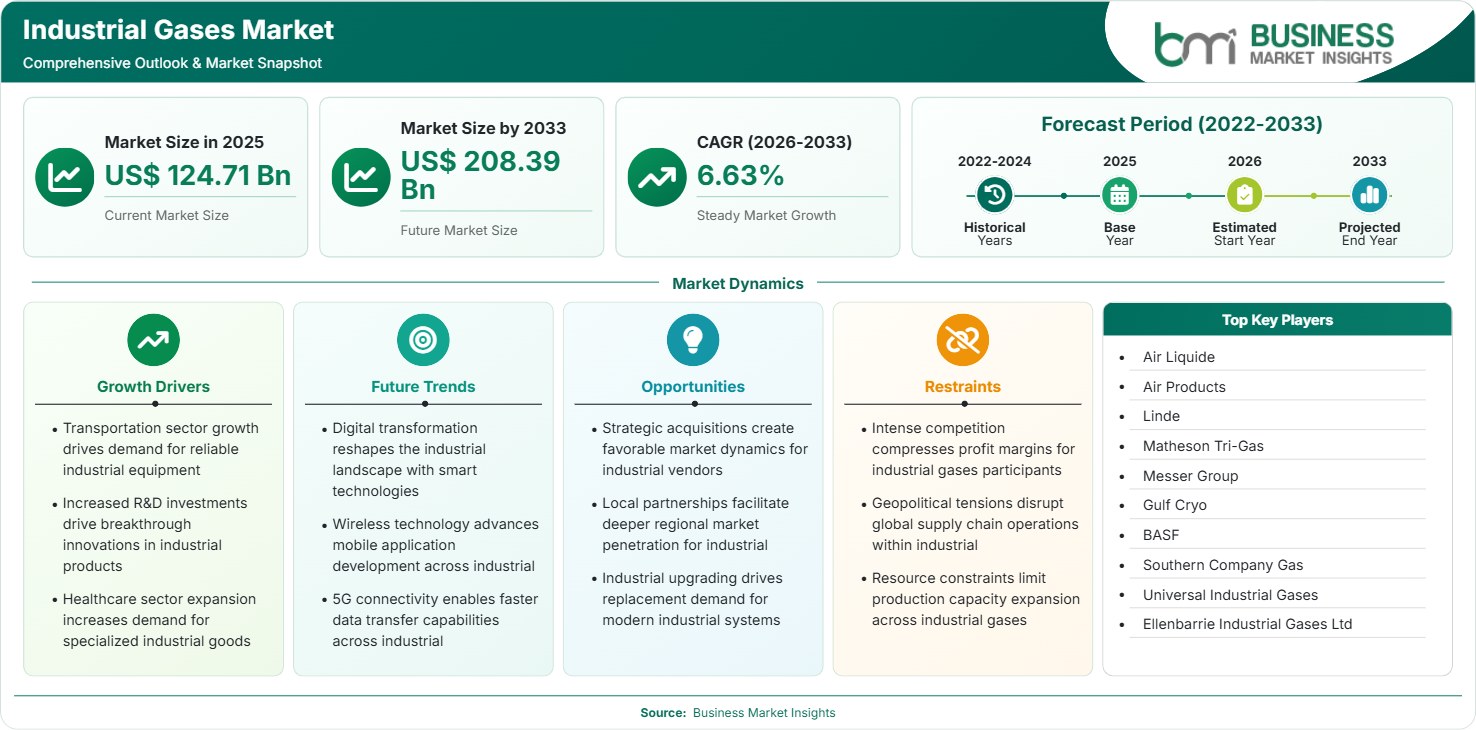
The Industrial Gases Market was valued at US$ 124.71 Billion in 2025 and is expected to reach US$ 208.39 Billion by 2033, growing at a CAGR of 6.63% during 2026–2033. Market growth is driven by rising demand from healthcare, steel, chemicals, electronics, and food processing industries. Increasing investments in green hydrogen, CCUS, and renewable energy, along with advancements in gas generation and distribution technologies, are further supporting market expansion.

Report Coverage
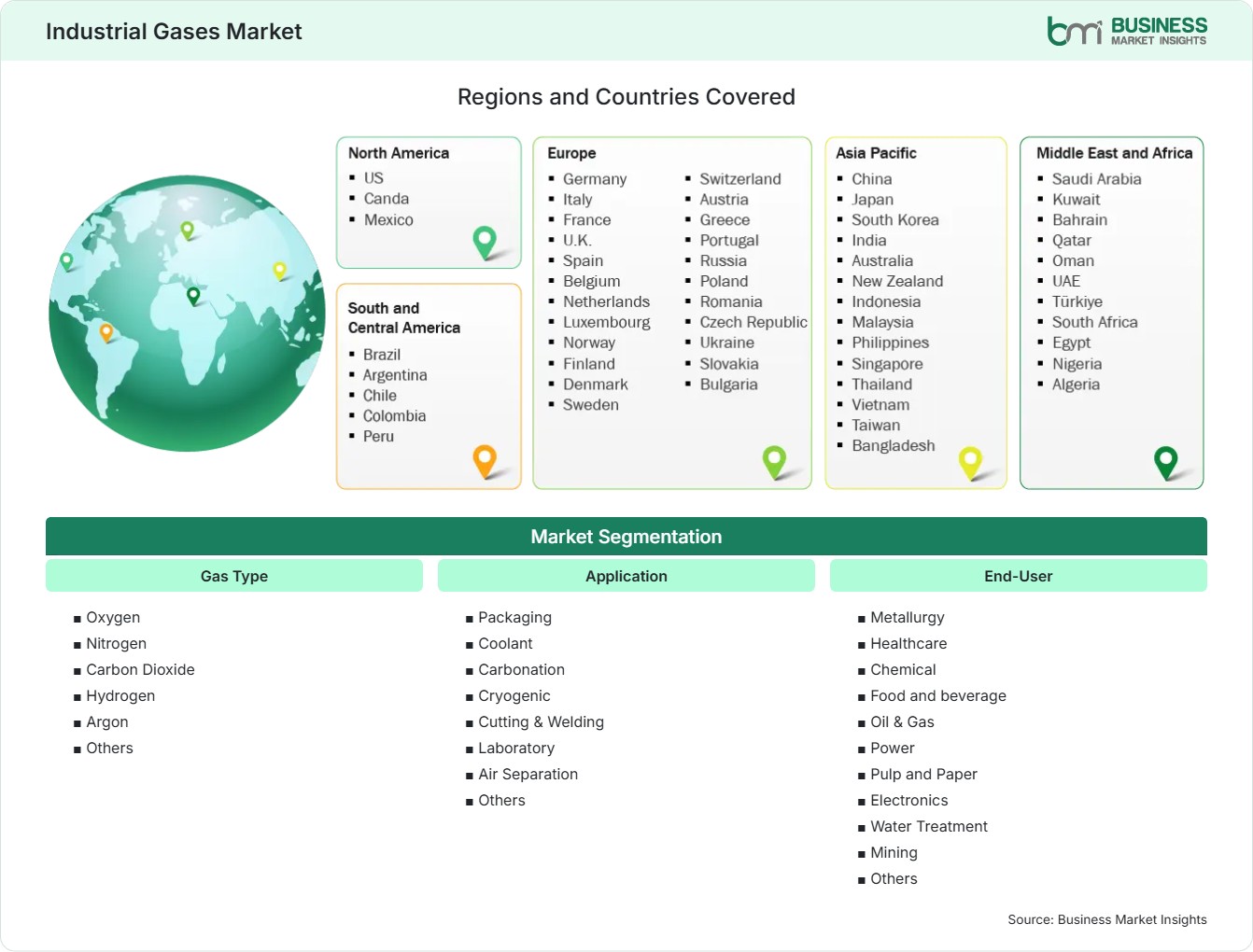
  • Gas Type: Oxygen, Nitrogen, Carbon Dioxide, Hydrogen, Argon, Others
  • Application: Packaging, Coolant, Carbonation, Cryogenic, Cutting & Welding, Laboratory, Air Separation, Others
  • End-User: Metallurgy, Healthcare, Chemical, Food and beverage, Oil & Gas, Power, Pulp and Paper, Electronics, Water Treatment, Mining, Others
US$ 124.71 Bn Market size in 2025
US$ 208.39 Bn Market Size by 2033
6.63% CAGR, 2026 - 2033
2026-2033 Forecast Period

AI Overview

Industrial Gases Market Summary

  • North America Region: North America holds a 25%–28% share in 2025, growing at a 5.9%–6.5% CAGR, supported by semiconductor, healthcare, LNG, hydrogen, and advanced manufacturing investment, while carbon capture creates infrastructure opportunities. The U.S. market should expand at a 6.0%–6.6% CAGR as semiconductor fabrication, healthcare, metals, and hydrogen projects increase demand for reliable bulk and specialty gases.
  • Fastest Growing Region: Asia Pacific holds a 36%–40% share in 2025, growing at a 7.2%–8.1% CAGR, driven by semiconductor fabrication, steel expansion, electronics, healthcare modernization, food processing, hydrogen projects, and urban industrialization.
  • Leading Segment: Oxygen holds a 35%–39% share in 2025, growing at a 6.0%–6.5% CAGR, supported by metallurgy, healthcare, welding, wastewater treatment, and increasingly efficient on-site production technologies.
  • High Growth Segment: Hydrogen holds an 8%–11% share in 2025, growing at a 9.5%–11.0% CAGR, supported by refining, ammonia, mobility, direct reduced iron, clean-energy projects, and decarbonization investments.
  • Key Market Opportunity: Integrated on-site generation, ultra-high-purity gases, hydrogen, carbon dioxide management, and digital supply systems can capture value as customers prioritize reliability, efficiency, safety, and lower emissions.
  • Major Market Players: Air Liquide S.A.; Air Products and Chemicals, Inc.; Linde plc; Matheson Tri-Gas, Inc.; Messer SE & Co. KGaA; Gulf Cryo Holding FZCO; BASF SE; Southern Company Gas; Universal Industrial Gases, Inc.; Ellenbarrie Industrial Gases Limited; Bhuruka Gases Limited; Concorde-Corodex Group; Dubai Industrial Gases.
Strategic Insights

Industrial Gases Market: Strategic Insights

Industrial Gases Market Strategic Framework
FREE PDF
Request your free sample
Request free sample
Stakeholder View

Key Takeaways

  • Supply economics increasingly favor integrated producers with air-separation assets, regional distribution networks, storage infrastructure, and long-term contracts. Merchant distribution remains important, but large customers increasingly prefer on-site or pipeline supply where continuous consumption justifies dedicated assets.
  • Electronics, hydrogen-linked metallurgy, healthcare, food preservation, and water treatment provide attractive incremental demand. Ultra-high-purity gases offer greater value density than conventional merchant gases because contamination tolerance is extremely low.
  • Digital monitoring, remote plant management, advanced purification, high-efficiency air separation, and modular generation are improving utilization and reducing supply interruptions. Hydrogen and carbon dioxide systems are expanding the technology portfolio beyond conventional oxygen and nitrogen.
  • Asia Pacific offers the strongest investment case because semiconductor manufacturing, steel capacity, healthcare infrastructure, electronics assembly, and food processing are expanding simultaneously. South Korea, China, India, and Southeast Asia are particularly important demand centers.
  • Strategic acquisitions are being used to gain local production capacity, customer contracts, and geographic density. Air Liquide acquired DIG Airgas and NovaAir, while Linde increased its Middle Eastern exposure through Airtec.
Geographic Outlook

Industrial Gases Market Regional Highlights

North America Industrial Gases Market

North America represented a 25%–28% Industrial Gases Market share in 2025 and is modelled to expand at a 5.9%–6.5% CAGR through 2033. The United States dominates regional consumption, supported by healthcare, electronics, chemicals, metals, food processing, and energy infrastructure. Canada adds demand from mining, metallurgy, healthcare, and hydrogen projects. Regional investment increasingly emphasizes resilient supply chains, local production, and high-purity applications.

  • Semiconductor investments are increasing requirements for nitrogen, argon, hydrogen, and specialty gases, creating recurring demand from advanced fabrication facilities.
  • Healthcare consumption remains structurally resilient because hospitals require medical oxygen and related gases regardless of industrial production cycles.
  • Hydrogen and carbon-management projects are encouraging investment in dedicated production, compression, storage, and distribution infrastructure.
  • On-site generation is gaining relevance among customers seeking lower transport exposure and stronger supply continuity.

US Industrial Gases Market

The United States accounted for approximately 21%–24% of the regional Industrial Gases Market share in 2025 and is modelled to grow at a 6.0%–6.6% CAGR. Industrial corridors across Texas, Louisiana, California, Ohio, and the Midwest support chemicals, refining, metals, electronics, healthcare, and food processing. New semiconductor and energy projects are strengthening demand for high-purity and bulk gases.

  • Semiconductor fabrication is increasing requirements for ultra-high-purity gases and dedicated supply infrastructure, particularly nitrogen, argon, oxygen, and hydrogen.
  • Gulf Coast chemical and refining clusters sustain substantial oxygen, nitrogen, hydrogen, and carbon dioxide consumption.
  • New regional packaging and distribution facilities are improving supply responsiveness for smaller industrial and healthcare customers.

Europe Industrial Gases Market

Europe held a 22%–25% share of the Industrial Gases Market in 2025 and is modelled to grow at a 5.4%–6.2% CAGR through 2033. Germany, France, Italy, the United Kingdom, and the Netherlands remain leading consumption centers, while Germany and the Netherlands provide strong high-growth opportunities in hydrogen, chemicals, refining, and industrial decarbonization. Energy costs continue influencing production economics and plant-location decisions.

  • Germany remains a leading industrial-gas market because of chemicals, steel, automotive manufacturing, healthcare, and hydrogen infrastructure development.
  • France benefits from healthcare consumption, aerospace manufacturing, chemicals, food processing, and low-carbon industrial investment.
  • The Netherlands provides opportunities around ports, refining, chemicals, hydrogen import infrastructure, and carbon-management networks.
  • Industrial decarbonization is increasing demand for hydrogen, oxygen enrichment, carbon dioxide handling, and process-gas optimization.

Asia Pacific Industrial Gases Market

Asia Pacific held a 36%–40% share in 2025 and is modelled to achieve a 7.2%–8.1% CAGR, making it the fastest-growing regional opportunity. China, Japan, South Korea, and India are leading consumption centers, while India, Vietnam, Indonesia, Malaysia, and Thailand offer strong incremental potential. Semiconductor fabrication, steel, electronics, healthcare, food, and chemical manufacturing support diversified demand.

  • South Korea is attracting substantial semiconductor-related gas investments, including new on-site air separation and hydrogen supply capacity for Samsung facilities.
  • India offers strong demand potential from steel, electronics, healthcare, automotive manufacturing, food processing, and expanding industrial corridors.
  • China remains strategically important because of its large metals, chemicals, electronics, and manufacturing base.
  • Southeast Asia is gaining investment as electronics and manufacturing supply chains diversify beyond established production centers, strengthening the Industrial Gases Market Forecast.

Rest of World Industrial Gases Market

South and Central America represented an estimated 6%–8% Industrial Gases Market share in 2025 and are modelled to grow at 6.0%–6.8% CAGR. Brazil and Mexico are leading regional demand centers, supported by metallurgy, healthcare, food processing, chemicals, and manufacturing. Mexico also benefits from nearshoring-linked industrial expansion and growing demand for reliable gas supply.

The Middle East and Africa represented approximately 4%–6% share in 2025 and are modelled to grow at 6.3%–7.2% CAGR. Saudi Arabia, the UAE, Qatar, and South Africa provide leading opportunities through energy, healthcare, metals, manufacturing, and new hydrogen projects.

  • Brazil offers opportunities in steel, food processing, healthcare, mining, and chemical production, where reliable merchant supply remains important.
  • Mexico benefits from automotive, electronics, food, healthcare, and manufacturing investments associated with nearshoring.
  • Gulf markets are expanding integrated industrial-gas systems alongside energy, petrochemical, healthcare, and hydrogen developments.
  • South Africa provides demand from mining, metals, healthcare, chemicals, and industrial manufacturing, although infrastructure reliability remains an investment consideration.
Global Market Geography
FREE PDF
Request your free sample
Request free sample
Segment Analysis

Industrial Gases Market Segmentation

Gas Type

Gas Type remains the core supply-side segmentation, with oxygen representing a 35%–39% Industrial Gases Market share in 2025 and a 6.0%–6.5% CAGR through 2033. Demand spans metallurgy, healthcare, welding, water treatment, chemicals, and manufacturing. Nitrogen remains essential for inerting and food preservation, while hydrogen provides the fastest strategic expansion potential across refining and decarbonization.

  • Oxygen: Oxygen demand is anchored by steelmaking, healthcare, cutting and welding, chemicals, and wastewater treatment, with higher-purity requirements supporting investment in efficient generation and distribution systems.
  • Nitrogen: Nitrogen supports inerting, blanketing, food packaging, electronics, chemicals, and refining, while on-site generation helps customers reduce delivered-gas costs and improve continuity.
  • Carbon Dioxide: Carbon dioxide serves beverage carbonation, food preservation, water treatment, and industrial processes, with supply optimization increasingly important because availability depends on multiple upstream production sources.
  • Hydrogen: Hydrogen demand is expanding through refining, ammonia, direct reduced iron, mobility, and emerging clean-energy applications, encouraging investment in production, purification, compression, and storage infrastructure.
  • Argon: Argon is critical for welding, metallurgy, electronics, and specialty manufacturing, where shielding performance and purity requirements support recurring demand from high-value industrial processes.

Application

Application demand is diversified across packaging, coolant, carbonation, cryogenic processing, cutting and welding, laboratories, and air separation. Air separation remains foundational to supply economics because it produces multiple atmospheric gases simultaneously. Packaging and cryogenic applications benefit from food, healthcare, electronics, and pharmaceutical activity, while welding demand follows manufacturing and infrastructure investment.

  • Packaging: Modified-atmosphere packaging uses nitrogen and carbon dioxide to extend food shelf life, supporting demand as processed-food production, cold-chain logistics, and retail distribution expand.
  • Coolant: Industrial gases provide controlled cooling across manufacturing and specialized processes, where precise temperature management can improve product quality, equipment performance, and process stability.
  • Carbonation: Carbon dioxide remains essential for beverage carbonation, creating demand linked to beverage production, consumer consumption, and regional food-and-drink manufacturing capacity.
  • Cryogenic: Cryogenic gases support freezing, storage, healthcare, laboratories, and specialized manufacturing, with demand benefiting from cold-chain development and increased use of low-temperature processing.
  • Cutting & Welding: Oxygen, acetylene-related gases, argon, and other shielding gases remain essential to fabrication, construction, automotive, shipbuilding, and metal-processing applications.
  • Laboratory: High-purity gases support analytical instruments, calibration, research, pharmaceuticals, and semiconductor testing, where contamination control and consistent composition determine application reliability.
  • Air Separation: Air separation units provide oxygen, nitrogen, and argon at scale, making them central to integrated industrial-gas supply and large customer contracts.

End-User

End-user demand is led by metallurgy and healthcare, while chemicals, food and beverage, electronics, oil and gas, and power provide substantial recurring consumption. Electronics and hydrogen-intensive metallurgy offer stronger upside because purity, process control, and decarbonization requirements encourage dedicated supply infrastructure. This diversification improves resilience against downturns in individual industrial sectors.

  • Metallurgy: Oxygen and inert gases support steelmaking, refining, welding, and heat treatment, while hydrogen-based direct reduction could create additional long-term consumption.
  • Healthcare: Medical oxygen and specialty gases support hospitals, clinics, laboratories, and pharmaceutical production, creating relatively defensive demand compared with cyclical industrial applications.
  • Chemical: Chemical producers use hydrogen, nitrogen, oxygen, carbon dioxide, and specialty gases for synthesis, inerting, processing, and emissions-management applications.
  • Food and beverage: Nitrogen and carbon dioxide support packaging, freezing, carbonation, preservation, and beverage processing, linking consumption to food production and cold-chain expansion.
  • Oil & Gas: Refining and petrochemical operations consume hydrogen, nitrogen, and other gases for processing, inerting, desulfurization, and safety-critical applications.
  • Power: Industrial gases support generation, maintenance, water treatment, emissions control, and emerging hydrogen applications within evolving power-sector infrastructure.
  • Pulp and Paper: Oxygen, hydrogen peroxide-related processes, and other industrial gases support bleaching, wastewater treatment, and process optimization within pulp and paper operations.
  • Electronics: Semiconductor manufacturing requires ultra-high-purity nitrogen, oxygen, argon, hydrogen, and specialty gases, making contamination control and dedicated supply systems strategically important.
  • Water Treatment: Oxygen, ozone-related gases, carbon dioxide, and other gases support oxidation, pH management, wastewater treatment, and advanced purification processes.
  • Mining: Oxygen, nitrogen, and specialty gases support mineral processing, welding, maintenance, safety, and selected metallurgical operations, with demand tied to mining investment cycles.
Market Forces

Industrial Gases Market Dynamics

Key Market Drivers

Semiconductor manufacturing is raising ultra-high-purity gas demand

Semiconductor fabrication is becoming one of the most technically demanding consumption centers because advanced nodes require extremely controlled gas composition, purity, pressure, and delivery. Linde announced an eighth on-site air separation unit for Samsung’s Pyeongtaek complex, supplying nitrogen, oxygen, and argon alongside hydrogen, with startup expected from mid-2026. Air Products similarly announced new facilities for Samsung’s next-generation fab, with phased commissioning from 2028 through 2030. These investments demonstrate how gas suppliers increasingly secure demand through dedicated infrastructure rather than conventional merchant distribution. The trend supports market growth by increasing the value of reliability, purification, telemetry, and customer-specific engineering. Electronics-related Industrial Gases Market trends therefore favor suppliers with engineering depth, local production assets, and long-term contracts capable of meeting stringent contamination thresholds.

Healthcare demand strengthens recurring consumption and supply resilience

Healthcare creates comparatively resilient demand because oxygen and specialty gases are required continuously across hospitals, emergency care, laboratories, pharmaceutical manufacturing, and medical-device production. The consumption profile differs from metals and chemicals because supply interruption can directly affect patient care, increasing the value placed on storage redundancy, cylinder logistics, telemetry, and local generation. Suppliers are consequently investing in production and distribution networks that can serve both large hospitals and decentralized healthcare facilities. Aging populations, healthcare infrastructure expansion, and increased treatment capacity in emerging economies provide additional demand support. The strongest commercial opportunity is not simply higher gas volume but integrated supply contracts covering bulk oxygen, cylinders, storage, monitoring, maintenance, and emergency response. This service-intensive model increases customer retention and reduces exposure to spot-Industrial Gases Market price competition.

Industrial decarbonization is broadening hydrogen and oxygen applications

Industrial decarbonization is creating new gas requirements beyond conventional oxygen, nitrogen, and argon consumption. According to the IEA, global demand for hydrogen was almost 100 Mt in 2024 and is forecasted to exceed this figure in 2025; however, conventional uses, including refining, ammonia, methanol, and fossil-based direct reduced iron, remain prevalent. This results in a well-established infrastructure for hydrogen production, purification, compression, and delivery. For steel producers exploring hydrogen reduction, increased amounts of oxygen and other process gases may be needed. Industrial gas suppliers with existing pipelines, air separation plants, hydrogen production assets, and customer engineering capabilities can therefore participate across several stages of the transition, supporting Industrial Gases Market growth.

Key Market Opportunities

Dedicated gas infrastructure for semiconductor clusters

Semiconductor expansion offers an attractive investment pathway because each large fabrication facility can support long-duration demand for multiple gases and requires high-reliability supply infrastructure. Air Products’ 2026 agreement to support Samsung’s new South Korean fab illustrates the scale and duration of this opportunity, with multiple production facilities and bulk specialty-gas systems scheduled across several phases. Similar investments are developing around Taiwan, Japan, India, the United States, and Europe, supporting the Industrial Gases Market Forecast. Suppliers can capture higher-value revenue by combining gas production with purification, storage, pipeline engineering, monitoring, and emergency systems. The opportunity extends to specialty gases and digital quality management, where switching suppliers can be operationally difficult once qualification and facility integration are complete.

Hydrogen and carbon-management infrastructure can create new revenue pools

Hydrogen and carbon-management projects offer Industrial Gases Market opportunities for industrial-gas companies to expand beyond traditional merchant supply. Refineries, ammonia producers, steelmakers, chemical plants, and emerging clean-fuel projects require hydrogen generation, purification, compression, storage, and distribution capabilities. Carbon capture projects similarly require interfaces for conditioning, transportation, utilization, or storage. Those companies with pre-existing large gas networks will definitely have an advantage due to the existing customer base, engineering capabilities, and infrastructure, which will help overcome any development obstacles for a project. This opportunity becomes more favorable in the regions of concentrated industrial clusters where there are many offtakers, allowing for common pipelines and production facilities to be used.

Digitalized on-site generation can improve economics for distributed users

Digitalized on-site generation presents an opportunity among medium and large customers whose consumption patterns justify dedicated equipment but do not support traditional pipeline-scale infrastructure. Nitrogen and Oxygen modular systems, automation for purity monitoring, remote diagnostics, predictive maintenance, and usage statistics may lead to less reliance on delivered gas while making operations more transparent. Potential target clients might include food processing industries, hospitals, labs, electronics manufacturing, wastewater treatment facilities, and metal manufacturing facilities. The suppliers have the opportunity to charge for equipment, maintenance, monitoring, consumables, and gas supply on a subscription basis. Moreover, such an approach facilitates the achievement of decentralized resilience since it is possible for clients to minimize their dependency on transportation problems and the shortage of cylinders.

Market Restraints and Challenges

Energy intensity and electricity-price volatility constrain production economics

Factor: Air separation, compression, purification, and liquefaction are energy-intensive processes, and hence, the cost of electricity is a significant cost element in production. Consideration: power price fluctuations may impact profits, especially for plants whose prices fluctuate due to a lack of contracts with end customers.

Impact: High energy prices can also impact investment decision-making due to the preference of gas companies for industrial areas with a stable energy supply and good customer concentration. Messer invested €747 million in 2025 with 31% EBITDA margin. The example shows how capital-intensive it is to support and expand the network of gas pipelines. Energy optimization, renewable energy, and better separation technology will be key differentiating factors in competition.

Logistics, storage, and infrastructure requirements create supply-chain exposure

Factor: Storage tanks for cryogenic liquids and compressed gases need special design for transportation, safety precautions, and qualified manpower, making their logistics operations more complex than those associated with ordinary industrial products. Factor: Transport over long distances may be unprofitable at low customer density.

Impact: While suppliers will have to make a trade-off between efficiencies from centralized production and redundant facilities closer to customers, local presence through dedicated facilities on-site, as well as at filling stations, adds to the cost of implementation. The added expense comes from the need for pressure vessels, hazardous gas handling systems, transport equipment, and safety precautions.

Company Analysis

Competitive Landscape

The Industrial Gases Market analysis indicates a competitive structure shaped by scale, local production assets, engineering capabilities, purity technology, distribution density, and long-term customer contracts. Large integrated producers compete through on-site plants and pipeline networks, while regional specialists remain important in merchant distribution and cylinder supply.

Company Name

Overview

Products and Services relevant to this market

Air Liquide S.A.

France-based global gas and technology provider serving healthcare, industrial, electronics, and energy-transition customers across major production regions.

Oxygen, nitrogen, argon, hydrogen, specialty gases, air separation, on-site supply, healthcare gases, engineering, and carbon-management solutions.

Air Products and Chemicals, Inc.

U.S.-based industrial-gas producer with extensive capabilities serving electronics, chemicals, energy, healthcare, and manufacturing customers.

Hydrogen, oxygen, nitrogen, argon, specialty gases, air separation, on-site systems, liquefied gases, and industrial gas infrastructure.

Linde plc

Ireland-domiciled industrial-gas and engineering company with broad exposure to electronics, healthcare, metals, chemicals, food, and energy.

Oxygen, nitrogen, argon, hydrogen, specialty gases, cryogenic systems, air separation, on-site production, and gas engineering services.

Matheson Tri-Gas, Inc.

U.S. supplier serving industrial, medical, electronic, and specialty-gas users through production and distribution infrastructure.

Industrial gases, medical gases, specialty gases, welding gases, bulk supply, cylinders, electronics gases, and distribution services.

Messer SE & Co. KGaA

Germany-based privately held specialist focused on industrial, medical, electronic, and specialty gases across multiple regions.

Oxygen, nitrogen, argon, hydrogen, specialty gases, medical gases, on-site plants, cryogenic products, and gas technologies.

Gulf Cryo Holding FZCO

Middle Eastern industrial-gas specialist with strong regional exposure across healthcare, manufacturing, food, and industrial customers.

Oxygen, nitrogen, argon, carbon dioxide, hydrogen, helium, medical gases, cryogenic services, and distribution solutions.

BASF SE

Germany-headquartered chemical producer with significant internal and external industrial-gas requirements across integrated manufacturing operations.

Hydrogen, oxygen, nitrogen, carbon dioxide, process gases, gas-management systems, chemical production integration, and industrial process applications.

Southern Company Gas

U.S. energy business associated with natural-gas infrastructure and energy services supporting industrial and commercial customers.

Natural-gas infrastructure, energy services, industrial energy solutions, distribution networks, and related process-energy applications.

Universal Industrial Gases, Inc.

U.S. industrial-gas supplier specializing in bulk and packaged gases for industrial and commercial customers.

Oxygen, nitrogen, argon, carbon dioxide, hydrogen, specialty gases, bulk systems, cylinders, and gas-generation equipment.

Ellenbarrie Industrial Gases Limited

Indian industrial-gas company serving manufacturing, healthcare, metals, engineering, and regional industrial customers.

Oxygen, nitrogen, argon, carbon dioxide, medical gases, cylinders, bulk supply, and industrial gas distribution.

Bhuruka Gases Limited

Indian supplier serving industrial and healthcare applications with production and distribution capabilities across regional markets.

Oxygen, nitrogen, argon, hydrogen, carbon dioxide, medical gases, bulk supply, cylinders, and industrial gas services.

Concorde-Corodex Group

UAE-based industrial and safety solutions group serving industrial, healthcare, energy, and regional infrastructure customers.

Industrial gases, medical gases, gas systems, equipment, safety solutions, specialty applications, and regional distribution services.

Dubai Industrial Gases

UAE-based industrial-gas supplier supporting manufacturing, construction, healthcare, food, and industrial customers.

Oxygen, nitrogen, argon, carbon dioxide, medical gases, cylinders, bulk gases, and industrial gas distribution.

Trust & Transparency

Research Methodology

The market analysis combines proprietary research with secondary data from government agencies, company disclosures, regulatory filings, industry databases and expert interviews. Market estimates are validated through data triangulation, cross-market benchmarking and analyst review.

View Full Research Methodology

Questions Answered

Frequently Asked Questions

What makes specialty gases different from commodity gases?

Specialty gases depend more heavily on purity, composition accuracy, certification, packaging, traceability, and technical support than commodity gases. Customers in electronics, laboratories, pharmaceuticals, and advanced manufacturing often prioritize consistency and qualification reliability over the lowest unit price.

Why do customers use on-site gas generation?

On-site generation can improve supply continuity, reduce transportation exposure, lower cylinder handling requirements, and provide better control over consumption. It is particularly attractive for customers with predictable, high-volume nitrogen or oxygen requirements and sufficient operating scale to justify dedicated equipment.

How does hydrogen affect industrial-gas suppliers?

Hydrogen expands the addressable product portfolio into refining, ammonia, direct reduced iron, clean fuels, and emerging energy applications. Suppliers with production, purification, compression, storage, and pipeline expertise can participate in both established industrial demand and emerging low-carbon hydrogen projects.

Why are semiconductor facilities important gas customers

Semiconductor manufacturing requires exceptionally pure nitrogen, oxygen, argon, hydrogen, and specialty gases. Production interruptions can cause substantial losses, so fabs often favor dedicated production plants, pipeline delivery, redundant storage, and continuous quality monitoring rather than conventional cylinder-only supply.

What does the Industrial Gases Market Report provide?

The Industrial Gases Market Report provides comprehensive insights into market size, market share, growth trends, competitive landscape, regional analysis, segmentation, key market drivers, opportunities, challenges, technological developments, and future market forecasts across global industries.

Access the Full Industrial Gases Market Report

Get segment-level forecasts, regional estimates, competitive benchmarking, company profiles and downloadable Excel datasets.

Access the full Industrial Gases Market Report
350 pages PDF & Excel | 2026-08-17