
Portable Gas Leak Detector Market Outlook: Size, Share, Trends, Growth Analysis, Competitive Landscape & Forecast, 2026-2033

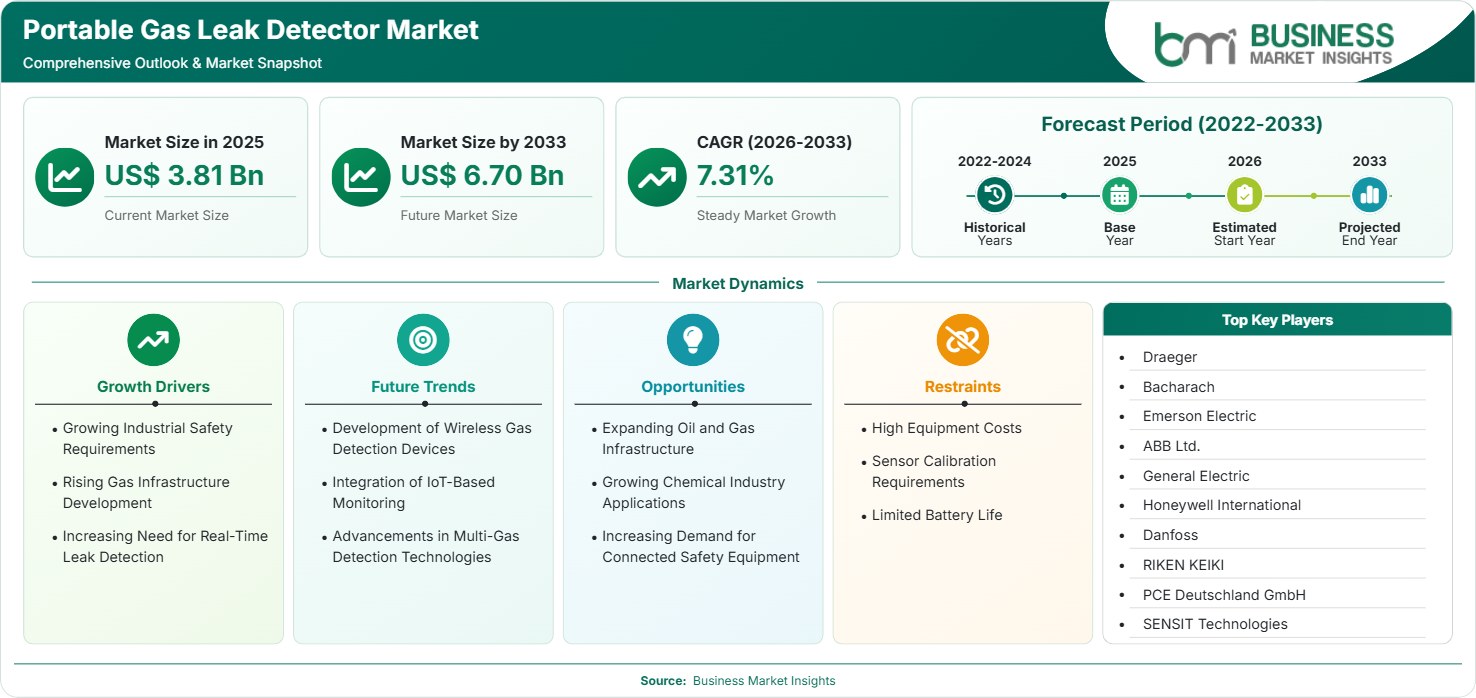
The Portable Gas Leak Detector Market size was valued at US$ 3.81 Billion in 2025 and is projected to reach US$ 6.70 Billion by 2033, growing at a CAGR of 7.31% during 2026–2033, supported by industrial safety requirements, expanding gas infrastructure, connected monitoring, and demand for rapid field detection.

Report Coverage
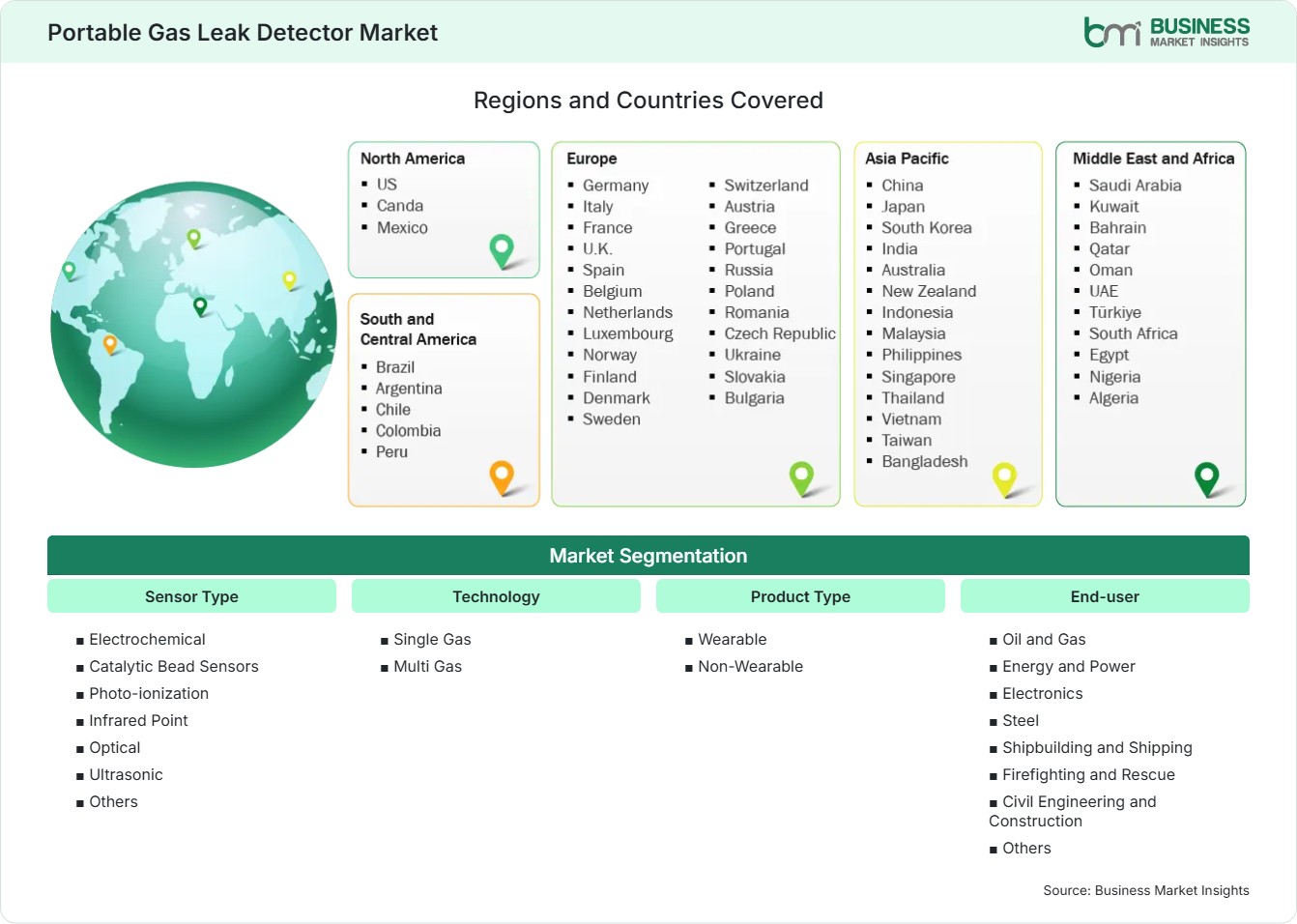
  • Sensor Type: Electrochemical, Catalytic Bead Sensors, Photo-ionization, Infrared Point, Optical, Ultrasonic, Others
  • Technology: Single Gas, Multi Gas
  • Product Type: Wearable, Non-Wearable
  • End-user: Oil and Gas, Energy and Power, Electronics, Steel, Shipbuilding and Shipping, Firefighting and Rescue, Civil Engineering and Construction, Others
US$ 3.81 Bn Market size in 2025
US$ 6.70 Bn Market Size by 2033
7.31% CAGR, 2026 - 2033
2026-2033 Forecast Period

01 AI Overview

Portable Gas Leak Detector Market Summary

  • North America Region: North America holds a 28%–32% share in 2025, growing at a 7.0%–7.8% CAGR during 2026–2033, influenced by industrial safety programs, mature oil and gas operations, replacement demand, connected monitoring, hazardous-area requirements, and advanced multi-gas detection adoption across processing facilities. The US market remains the principal regional contributor, supported by established industrial safety practices and broad deployment of portable detection equipment, with a modeled 7.1%–7.9% CAGR during 2026–2033.
  • Fastest Growing Region: Asia Pacific represents a 25%–29% share in 2025 and is modeled to expand at a 8.0%–8.8% CAGR during 2026–2033, driven by industrial expansion, infrastructure development, workplace safety modernization, increasing electronics production, expanding energy capacity, and greater adoption of portable monitoring technologies across manufacturing environments.
  • Leading Segment: Multi Gas technology accounts for a modeled 52%–56% share in 2025 and is projected at a 7.6%–8.3% CAGR during 2026–2033, supported by broader hazard coverage, operational convenience, reduced equipment handling, integrated alarms, and suitability for complex industrial environments where several gases may present simultaneous risks.
  • High Growth Segment: Wearable product type represents a modeled 31%–35% share in 2025 and is projected to record a 8.0%–8.8% CAGR during 2026–2033, benefiting from worker mobility, continuous personal monitoring, compact electronics, wireless connectivity, emergency alerts, and stronger emphasis on individual exposure management.
  • Key Market Opportunity: Connected portable detectors can combine sensing, worker identification, wireless alerts, location awareness, maintenance records, and centralized dashboards, creating recurring software, service, calibration, replacement, and fleet-management opportunities.
  • Major Market Players: Drägerwerk AG & Co. KGaA; Bacharach, Inc.; Emerson Electric Co.; ABB Ltd.; General Electric Company; Honeywell International Inc.; Danfoss A/S; RIKEN KEIKI CO., LTD.; PCE Deutschland GmbH; SENSIT Technologies, LLC.
02 Strategic Insights

Portable Gas Leak Detector Market: Strategic Insights

Portable Gas Leak Detector Market Strategic Framework
FREE PDF
Request your free sample
Request free sample
03 Stakeholder View

Key Takeaways

  • The value chain extends from sensor and component suppliers through instrument manufacturers, distributors, calibration providers, maintenance specialists, and industrial end users.
  • Multi-gas instruments have higher potential for expansion compared to the narrowly focused instruments since there will be opportunities for the industrial users to respond to multiple threats using one portable device.
  • Miniaturized sensors, lower-power electronics, wireless technology, event logging, better alarm interface, and connection to safety networks have been changing the design of products.
  • Asia Pacific provides an attractive investment environment because industrial capacity expansion can generate new demand rather than relying exclusively on replacement cycles.
  • Strategic investment is likely to favor companies combining sensing technologies, portable instrumentation, connectivity, software, and service capabilities.
04 Geographic Outlook

Portable Gas Leak Detector Market Regional Highlights

North America Portable Gas Leak Detector Market

North America holds a modeled 28%–32% share in 2025, with a 7.0%–7.8% CAGR during 2026–2033. Portable Gas Leak Detector Market share remains supported by oil and gas, utilities, manufacturing, and emergency-response applications. Market growth is also influenced by demand for connected instruments and broader multi-gas functionality.

  • Mature industrial facilities sustain recurring replacement demand as organizations standardize equipment fleets and prioritize dependable monitoring across maintenance, inspection, emergency-response, and confined-space activities.
  • Multi-gas platforms remain commercially attractive because they reduce the number of instruments workers need to carry while supporting broader hazard identification during complex field operations.
  • Connected safety equipment creates opportunities for suppliers offering wireless alerts, event records, centralized monitoring, worker identification, and maintenance visibility alongside traditional detection functionality.
  • Industrial service networks remain important purchasing factors because calibration availability, technical assistance, replacement sensors, batteries, and accessories influence equipment uptime and long-term operational value.

US Portable Gas Leak Detector Market

The US represents a modeled 22%–25% share of North American demand in 2025, expanding at a 7.1%–7.9% CAGR during 2026–2033. Demand is supported by established oil and gas operations, industrial processing, utilities, construction, and emergency-response requirements. Portable Gas Leak Detector Market share benefits from replacement cycles and increasing preference for connected equipment.

  • Oil and gas facilities provide an important application base because inspection, maintenance, shutdown, and emergency activities require mobile detection capabilities across changing work locations and operating conditions.
  • Wearable equipment can gain traction where organizations seek continuous worker awareness, compact instrumentation, rapid alarms, and easier integration into broader personal protective equipment programs.
  • Service availability remains commercially important because scheduled calibration, sensor replacement, preventive maintenance, and technical support influence purchasing decisions beyond the initial equipment acquisition.

Europe Portable Gas Leak Detector Market

Europe accounts for a modeled 23%–27% share in 2025, with a 6.6%–7.4% CAGR during 2026–2033. Germany and the United Kingdom represent leading demand centers, while Italy and France provide established industrial opportunities. Germany is modeled at 6.9%–7.6% CAGR, while the United Kingdom is modeled at 7.1%–7.8%. Portable Gas Leak Detector Market trends emphasize worker protection, equipment modernization, process reliability, and lower-power instrumentation.

  • Germany offers strong industrial demand across manufacturing, chemicals, engineering, utilities, and process operations, creating opportunities for robust multi-gas instruments and professional calibration services.
  • The United Kingdom provides opportunities across energy, industrial maintenance, utilities, and emergency-response applications, with connected monitoring creating additional value around field data and equipment management.
  • France and Italy provide diversified industrial demand where portable detectors support inspection, maintenance, confined-space work, and process safety activities across established facilities.
  • European buyers can favor lower-maintenance equipment because lifecycle efficiency influences procurement decisions, particularly where detector fleets require repeated calibration, sensor replacement, documentation, and operator training.

Asia Pacific Portable Gas Leak Detector Market

Asia Pacific holds a modeled 25%–29% share in 2025, with an 8.0%–8.8% CAGR during 2026–2033, making it the fastest-growing regional market. China and Japan remain important demand centers, while India and Southeast Asian economies provide higher expansion opportunities. India is modeled at 8.4%–9.2% CAGR, reflecting industrialization and infrastructure development. Portable Gas Leak Detector Market share can increase as organizations modernize workplace safety practices, expand processing capacity, and adopt more systematic inspection and monitoring procedures.

  • China provides broad demand across manufacturing, energy, chemicals, electronics, construction, and industrial infrastructure, supporting opportunities for both standardized and application-specific detection equipment.
  • Japan offers established industrial demand with emphasis on compact instrumentation, dependable measurement, equipment quality, and integration into disciplined maintenance and safety procedures.
  • India provides strong expansion potential as industrial facilities, infrastructure projects, energy assets, and construction activity create broader requirements for portable hazard detection.
  • Southeast Asian markets offer opportunities across energy, manufacturing, marine operations, and industrial construction, where distributors with technical support capabilities can strengthen market penetration.
Global Market Geography
FREE PDF
Request your free sample
Request free sample
05 Segment Analysis

Portable Gas Leak Detector Market Segmentation

Sensor Type

Sensor Type remains a central technology determinant, with a modeled Electrochemical, Catalytic Bead Sensors, Photo-ionization, Infrared Point, Optical, Ultrasonic, and Others structure. The segment is estimated to account for the largest equipment-value base, with a 7.0%–7.8% CAGR during 2026–2034, supported by application-specific sensing, multi-hazard requirements, improved portability, and demand for dependable field measurements across industrial environments.

  • Electrochemical: Electrochemical sensors support toxic and reactive gas monitoring where selective measurement, compact construction, low power consumption, and dependable alarm response are important for workplace safety applications.
  • Catalytic Bead Sensors: Catalytic bead sensors remain relevant for combustible gases, particularly where established detection principles, straightforward operation, and broad industrial familiarity support continued deployment across inspection and maintenance activities.
  • Photo-ionization: Photo-ionization technology serves applications requiring detection of volatile organic compounds, offering value in industrial inspection, chemical handling, environmental assessment, and situations requiring sensitivity to lower-concentration vapors.
  • Infrared Point: Infrared point sensors provide opportunities where non-consuming detection, measurement stability, and suitability for specific combustible gases support demanding industrial monitoring applications and repeated field deployment.
  • Optical: Optical approaches enable specialized detection configurations where sensitivity, selectivity, and compact instrumentation can provide differentiation, particularly as manufacturers pursue improved measurement capability within portable platforms.
  • Ultrasonic: Ultrasonic detection can complement conventional concentration-based approaches by identifying leak-related acoustic signatures, supporting rapid screening where immediate localization can reduce inspection time and operational disruption.

Technology

Technology segmentation differentiates Single Gas and Multi Gas configurations. Multi Gas is modeled as the leading category, representing 52%–56% share in 2025, with a 7.6%–8.3% CAGR during 2026–2034. Portable Gas Leak Detector Market scope is strengthened by multi-hazard monitoring, operational convenience, and demand for broader protection during complex industrial activities.

  • Single Gas: Single-gas instruments remain suitable for focused monitoring requirements where one dominant hazard determines equipment selection, supporting lower complexity, targeted applications, and straightforward operator procedures.
  • Multi Gas: Multi-gas systems provide broader hazard coverage through integrated sensing, supporting confined-space work, maintenance, emergency response, and industrial inspection where several gases may require simultaneous monitoring.

Product Type

Product Type includes Wearable and Non-Wearable equipment. Wearable devices are modeled as the high-growth category, representing 31%–35% share in 2025 and a 8.0%–8.8% CAGR during 2026–2034. Portable Gas Leak Detector Market trends increasingly emphasize worker mobility, continuous awareness, compact design, wireless communication, and hands-free operation.

  • Wearable: Wearable detectors support continuous personal monitoring while workers move through hazardous environments, offering compact form factors, immediate alarms, and greater suitability for mobile maintenance and inspection activities.
  • Non-Wearable: Non-wearable instruments remain important for targeted inspection, leak investigation, confined-space assessment, maintenance activities, and applications where operators require flexible handheld measurement and display functionality.

End-user

End-user demand is driven by occupational safety requirements, industrial process risks, regulatory compliance obligations, and infrastructure development. Oil and Gas accounted for approximately 34%–37% share in 2025 and is projected to achieve a CAGR of 7.5%–8.3% through 2034. The Portable Gas Leak Detector Market share remains strongest within this sector due to extensive deployment across exploration, production, refining, storage, and transportation operations.

  • Oil and Gas: Oil and gas operations require portable detection across production, processing, storage, maintenance, inspection, shutdown, and emergency activities where combustible and toxic gases can create operational hazards.
  • Energy and Power: Power facilities use portable detection for maintenance, inspection, confined-space activities, and equipment monitoring, with demand influenced by plant configuration and workforce safety procedures.
  • Electronics: Electronics manufacturing requires controlled environments and targeted monitoring, creating demand for compact instruments where sensitive processes and chemical handling require dependable field detection capabilities.
  • Steel: Steel operations provide applications across processing areas, maintenance activities, confined spaces, and supporting utilities, favoring durable equipment capable of operating in demanding industrial environments.
  • Shipbuilding and Shipping: Marine environments create requirements for portable detection during vessel construction, maintenance, tank inspection, confined-space work, and emergency activities where mobility and ruggedness are essential.
  • Firefighting and Rescue: Emergency-response users prioritize rapid deployment, clear alarms, rugged construction, and multi-gas capability because operating conditions can change quickly during rescue, fire, and hazardous-material incidents.
  • Civil Engineering and Construction: Construction applications include confined-space entry, excavation-related activities, maintenance, and infrastructure work, supporting demand for compact detectors that can move easily between changing work locations.
06 Market Forces

Portable Gas Leak Detector Market Dynamics

Key Market Drivers

Growing Industrial Safety Requirements

Industrial organizations continue strengthening occupational safety programs to reduce accidents, improve compliance performance, and protect personnel operating in hazardous environments. Gas detectors have played a very important role in detecting dangerous levels of gases even before accidents take place. Today’s industries like chemicals, mining, energy, manufacturing, and utilities have started adopting extensive monitoring processes for ensuring the safety of their employees. Various regulatory authorities around the world have been tightening workplace safety regulations in order to promote the use of these technologies. The Portable Gas Leak Detector Market trends, the adoption of connected safety ecosystems is being encouraged with detection devices and monitoring systems.

Rising Gas Infrastructure Development

Global investments in natural gas production, liquefied natural gas facilities, pipelines, storage terminals, and distribution networks continue to generate demand for gas monitoring solutions. Increased infrastructure leads to increased needs for inspection, maintenance, emergency preparedness, and management of workforce safety. Portable devices are used to detect leaks, reduce operational disruption, and ensure personnel safety throughout the lifecycle of such projects. Government backing for upgrades to energy infrastructure, as well as increased energy consumption, hastens adoption of such devices. Industrialization in developing nations is also adding facilities that need a gas detection system.

Increasing Need for Real-Time Leak Detection

Industrial sectors are showing an increasing preference for real-time monitoring technology that can give instant notifications about the presence of dangerous gases. Real-time detection helps to ensure continuity of operations, safety of workers, compliance with regulations, and preparedness in case of emergencies. The developments in the field of wireless communication, cloud computing, analysis, and sensors have enabled innovative leak detection techniques to emerge. The Portable Gas Leak Detector Market growth continues to be driven by the need for proactive safety management practices instead of reactive measures. Advanced portable detection devices that can provide accurate information and insights have become necessary.

Key Market Opportunities

Expanding Oil and Gas Infrastructure

The investments made in the exploration of oil and gas, pipeline construction, development of LNG plants, refinery capacities, and distribution networks will continue to offer numerous opportunities for companies specializing in portable gas detectors. New facilities need an advanced system that would be able to detect any dangerous leakage in the process of commissioning, maintenance, and regular functioning. An increase in demand for energy in emerging economies leads to higher adoption rates of portable monitoring devices. The Portable Gas Leak Detector Market Forecasts demonstrate the continuous demand in upstream, midstream, and downstream operations driven by the focus on worker safety and regulations.

Growing Chemical Industry Applications

The industry of chemical production is growing all around the world, resulting in an increased demand for mobile detectors of various gases. In addition, the processing plants deal with gases that are dangerous, flammable, and reactive, and there is a constant need for safety and control in order to prevent leaks. Mobile detectors allow operators to perform their tasks, such as maintenance, inspection, confined space entry, and emergencies safely. Increasing investments in the production of specialty chemicals, petrochemicals, and industrial materials are resulting in an increased number of facilities with the need for gas monitoring systems.

Increasing Demand for Connected Safety Equipment

Industrial enterprises are embracing the use of connected safety ecosystems which incorporate wearables, wireless technology, cloud computing, and safety management systems. Portable gas detectors that include connectivity features enable visibility, automated reporting of incidents, tracking of employees, and predictive safety approaches. This will increase awareness and facilitate compliance as well as emergency preparedness for industrial operations. The Portable Gas Leak Detector Market need connected worker solutions that is high for large-scale industrial companies engaged in digital transformation projects. As the connected worker trend increases, there is an opportunity for the makers of portable gas detectors to produce sophisticated products.

Market Restraints and Challenges

High Equipment Costs

Factor: Advanced portable gas detectors incorporate sophisticated sensing technologies, wireless communication capabilities, ruggedized designs, and compliance-certified safety features that increase production costs. Impact: The cost of premium quality equipment could hinder the uptake by small businesses, contractors, or organizations that work within tight financial constraints. The cost element becomes particularly important where the implementation requires huge numbers of devices at various locations. Despite the obvious advantages in terms of safety, cost-conscious organizations might take time to upgrade their equipment.

Sensor Calibration Requirements

Factor: Portable gas detectors require regular calibration, functional testing, and maintenance to maintain measurement accuracy and ensure compliance with safety standards. Impact: Calibration processes make operations more complicated and costly, while increasing the cost of maintaining and training workers. Improper calibration can decrease reliability, pose safety hazards, and violate regulations. Companies using many detectors should allocate funds for their maintenance and calibration.

07 Company Analysis

Competitive Landscape

Competitive positioning is increasingly shaped by sensor breadth, instrument durability, connectivity, application coverage, service infrastructure, and lifecycle support. Portable Gas Leak Detector Market analysis indicates that established instrumentation providers can differentiate through diversified product portfolios, while specialist manufacturers can compete through focused sensing technologies and application-specific solutions.

Company Name

Overview

Products and Services relevant to this market

Drägerwerk AG & Co. KGaA

Global safety technology provider with established expertise in gas detection, respiratory protection, and workplace monitoring equipment.

Portable gas detection instruments, multi-gas monitors, personal detection equipment, accessories, calibration, and safety-support services.

Bacharach, Inc.

Specialist provider of gas detection and measurement solutions serving refrigeration, HVAC, industrial, and safety-related applications.

Portable gas leak detectors, combustion analyzers, refrigerant detection equipment, measurement instruments, and related service solutions.

Emerson Electric Co.

Diversified industrial technology company offering measurement, automation, and process-management solutions across demanding industrial environments.

Gas detection technologies, measurement solutions, industrial instrumentation, automation integration, monitoring, and related support capabilities.

ABB Ltd.

Global technology company serving industrial, energy, automation, electrification, and process-management markets.

Gas detection and measurement solutions, industrial monitoring technologies, automation integration, safety systems, and related services.

General Electric Company

Industrial technology organization with capabilities spanning energy, industrial equipment, digital technologies, and monitoring applications.

Gas and environmental monitoring capabilities, industrial measurement technologies, digital solutions, and equipment-support services.

Honeywell International Inc.

Diversified technology company with extensive industrial safety, automation, sensing, and connected-worker capabilities.

Portable gas detectors, multi-gas instruments, connected safety equipment, sensors, monitoring solutions, and lifecycle support.

Danfoss A/S

Industrial technology company serving energy efficiency, refrigeration, heating, and industrial applications requiring reliable measurement and control.

Gas-related sensing technologies, industrial measurement capabilities, controls, monitoring equipment, and application-support solutions.

RIKEN KEIKI CO., LTD.

Specialist gas detection manufacturer focused on industrial safety, gas monitoring, and measurement technologies.

Portable gas monitors, single-gas and multi-gas detectors, sensors, alarms, calibration support, and gas monitoring solutions.

PCE Deutschland GmbH

Measurement technology provider offering instruments for industrial inspection, environmental measurement, and safety-related applications.

Portable gas detectors, measuring instruments, inspection equipment, environmental monitoring products, and technical measurement support.

SENSIT Technologies, LLC

Specialist provider of gas detection and leak detection technologies for professional field applications.

Portable gas detectors, leak detection instruments, combustible gas detection equipment, accessories, and application-oriented measurement solutions.

10 Trust & Transparency

Research Methodology

The market analysis combines proprietary research with secondary data from government agencies, company disclosures, regulatory filings, industry databases and expert interviews. Market estimates are validated through data triangulation, cross-market benchmarking and analyst review.

View Full Research Methodology

11 Questions Answered

Frequently Asked Questions

What technological trend is shaping the future of the industry?

Wireless connectivity, cloud-based analytics, connected worker ecosystems, predictive maintenance capabilities, and integration with industrial safety platforms are shaping future product development.

What insights does the Portable Gas Leak Detector Market Report provide?

The report provides detailed insights into sensor technologies, end-user demand, safety trends, regional opportunities, competitive dynamics, and future industry developments.

How do wearable gas detectors improve workplace safety?

Wearable devices provide continuous personal monitoring, instant alarms, worker mobility, and real-time hazard awareness, helping organizations respond quickly to dangerous conditions.

Why are multi-gas detectors preferred over single-gas devices?

Multi-gas detectors enhance operational efficiency by enabling simultaneous monitoring of multiple hazards, reducing equipment requirements while improving worker safety and regulatory compliance.

What industries generate the highest demand for Portable Gas Leak Detector Market?

Oil and gas, chemicals, utilities, mining, manufacturing, emergency response, and construction industries generate the highest demand because they routinely operate in environments where hazardous gas exposure risks exist.

Access the Full Portable Gas Leak Detector Market Report

Get segment-level forecasts, regional estimates, competitive benchmarking, company profiles and downloadable Excel datasets.

Access the full Portable Gas Leak Detector Market Report
350 pages PDF & Excel | 2026-08-19