
Gas Separation Membrane Market Outlook: Size, Share, Trends, Growth Analysis, Competitive Landscape & Forecast, 2026-2033

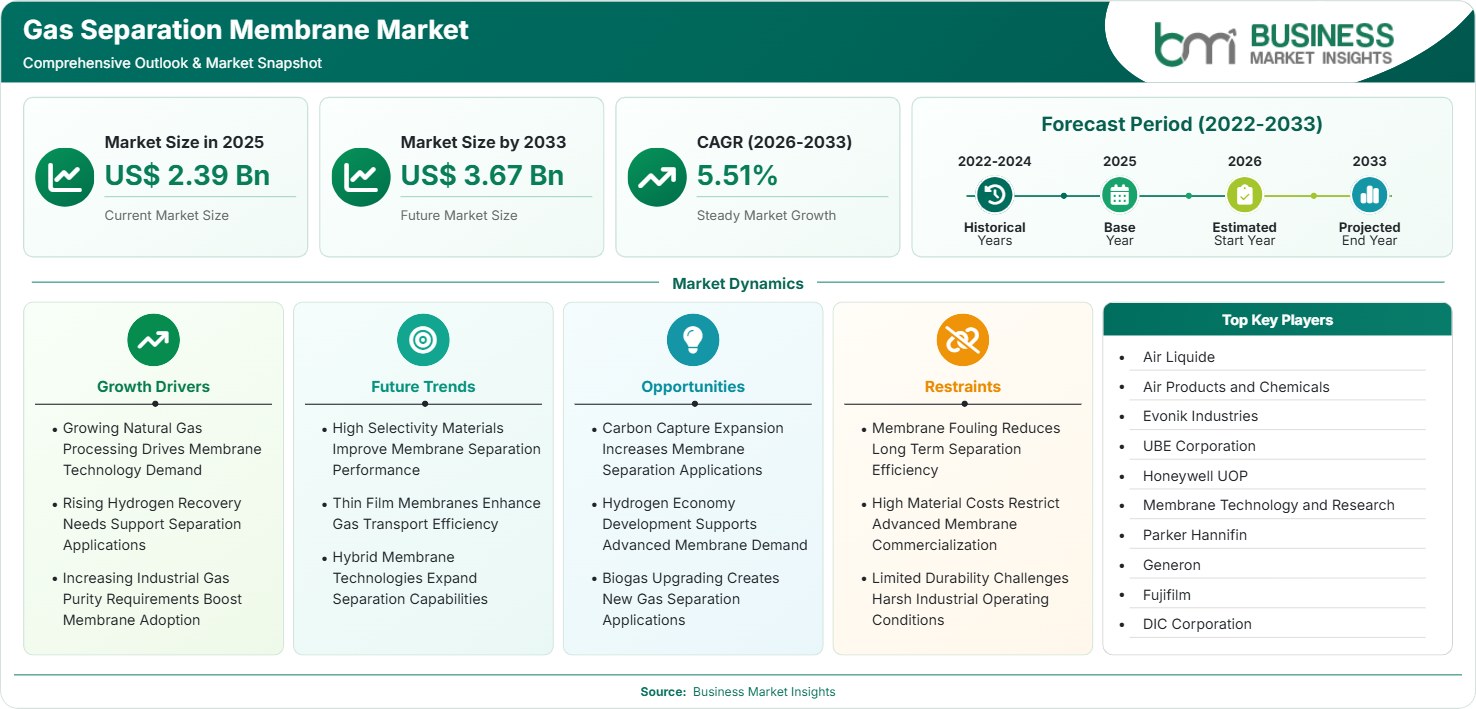
The Gas Separation Membrane Market size was valued at US$ 2.39 billion in 2025 and is projected to reach US$ 3.67 billion by 2033, growing at a CAGR of 5.51% during 2026–2033. Increasing natural gas processing, hydrogen recovery requirements, industrial gas purification needs, and carbon capture initiatives are creating growth opportunities for membrane technology providers.

Report Coverage
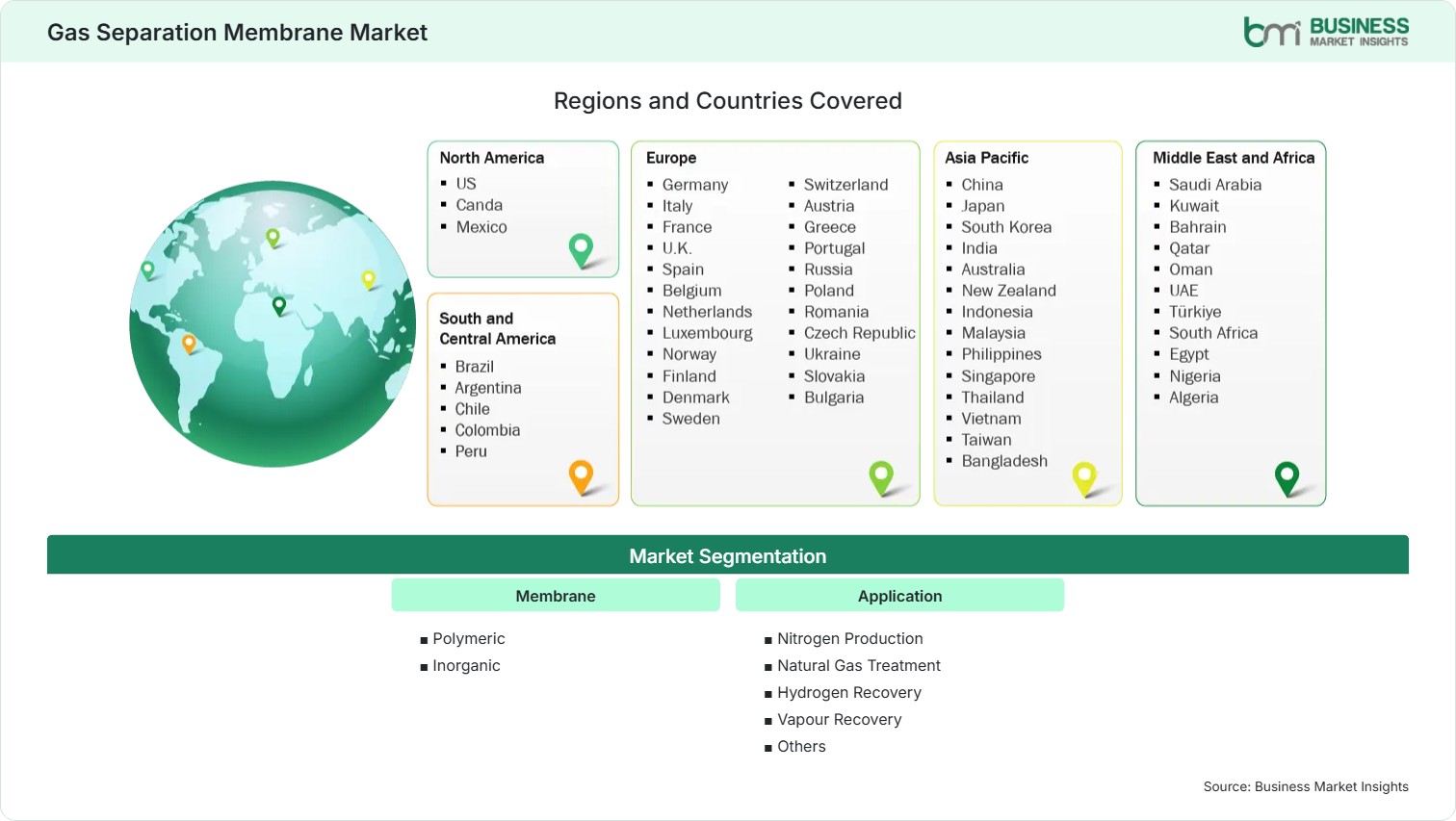
  • Membrane: Polymeric, Inorganic
  • Application: Nitrogen Production, Natural Gas Treatment, Hydrogen Recovery, Vapour Recovery, Others
US$ 2.39 Bn Market size in 2025
US$ 3.67 Bn Market Size by 2033
5.51% CAGR, 2026 - 2033
2026-2033 Forecast Period

AI Overview

Gas Separation Membrane Market Summary

  • North America Region: North America holds a significant position with a share ranging between 32%–35% in 2025 and is projected to grow at a CAGR of 4.8%–5.4% during 2026–2033. The region benefits from natural gas processing activities, hydrogen infrastructure investments, and industrial decarbonization initiatives. The United States remains a key contributor due to expanding gas processing capacity, refinery modernization, and clean energy projects. The U.S. market is projected to grow at a CAGR of 5.0%–5.6% through 2033.
  • Fastest Growing Region: Asia Pacific represents the fastest-growing region with a share ranging between 30%–33% in 2025 and is expected to expand at a CAGR of 6.0%–6.6% during 2026–2033. Industrial gas demand, hydrogen development programs, and expanding manufacturing capacity are supporting membrane adoption.
  • Leading Segment: Polymeric membranes represent the leading segment with a share ranging between 70%–73% in 2025 and are projected to grow at a CAGR of 5.2%–5.8% through 2033. Cost efficiency, scalability, and established industrial applications support their widespread adoption.
  • High Growth Segment: Hydrogen Recovery represents a high-growth application segment with a share ranging between 16%–19% in 2025 and is expected to grow at a CAGR of 6.2%–6.8%. Increasing hydrogen utilization and clean energy transition initiatives are supporting demand.
  • Key Market Opportunity: Carbon capture, hydrogen economy development, and biogas upgrading applications are creating opportunities for advanced membrane solutions offering higher selectivity, efficiency, and reduced energy consumption.
  • Major Market Players: Air Liquide, Air Products and Chemicals, Evonik Industries, UBE Corporation, Honeywell UOP, Membrane Technology and Research, Parker Hannifin, Generon, Fujifilm, and DIC Corporation.
Strategic Insights

Gas Separation Membrane Market: Strategic Insights

Gas Separation Membrane Market Strategic Framework
FREE PDF
Request your free sample
Request free sample
Stakeholder View

Key Takeaways

  • Gas separation technology ecosystems are evolving through integration of advanced membrane materials, industrial process systems, and energy-efficient separation solutions. This is improving efficiency and supporting sustainable industrial operations.
  • Hydrogen recovery, carbon capture, and natural gas treatment applications provide strong opportunities as industries pursue cleaner and more efficient processing methods. These applications are driving wider adoption of membrane technologies.
  • Innovation is focused on high-performance membranes, improved selectivity, enhanced durability, and materials capable of operating under demanding industrial conditions. New materials are improving performance and reliability.
  • Asia Pacific offers attractive investment potential due to industrial expansion, rising gas demand, and increasing hydrogen development initiatives. Regional investments are supporting market growth.
  • Collaboration between membrane manufacturers, industrial gas companies, and technology developers is accelerating commercialization of advanced separation systems. These partnerships are promoting faster technology adoption.
  • Decarbonization strategies are encouraging industries to adopt membrane-based solutions as alternatives to energy-intensive conventional separation technologies. This trend is increasing demand for cleaner separation processes.
Geographic Outlook

Gas Separation Membrane Market Regional Highlights

North America Gas Separation Membrane Market

North America accounted for approximately 32%–35% of global revenue in 2025 and is expected to expand at a CAGR of 4.8%–5.4% through 2033. The region benefits from established natural gas infrastructure, industrial gas production capabilities, and increasing investment in hydrogen and carbon management projects. The Gas Separation Membrane Market share in North America is supported by demand from energy companies, chemical producers, and industrial gas suppliers.

  • The United States represents the major regional contributor due to extensive natural gas processing and clean energy investments.
  • Industrial facilities are adopting membrane systems to improve separation efficiency and reduce operational energy requirements.
  • Hydrogen recovery projects are increasing demand for advanced separation technologies.
  • Carbon capture initiatives are creating additional applications for membrane-based solutions.

US Gas Separation Membrane Market

The United States represents the largest contributor within North America, supported by natural gas processing activities, refinery operations, and increasing focus on hydrogen infrastructure. The market is projected to grow at a CAGR of 5.0%–5.6% through 2033 as industries invest in efficient separation technologies. Growing decarbonization initiatives are strengthening demand for advanced membrane systems.
  • Natural gas producers are adopting membrane technologies for efficient processing and purification.
  • Industrial gas companies are expanding separation capabilities for hydrogen and specialty gas applications.
  • Clean energy projects are supporting demand for innovative membrane solutions.

Europe Gas Separation Membrane Market

Europe represented approximately 23%–26% of global revenue in 2025 and is projected to grow at a CAGR of 4.7%–5.3% through 2033. The region benefits from strong environmental regulations, hydrogen economy initiatives, and industrial decarbonization programs. Germany leads regional adoption, while the United Kingdom and France are expanding membrane applications through clean energy investments.

  • Germany supports adoption through chemical industry strength and hydrogen development programs.
  • The United Kingdom is investing in carbon management and industrial decarbonization technologies.
  • France is expanding gas separation applications through energy transition projects.
  • Regulatory focus on emissions reduction is encouraging advanced separation technology deployment.

Asia Pacific Gas Separation Membrane Market

Asia Pacific accounted for approximately 30%–33% of global revenue in 2025 and is expected to register the fastest CAGR of 6.0%–6.6% through 2033. Industrial expansion, increasing gas consumption, and hydrogen initiatives are strengthening regional demand. China leads adoption, while Japan, South Korea, and India are increasing investments in advanced separation technologies.

  • China is expanding membrane adoption through industrial gas production and manufacturing growth.
  • Japan is developing hydrogen infrastructure requiring efficient separation solutions.
  • South Korea is investing in clean energy technologies and advanced processing systems.
  • India is increasing demand through industrial expansion and energy transition initiatives.

Rest of World Gas Separation Membrane Market

Rest of World regions contribute approximately 6%–9% of global revenue in 2025 and are projected to grow at a CAGR of 5.2%–5.8% through 2033. Middle Eastern and Latin American markets are adopting membrane technologies through natural gas development, industrial processing expansion, and energy diversification initiatives. Growing investment in gas infrastructure is creating opportunities for technology suppliers.

  • Middle Eastern countries are adopting separation technologies across natural gas and petrochemical industries.
  • Latin American markets are expanding gas processing capabilities and industrial applications.
  • Energy diversification programs are encouraging adoption of efficient separation solutions.
  • Industrial modernization initiatives are supporting demand for advanced membrane systems.
Global Market Geography
FREE PDF
Request your free sample
Request free sample
Segment Analysis

Gas Separation Membrane Market Segmentation

Membrane

The Membrane segment represents the core technology category, with adoption influenced by separation efficiency, material performance, and industrial application requirements. Polymeric membranes maintain widespread utilization due to scalability and cost advantages, while inorganic membranes are gaining attention for high-temperature and demanding separation environments. The Gas Separation Membrane Market scope continues expanding as industries seek energy-efficient alternatives for gas processing operations.

  • Polymeric: Polymeric membranes dominate industrial applications due to cost effectiveness, flexible processing capabilities, and suitability for natural gas treatment, hydrogen recovery, and industrial gas separation.
  • Inorganic: Inorganic membranes support specialized applications requiring higher thermal stability, durability, and improved separation performance in challenging industrial operating environments.

Application

The Application segment reflects growing adoption across energy, industrial gas, and environmental applications requiring efficient gas separation processes. Natural gas treatment remains a significant application due to increasing demand for purification technologies. The Gas Separation Membrane Market trend indicates rising interest in hydrogen recovery, carbon capture, and biogas upgrading applications as industries focus on cleaner energy pathways.

  • Nitrogen Production: Supports industrial gas generation requirements by enabling efficient nitrogen separation for manufacturing, energy, and processing applications.
  • Natural Gas Treatment: Uses membrane systems for removing impurities and improving gas quality across processing and transportation operations.
  • Hydrogen Recovery: Gains adoption through clean energy initiatives requiring efficient recovery and purification of hydrogen streams.
  • Vapour Recovery: Enables reduction of emissions and recovery of valuable gases from industrial operations and storage processes.
Market Forces

Gas Separation Membrane Market Dynamics

Key Market Drivers

Growing Natural Gas Processing Drives Membrane Technology Demand

There is an increase in activities related to natural gas processing, which creates a need for effective separation technology to improve process quality and efficiency. There is increased use of membranes as a separation technology because of their low energy requirements compared to conventional separation technologies. An increase in natural gas infrastructure and in demand for natural gas as a fuel will lead to growth in the adoption of the technology. The Gas Separation Membrane Market growth will be driven by innovations in membrane technology that improve performance.

Rising Hydrogen Recovery Needs Support Separation Applications

The increased emphasis on hydrogen use is driving a growing need for separation techniques to enable efficient extraction of hydrogen from gas streams. This has led refineries, chemical facilities, and hydrogen projects to look for membrane options to make their processes more efficient. Membrane techniques offer opportunities for efficient hydrogen purification with reduced operational complexity. Increased investment in the clean energy sector is motivating technology providers to develop higher-performing membranes. The implementation of hydrogen recovery systems is likely to grow as more companies adopt carbon-neutral production methods.

Increasing Industrial Gas Purity Requirements Boost Membrane Adoption

Many industries today need to use high-purity gas for manufacturing and in electronics, chemistry, and energy-related processes. There is increasing demand for the use of membranes as separation processes become easier and more continuous. Manufacturers are designing advanced materials to enhance the separation process. The increased quality demands across various industrial sectors are pushing manufacturers to upgrade gas separation processes. These demands are driving the use of membrane technology due to the reliability of its performance.

Key Market Opportunities

Carbon Capture Expansion Increases Membrane Separation Applications

Increased use of carbon capture projects is creating opportunities for membranes to separate carbon dioxide from industrial gases. There are ongoing efforts across various industries to adopt membrane-based solutions because they are energy-efficient and compatible with existing systems. The growing pressure within the energy and manufacturing industries for decarbonization is driving investments in new separation technologies. Technology vendors are investing to enhance the selectivity, durability, and scalability of membranes to meet carbon management needs. The growing trend towards emissions-reduction solutions will create more applications for membrane technologies.

Hydrogen Economy Development Supports Advanced Membrane Demand

Hydrogen infrastructure development is creating new opportunities for innovative membrane technologies in hydrogen production, purification, and recovery. With the implementation of hydrogen projects across industries, there is an increasing need for separation technologies to ensure process efficiency. Membrane technology companies have been developing membranes capable of effectively and efficiently handling complex hydrogen streams. The expansion of hydrogen ecosystems across different sectors of the economy will increase demand for innovative separation technology. Membrane technology companies can benefit from new applications of hydrogen.

Biogas Upgrading Creates New Gas Separation Applications

Growing attention to renewable energy is driving demand for biogas upgrading systems, which improve methane quality and enable the production of cleaner fuels. Membrane systems are useful for efficiently separating carbon dioxide and other impurities from biogas streams. Agricultural companies, wastewater treatment plants, and renewable energy companies are interested in adopting membrane technology to better utilize resources. Growing attention to the principles of the circular economy and the production of renewable gases creates market opportunities. The Gas Separation Membrane Market forecast is driven by growing applications within sustainable energy production.

Market Restraints and Challenges

Membrane Fouling Reduces Long Term Separation Efficiency

Factor: Contaminants and impurities can cause membrane fouling due to exposure to varying gas compositions. Impacts: It will be difficult to achieve efficient separation processes due to membrane fouling, which increases maintenance needs. Manufacturers are developing advanced membranes that can withstand contamination. Maintaining membrane performance over time remains an important issue, especially for complex gas compositions.

High Material Costs Restrict Advanced Membrane Commercialization

Factor: Advanced membrane materials, specialized manufacturing processes, and research requirements contribute to higher production costs for high-performance separation systems. Impact: Increased costs can limit adoption among price-sensitive industries and delay commercialization of advanced membrane technologies. Companies are investing in material innovation and scalable production methods to improve affordability. However, cost optimization remains important for expanding adoption across broader industrial applications and emerging markets.

Company Analysis

Competitive Landscape

The competitive landscape includes industrial gas companies, membrane technology developers, and engineering solution providers focusing on advanced separation technologies. The Gas Separation Membrane Market analysis highlights strategic priorities such as material innovation, customized separation solutions, energy-efficient systems, and expansion into hydrogen, carbon capture, and industrial gas applications.

Company Name

Overview

Products and Services relevant to this market

Air Liquide

Global industrial gases and technology company providing solutions for energy, healthcare, and industrial applications.

Gas separation membrane technologies, industrial gas processing solutions, hydrogen purification systems, and carbon management technologies.

Air Products and Chemicals

Industrial gases company specializing in hydrogen, gas processing, and energy transition solutions.

Gas separation systems, hydrogen recovery solutions, industrial gas technologies, and membrane-based purification applications.

Evonik Industries

Specialty chemicals company developing advanced materials and membrane technologies.

Polymeric membrane materials, gas separation solutions, specialty polymers, and industrial separation technologies.

UBE Corporation

Chemical company providing advanced materials and industrial solutions across multiple sectors.

Gas separation membranes, polymer materials, chemical processing solutions, and membrane-related technologies.

Honeywell UOP

Industrial technology provider specializing in refining, petrochemical, and gas processing solutions.

Gas separation technologies, membrane systems, natural gas processing solutions, and industrial purification technologies.

Membrane Technology and Research

Membrane technology company focused on advanced separation solutions for industrial applications.

Gas separation membranes, carbon capture membranes, hydrogen separation solutions, and customized membrane systems.

Parker Hannifin

Motion and control technology company providing filtration and separation solutions.

Gas separation systems, filtration technologies, industrial purification equipment, and membrane-based solutions.

Generon

Gas separation technology provider specializing in nitrogen generation and membrane systems.

Nitrogen membrane systems, gas purification solutions, industrial separation equipment, and onsite gas generation technologies.

Fujifilm

Technology company developing advanced materials and industrial solutions.

Membrane materials, specialty separation technologies, advanced polymer solutions, and industrial applications.

DIC Corporation

Chemical company producing advanced materials and specialty chemical solutions.

Polymer materials, membrane components, specialty chemicals, and separation technology solutions.

Trust & Transparency

Research Methodology

The market analysis combines proprietary research with secondary data from government agencies, company disclosures, regulatory filings, industry databases and expert interviews. Market estimates are validated through data triangulation, cross-market benchmarking and analyst review.

View Full Research Methodology

Questions Answered

Frequently Asked Questions

What factors affect the selection of gas separation membrane systems?

Selection depends on gas composition, required purity levels, operating conditions, energy efficiency goals, maintenance requirements, and application-specific performance needs. Industries evaluate membrane durability, separation efficiency, and integration capabilities before implementing these systems.

What does the Gas Separation Membrane Market report cover?

The report covers membrane types, application areas, regional developments, competitive strategies, adoption factors, and emerging opportunities. It provides insights into technology trends influencing industrial gas separation and future market expansion.

How is hydrogen development influencing membrane technology adoption?

Hydrogen economy investments are increasing demand for membrane solutions that enable efficient hydrogen recovery and purification. Advanced membranes are being developed to improve selectivity, durability, and performance for emerging clean energy applications.

Why are polymeric membranes widely used in gas separation applications?

Polymeric membranes are widely adopted because they offer cost advantages, scalability, and flexibility across multiple industrial gas separation processes. Their established manufacturing capabilities make them suitable for natural gas treatment, hydrogen recovery, and nitrogen production applications.

What industries are adopting gas separation membrane technologies?

Natural gas processing, hydrogen production, industrial gases, chemical processing, and environmental management industries are adopting gas separation membrane technologies. These sectors use membrane systems to improve purification efficiency, reduce energy consumption, and support cleaner processing operations.

Access the Full Gas Separation Membrane Market Report

Get segment-level forecasts, regional estimates, competitive benchmarking, company profiles and downloadable Excel datasets.

Access the full Gas Separation Membrane Market Report
350 pages PDF & Excel | 2026-08-07
Similar Research

Related Market Reports