
Ultrafiltration Membrane Market Outlook: Size, Share, Trends, Growth Analysis, Competitive Landscape & Forecast, 2026-2033

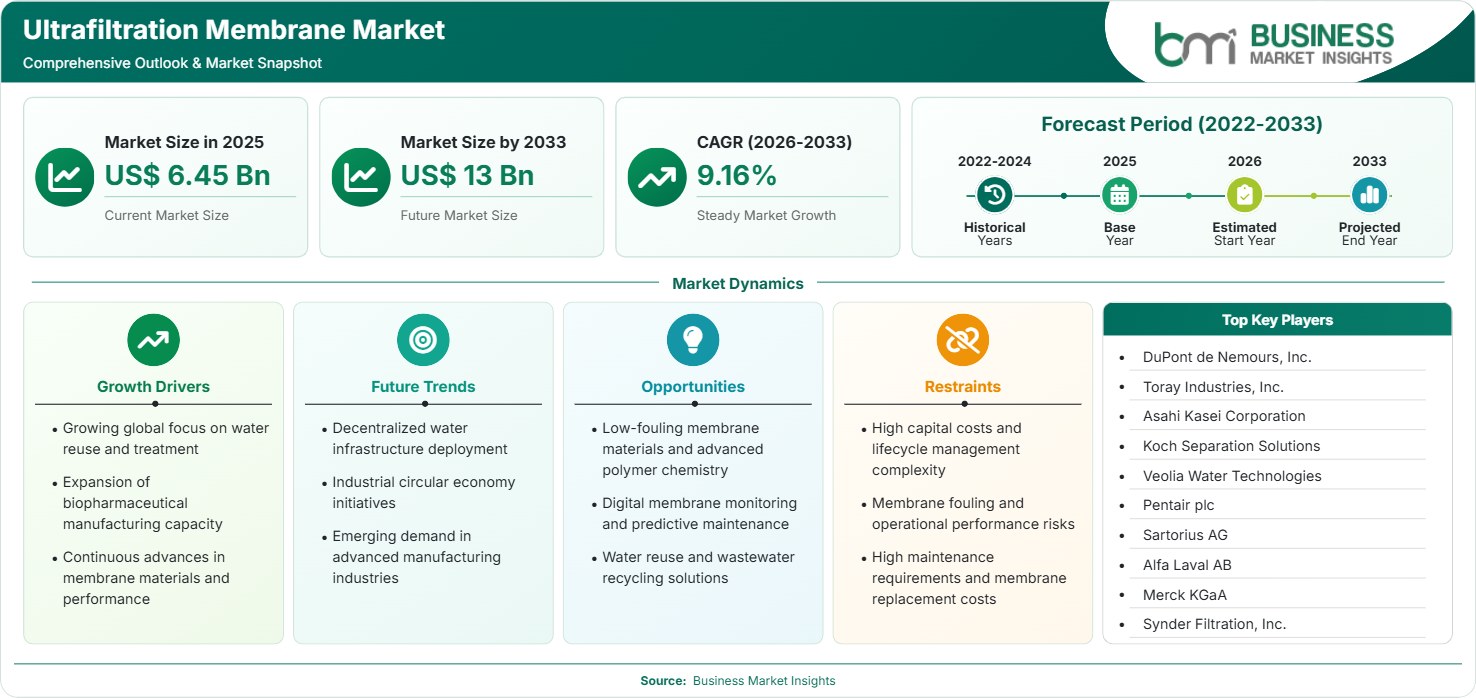
The Ultrafiltration Membrane Market size was valued at US$ 6.45 Billion in 2025 and is projected to reach US$ 13 Billion by 2033, growing at a CAGR of 9.16% during 2026–2033, supported by rising water reuse requirements, biopharmaceutical filtration demand, tighter discharge standards, and investment in advanced membrane materials.

Report Coverage
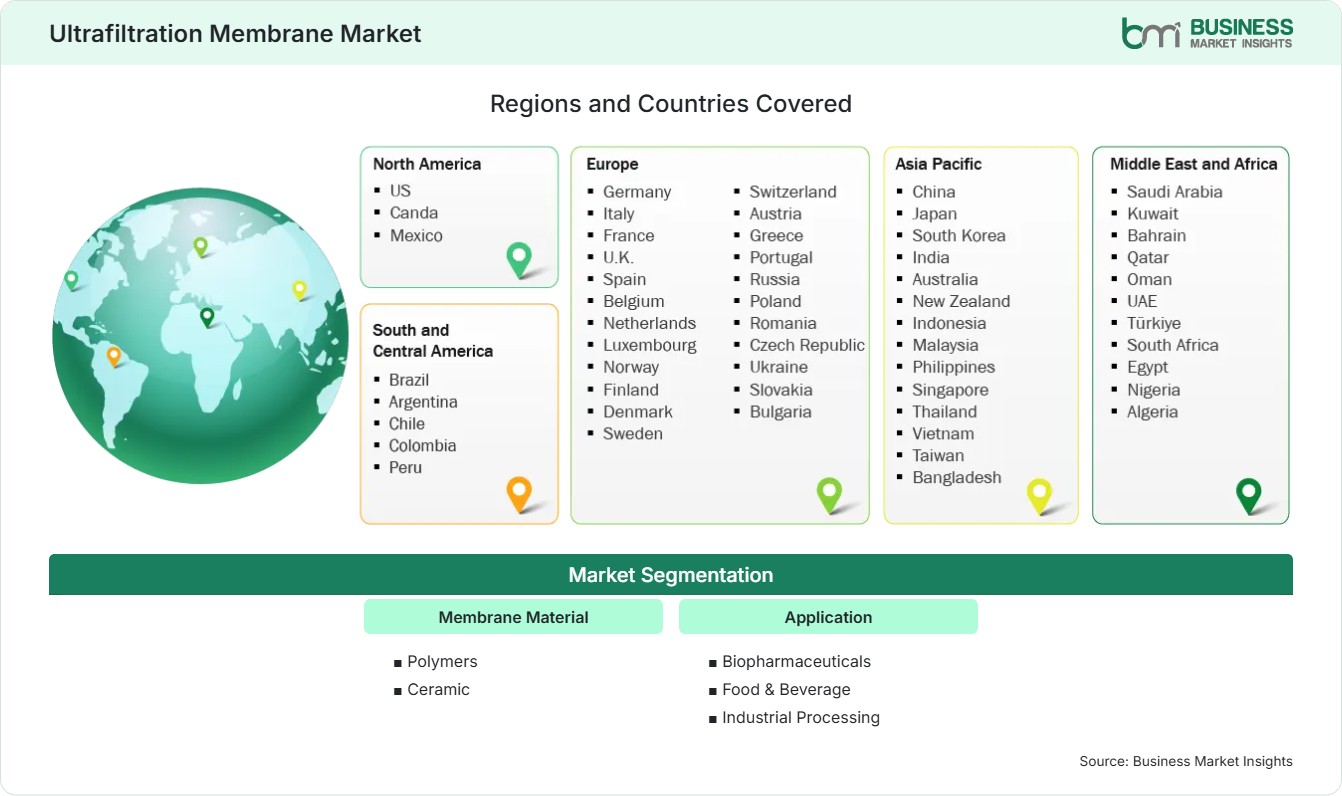
  • Membrane Material: Polymers, Ceramic
  • Application: Biopharmaceuticals, Food & Beverage, Industrial Processing
US$ 6.45 Bn Market size in 2025
US$ 13 Bn Market Size by 2033
9.16% CAGR, 2026 - 2033
2026-2033 Forecast Period

AI Overview

Ultrafiltration Membrane Market Summary

  • North America Region: North America holds market share of 34%–37% in 2025, growing with a CAGR of 8.2%–8.8% during 2026–2033. Growth is supported by municipal water upgrades, industrial wastewater recycling mandates, pharmaceutical expansion, membrane replacement demand, digital monitoring adoption, sustainability targets, infrastructure funding, utility modernization programs, and resource efficiency initiatives. US market benefits from strong biopharmaceutical manufacturing, water reuse investment, and an estimated CAGR of 8.4%–9.0%.
  • Fastest Growing Region: Asia Pacific holds market share of 28%–31% in 2025, growing with a CAGR of 10.8%–11.5% during 2026–2033. Expansion is driven by industrialization, urban water treatment investment, stricter environmental enforcement, desalination integration, semiconductor manufacturing demand, pharmaceutical capacity additions, wastewater reuse projects, government infrastructure spending, and rising freshwater scarcity.
  • Leading Segment: Polymers account for 67%–71% share in 2025 and are expected to advance at 8.9%–9.5% CAGR. Adoption benefits from cost efficiency, scalable manufacturing, broad industrial compatibility, high deployment across municipal facilities, bioprocessing applications, replacement demand, operational flexibility, and continuous material innovation.
  • High Growth Segment: Biopharmaceuticals represent 23%–27% share in 2025 and are projected to expand at 10.8%–11.6% CAGR. Demand stems from biologics production, vaccine manufacturing, sterile processing requirements, protein concentration applications, regulatory compliance expectations, contamination control priorities, and growing contract development activities.
  • Key Market Opportunity: Large-scale water reuse infrastructure and decentralized industrial treatment systems create opportunities for high-performance membrane platforms, lifecycle service contracts, predictive maintenance solutions, and advanced fouling-resistant materials supporting long-term operational efficiency.
  • Major Market Players: DuPont de Nemours, Inc., Toray Industries, Inc., Asahi Kasei Corporation, Koch Separation Solutions, Veolia Water Technologies, Pentair plc, Sartorius AG, Alfa Laval AB, Merck KGaA, and Synder Filtration, Inc.
Strategic Insights

Ultrafiltration Membrane Market: Strategic Insights

Ultrafiltration Membrane Market Strategic Framework
FREE PDF
Request your free sample
Request free sample
Stakeholder View

Key Takeaways

  • The value chain increasingly integrates membrane manufacturers, module assemblers, engineering firms, automation providers, and long-term service operators, creating recurring revenue streams beyond equipment sales.
  • Biopharmaceutical processing and advanced industrial water reuse projects offer the strongest upside due to stringent purification requirements and expanding regulatory oversight.
  • Product innovation is shifting toward low-fouling surfaces, higher flux materials, digital monitoring capabilities, and longer service-life membrane configurations.
  • India, China, Vietnam, Saudi Arabia, and the United Arab Emirates present compelling investment opportunities linked to infrastructure modernization and water security objectives.
  • Strategic acquisitions continue enhancing technical capabilities, geographic reach, and service portfolios as leading suppliers seek integrated treatment offerings.
  • Demand is gradually shifting from standalone filtration equipment toward turnkey solutions combining membranes, analytics, monitoring, and lifecycle maintenance services.
Geographic Outlook

Ultrafiltration Membrane Market Regional Highlights

North America Ultrafiltration Membrane Market

North America accounted for approximately 34%–37% Ultrafiltration Membrane Market share in 2025 and is projected to expand at a CAGR of 8.2%–8.8% through 2033. Regional demand is supported by aging water infrastructure replacement, industrial recycling mandates, and pharmaceutical manufacturing capacity. Municipal utilities continue investing in resilient treatment systems to meet increasingly stringent water quality standards. Strong technology adoption, established supplier networks, and regulatory enforcement contribute to sustained revenue generation. The region remains a major center for innovation and aftermarket membrane replacement demand.

  • Federal and state infrastructure programs support modernization of treatment facilities and encourage deployment of advanced separation technologies across utility networks.
  • Pharmaceutical and biotechnology production clusters generate consistent demand for sterile filtration and process purification systems.
  • Industrial wastewater recycling requirements are accelerating adoption among food, chemical, and manufacturing facilities.
  • Digital monitoring integration improves operational efficiency, predictive maintenance capability, and asset utilization rates.
  • Service contracts and membrane replacement revenues remain important contributors to supplier profitability.

US Ultrafiltration Membrane Market

The United States represents approximately 76%–80% of the North American Ultrafiltration Membrane Market revenue and advances at 8.4%–9.0% CAGR. Investment in municipal treatment infrastructure, semiconductor manufacturing, pharmaceutical production, and industrial sustainability initiatives continues driving adoption. Utilities increasingly focus on water reuse programs and pathogen control performance. Growing emphasis on operational resilience supports replacement of older filtration technologies with advanced membrane systems. Continued research activity and established supplier presence strengthen competitive intensity and technological leadership.

  • Expansion of biologics manufacturing supports demand for precision filtration technologies across production processes.
  • Water reuse initiatives in drought-prone states encourage implementation of advanced treatment systems.
  • Industrial operators pursue resource efficiency targets through wastewater recycling and recovery programs.
  • Investments in semiconductor facilities create opportunities for high-purity water treatment solutions.

Europe Ultrafiltration Membrane Market

Europe holds 25%–28% market share in 2025 and is forecast to grow at 8.0%–8.6% CAGR. Strong environmental regulation, circular economy objectives, and wastewater treatment standards continue supporting demand. Germany leads regional revenue generation, while Central and Eastern European markets are expanding steadily through infrastructure investments. Scandinavian nations emphasize sustainable water management and industrial efficiency. The combination of regulatory compliance requirements and modernization projects supports long-term deployment across municipal and industrial sectors.

  • Germany remains the leading national market, supported by advanced manufacturing and environmental compliance spending.
  • Spain and Italy increasingly adopt water reuse technologies to address supply constraints.
  • Poland represents a notable high-growth market with infrastructure-focused investments.
  • Food and beverage processors continue upgrading filtration systems to improve product quality.
  • Decarbonization initiatives encourage resource efficiency and wastewater recovery projects.

Asia Pacific Ultrafiltration Membrane Market

Asia Pacific accounts for 28%–31% share in 2025 and records the fastest expansion at 10.8%–11.5% CAGR. Factors such as fast-paced industrialization, urbanization, scarcity of water, and investments in infrastructure contribute to demand growth. China is the regional leader owing to its many treatment projects and manufacturing capabilities. India is the high-growth target country due to industrialization and urbanization. The semiconductor industry, pharmaceuticals, and food processing industry require highly sophisticated purification systems.

  • China leads deployment through municipal, industrial, and manufacturing water treatment applications.
  • India demonstrates the strongest growth profile supported by infrastructure development programs.
  • Southeast Asian countries are increasing investments in wastewater management and reuse systems.
  • Desalination-linked treatment projects support adoption in coastal economies.
  • Electronics manufacturing expansion drives demand for high-purity process water solutions.

Rest of World Ultrafiltration Membrane Market

Rest of World contributes 10%–13% of global revenue and is anticipated to grow at 9.3%–10.0% CAGR. Modernization and industrialization will prove helpful for South and Central America, especially Brazil and Chile. Momentum in the Middle East and Africa will be achieved through the development of desalination plants, water security programs, and an increase in population. The need is now focused on large metropolitan and industrialized cities.

  • Brazil leads South and Central American demand through industrial and municipal investment.
  • Chile supports growth through mining-related water treatment requirements.
  • Saudi Arabia remains the largest Middle Eastern market due to desalination integration.
  • United Arab Emirates demonstrates strong adoption linked to sustainability initiatives.
  • Infrastructure financing and resource scarcity support long-term deployment potential.
Global Market Geography
FREE PDF
Request your free sample
Request free sample
Segment Analysis

Ultrafiltration Membrane Market Segmentation

Membrane Material

This segment accounted for the largest revenue contribution, with polymers representing the dominant technology base. The Ultrafiltration Membrane Market scope continues expanding due to broad industrial compatibility. Main material categories collectively hold substantial demand, with polymers contributing around 67%–71% share in 2025 and advancing at 8.9%–9.5% CAGR. Manufacturers focus on durability, fouling resistance, and lifecycle optimization.

  • Polymers: Preferred across municipal treatment, industrial processing, and life sciences applications because of cost competitiveness, scalable production, operational flexibility, and ongoing membrane chemistry improvements.
  • Ceramic: Selected for harsh operating conditions requiring chemical resistance, thermal stability, extended lifespan, and reliable performance in challenging industrial separation environments.

Application

Applications continue diversifying as industries pursue resource efficiency and regulatory compliance goals. The Ultrafiltration Membrane Market trends increasingly favor water reuse, biologics processing, and product quality enhancement. Biopharmaceuticals account for approximately 23%–27% share in 2025 and achieve the fastest CAGR of 10.8%–11.6%, supported by expanding biologics manufacturing and stricter purity requirements.

  • Biopharmaceuticals: Utilized for protein concentration, vaccine production, sterile processing, contamination control, and purification workflows requiring consistent performance and regulatory compliance.
  • Food & Beverage: Supports dairy concentration, beverage clarification, ingredient recovery, quality assurance, and reduced process variability while enhancing product consistency.
  • Industrial Processing: Applied in wastewater reuse, chemical processing, surface treatment operations, and resource recovery initiatives seeking operational and environmental benefits.
Market Forces

Ultrafiltration Membrane Market Dynamics

Key Market Drivers

Growing Global Focus on Water Reuse and Treatment

Water scarcity is a major issue for billions of people around the world and remains a determinant for technology investments. International bodies, such as the UN and WHO, have highlighted better water quality and sanitation. Industrial facilities face increasingly stringent discharge requirements, encouraging the adoption of advanced filtration systems. Municipal authorities are modernizing treatment assets while expanding water recycling capabilities. These conditions directly support Ultrafiltration Membrane Market growth. Applications go beyond conventional uses of water for drinking purposes to include reuses of water in industry and resource recovery projects. This situation is resulting in suppliers of highly efficient, low-maintenance systems positioning themselves within the market through long-term contractual arrangements and specific application know-how.

Expansion of Biopharmaceutical Manufacturing Capacity

Biopharmaceutical production requires highly controlled purification processes capable of maintaining product quality and compliance. The rise in biologics, vaccines, monoclonal antibodies, and contract manufacturing has increased filtration intensity in production processes. Ultrafiltration systems are helpful in concentration, separation, and purification processes, along with making processes more efficient. Regulations involving contamination control have made the adoption of the same more favorable. Trends of investment in pharmaceuticals worldwide continue to favor the demand for such membranes. The addition of capacities in North America, Europe, and Asia has also helped in the adoption of such technology. Membrane applications will become more prevalent in biologics due to their increasing importance.

Continuous Advances in Membrane Materials and Performance

Innovation in materials continues to be a crucial competitive edge. Manufacturers have been able to increase permeability, anti-fouling, cleaner-tolerant properties, and extended lifetime of membranes through advances in polymer technology and membrane design. Advancements in PVDF and PES technology have brought about cost reduction and greater production. This invention is not only economically advantageous but also technologically advantageous due to automation and predictive maintenance. The combination of performance improvements and digital integration is shaping broader Ultrafiltration Membrane Market trends. Companies that have invested significantly in research and development will be able to seize on the opportunity of customers looking for increased reliability, efficiency, and low cost of ownership.

Key Market Opportunities

Decentralized Water Infrastructure Deployment

Decentralized treatment systems have been gaining popularity in industrial parks, rural settlements, and commercial complexes. The compact systems based on membranes are flexible in operation, quick to build, and scalable in capacity. Increasingly, governments and development institutions are supporting distributed infrastructure solutions to enhance water resilience and accessibility. The situation opens up prospects for modular systems that can be quickly installed. Suppliers can earn money by selling the equipment, providing monitoring systems, and performing maintenance. Long-term Ultrafiltration Membrane Market Forecasts increasingly incorporate decentralized treatment growth as utilities and industries seek adaptable solutions capable of addressing localized resource challenges and changing environmental requirements.

Industrial Circular Economy Initiatives

Manufacturers in various sectors, including mining, chemicals, electronics, and food, are adopting circular economy strategies for resources. Recovering wastewater, recycling process water, and efficient utilization of water are some of the key focus areas in this regard. UF systems have a key role to play in achieving this goal since they allow for the efficient recovery and purification of resources. Companies now evaluate technologies based not only on economic considerations but also on sustainability grounds. New environmental reporting and sustainability policies have also generated additional demand. With the adoption of circular economy projects continuing around the world, membrane applications will remain in a strong growth mode.

Emerging Demand in Advanced Manufacturing Industries

Strict water quality requirements are needed for semiconductors, battery production, special chemicals, and precision electronics. Reliable separation technology is essential for the consistent performance of highly pure processing systems. The development of advanced manufacturing plants in the Asia Pacific, North America, and Europe offers an enabling environment for investments in filtration systems. Suppliers of membrane filters will have an opportunity to offer customized solutions for overcoming the specific contamination control problems in these sectors. High levels of government support in creating strategic manufacturing capabilities add to the investment opportunities. Increasing production standards are expected to require filtration technologies.

Market Restraints and Challenges

High Capital Costs and Lifecycle Management Complexity

Factor: Highly advanced membrane plants can need substantial initial capital investments, as well as systems for control and maintenance. Impact: Smaller towns and industries may be reluctant to adopt due to budgetary issues limiting infrastructure expenditure. Even though there are benefits in the long run that justify the investment, financial considerations take priority in the purchase process. The membrane replacement schedule, cleaning procedures, and technical knowledge requirements all play a role in the economics of the project. Competition from other filtration methods is another factor in the purchasing process. Manufacturers have to prove the added value in the life cycle of the technology.

Membrane Fouling and Operational Performance Risks

Factor: Fouling caused by organic matter, suspended solids, biofilms, and industrial contaminants can reduce efficiency and increase maintenance demands. Impact: The efficiency of treatment will be low, leading to increased costs and process interruptions. Treatments where the quality of feed water is not constant are prone to performance problems. Such processes need advanced monitoring and cleaning programs to remain efficient. Despite advancements in technology, fouling is still an important factor. There is a continued effort by manufacturers to design surfaces, improve module designs, and offer analytical solutions to minimize maintenance and achieve reliable filtering results.

Company Analysis

Competitive Landscape

The competitive environment reflects ongoing consolidation, technological differentiation, and service expansion. Current Ultrafiltration Membrane Market analysis indicates strong competition among global filtration specialists and diversified industrial technology providers.

Company Name

Overview

Products and Services relevant to this market

DuPont de Nemours, Inc.

Global water solutions provider with broad membrane technology capabilities and strong municipal and industrial presence.

Ultrafiltration modules, water treatment solutions, purification technologies, technical support, and lifecycle services.

Toray Industries, Inc.

Major membrane technology developer serving water, industrial, and environmental applications worldwide.

UF membranes, process filtration systems, treatment modules, engineering solutions, and performance optimization services.

Asahi Kasei Corporation

Diversified technology company with established presence in specialty membrane applications.

Membrane filtration products, industrial separation systems, process treatment technologies, and technical services.

Koch Separation Solutions

Specialized separation technology provider with broad industrial customer base.

UF systems, process separation equipment, wastewater treatment technologies, and engineering support.

Veolia Water Technologies

Leading water treatment specialist serving municipal and industrial infrastructure projects.

Membrane plants, advanced filtration systems, reuse solutions, and integrated water management services.

Pentair plc

Water solutions company focused on treatment efficiency and infrastructure reliability.

Membranes, filtration equipment, treatment components, monitoring technologies, and support services.

Sartorius AG

Life sciences leader supporting bioprocessing and pharmaceutical manufacturing markets.

Bioprocess filtration systems, ultrafiltration devices, sterile processing solutions, and laboratory technologies.

Alfa Laval AB

Global process technology provider serving industrial separation applications.

Membrane filtration systems, processing equipment, fluid handling products, and optimization services.

Merck KGaA

Science and technology company with strong life sciences filtration portfolio.

Purification solutions, filtration technologies, bioprocessing tools, and laboratory support products.

Synder Filtration, Inc.

Specialized membrane producer focused on industrial and food processing applications.

Ultrafiltration membranes, custom modules, separation technologies, and technical consulting services.

Trust & Transparency

Research Methodology

The market analysis combines proprietary research with secondary data from government agencies, company disclosures, regulatory filings, industry databases and expert interviews. Market estimates are validated through data triangulation, cross-market benchmarking and analyst review.

View Full Research Methodology

Questions Answered

Frequently Asked Questions

What does the Ultrafiltration Membrane Market Report typically evaluate?

It commonly assesses market structure, technology developments, regional opportunities, competitive positioning, end-user demand patterns, regulatory influences, investment trends, and long-term growth prospects.

Why is Asia Pacific attracting significant investment?

Rapid industrialization, urban population growth, water scarcity concerns, infrastructure spending, and stricter environmental regulations are encouraging deployment of advanced treatment technologies across the region.

How does membrane fouling affect operations?

Fouling can lower throughput, increase cleaning frequency, raise operating costs, and reduce membrane lifespan. Modern systems increasingly use advanced materials and monitoring tools to reduce these effects.

What differentiates polymer membranes from ceramic membranes?

Polymer membranes generally offer lower costs and broad applicability, while ceramic membranes provide superior resistance to chemicals, temperature extremes, and aggressive operating conditions, making them suitable for demanding industrial environments.

Which industries generate the highest demand for ultrafiltration technology?

Biopharmaceuticals, municipal water treatment, food and beverage processing, chemicals, electronics manufacturing, and industrial wastewater reuse are among the most significant demand-generating sectors because they require reliable contaminant removal and quality control.

Access the Full Ultrafiltration Membrane Market Report

Get segment-level forecasts, regional estimates, competitive benchmarking, company profiles and downloadable Excel datasets.

Access the full Ultrafiltration Membrane Market Report
350 pages PDF & Excel | 2026-09-02