
Membrane Bioreactor Market Outlook: Size, Share, Trends, Growth Analysis, Competitive Landscape & Forecast, 2026-2033

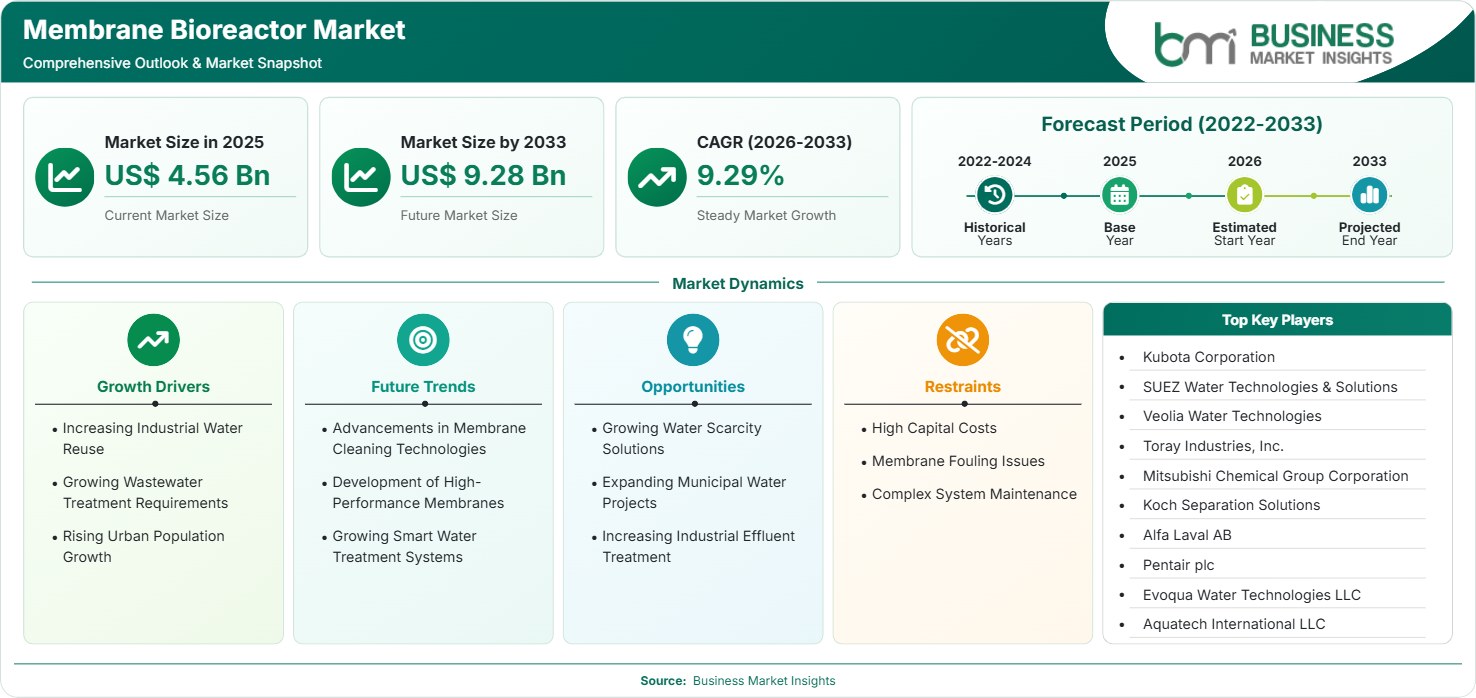
The Membrane Bioreactor Market size was valued at US$ 4.56 Billion in 2025 and is projected to reach US$ 9.28 Billion by 2033, growing at a CAGR of 9.29% during 2026–2033, driven by increasing wastewater treatment requirements, industrial water reuse adoption, urbanization, and advanced filtration technologies. Rising water scarcity solutions, expanding municipal projects, and stricter environmental standards are creating investment opportunities for membrane-based treatment systems.

Report Coverage
  • Membrane Type: Hollow Fiber Membranes, Flat Sheet Membranes, Multi-Tubular/Capillary Membranes
  • System Configuration: Submerged MBR Systems, Side-Stream MBR Systems
  • End-Use: Municipal Wastewater Treatment, Industrial Wastewater Treatment
US$ 4.56 Bn Market size in 2025
US$ 9.28 Bn Market Size by 2033
9.29% CAGR, 2026 - 2033
2026-2033 Forecast Period

AI Overview

Membrane Bioreactor Market Summary

  • North America Region: North America holds a 28%–32% share in 2025, growing with a CAGR of 8.5%–9.5% during 2026–2033, supported by wastewater regulations, industrial reuse initiatives, and infrastructure modernization. The US market analysis indicates steady adoption with a CAGR of 8.8%–9.4% driven by municipal upgrades and advanced treatment demand.
  • Fastest Growing Region: Asia Pacific accounts for a 34%–38% share in 2025, expanding at a CAGR of 10.5%–11.5% during 2026–2033, supported by rapid urban development, industrial wastewater management, water security investments, and government-led sanitation programs.
  • Leading Segment: Municipal Wastewater Treatment represents a 55%–60% share in 2025, growing at a CAGR of 9.0%–10.0% during 2026–2033, supported by population growth, wastewater infrastructure expansion, regulatory compliance, and demand for compact treatment facilities.
  • High Growth Segment: Industrial Wastewater Treatment is estimated to hold a 40%–45% share in 2025, expanding at a CAGR of 9.8%–10.8% during 2026–2033, driven by industrial water recycling, discharge regulations, resource efficiency, and process optimization requirements.
  • Key Market Opportunity: Advanced membrane technologies, decentralized treatment systems, and digital monitoring platforms are creating opportunities through improved efficiency, reduced operating costs, and increased adoption across municipal, industrial, and commercial wastewater applications.
  • Major Market Players: Kubota Corporation, SUEZ Water Technologies & Solutions, Veolia Water Technologies, Toray Industries, Inc., Mitsubishi Chemical Group Corporation, Koch Separation Solutions, Alfa Laval AB, Pentair plc, Evoqua Water Technologies LLC, Aquatech International LLC.
Strategic Insights

Membrane Bioreactor Market: Strategic Insights

Membrane Bioreactor Market Strategic Framework
FREE PDF
Request your free sample
Request free sample
Stakeholder View

Key Takeaways

  • The value chain includes membrane manufacturers, system integrators, engineering firms, wastewater operators, and technology providers, creating opportunities for partnerships focused on customized treatment solutions and lifecycle service models.
  • Municipal wastewater facilities represent a major adoption area, while industrial applications provide additional upside through pharmaceutical, food processing, chemical, and manufacturing sectors requiring advanced water purification capabilities.
  • Innovation is shifting toward low-energy membranes, anti-fouling coatings, hybrid treatment configurations, and artificial intelligence-based monitoring platforms that improve operational reliability and reduce maintenance requirements.
  • Asia Pacific presents a strong investment opportunity due to expanding urban infrastructure, rising water stress, and government-backed wastewater management programs across China, India, Japan, and Southeast Asian economies.
  • Strategic collaborations, technology acquisitions, and expansion of engineering capabilities are shaping competitive positioning as companies seek broader geographic presence and advanced membrane treatment portfolios.
  • Decentralized wastewater treatment systems are gaining attention because they enable flexible deployment in remote communities, industrial parks, and regions where centralized infrastructure development remains limited.
Geographic Outlook

Membrane Bioreactor Market Regional Highlights

North America Membrane Bioreactor Market

North America accounted for a 28%–32% share in 2025 and is projected to expand at a CAGR of 8.5%–9.5% during 2026–2033. The region benefits from advanced wastewater infrastructure, stringent environmental regulations, and increasing industrial recycling initiatives. The market share in North America is supported by municipal modernization projects and demand for high-quality water treatment solutions across industrial sectors.

  • The United States and Canada are adopting advanced wastewater technologies due to stricter discharge standards and growing investments in water reuse infrastructure, supporting long-term treatment capacity expansion.
  • Municipal utilities are integrating compact membrane systems to upgrade aging facilities, improve effluent quality, and meet sustainability objectives without requiring extensive land availability.
  • Industrial sectors including pharmaceuticals, food processing, and chemicals are increasing adoption of membrane solutions to achieve compliance and optimize water consumption.
  • Technology providers are focusing on energy-efficient membranes and automated monitoring systems to improve operational performance and reduce lifecycle expenses.

US Membrane Bioreactor Market

The US market represented a 22%–26% share in 2025 within North America and is expected to grow at a CAGR of 8.8%–9.4% during 2026–2033. The country’s adoption is supported by wastewater infrastructure upgrades, industrial sustainability programs, and increasing emphasis on water conservation. The Membrane Bioreactor Market share in the US reflects strong demand from municipalities and industries requiring advanced treatment capabilities.

  • Federal and state-level water quality initiatives are encouraging utilities to replace conventional treatment systems with efficient membrane-based alternatives.
  • Industrial users are implementing advanced wastewater treatment systems to reduce freshwater dependency and improve environmental compliance.
  • Growing investments in decentralized treatment facilities are supporting adoption in smaller communities and industrial clusters requiring flexible solutions.
  • Research activities around low-energy membrane materials are improving system efficiency and encouraging wider commercial deployment.

Europe Membrane Bioreactor Market

Europe held a 25%–29% share in 2025 and is anticipated to register a CAGR of 8.7%–9.7% through 2026–2033. Adoption is driven by circular water management policies, wastewater reuse initiatives, and strict environmental frameworks. Countries including Germany, France, the United Kingdom, and Italy are expanding advanced treatment infrastructure. The market share in Europe reflects strong regulatory support and sustainability-focused investments.

  • Germany is increasing adoption of advanced wastewater solutions through industrial water recycling projects and modernization of municipal treatment plants.
  • France is promoting resource-efficient wastewater management through technology upgrades and environmental compliance programs across urban facilities.
  • The United Kingdom is investing in resilient water infrastructure, supporting membrane treatment deployment for improved quality management.
  • European technology developers are advancing membrane materials designed to reduce energy usage and operational complexity.
  • Industrial users are adopting membrane systems to support sustainability targets and reduce environmental impact from wastewater discharge.

Asia Pacific Membrane Bioreactor Market

Asia Pacific accounted for a 34%–38% share in 2025 and is projected to grow at a CAGR of 10.5%–11.5% during 2026–2033. Rapid urbanization, industrial expansion, and water scarcity concerns are accelerating adoption. China, India, Japan, and South Korea represent key markets due to wastewater infrastructure investments. The Membrane Bioreactor Market growth in Asia Pacific is supported by government sanitation programs and industrial treatment requirements.

  • China is expanding wastewater treatment capacity through urban environmental initiatives and industrial pollution control measures.
  • India is increasing investments in municipal sanitation infrastructure and industrial wastewater reuse programs to address growing water demand.
  • Japan and South Korea are focusing on advanced treatment technologies due to limited water resources and strong environmental standards.
  • Southeast Asian economies are adopting modular treatment systems for industrial zones and rapidly developing urban areas.
  • Regional manufacturers are improving cost competitiveness through localized production and membrane technology development.

Rest of World Membrane Bioreactor Market

Latin America, Middle East, and Africa accounted for a 10%–14% share in 2025 and are expected to expand at a CAGR of 8.0%–9.0% between 2026–2033. South America is adopting advanced treatment systems due to urban growth and water availability challenges, while Middle Eastern countries are investing in water reuse technologies. The Membrane Bioreactor Market share in these regions is influenced by sustainability programs and infrastructure development.

  • Brazil and Mexico are increasing wastewater treatment investments to support urban expansion and improve environmental management practices.
  • Middle Eastern countries are adopting membrane systems as part of water security strategies and non-traditional water resource development.
  • African nations are exploring decentralized wastewater treatment solutions to improve sanitation access and manage limited water resources.
  • Public-private partnerships are supporting infrastructure financing and accelerating deployment of advanced treatment technologies.
  • Industrial projects in mining, energy, and manufacturing sectors are creating additional demand for reliable wastewater management systems.
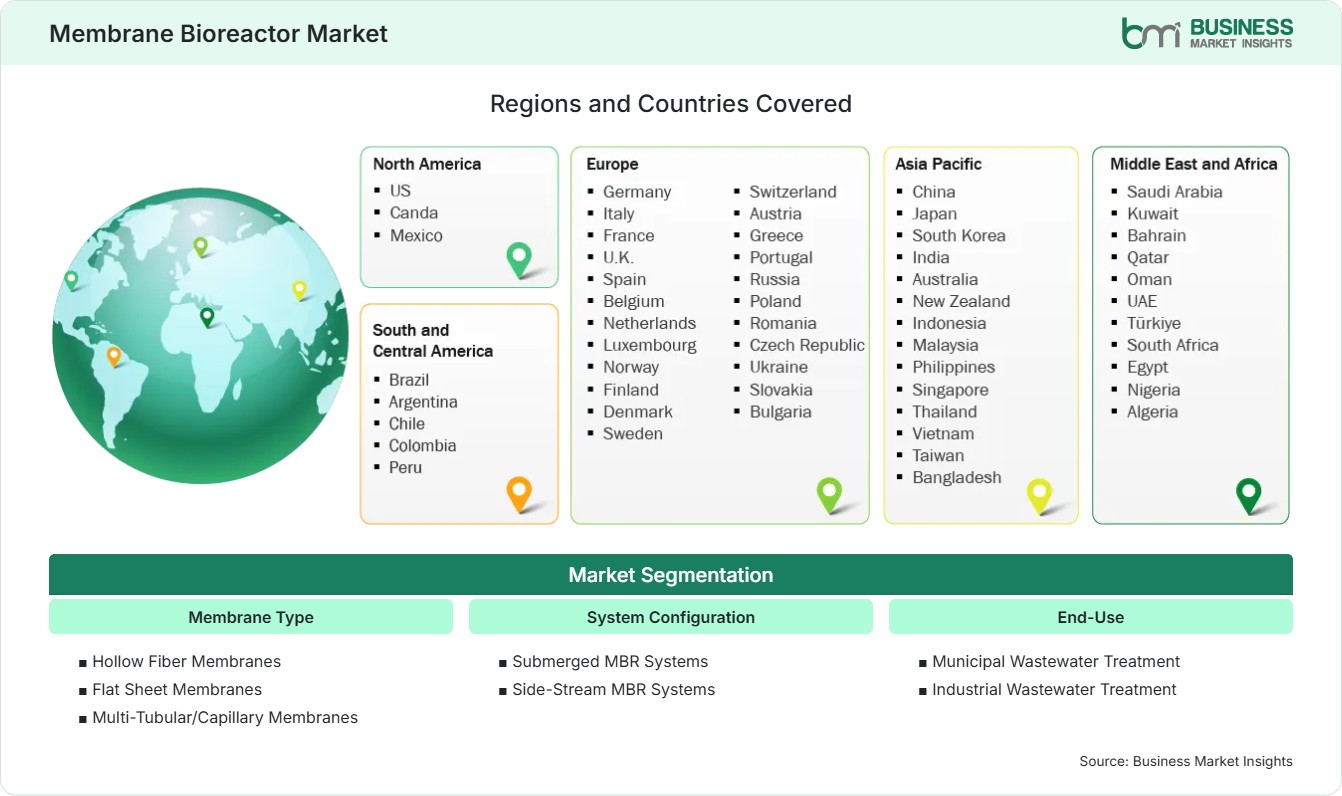
Global Market Geography
FREE PDF
Request your free sample
Request free sample
Segment Analysis

Membrane Bioreactor Market Segmentation

Membrane Type

Membrane Type represents a critical technology category, accounting for a 45%–50% share in 2025 and expanding at a CAGR of 9.0%–10.0% between 2026–2033. The Membrane Bioreactor Market scope within this segment is shaped by material innovation, improved filtration efficiency, and demand for durable membranes supporting municipal and industrial wastewater applications.

  • Hollow Fiber Membranes: These membranes offer high surface area efficiency, compact designs, and flexible installation options, making them widely adopted in municipal and industrial treatment facilities requiring reliable filtration performance.
  • Flat Sheet Membranes: Flat sheet technologies provide strong mechanical stability, reduced fouling risks, and simplified maintenance advantages, supporting adoption in applications requiring consistent wastewater treatment quality.
  • Multi-Tubular/Capillary Membranes: These configurations support high-flow treatment requirements and demanding industrial applications through robust designs, improved resistance, and efficient operation under challenging wastewater conditions.

System Configuration

System Configuration accounted for a 35%–40% share in 2025 and is projected to grow at a CAGR of 9.2%–10.2% during 2026–2033. The segment benefits from increasing demand for optimized wastewater treatment layouts, reduced footprint requirements, and operational flexibility. The Membrane Bioreactor Market trends within system configurations indicate rising preference for efficient submerged systems.

  • Submerged MBR Systems: These systems integrate membranes directly into biological reactors, reducing energy requirements and supporting compact installations across municipal and industrial wastewater treatment facilities.
  • Side-Stream MBR Systems: Side-stream configurations provide enhanced process control and operational flexibility, making them suitable for high-strength industrial wastewater applications requiring advanced separation performance.

End-Use

End-Use represented a significant portion of adoption, accounting for a 60%–65% share in 2025 and growing at a CAGR of 9.1%–10.1% during 2026–2033. Increasing water stress, regulatory requirements, and sustainability commitments are strengthening demand across end-use industries. The market is witnessing broader deployment as organizations prioritize efficient wastewater management strategies.

  • Municipal Wastewater Treatment: Municipal facilities are adopting membrane systems to improve effluent quality, expand treatment capacity, and support water reuse initiatives in growing urban regions.
  • Industrial Wastewater Treatment: Industries are deploying advanced membrane solutions to manage complex wastewater streams, meet discharge regulations, and improve operational efficiency through resource recovery practices.
Market Forces

Membrane Bioreactor Market Dynamics

Key Market Drivers

Increasing Industrial Water Reuse

Increasing industrial water reuse is becoming a major driver as manufacturers seek to reduce freshwater dependency and improve resource efficiency. Various industries such as the pharmaceuticals industry, chemical industry, food processing industry, and electronics industry are utilizing more advanced treatment plants to recycle process water. Membrane Bioreactor Market growth is driven by sustainable practices of companies as well as regulations that prevent the discharge of wastewater. As per various water management projects around the world, there has been a rise in adoption of closed water systems by industrial organizations to make efficient use of water.

Growing Wastewater Treatment Requirements

Increasing demands for wastewater treatment are driving the adoption of membrane bioreactors owing to increased pressure on cities and industries to treat their wastewater. The rapid growth of urban areas, increased discharge standards, and environmental consciousness are driving the investment in modern wastewater treatment technology. Membrane bioreactors offer better contamination elimination when compared to other wastewater treatment technologies and are therefore fit for high-purity effluent applications. The Membrane Bioreactor Market is being driven by the need for small-scale equipment that can cope with high capacity wastewater management needs. Increasing challenges in wastewater management have led to development of equipment that is more durable, energy efficient, and maintenance-free.

Rising Urban Population Growth

Growth in the urban population is raising demand for wastewater management technology in highly populated areas. Urban areas need solutions that offer high performance while consuming little land space. Urban areas are developing their infrastructure to manage the need for sanitation and water protection. The United Nations has emphasized the ongoing trend of urbanization in the world, putting pressure on urban water management systems. Membrane technologies assist in urban growth through decentralization and centralization of wastewater treatment. High population density, lack of available land space, and sustainability goals are promoting the use of membrane technologies in urban areas.

Key Market Opportunities

Growing Water Scarcity Solutions

Growing water scarcity solutions are creating opportunities for advanced wastewater treatment technologies that enable water recovery and reuse. Regions facing freshwater limitations are investing in treatment infrastructure capable of producing high-quality reclaimed water. Membrane bioreactors provide a sustainable option in water management through biological processes and high-tech filtration. Membrane Bioreactor Market Forecasts show growing investment potential in water-scarce areas where government bodies and businesses are emphasizing the need for conserving resources. Manufacturers are concentrating on enhancing energy consumption, lessening maintenance needs, and widening the usage areas outside conventional wastewater plants. These innovations are presenting possibilities for tailor-made solutions that meet the demands of municipal and industrial parks as well as commercial complexes.

Expanding Municipal Water Projects

Developing municipal water projects has created many opportunities as funding from the government for the improvement of sanitation and modernization of wastewater infrastructure is being increased. Municipal growth means that the treatment plants need to be able to treat water in accordance with the rising demand along with adhering to environmental laws. Membrane systems bring benefits through small size, high quality of the treated water and the flexibility in terms of treating various volumes. Public-private partnership projects are helping developing countries in infrastructure development for further expansion of their wastewater treatment facilities. Technology providers take advantage of these opportunities offering flexible and convenient modular solutions.

Increasing Industrial Effluent Treatment

The increased need for effluent treatment from industrial sectors is creating new possibilities for sectors with complicated wastewater treatment streams. The industrial sectors including chemical industries, pharmaceutical industries, textile industries, and food processing industries need innovative treatment solutions that can help to address the issues related to contaminants as well as discharge requirements. The membrane bioreactor technology can offer efficient treatment performance along with water recovery. The digital monitoring technologies have improved the operation capabilities of industries to enhance treatment performance.

Market Restraints and Challenges

High Capital Costs

Factor: High capital costs associated with membrane bioreactor installation can limit adoption among smaller municipalities and industrial operators. Impact: Significant upfront investment requirements may delay project implementation, particularly in cost-sensitive markets. Advanced membrane materials, specialized equipment, and engineering requirements contribute to overall system expenses. Although lifecycle benefits can offset initial costs, budget constraints remain a challenge for organizations evaluating wastewater technology upgrades. Financial planning, government incentives, and innovative financing models are becoming important mechanisms to improve accessibility. Technology providers are focusing on cost optimization through modular designs and improved manufacturing processes to address affordability concerns and expand adoption across diverse application segments.

Membrane Fouling Issues

Factor: Membrane fouling caused by accumulated biological materials and contaminants can reduce filtration efficiency and increase maintenance requirements. Impact: Operational disruptions and higher cleaning expenses may affect system performance and long-term economic viability. Fouling management remains a technical challenge requiring improved membrane materials, optimized operating conditions, and advanced monitoring approaches. Manufacturers are investing in anti-fouling coatings, automated cleaning technologies, and process optimization techniques to enhance reliability. Effective fouling control strategies are essential for maintaining consistent treatment performance, reducing downtime, and improving customer confidence in membrane-based wastewater treatment systems.

Company Analysis

Competitive Landscape

The competitive landscape reflects continuous innovation in membrane materials, wastewater treatment solutions, and integrated water management technologies. The Membrane Bioreactor Market analysis indicates that leading companies are focusing on advanced filtration systems, digital monitoring capabilities, energy-efficient designs, and strategic partnerships to strengthen their positions across municipal and industrial applications.

Company Name

Overview

Products and Services relevant to this market

Kubota Corporation

Kubota Corporation is a Japanese technology company providing environmental engineering solutions with strong expertise in wastewater treatment systems.

Offers submerged membrane bioreactor systems, membrane modules, and wastewater treatment technologies for municipal and industrial applications.

SUEZ Water Technologies & Solutions

SUEZ Water Technologies & Solutions provides integrated water treatment technologies and services for industrial and municipal customers globally.

Supplies ZeeWeed membrane bioreactor technologies, filtration systems, and advanced wastewater treatment solutions.

Veolia Water Technologies

Veolia Water Technologies develops sustainable water treatment solutions supporting industrial and municipal water management requirements worldwide.

Provides membrane bioreactor systems, wastewater treatment plants, and integrated water reuse technologies.

Toray Industries, Inc.

Toray Industries, Inc. is a materials technology company specializing in advanced polymers, filtration membranes, and environmental solutions.

Manufactures membrane technologies including hollow fiber solutions used in wastewater treatment and purification systems.

Mitsubishi Chemical Group Corporation

Mitsubishi Chemical Group Corporation develops chemical materials and separation technologies for environmental and industrial applications.

Provides membrane materials, filtration products, and advanced separation solutions supporting wastewater treatment operations.

Koch Separation Solutions

Koch Separation Solutions specializes in membrane filtration and separation technologies for industrial processing applications.

Offers membrane bioreactor solutions, filtration equipment, and wastewater treatment technologies for diverse industries.

Alfa Laval AB

Alfa Laval AB provides engineering solutions focused on heat transfer, separation, and fluid handling technologies.

Supplies wastewater treatment equipment, membrane filtration systems, and process optimization solutions for industrial users.

Pentair plc

Pentair plc delivers water treatment and sustainability solutions across residential, commercial, and industrial applications.

Provides water purification technologies, filtration systems, and wastewater management solutions supporting treatment efficiency.

Evoqua Water Technologies LLC

Evoqua Water Technologies LLC specializes in water treatment technologies serving industrial and municipal customers.

Offers membrane filtration systems, wastewater treatment solutions, and service support for water management facilities.

Aquatech International LLC

Aquatech International LLC provides advanced water purification and wastewater treatment technologies for industrial sectors.

Develops membrane-based treatment systems, water reuse solutions, and integrated wastewater management technologies.

Trust & Transparency

Research Methodology

The market analysis combines proprietary research with secondary data from government agencies, company disclosures, regulatory filings, industry databases and expert interviews. Market estimates are validated through data triangulation, cross-market benchmarking and analyst review.

View Full Research Methodology

Questions Answered

Frequently Asked Questions

How can stakeholders use the Membrane Bioreactor Market Report for strategic planning?

The report provides insights into technology developments, competitive positioning, application trends, regional opportunities, and investment priorities, helping stakeholders evaluate expansion strategies and identify emerging growth areas within wastewater treatment markets.

What industries are creating new demand for membrane bioreactor solutions?

Pharmaceutical, food processing, chemical, electronics, and manufacturing industries are increasing adoption due to complex wastewater streams, environmental compliance requirements, and growing emphasis on water conservation practices.

How does digitalization influence membrane bioreactor operations?

Digital monitoring, automated controls, and predictive maintenance technologies improve operational visibility, reduce downtime, and optimize energy consumption. These capabilities help operators maintain consistent treatment performance while improving lifecycle management.

What advantages do membrane bioreactor technologies provide compared with conventional treatment methods?

These systems deliver higher-quality treated water, require smaller installation footprints, and support efficient contaminant removal. Their ability to integrate biological treatment with membrane filtration makes them suitable for applications requiring strict water quality standards.

What factors are increasing adoption of membrane bioreactor systems?

Growing water scarcity, stricter wastewater discharge regulations, industrial reuse initiatives, and demand for compact treatment infrastructure are encouraging municipalities and industries to deploy advanced membrane-based wastewater treatment solutions.

Access the Full Membrane Bioreactor Market Report

Get segment-level forecasts, regional estimates, competitive benchmarking, company profiles and downloadable Excel datasets.

Access the full Membrane Bioreactor Market Report
350 pages PDF & Excel | 2026-08-07
Similar Research

Related Market Reports