Market Summary
Executive Summary and Global Market Analysis
Liquid applied membranes are fluid waterproofing materials that cure into seamless protective layers across roofs, walls, foundations, and other exposed construction surfaces. They are formulated to resist moisture ingress while adapting to irregular geometries, substrate movement, and detailing complexity that often challenge sheet-based systems. Their use spans new construction and refurbishment where durable surface continuity is central to asset protection.
Adoption is advancing as construction stakeholders seek waterproofing systems that simplify installation while improving long-term substrate defense. Project teams increasingly favor liquid-applied formats for their ability to cover penetrations, joints, and uneven surfaces without introducing seam-related vulnerabilities. This preference is reinforced in refurbishment settings, where overlay compatibility and reduced application disruption support efficient building renewal.
Segmentation indicates broad relevance across product chemistries, end-use settings, and waterproofing requirements. Cementitious membranes align with mineral substrates and below-grade use, while bituminous and elastomeric variants address demanding exposure conditions and movement tolerance. Applications extend from roofing and walls to tunnels, landfills, and underground construction, showing how performance expectations differ by installation environment and service conditions.
Technology development is refining curing behavior, crack-bridging performance, adhesion reliability, and formulation sustainability. Manufacturers are improving application properties for faster project execution while also addressing environmental compliance through lower-emission systems and more specialized chemistries. These shifts are widening suitability across residential, commercial, industrial, and public infrastructure projects with distinct exposure and maintenance profiles.
Competitive conditions are defined by formulation performance, substrate compatibility, installer confidence, and the ability to serve varied construction scenarios with consistent results. Suppliers compete through product breadth, technical support, and application-specific positioning rather than through volume presence alone. As specification standards become more exacting, the market increasingly rewards participants that combine material expertise with dependable project execution support.
Segment Analysis
Liquid Applied Membrane Market Segmentation
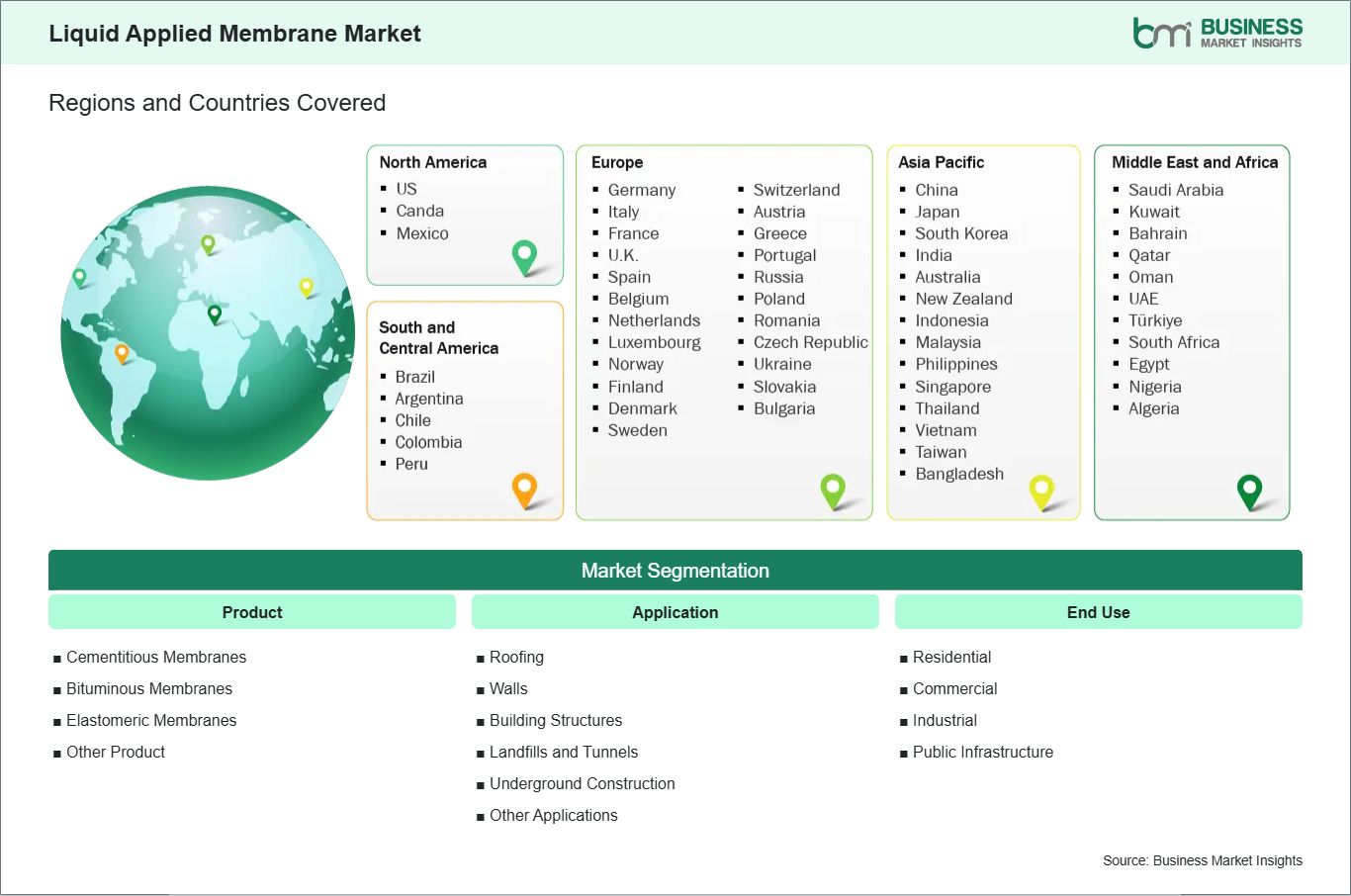
The market is structured by product, application, and end use, reflecting distinct material behavior and project-specific waterproofing requirements.
By Product
- Cementitious Membranes: Suitable for concrete-based areas needing durable moisture shielding.
- Bituminous Membranes: Selected for robust waterproofing across exposed and below-grade surfaces.
- Elastomeric Membranes: Favored where substrate movement demands flexible continuous protection.
- Other Product Type: Covers specialized formulations designed for niche construction needs.
By Application
- Roofing: Remains central for seamless coverage across exposed horizontal surfaces.
- Walls: Supports exterior envelope protection against persistent moisture penetration.
- Building Structures: Protects critical structural components from long-term water exposure.
- Landfills and Tunnels: Addresses containment and underground sealing requirements.
- Underground Construction: Performs in subgrade settings where seepage control is essential.
- Other Application: Includes specialized waterproofing uses across complex project types.
By End Use
- Residential: Gains traction in housing projects requiring practical waterproofing reliability.
- Commercial: Benefits from efficient installation across complex building envelopes.
- Industrial: Requires resilient performance under demanding operational conditions.
- Public Infrastructure: Aligns with long-service waterproofing needs in civil assets.
Market Forces
Liquid Applied Membrane Market Drivers and Opportunities
Greater Preference for Seamless Waterproofing in Complex Construction Assemblies
Modern construction envelopes include penetrations, junctions, curves, and irregular surfaces that challenge conventional waterproofing formats. This complexity creates a stronger need for coatings that conform directly to varied substrate shapes while maintaining continuous coverage. Liquid applied membranes answer that need through brush, roller, or spray application methods that adapt well to detailing-intensive areas, making them attractive for contractors focused on practical site execution.
The result is broader relevance across roofing, walls, structural sections, and underground works where water ingress can undermine service life. In refurbishment projects, the same attributes support targeted renewal without extensive material removal. This practical fit makes the driver especially relevant in markets where asset preservation, installation efficiency, and reliable sealing performance shape specification decisions across both private and public construction programs.
Innovation in Sustainable and Performance-Tuned Membrane Formulations
An important opportunity is emerging from formulation advances that improve curing speed, elasticity, adhesion, and environmental compatibility in a single system. These innovations are expanding use cases in roofs, basements, tunnels, and civic assets where application efficiency and long-service protection must coexist. They also support project teams seeking materials that align with stricter specification standards while accommodating diverse substrate and exposure conditions.
Future scope extends across renovation-led construction cycles, infrastructure rehabilitation, and higher-performance building envelopes that require tailored moisture control strategies. Suppliers that expand portfolios with specialized chemistries can address broader project categories without relying on uniform product positioning. This creates room for market expansion through differentiated offerings that improve durability, simplify application, and strengthen long-term waterproofing confidence across multiple end-use environments.
Size and Share Analysis
Liquid Applied Membrane Market Size and Share Analysis
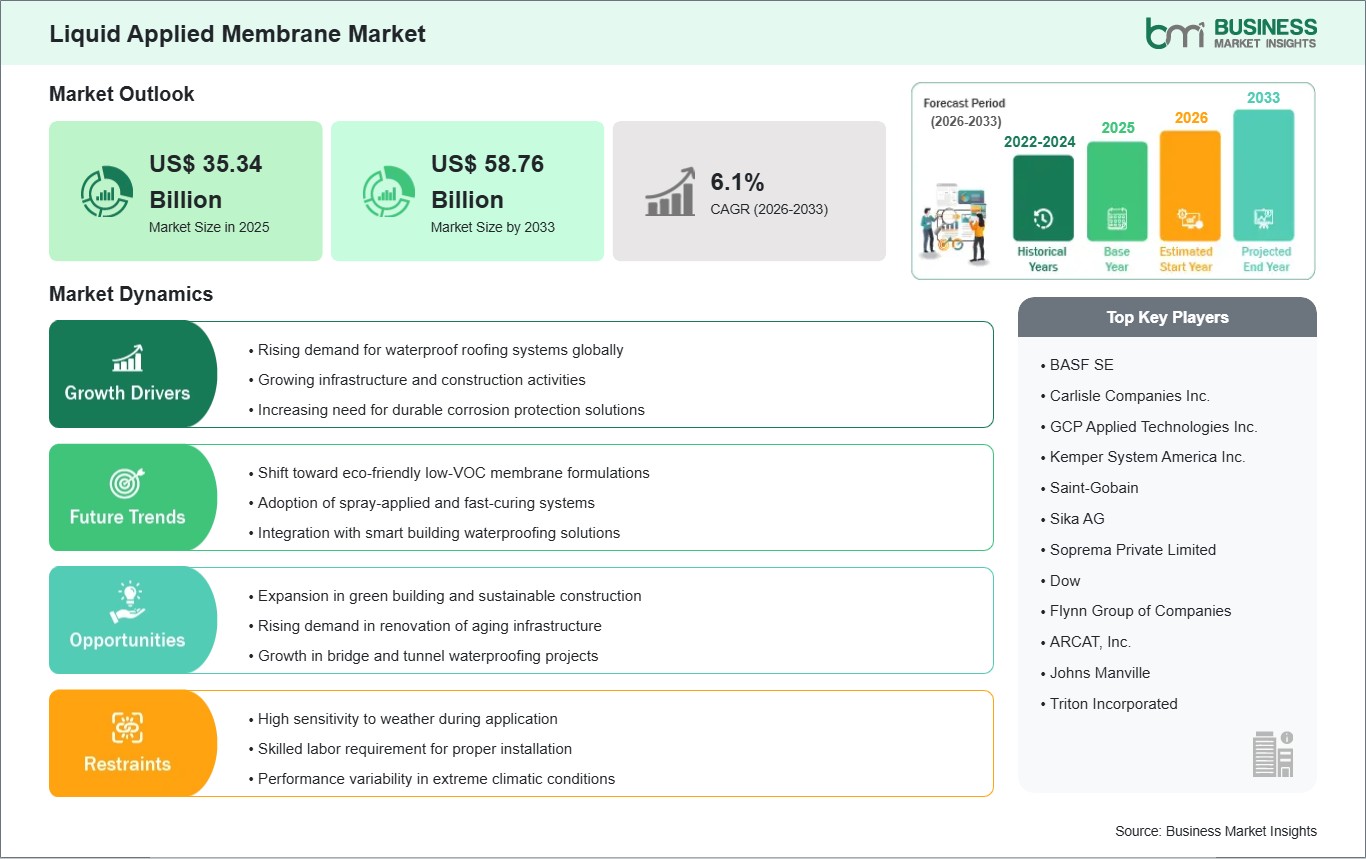
The Liquid Applied Membrane market size is projected to grow from US$ 35.34 Billion in 2025 to US$ 58.76 Billion by 2033, registering a CAGR of 6.1% during 2026 - 2033. This progression reflects a sector benefiting from broader use of seamless waterproofing systems in construction environments where durability, adaptability, and maintenance efficiency increasingly influence material selection.
Among product segments, elastomeric membranes hold a strong position because they combine flexibility with dependable coverage across surfaces exposed to movement and weathering. Bituminous membranes remain relevant in demanding protection scenarios, while cementitious products retain importance in substrate-specific applications. This segment structure shows how material choice is closely tied to installation context, exposure profile, and performance durability over time.
By application, roofing commands substantial attention because exposed surfaces require continuous waterproofing performance across large coverage areas and complex detailing points. Building structures and underground construction also represent notable demand centers where moisture protection directly affects asset longevity. The application mix illustrates how the market serves both visible envelope systems and concealed structural zones with different technical expectations.
Report Coverage
Liquid Applied Membrane Market Report Coverage and Deliverables
The "Lipid Applied Membrane Market Size and Forecast (2022–2033)" report provides a detailed analysis of the market covering below areas:
- Market size and forecast at global, regional, and country levels for all the key market segments covered under the scope
- Market trends, as well as market dynamics such as drivers, restraints, and key opportunities
- Market analysis covering key market trends, global and regional framework, major players, regulations, and recent market developments
- Industry landscape and competition analysis covering market concentration, heat map analysis, prominent players, and recent developments for the market
- Detailed company profiles, including SWOT analysis
Geographic Insights
Liquid Applied Membrane Market Geographic Insights
The Liquid Applied Membrane market shows diverse regional adoption patterns influenced by construction methods, refurbishment cycles, climate exposure, and waterproofing specification practices. Across the global landscape, demand is shaped by the need for seamless moisture barriers that can accommodate complex surfaces and variable substrate conditions. This creates a market environment where formulation versatility and installation practicality matter across both mature and developing construction economies.
North America benefits from active reroofing activity, commercial asset maintenance, and heightened attention to long-term building envelope performance. Buyers in this region often value systems that support reliable application over existing substrates while reducing seam-related failure points. Product selection also reflects the importance of contractor familiarity, compliance expectations, and lifecycle-oriented investment decisions in both residential and commercial waterproofing programs.
Asia Pacific continues to broaden its role through urban expansion, transport-linked construction, industrial development, and large-scale residential activity. The region presents favorable conditions for liquid applied systems because diverse project types frequently require adaptable waterproofing across roofs, basements, walls, and structural zones. Procurement patterns often balance cost sensitivity with the need for dependable performance, encouraging wider use of formulations suited to varied site conditions.
Europe maintains relevance through renovation-focused construction, stricter material expectations, and sustained attention to building resilience. Emerging markets across the Middle East and Africa and South and Central America are also creating opportunities as infrastructure development and urban projects raise the need for durable waterproofing solutions. Across these regions, suppliers gain traction when they align product chemistry with local climate demands, substrate realities, and evolving construction practices.
Industry Activity
Recent Developments
The Liquid Applied Membrane market is evaluated by gathering qualitative and quantitative data post primary and secondary research, which includes important corporate publications, association data, and databases. A few of the key developments in the Liquid Applied Membrane marketare.
- In February 2026, Dencoat India announced the launch of a new advanced waterproofing membrane designed for the Indian construction market. The product aims to improve building protection against water seepage and leakage issues commonly faced in residential and commercial structures, especially during heavy monsoon conditions. The launch strengthens the company’s presence in the fast-growing waterproofing and construction chemicals segment by offering improved durability, ease of application, and enhanced resistance to weathering and moisture-related damage.
- In February 2025, Sika Corporation launched the SikaShield® brand and introduced an innovative hybrid modified bitumen waterproofing membrane in the U.S. market. The new system combines APP and SBS polymer technologies to deliver improved durability, flexibility, and climate adaptability. It is designed for roofing and waterproofing applications requiring high resistance to temperature variations, heavy foot traffic, and long-term performance reliability. The launch strengthens Sika’s roofing portfolio and expands its presence in advanced waterproofing solutions across the construction sector.
Trust & Transparency
Research Methodology
The market analysis combines proprietary research with secondary data from government agencies, company disclosures, regulatory filings, industry databases and expert interviews. Market estimates are validated through data triangulation, cross-market benchmarking and analyst
review.
View Full Research Methodology
Key Sources Referred:
World Bank – Global Trade IndicatorsWorld Trade Organization (WTO)(International Monetary Fund )IMFInternational Trade Administration (ITA)Company websiteCompany annual reportsCompany investor presentations