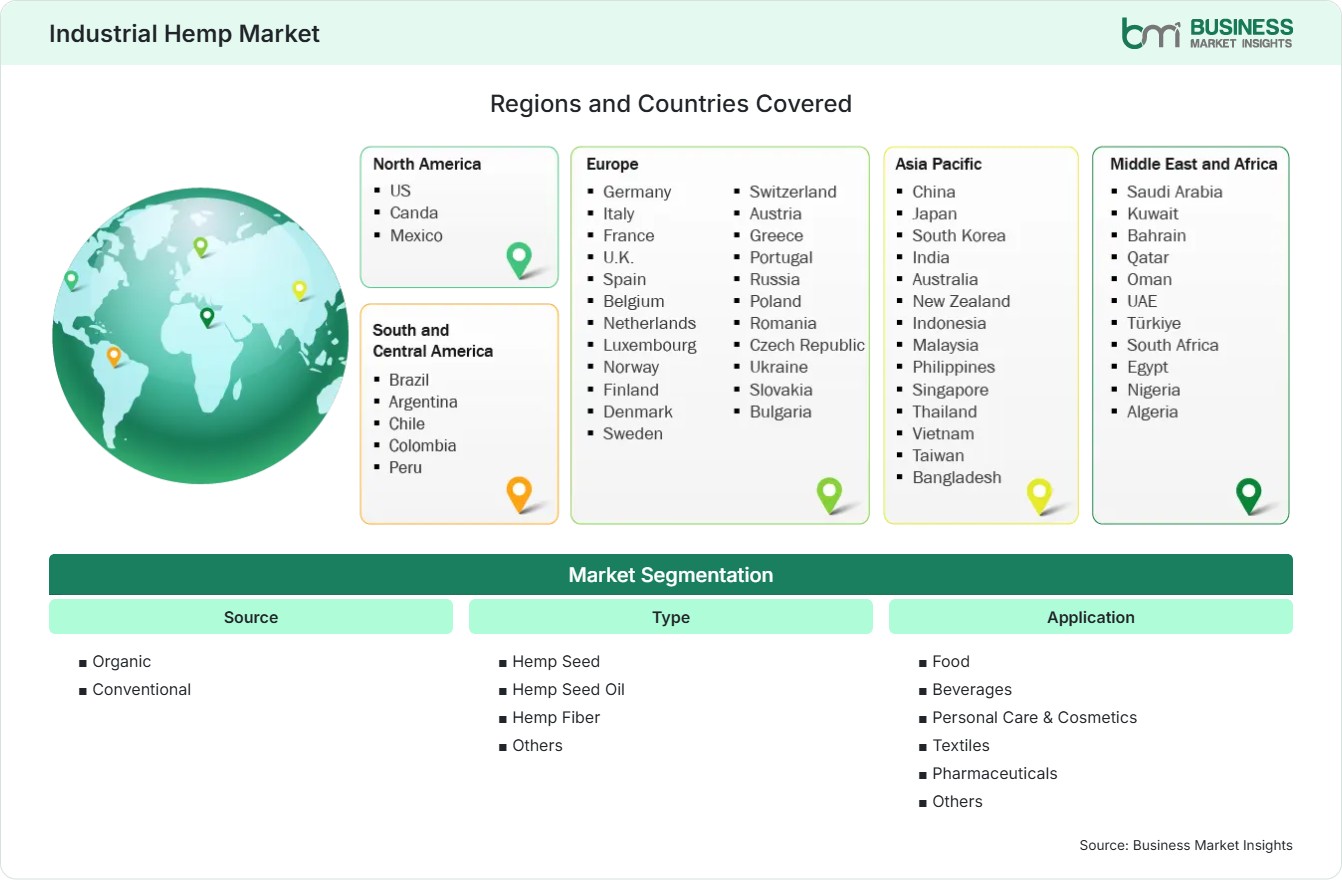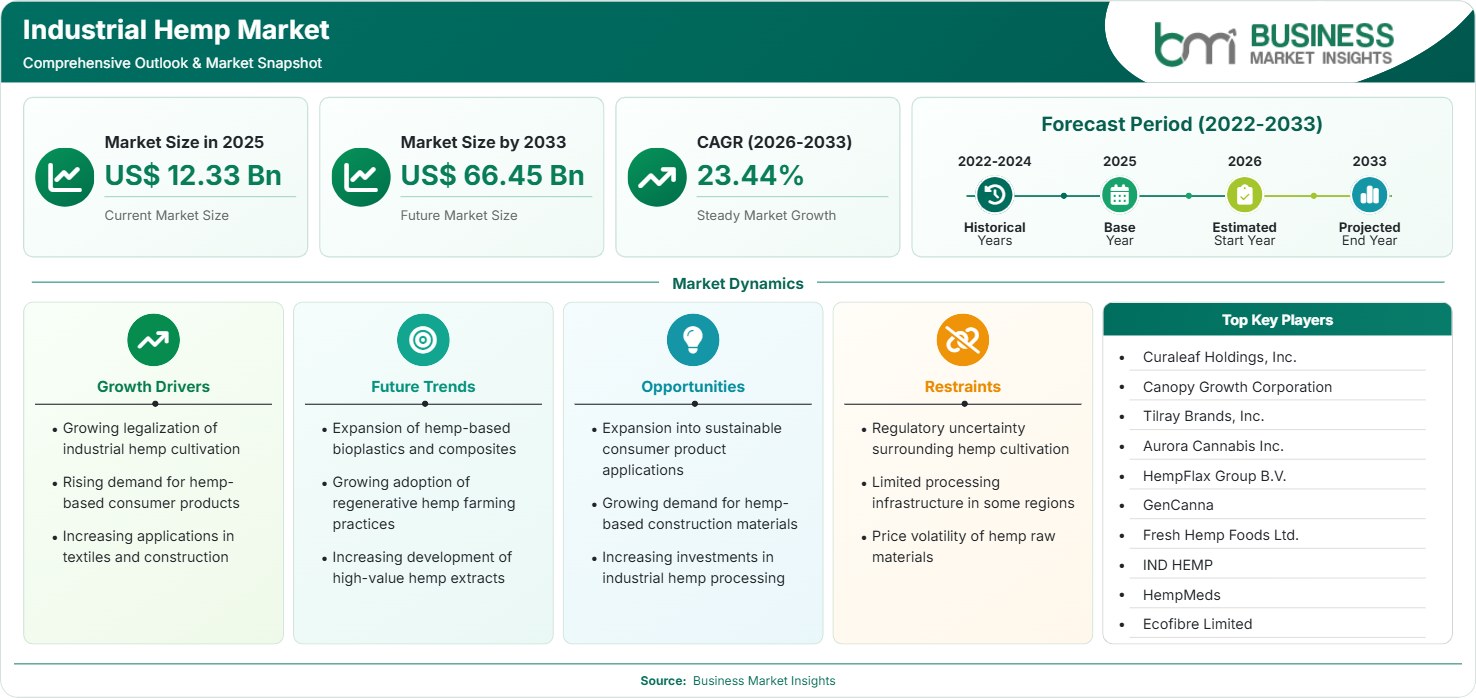
Industrial Hemp Market Regional Highlights
North America Industrial Hemp Market
North America accounted for 38%–42% share in 2025 and is projected to expand at a CAGR of 22.80%–23.60% during 2026–2033. The region maintains market leadership due to regulatory progress, established agricultural capabilities, and strong consumer demand for hemp-based products. The Industrial Hemp Market share in North America is supported by increasing cultivation, advanced processing facilities, and applications across food, wellness, textiles, and sustainable materials. The United States remains the largest contributor due to expanding commercialization, research activities, and growing investments in hemp-derived product development.
- The United States represents the leading regional market due to increasing cultivation activities, consumer adoption, and industrial hemp product commercialization.
- Canada continues supporting market growth through established hemp farming practices, export capabilities, and regulatory frameworks for hemp-based products.
- Companies are investing in processing infrastructure to improve extraction, fiber production, and value-added product manufacturing capabilities.
- Consumer demand for plant-based wellness products is encouraging broader adoption of hemp-derived ingredients across multiple industries.
US Industrial Hemp Market
The United States represented 32%–36% share within North America in 2025 and is expected to grow at a CAGR of 23.00%–23.80% between 2026–2033. The country remains a key market due to increasing cultivation licenses, expanding consumer product applications, and rising interest in sustainable materials. Food, personal care, textiles, and construction sectors are driving adoption of hemp-derived solutions. The Industrial Hemp Market analysis highlights opportunities from improved processing capacity, farmer participation, and increasing commercialization of hemp-based products across domestic industries.
- Growing consumer preference for natural ingredients is increasing demand for hemp-based food, supplements, and wellness products.
- Textile manufacturers are exploring hemp fiber as a sustainable alternative to conventional materials.
- Businesses are investing in hemp processing technologies to improve product consistency and commercial scalability.
Europe Industrial Hemp Market
Europe accounted for 26%–30% share in 2025 and is forecast to grow at a CAGR of 22.50%–23.20% from 2026–2033. France, Germany, Italy, and the Netherlands represent important markets due to established hemp cultivation traditions and demand for sustainable materials. France and Germany are among high-growth countries supported by industrial applications, textile innovation, and renewable material initiatives. European sustainability regulations and environmental targets are encouraging industries to explore hemp-based alternatives for construction, packaging, and consumer products.
- France maintains a strong position due to established hemp cultivation and fiber processing capabilities.
- Germany is expanding adoption of hemp-based materials through sustainable manufacturing and industrial innovation programs.
- Italy is increasing utilization of hemp ingredients across food, wellness, and personal care applications.
- The Netherlands supports market development through agricultural innovation and sustainable product initiatives.
Asia Pacific Industrial Hemp Market
Asia Pacific represented 22%–26% share in 2025 and is expected to grow at a CAGR of 24.00%–24.80% during 2026–2033. The region is experiencing rapid expansion due to agricultural diversification, textile manufacturing demand, and increasing sustainable material adoption. China, India, Japan, and Australia are key markets supported by industrial development and growing interest in bio-based products. The Industrial Hemp Market trends in Asia Pacific are influenced by rising processing investments, expanding end-use industries, and demand for environmentally friendly materials.
- China is increasing hemp applications through textile production, agricultural development, and industrial material utilization.
- India is exploring hemp cultivation opportunities through sustainable agriculture and emerging wellness product demand.
- Japan is adopting hemp-derived materials in specialized consumer applications and sustainable product categories.
- Australia is developing hemp farming and processing activities supported by growing market interest.
Rest of World Industrial Hemp Market
Rest of World accounted for 6%–10% share in 2025 and is projected to grow at a CAGR of 23.50%–24.20% during 2026–2033. South America and Middle East and Africa regions are gradually developing hemp industries through agricultural diversification, sustainable manufacturing initiatives, and increasing awareness of hemp applications. Brazil, Chile, South Africa, and selected Middle Eastern markets represent emerging opportunities. Growing interest in renewable materials and alternative crops is encouraging investments in cultivation and processing infrastructure.
- Brazil is exploring industrial hemp opportunities through agricultural innovation and sustainable product development initiatives.
- South American countries are evaluating hemp cultivation for textile, food, and industrial applications.
- South Africa is developing interest in hemp farming and processing as part of agricultural diversification efforts.
- Middle Eastern markets are exploring sustainable materials for construction and industrial applications.
Industrial Hemp Market: Segmentation Size and Share Analysis
Source
The source segment is divided into organic and conventional cultivation methods based on farming practices and production standards. Conventional hemp represented the larger category in 2025 due to established cultivation systems and broader availability, while organic hemp is expanding rapidly due to increasing consumer preference for sustainable and chemical-free products. The segment accounted for 28%–32% share for organic sources in 2025 and is expected to grow at a CAGR of 24.00%–24.80% during 2026–2033. Demand is increasing across premium food, wellness, and personal care applications.
- Organic: Organic hemp cultivation is gaining demand due to clean-label preferences, sustainable farming practices, and increasing adoption in premium consumer product categories.
- Conventional: Conventional hemp cultivation remains widely adopted due to established farming methods, larger production volumes, and cost advantages for industrial applications.
Type
The type segment is driven by diverse applications of hemp-derived materials across food, wellness, industrial, and manufacturing sectors. Hemp Fiber represented the leading category with 30%–34% share in 2025 and is expected to grow at a CAGR of 23.20%–24.00% during 2026–2033. Increasing demand for sustainable textiles, construction materials, and bio-based composites is supporting fiber adoption. The Industrial Hemp Market scope is expanding as manufacturers explore renewable alternatives to conventional materials across multiple industries.
- Hemp Seed: Hemp seeds are increasingly used in nutritional products due to protein content, essential fatty acids, and growing consumer interest in plant-based food ingredients.
- Hemp Seed Oil: Hemp seed oil is gaining adoption in dietary supplements, personal care products, and wellness formulations due to its nutritional and cosmetic applications.
- Hemp Fiber: Hemp fiber is expanding across textiles, construction materials, and industrial applications because of durability, sustainability benefits, and renewable material characteristics.
Application
The application segment is expanding due to increasing utilization of hemp-derived materials across consumer and industrial sectors. Food applications represented a significant category in 2025 due to rising demand for functional ingredients and dietary supplements. The segment accounted for 34%–38% share in 2025 and is projected to grow at a CAGR of 23.00%–23.70% during 2026–2033. Growing awareness regarding plant-based nutrition, sustainable products, and alternative materials is encouraging adoption across diverse applications in Industrial Hemp Market.
- Food: Food applications are increasing due to demand for hemp-based nutritional products, protein ingredients, dietary supplements, and functional food solutions.
- Dietary Supplements: Dietary supplements utilize hemp ingredients due to increasing consumer interest in plant-based wellness products and nutritional formulations.
- Functional Foods: Functional foods incorporate hemp-derived ingredients to support health-focused product development and expanding consumer demand for nutritious alternatives.
- Beverages: Hemp beverages are gaining attention due to growing demand for plant-based drinks, wellness beverages, and alternative nutritional products.
- Personal Care & Cosmetics: Personal care and cosmetic applications are expanding through demand for natural ingredients used in skincare, beauty, and wellness formulations.
- Textiles: Textile applications are increasing as manufacturers adopt hemp fiber for sustainable fabrics, durable materials, and environmentally responsible clothing production.
- Pharmaceuticals: Pharmaceutical applications are developing through research into hemp-derived compounds and increasing interest in plant-based therapeutic formulations.