
Industrial Fabrics Market Outlook: Size, Share, Trends, Growth Analysis, Competitive Landscape & Forecast, 2026-2033

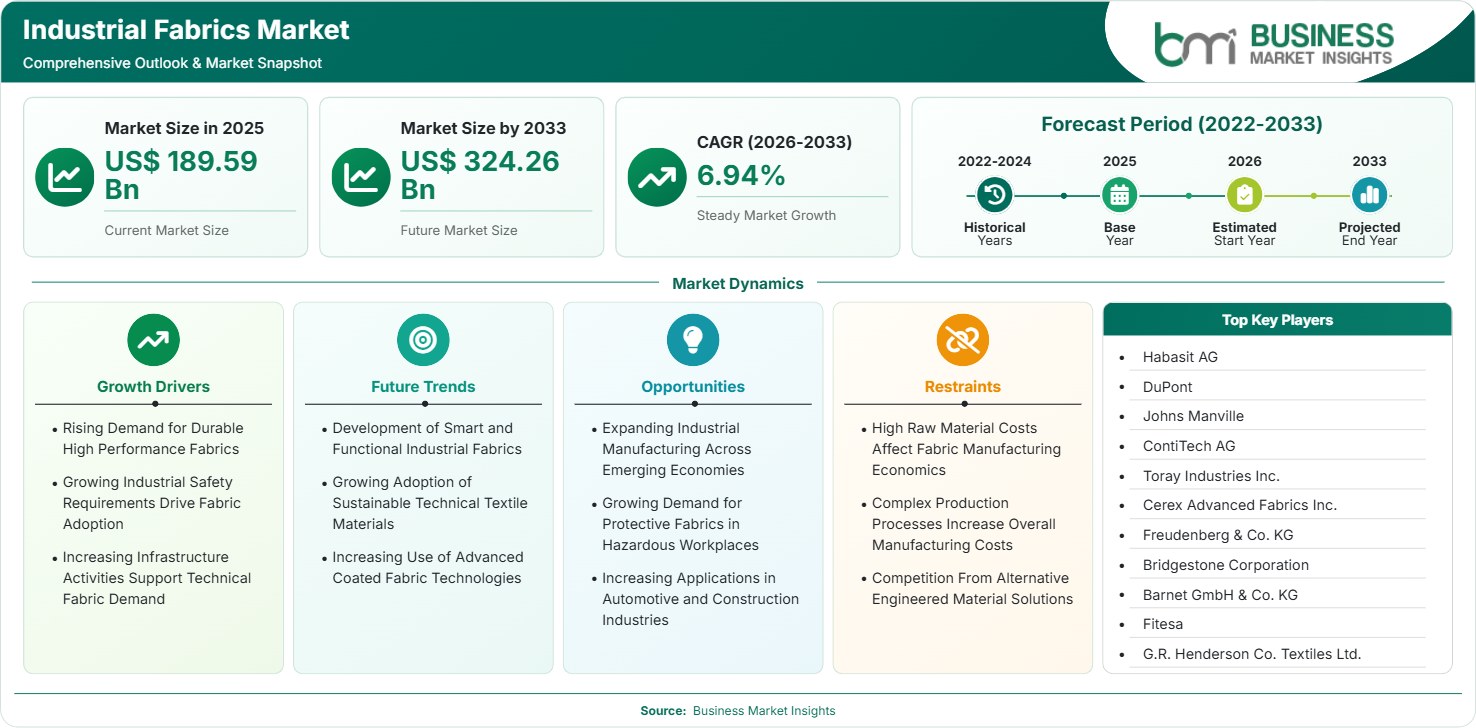
The Industrial Fabrics Market size was valued at US$ 189.59 Billion in 2025 and is projected to reach US$ 324.26 Billion by 2033, growing at a CAGR of 6.94% during 2026–2033, write some key drivers and opportunities in 30 words. Increasing demand for high-performance materials, expanding automotive applications, rising workplace safety requirements, infrastructure development, and innovation in durable fiber technologies are driving opportunities across industrial sectors.

Report Coverage
  • Fiber Type: Polyamide, Polyester, Aramid, Composites
  • Application: Conveyor Belts, Transmission Belts, Protective Apparel, Automotive, Flame Resistant Apparel
US$ 189.59 Bn Market size in 2025
US$ 324.26 Bn Market Size by 2033
6.94% CAGR, 2026 - 2033
2026-2033 Forecast Period

01 AI Overview

Industrial Fabrics Market Summary

  • North America Region: North America holds a share range of 32%–35% in 2025, expanding with a CAGR range of 6.20%–6.60% driven by advanced manufacturing, automotive production, safety regulations, and infrastructure modernization. The US market analysis indicates steady adoption with a CAGR of 6.30%–6.50% between 2026 and 2033 due to protective apparel demand, industrial automation, and transportation applications.
  • Fastest Growing Region: Asia Pacific accounts for a share range of 34%–37% in 2025, growing with a CAGR range of 7.40%–7.80% supported by textile manufacturing expansion, industrialization, automotive production, and investments in advanced materials. Increasing infrastructure spending and manufacturing capacity development create new opportunities for regional suppliers.
  • Leading Segment: Polyester fiber type maintains a share range of 38%–41% in 2025, progressing with a CAGR range of 6.50%–6.90% influenced by cost efficiency, durability, chemical resistance, and broad usage across conveyor belts, automotive components, and industrial reinforcement applications.
  • High Growth Segment: Aramid fiber type demonstrates a CAGR range of 8.00%–8.50% from 2026–2033, supported by heat resistance, lightweight strength, defense applications, and protective apparel innovation. Increasing workplace safety standards and demand for flame-resistant materials create additional growth opportunities.
  • Key Market Opportunity: Manufacturers are focusing on recyclable fibers, smart textiles, and lightweight reinforcement materials to address sustainability targets, improve performance characteristics, and capture emerging demand from transportation, safety equipment, and industrial automation sectors.
  • Major Market Players: Habasit AG, DuPont, Johns Manville, ContiTech AG, Toray Industries Inc., Cerex Advanced Fabrics Inc., Freudenberg & Co. KG, Bridgestone Corporation, Barnet GmbH & Co. KG, Fitesa, and G.R. Henderson Co. Textiles Ltd.
02 Strategic Insights

Industrial Fabrics Market: Strategic Insights

Industrial Fabrics Market Strategic Framework
FREE PDF
Request your free sample
Request free sample
03 Stakeholder View

Key Takeaways

  • The value chain is becoming increasingly integrated, with fiber manufacturers, textile processors, equipment suppliers, and end-use industries collaborating to improve material performance, production efficiency, and sustainability outcomes across industrial applications.
  • High-growth opportunities are emerging in protective apparel, automotive reinforcement materials, and advanced composite applications where lightweight construction, durability, and resistance against extreme operating conditions are becoming essential purchasing criteria.
  • Innovation is shifting toward engineered fibers, recyclable materials, and multifunctional textile structures that combine strength, thermal stability, chemical resistance, and improved lifecycle performance for demanding industrial environments.
  • Asia Pacific presents a strong investment opportunity due to expanding manufacturing hubs, infrastructure development, increasing automotive production, and rising adoption of industrial safety standards across developing economies.
  • Strategic partnerships, capacity expansions, and technology-focused acquisitions are shaping competitive dynamics as manufacturers seek stronger positions in specialty fibers, sustainable materials, and high-performance industrial textile applications.
  • Companies focusing on digital manufacturing, customized material solutions, and environmentally responsible production processes are better positioned to address evolving customer requirements across global industrial sectors.
04 Geographic Outlook

Industrial Fabrics Market Regional Highlights

North America Industrial Fabrics Market

North America represents a share range of 32%–35% in 2025, expanding at a CAGR range of 6.20%–6.60% during 2026–2033. The Industrial Fabrics Market share remains supported by strong demand from transportation, protective equipment, and industrial processing industries across the US and Canada.

  • The US market contributes major regional demand through automotive manufacturing, industrial safety equipment, and infrastructure modernization projects requiring durable textile-based reinforcement materials and specialized protective solutions.
  • Canada is witnessing increased adoption of industrial textile materials in mining, construction, and energy sectors where resistance to abrasion, extreme temperatures, and mechanical stress is essential.
  • Regional manufacturers are prioritizing sustainable fiber technologies and recycled material integration to align with environmental targets while maintaining performance standards required by industrial customers.
  • Advanced research activities in engineered fibers, composites, and smart textile solutions are supporting product differentiation and improving competitiveness among established industrial material suppliers.

US Industrial Fabrics Market

The US market holds a share range of 27%–30% within North America in 2025 and is projected to grow at a CAGR range of 6.30%–6.50% between 2026–2033. The Industrial Fabrics Market growth is influenced by investments in advanced manufacturing, replacement of conventional materials, and increasing adoption of lightweight high-performance textiles.

  • The US industrial sector increasingly adopts aramid and composite-based materials for applications requiring enhanced thermal resistance, durability, and protection against challenging operating environments.
  • Government infrastructure investments are encouraging the use of reinforced industrial textiles in transportation projects, construction applications, and heavy-duty manufacturing environments.
  • Safety regulations from occupational authorities are supporting consistent demand for flame-resistant apparel and protective industrial textile products across multiple workplace categories.
  • Automotive manufacturers are incorporating lightweight textile reinforcement solutions to improve vehicle efficiency, durability, and performance characteristics.

Europe Industrial Fabrics Market

Europe accounts for a share range of 26%–29% in 2025, growing at a CAGR range of 6.00%–6.40% during 2026–2033. Germany, France, Italy, and the UK represent important markets due to automotive manufacturing, industrial engineering capabilities, and sustainability initiatives. The region focuses on recyclable materials, advanced manufacturing processes, and high-performance fibers.

  • Germany remains a leading regional contributor due to automotive production, machinery manufacturing, and demand for technically advanced reinforcement fabrics used in industrial applications.
  • France and Italy are increasing adoption of sustainable textile solutions as manufacturers focus on reducing environmental impact while maintaining industrial performance requirements.
  • The UK market benefits from aerospace, defense, and protective equipment industries requiring specialized fabrics with superior strength and resistance characteristics.
  • European companies are investing in circular textile development and innovative fiber technologies to support sustainability goals and improve lifecycle efficiency.

Asia Pacific Industrial Fabrics Market

Asia Pacific maintains a share range of 34%–37% in 2025 and records the highest CAGR range of 7.40%–7.80% between 2026–2033. China, Japan, India, and South Korea are major contributors due to expanding manufacturing activities, automotive production, infrastructure development, and textile industry capabilities. The Industrial Fabrics Market trends indicate strong potential from emerging applications requiring durable and specialized textile solutions.

  • China represents a major manufacturing hub with extensive demand for industrial textiles across automotive, construction, conveyor systems, and manufacturing industries.
  • India is experiencing increasing adoption due to infrastructure expansion, industrial growth, and rising focus on workplace safety standards across manufacturing sectors.
  • Japan and South Korea continue developing advanced fiber technologies through research activities focused on lightweight, durable, and high-performance industrial materials.
  • Regional investments in smart manufacturing and automated textile production are improving efficiency and enabling customized industrial fabric solutions.

Rest of World Industrial Fabrics Market

Rest of World represents a share range of 8%–11% in 2025, expanding at a CAGR range of 5.80%–6.20% during 2026–2033. South and Central America are supported by mining, agriculture, automotive activities, and industrial infrastructure development. Brazil and Mexico represent important markets due to manufacturing expansion and demand for durable industrial materials. Middle East and Africa adoption is increasing through construction projects, energy industries, and industrial diversification programs.

  • Brazil is supporting regional demand through mining, agriculture, and manufacturing sectors requiring strong industrial fabrics for heavy-duty operational applications.
  • Mexico benefits from automotive manufacturing growth and supply chain expansion, increasing requirements for specialized fabrics used in industrial production environments.
  • Middle Eastern countries are adopting advanced industrial textiles for construction, energy, and infrastructure projects requiring materials with improved durability and resistance.
  • African markets are gradually expanding usage through industrial development initiatives, mining activities, and increasing awareness regarding workplace protection solutions.
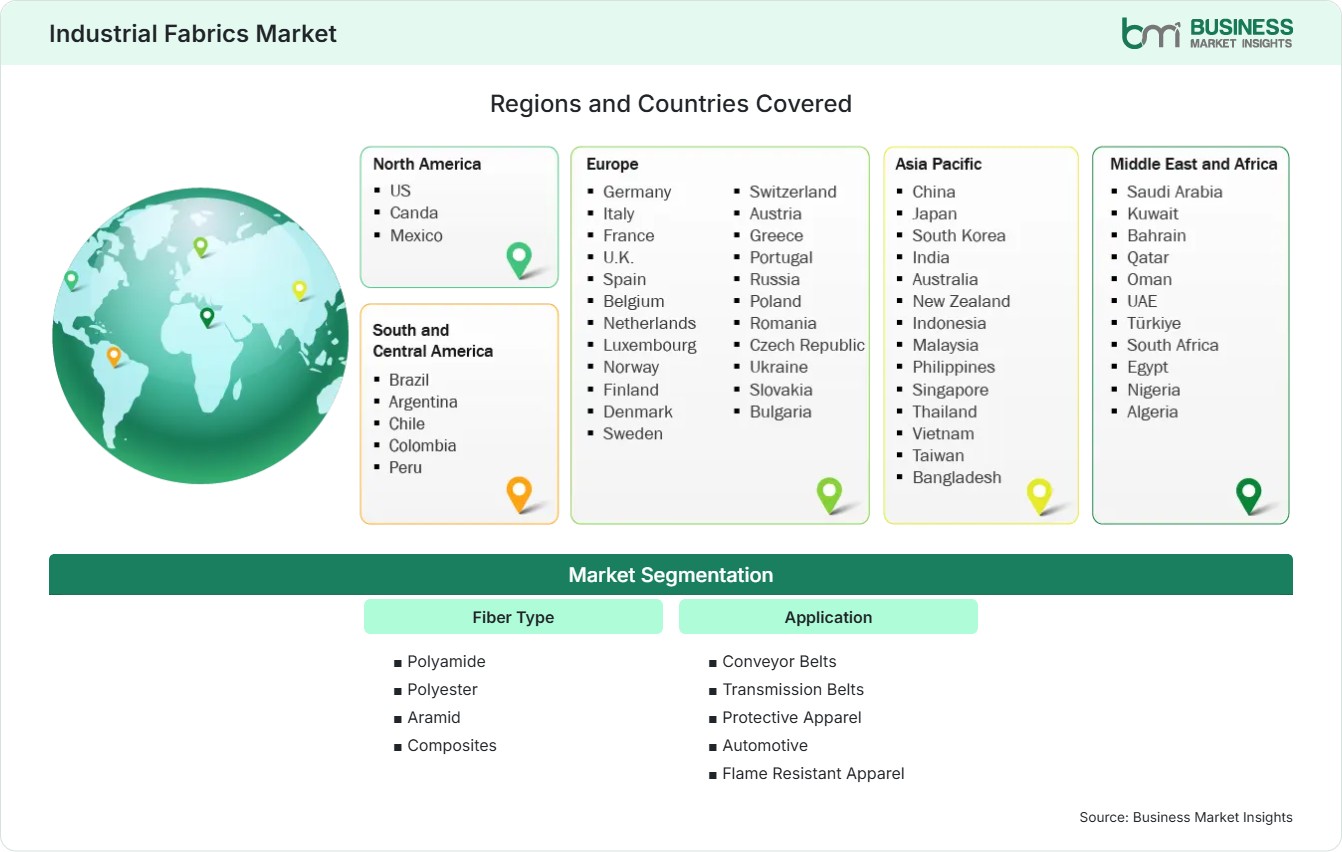
Global Market Geography
FREE PDF
Request your free sample
Request free sample
05 Segment Analysis

Industrial Fabrics Market Segmentation

Fiber Type

Fiber Type represents the foundation of industrial textile performance, with polyester maintaining a leading position due to cost efficiency, durability, and broad industrial usage. The segment accounted for a share range of 38%–41% in 2025 and is expected to expand at a CAGR range of 6.50%–6.90% during 2026–2033. The Industrial Fabrics scope continues expanding through innovations in engineered fiber combinations.

  • Polyamide: Polyamide fibers provide high abrasion resistance, flexibility, and mechanical strength, supporting applications in conveyor belts, filtration systems, and industrial components requiring reliable long-term operational performance.
  • Polyester: Polyester fibers are widely preferred due to affordability, dimensional stability, and resistance properties, making them suitable for industrial reinforcement fabrics, transportation systems, and manufacturing applications.
  • Aramid: Aramid fibers deliver exceptional heat resistance, lightweight strength, and durability, increasing adoption in protective apparel, aerospace-related applications, and environments requiring advanced safety performance.
  • Composites: Composite materials combine multiple fiber technologies to achieve enhanced strength, stiffness, and performance characteristics, supporting specialized applications in demanding industrial and engineering environments.

Application

Application-based demand is diversified across industrial operations, transportation, safety equipment, and manufacturing sectors. Conveyor belts represent the leading application segment with a share range of 31%–34% in 2025, supported by mining, logistics, and manufacturing activities. The segment is projected to grow at a CAGR range of 6.40%–6.80% between 2026–2033.

  • Conveyor Belts: Conveyor belt applications utilize reinforced fabrics for improved load-bearing capacity, abrasion resistance, and operational reliability across mining, manufacturing, logistics, and material handling industries.
  • Transmission Belts: Transmission belts require engineered textile reinforcement to enhance flexibility, strength, and resistance against continuous mechanical stress in industrial machinery applications.
  • Protective Apparel: Protective apparel demand is increasing due to workplace safety regulations, requiring flame-resistant, chemical-resistant, and high-performance textile solutions across industrial environments.
  • Automotive: Automotive applications use industrial fabrics for reinforcement, interior components, safety systems, and lightweight solutions that improve vehicle performance and manufacturing efficiency.
  • Flame Resistant Apparel: Flame resistant apparel applications are expanding due to stricter occupational safety requirements and increasing demand for protective materials in high-temperature industrial workplaces.
06 Market Forces

Industrial Fabrics Market Dynamics

Key Market Drivers

Increasing Demand for High-Performance Industrial Materials

With the growing need for more durable materials in manufacturing, the automobile, construction, and transportation sectors are seeing increased applications of advanced industrial textiles. The growth of this market can be attributed to the rising need for materials that replace traditional materials with those that offer greater strength, thermal resistance, and reliability during operations. As per the industry's safety standards framework, businesses are working to enhance their safety standards to minimize workplace risks, which is expected to create demand for specialized fabrics. According to the Industrial Fabrics Market Trends, there is a growing inclination towards engineered fibers, composites, and lightweight materials that increase efficiency.

Expansion of Automotive and Transportation Applications

In the automotive and transportation industries, there is an increasing trend towards using industrial textiles for weight reduction and improved performance. This trend is being led by automobile manufacturers, who are looking for ways to reduce vehicle weight while still ensuring structural integrity through the use of modern textile materials. With the increasing number of electric vehicles in recent years, there has also been an opportunity to develop industrial fabrics for use in various applications, such as battery protection and thermal insulation. The global automotive supply chain is increasing the need for industrial textiles that meet durability standards and other requirements. Manufacturers are developing new fiber structures that enhance efficiency and performance.

Rising Workplace Safety Regulations and Protective Requirements

The growing importance of occupational safety has increased the use of flame-resistant and protective textiles across industries. There have been ongoing efforts by regulatory authorities and industry groups to improve safety standards for workers in hazardous conditions. The oil & gas, manufacturing, mining, and chemical processing industries have high safety needs that require materials having resistance against various factors. Textile manufacturers in the industrial sector are continually investing in new fiber technologies with enhanced performance. Employers are increasingly becoming aware of the importance of safety and compliance.

Key Market Opportunities

Development of Sustainable and Recyclable Fiber Solutions

The rise in sustainability considerations is creating opportunities for manufacturers to develop recyclable fibers, biocompatible materials, and eco-friendly manufacturing processes. Technology that reduces the use of natural resources without compromising industry standards is attracting investment from businesses. Sustainable material innovations have become a strategic advantage as consumers consider environmental impacts in addition to product durability. Textile manufacturers in the industry are considering a new manufacturing process that uses recycled polyester. This provides an opportunity for companies to satisfy both performance and sustainability considerations. The Industrial Fabrics Market forecast suggests rising business prospects for environmentally-friendly products in the automotive, manufacturing, and protective industries.

Rising Adoption of Smart Textile Technologies

The integration of sensors, monitoring systems, and sophisticated coatings into industrial textiles opens new possibilities for smart textile solutions. Smart textiles can provide information on temperature and stress, improving operational safety and maintenance. Predictive monitoring and greater operational visibility are being explored by industries that need these technologies for their specific use cases. There is a growing effort by research organizations and manufacturers to enhance the performance of electronic devices in smart textiles and to make them durable and scalable. The increasing need for smart environments across industries will boost such innovations. Firms that develop practical, affordable smart textile technology can tap into market opportunities.

Growth Potential in Emerging Industrial Economies

The emerging economies are generating new opportunities through industrialization and manufacturing. Nations that invest in vehicle manufacturing, construction, mining, and industrial automation need textile fabrics for their operations. Manufacturing and government efforts, along with foreign investment, have increased the demand for sophisticated fabrics in developing countries. Manufacturing capabilities are rising as firms set up factories in these regions to simplify their logistics. According to the Industrial Fabrics Market Forecasts, there are opportunities in regions experiencing infrastructure development and industrial growth. Suppliers who have effective distribution systems and localized manufacturing operations are set to gain from rising regional consumption.

Market Restraints and Challenges

High Production Costs of Advanced Fiber Materials

Factor: Manufacturing advanced fibers such as aramid and composite materials requires specialized technologies, expensive raw materials, and complex processing systems. Impact: Higher production costs can limit adoption among price-sensitive end users and create challenges for manufacturers seeking broader market penetration. Industrial fabric producers must balance performance improvements with cost optimization to remain competitive. Research and development investments, energy expenses, and supply chain requirements further influence pricing structures. Companies are focusing on process efficiency, recycling technologies, and production automation to reduce manufacturing expenses. However, premium material costs remain a key challenge, particularly for small and medium-sized industrial consumers requiring advanced textile solutions.

Raw Material Price Volatility and Supply Chain Risks

Factor: Fluctuations in prices of synthetic fibers, chemicals, and specialty materials can directly affect manufacturing economics and product pricing. Impact: Unstable raw material availability may disrupt production planning, increase operational expenses, and create uncertainty across industrial textile supply chains. Global manufacturers depend on consistent access to polymers and specialized inputs, making supply chain resilience increasingly important. Geopolitical conditions, transportation disruptions, and energy cost variations can influence material availability. Companies are responding through supplier diversification, inventory management strategies, and regional sourcing initiatives. However, maintaining stable supply networks remains challenging for manufacturers operating across multiple geographic markets and industrial applications.

07 Company Analysis

Competitive Landscape

The Industrial Fabrics Market analysis indicates a competitive environment shaped by global manufacturers, specialty fiber producers, and technology-focused textile companies. Leading participants are strengthening their positions through product innovation, sustainability initiatives, strategic partnerships, and expansion of advanced material capabilities.

Company Name

Overview

Products and Services relevant to this market

Habasit AG

Switzerland-based manufacturer specializing in power transmission and conveyor belt solutions for industrial applications worldwide.

Provides conveyor belts, transmission belts, and engineered textile solutions designed for industrial material handling operations.

DuPont

Global science and technology company developing advanced material solutions for industrial and safety applications.

Offers Kevlar aramid fibers, protective materials, and high-performance textile technologies for demanding environments.

Johns Manville

US-based manufacturer producing engineered materials for construction and industrial applications.

Supplies industrial fabrics, reinforcement materials, and specialty textile solutions for insulation and performance applications.

ContiTech AG

Germany-based industrial technology company focused on rubber and textile-reinforced products.

Provides conveyor belts, reinforced industrial materials, and engineered textile components for industrial systems.

Toray Industries Inc.

Japanese advanced materials company specializing in fibers, composites, and high-performance textile technologies.

Develops polyester, carbon fiber composites, and specialty materials for industrial and transportation applications.

Cerex Advanced Fabrics Inc.

US manufacturer focused on engineered nonwoven fabrics and specialty material solutions.

Produces nylon-based nonwoven fabrics for filtration, industrial, and protective applications.

Freudenberg & Co. KG

German technology group developing innovative textile and material solutions.

Offers technical textiles, nonwoven materials, and industrial fabric solutions across multiple industries.

Bridgestone Corporation

Japanese multinational specializing in mobility solutions and reinforced rubber products.

Provides textile reinforcement materials used in tires, industrial products, and performance applications.

Barnet GmbH & Co. KG

German company specializing in recycling and processing synthetic fibers.

Supplies recycled polyester and specialty fiber solutions supporting industrial textile production.

Fitesa

Global manufacturer of nonwoven materials serving healthcare and industrial markets.

Provides engineered nonwoven fabrics and specialty textile materials for industrial applications.

G.R. Henderson Co. Textiles Ltd.

UK-based textile manufacturer producing specialized industrial fabric solutions.

Develops technical textiles and engineered fabric products for industrial and protective applications.

10 Trust & Transparency

Research Methodology

The market analysis combines proprietary research with secondary data from government agencies, company disclosures, regulatory filings, industry databases and expert interviews. Market estimates are validated through data triangulation, cross-market benchmarking and analyst review.

View Full Research Methodology

11 Questions Answered

Frequently Asked Questions

Why are Asia Pacific countries important for future industrial textile expansion?

Asia Pacific offers strong growth potential due to manufacturing expansion, infrastructure investments, automotive production growth, and increasing adoption of industrial safety standards.

What role does innovation play in Industrial Fabrics Market Report development?

Innovation supports improved fiber engineering, smart textile integration, lightweight materials, and advanced composites that enhance functionality across demanding industrial environments.

Which industries are major users of industrial fabric solutions?

Major users include automotive, manufacturing, mining, construction, logistics, safety equipment, and transportation industries requiring reinforced, protective, and high-performance textile materials.

How are sustainable materials affecting industrial textile development?

Sustainability is encouraging manufacturers to develop recycled fibers, energy-efficient production methods, and circular material solutions while maintaining performance standards required for industrial applications.

What factors are influencing demand for the industrial fabrics market?

Demand is influenced by increasing automation, industrial safety requirements, infrastructure development, automotive manufacturing, and the need for durable materials that provide improved strength, resistance, and operational efficiency.

Access the Full Industrial Fabrics Market Report

Get segment-level forecasts, regional estimates, competitive benchmarking, company profiles and downloadable Excel datasets.

Access the full Industrial Fabrics Market Report
350 pages PDF & Excel | 2026-08-26