Market Summary
Executive Summary and Global Market Analysis
Oxygen generation systems take oxygen from the air to provide a steady on-site supply for industrial and medical uses. This reduces the need for cylinder deliveries and helps keep oxygen available for important processes. These systems can be adjusted for different purity, flow, and capacity needs. As more industries look for decentralized gas supplies, these systems are being used more in manufacturing and healthcare. Companies value reliable oxygen access for smooth operations and emergencies, while also saving money and simplifying logistics.
Companies choose oxygen generators based on technology, flow needs, and system size. Large operations usually use stationary systems, while portable units are chosen for flexible or remote work. Main buyers are in chemical processing, healthcare, and metal production. New technology aims to improve energy use and keep purity levels steady. Pressure swing adsorption systems are popular for being reliable and easy to scale, while membrane and cryogenic systems are used for special needs. Manufacturers are making more units and adding features like better monitoring and automation. These changes are helping more businesses use these systems in both developed and growing markets.
Segment Analysis
Industrial Oxygen Generator Market Segmentation
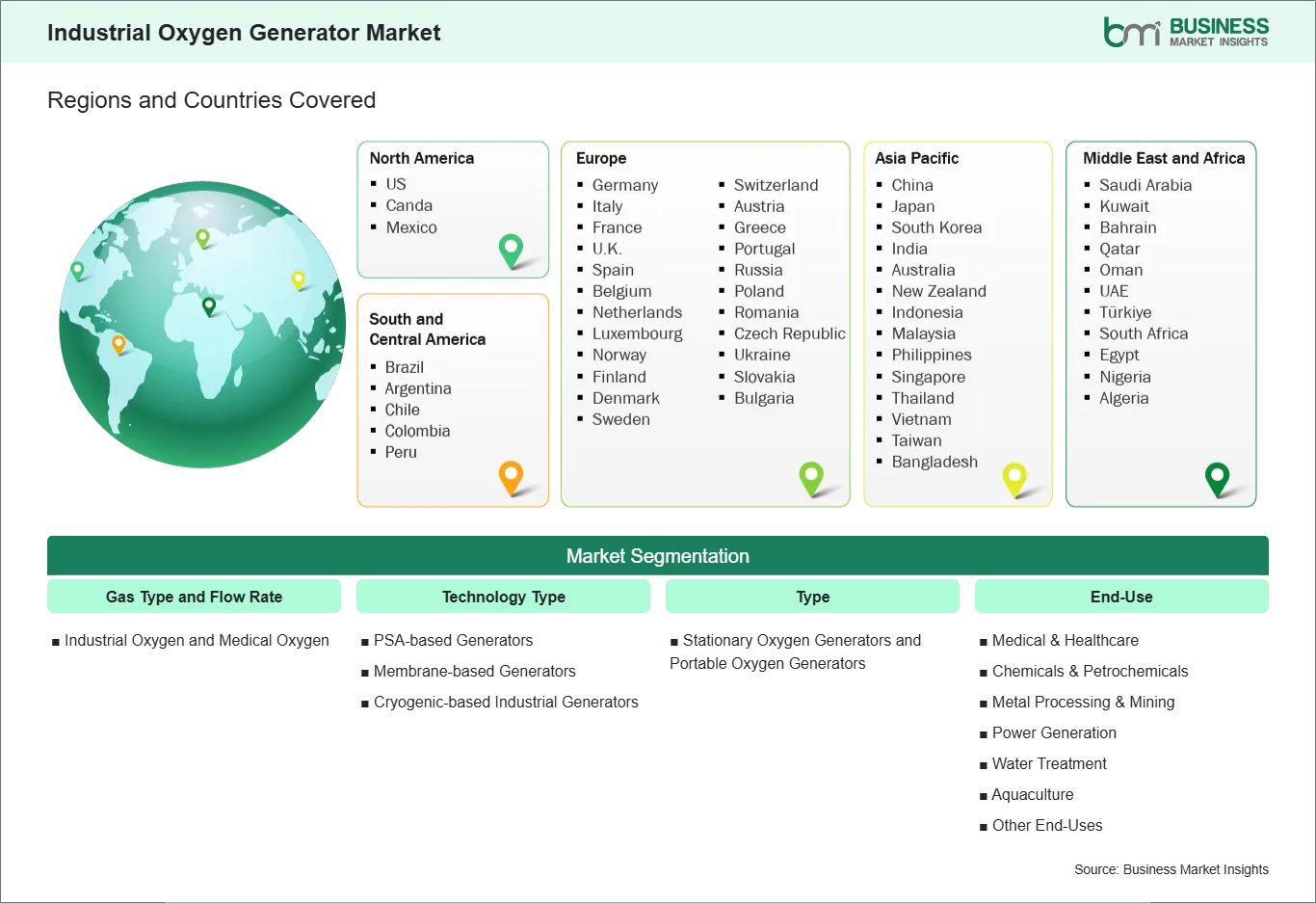
The Industrial Oxygen Generator market is segmented based on gas type and flow rate, technology type, type, and end-use. This shows the rising demand for advanced solutions in many different applications.
By Gas Type and Flow Rate
- Industrial Oxygen – High-volume industrial processing support applications.
- Medical Oxygen – Controlled purity supply for clinical environments.
By Technology Type
- PSA-based Generators – Widely used for scalable on-site oxygen production.
- Membrane-based Generators – Compact systems for moderate purity needs.
- Cryogenic-based Industrial Generators – Large-scale high-purity output systems.
By Type
- Stationary Oxygen Generators – Continuous high-capacity industrial deployment.
- Portable Oxygen Generators – Mobile and flexible operational usage.
By End-Use
- Medical and Healthcare – Emergency and routine oxygen supply systems.
- Chemicals and Petrochemicals – Process oxidation and refining operations.
- Metal Processing and Mining – Combustion and extraction enhancement systems.
- Power Generation – Supporting combustion efficiency in turbines.
- Water Treatment – Aeration and purification enhancement processes.
- Aquaculture – Oxygen enrichment for aquatic environments.
- Other End-Uses – Diverse industrial and niche applications.
Market Forces
Industrial Oxygen Generator Market Drivers and Opportunities
Rising need for localized oxygen production systems
More industrial facilities are choosing on-site oxygen generation to rely less on outside suppliers. This helps them keep running smoothly, even when gas needs change. Hospitals and clinics are also using smaller systems to make sure they always have oxygen. The move toward self-sufficiency is leading more industries to install scalable generator systems.
This change makes production more reliable and reduces transport delays and storage risks. Industrial users have less downtime during busy times. On-site generators also help save money and make it easier to follow safety rules where a steady oxygen supply is needed.
Expansion of energy-efficient gas separation technologies
New gas separation technologies now produce more oxygen while using less energy. Pressure swing adsorption (PSA) systems are now more efficient and cheaper to run. Manufacturers are adding automation to improve pressure control and system monitoring. These upgrades make the systems more reliable for ongoing use.
Remote industrial sites and smaller healthcare facilities are expected to use these systems more often. Their compact design makes them easy to install in tight spaces, so that more industries can use them. Better efficiency should also help more businesses adopt these systems.
Size and Share Analysis
Industrial Oxygen Generator Market Size and Share Analysis
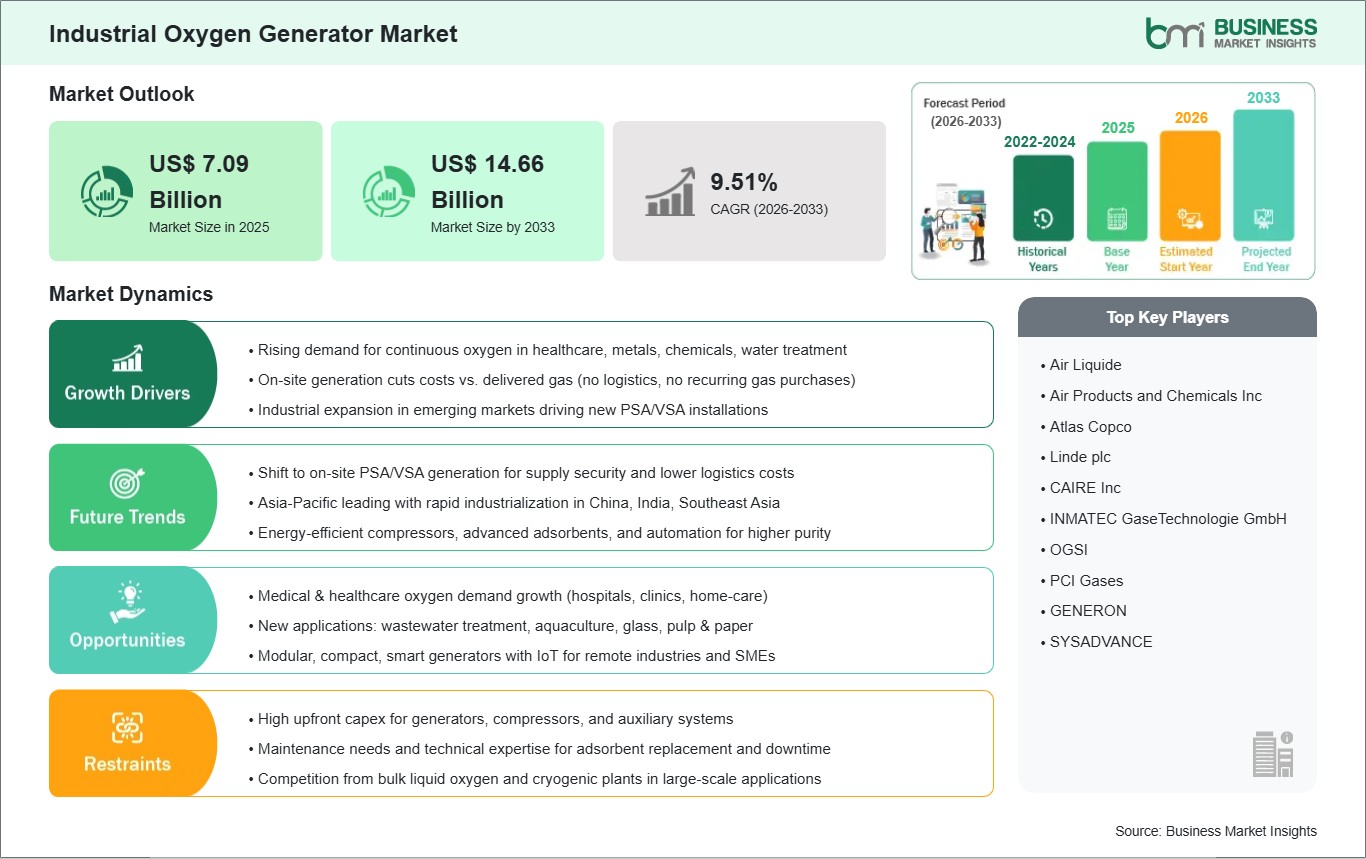
The Industrial Oxygen Generator Market is projected to grow from US$ 7.09 Billion in 2025 to US$ 14.66 Billion by 2033 , registering a CAGR of 9.51% from 2026 to 2033. This growth comes from steady investment in local gas generation and new advances in on-site oxygen technology.
Most of the market uses stationary systems because they can handle large volumes. Portable systems are becoming more popular where quick setup and mobility are important. Pressure swing adsorption (PSA) systems are still the top choice because they work efficiently and are easy to maintain.
Healthcare and chemical processing are the main users of these systems because they need a steady oxygen supply. Other industries like metallurgy and water treatment also use oxygen generators often.
Report Coverage
Industrial Oxygen Generator Market Report Coverage and Deliverables
The " Industrial Oxygen Generator Market Size and Forecast (2022-2033)" report provides a detailed analysis of the market covering below areas:
- Market size and forecast at global, regional, and country levels for all market segments covered under the scope
- Market trends, as well as drivers, restraints, and opportunities
- Market analysis covering key trends, global and regional framework, major players, regulations, and recent developments
- Industry landscape and competition analysis covering market concentration, heat map analysis, prominent players, and recent developments for the Industrial Oxygen Generator market
- Detailed company profiles, including SWOT analysis
Geographic Insights
Industrial Oxygen Generator Market Geographic Insights
The adoption of Industrial Oxygen Generators varies regionally, influenced by the level of industrial and infrastructural development. Demand fluctuates based on energy availability, healthcare sector expansion, and manufacturing activity. Regional readiness for technological innovation also impacts the rate of system adoption.
In North America, advanced oxygen generation systems are widely used in healthcare and manufacturing. Facilities focus on efficiency and meeting regulations, often upgrading their oxygen systems as industries modernize. Fast growth in industry, healthcare, and city infrastructure has led to more installations. Cost concerns also encourage the use of smaller, modular generators.
Asia Pacific reflects expanding deployment across heavy industries, supported by rapid industrialization and large-scale manufacturing growth. Healthcare expansion and urban infrastructure development further strengthen system installation rates. Cost-sensitive adoption also encourages compact and modular generator configurations.
Europe and emerging markets are using more oxygen generation systems to meet sustainability goals and improve industry performance. Rules that encourage efficient gas use help drive adoption of energy-saving technology. Emerging economies are also investing in local oxygen production to become more self-sufficient and keep operations running smoothly.
Industry Activity
Recent Developments
The Industrial Oxygen Generator market is evaluated by gathering qualitative and quantitative data post-primary and secondary research, which includes important corporate publications, association data, and databases. A few of the key developments in the Industrial Oxygen Generator market are:
- In September 2024, Atlas Copco launched the OGP 2-225, a next-generation oxygen generator designed to meet the growing market demand for on-site oxygen generation. This model offers optimal performance and energy efficiency, making it an ideal choice for industrial operations. By allowing users to produce their own oxygen, the OGP 2-225 mitigates logistical issues associated with gas procurement, reduces costs, and minimizes delivery emissions.
- In March 2025, Unitaid is expanding its East African Program of Oxygen Access (EAPOA) into Tanzania with a US$22 million investment to develop sustainable medical oxygen supplies in sub-Saharan Africa. The initiative, which began in Kenya in October 2024, has reached its second phase.
Trust & Transparency
Research Methodology
The market analysis combines proprietary research with secondary data from government agencies, company disclosures, regulatory filings, industry databases and expert interviews. Market estimates are validated through data triangulation, cross-market benchmarking and analyst
review.
View Full Research Methodology
Key Sources Referred:
European Commission
US Department of Energy
International Energy Agency
Company Websites
Company Annual Reports
Company Investor Presentations