
Industrial Coatings Market Outlook: Size, Share, Trends, Growth Analysis, Competitive Landscape & Forecast, 2026–2033

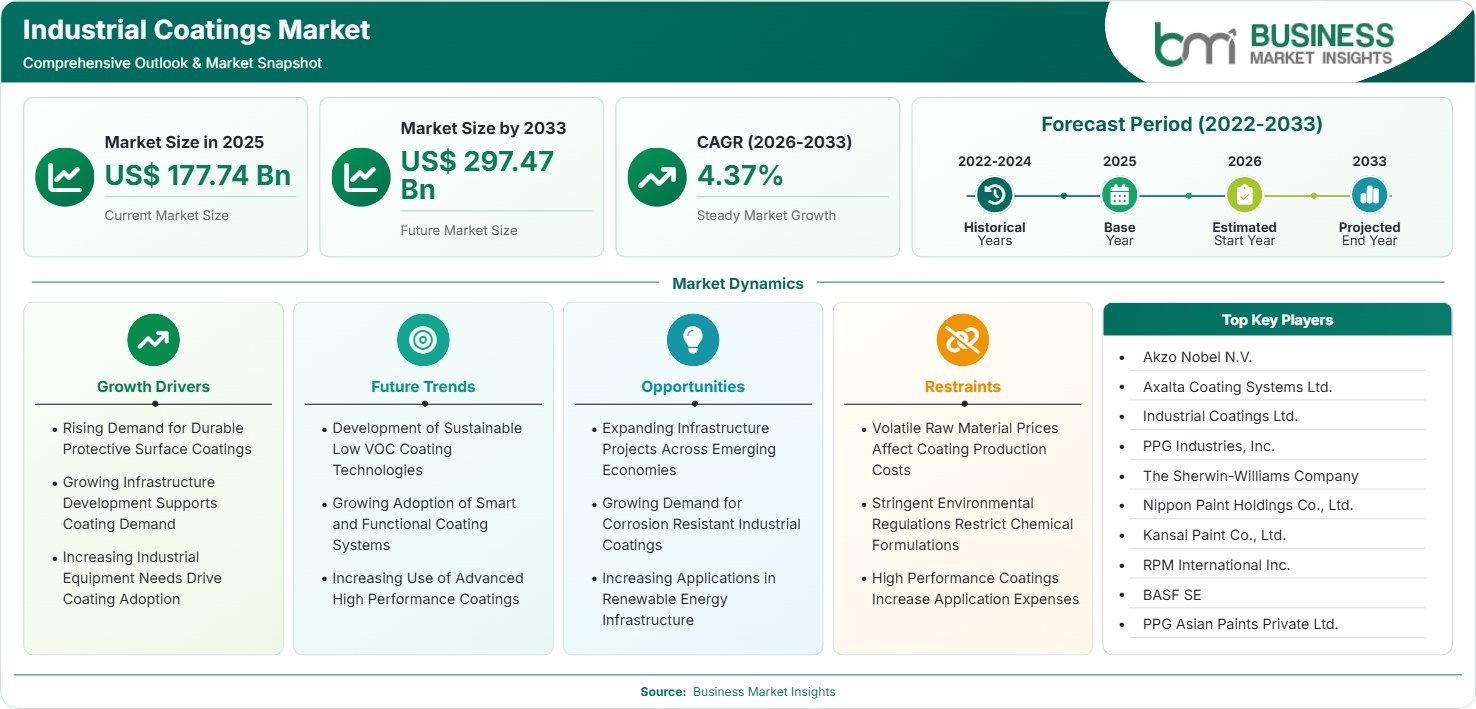
The Industrial Coatings Market size was valued at US$ 177.74 Billion in 2025 and is projected to reach US$ 297.47 Billion by 2033, growing at a CAGR of 4.37% during 2026–2033, driven by industrial production, infrastructure development, corrosion protection requirements, automotive manufacturing, sustainable coating technologies, and opportunities in water-borne, powder, and high-performance formulations.

Report Coverage
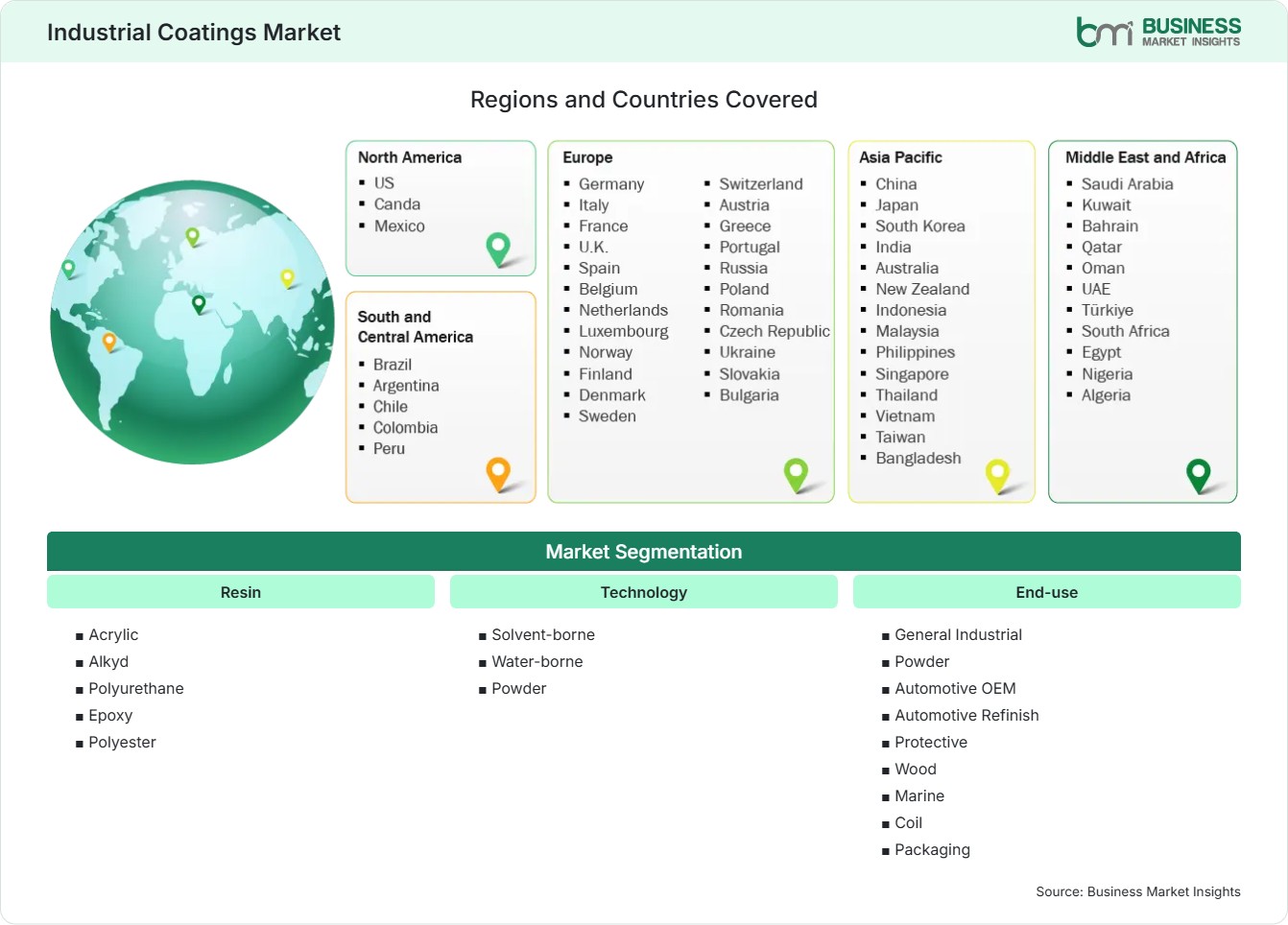
  • Resin: Acrylic, Alkyd, Polyurethane, Epoxy, Polyester
  • Technology: Solvent-borne, Water-borne, Powder
  • End-use: General Industrial, Powder, Automotive OEM, Automotive Refinish, Protective, Wood, Marine, Coil, Packaging
US$ 177.74 Bn Market size in 2025
US$ 297.47 Bn Market Size by 2033
4.37% CAGR, 2026 - 2033
2026-2033 Forecast Period

AI Overview

Industrial Coatings Market Summary

  • North America Region: North America holds an estimated 25%–28% share in 2025 and is projected to grow at a 3.8%–4.3% CAGR during 2026–2033. Manufacturing investment, infrastructure renewal, automotive production, protective maintenance, and stricter environmental requirements support demand while creating opportunities for water-borne technologies, advanced protective systems, and specialized industrial applications. The US is expected to grow at a 3.9%–4.4% CAGR.
  • Fastest Growing Region: Asia Pacific holds an estimated 41%–44% share in 2025 and is projected to expand at a 5.1%–5.8% CAGR through 2033. Industrialization, automotive production, construction activity, manufacturing expansion, and rising demand for durable surface protection create opportunities for localized production, advanced formulations, powder technologies, and environmentally compliant coating systems.
  • Leading Segment: Acrylic holds an estimated 28%–32% share in 2025 and is projected to grow at a 4.5%–5.0% CAGR, supported by versatility, weather resistance, adhesion properties, broad industrial applicability, and increasing adoption across automotive, construction-related, protective, and general manufacturing applications.
  • High Growth Segment: Powder technology holds an estimated 23%–27% share in 2025 and is projected to advance at a 5.4%–6.1% CAGR, driven by efficient material utilization, durable finishes, lower solvent requirements, automation compatibility, and growing demand for environmentally responsible industrial finishing processes.
  • Key Market Opportunity: Low-emission formulations, advanced corrosion-resistant systems, automated coating processes, specialty surfaces, and high-performance materials offer opportunities as manufacturers seek durability, regulatory compliance, operational efficiency, and differentiated product performance.
  • Major Market Players: Akzo Nobel N.V., Axalta Coating Systems Ltd., Industrial Coatings Ltd., PPG Industries, Inc., The Sherwin-Williams Company, Nippon Paint Holdings Co., Ltd., Kansai Paint Co., Ltd., RPM International Inc., BASF SE, and PPG Asian Paints Private Ltd.
Strategic Insights

Industrial Coatings Market: Strategic Insights

Industrial Coatings Market Strategic Framework
FREE PDF
Request your free sample
Request free sample
Stakeholder View

Key Takeaways

  • The value chain is becoming more specialized, linking resin suppliers, pigment producers, formulators, application equipment providers, industrial manufacturers, and technical service organizations around performance-specific coating requirements.
  • Powder-based and advanced water-borne technologies offer substantial growth potential as manufacturers seek durable finishes while improving material efficiency and reducing dependence on conventional solvent-intensive application processes.
  • Innovation is shifting toward multifunctional coatings that combine corrosion resistance, chemical protection, abrasion resistance, aesthetic performance, and easier application within a single formulation.
  • Asia Pacific presents the strongest regional investment case because expanding industrial production, automotive manufacturing, infrastructure development, and localized supply chains continue to increase coating consumption.
  • Investment activity is increasingly directed toward production capacity, sustainable formulations, application technologies, specialty products, and acquisitions that strengthen geographic reach or technical capabilities.
  • Competitive advantage will depend on formulation innovation, regulatory readiness, customer-specific technical support, supply reliability, and the ability to develop coatings suited to demanding industrial operating conditions.
Geographic Outlook

Industrial Coatings Market Regional Highlights

North America Industrial Coatings Market

North America accounted for 25%–28% share in 2025 and is projected to expand at a 3.8%–4.3% CAGR through 2033. Industrial production, infrastructure maintenance, transportation manufacturing, and protective applications support regional demand. Industrial Coatings Market share is influenced by increasing requirements for durable, high-performance, and environmentally compliant products.

  • Manufacturing modernization is increasing demand for coatings compatible with automated application systems, supporting consistent film quality, improved productivity, reduced waste, and efficient use across high-volume industrial production lines.
  • Infrastructure maintenance supports demand for protective coatings that resist corrosion, moisture, chemicals, and environmental exposure across industrial facilities, transportation assets, energy equipment, and other long-life structures.
  • Automotive manufacturing continues to require advanced surface technologies that balance appearance, durability, production efficiency, and compatibility with increasingly automated finishing processes.
  • Environmental requirements are encouraging manufacturers to expand water-borne, powder, and other lower-emission formulations while maintaining performance standards for demanding industrial applications.

US Industrial Coatings Market

The US represents approximately 20%–23% of global share in 2025 and is expected to grow at a 3.9%–4.4% CAGR through 2033. Demand is supported by manufacturing activity, transportation equipment, infrastructure maintenance, and industrial asset protection. Producers are increasingly focused on efficient application technologies and products that reduce operational complexity.

  • Manufacturing investment supports demand for factory-applied coatings used on machinery, equipment, fabricated metal products, transportation components, and other durable industrial goods.
  • Protective applications remain important as industrial operators seek longer maintenance cycles and improved resistance against corrosion, chemicals, abrasion, and severe operating conditions.
  • Application efficiency is becoming a stronger purchasing consideration, encouraging adoption of products that support automation, consistent coverage, reduced waste, and faster production throughput.
  • Product development increasingly focuses on balancing durability with environmental compliance, particularly for customers transitioning toward lower-emission manufacturing and finishing processes.

Europe Industrial Coatings Market

Europe held an estimated 20%–23% share in 2025 and is projected to grow at a 3.6%–4.1% CAGR through 2033. Germany remains a leading market, while France and Italy provide significant demand across automotive, machinery, marine, and industrial manufacturing.

  • Germany remains a major market because its automotive, machinery, equipment, and industrial manufacturing base requires advanced coatings with consistent technical performance.
  • France and Italy support demand across transportation, industrial equipment, consumer manufacturing, marine applications, and specialized finishing requirements for high-value products.
  • Poland and other Eastern European markets provide stronger expansion opportunities as manufacturing capacity, industrial investment, and infrastructure development continue to progress.
  • Sustainability requirements encourage greater adoption of water-borne and powder technologies while increasing research into products with improved application efficiency and reduced environmental impact.

Asia Pacific Industrial Coatings Market

Asia Pacific accounted for 41%–44% share in 2025 and is expected to grow at a 5.1%–5.8% CAGR through 2033. China, Japan, South Korea, and India represent important demand centers. Industrial Coatings Market growth is supported by manufacturing expansion, automotive production, infrastructure development, and increasing demand for durable surface protection.

  • China remains a major demand center because of its extensive manufacturing base, transportation production, machinery output, and continuing investment in industrial modernization.
  • India provides strong growth potential as manufacturing capacity expands across automotive, infrastructure, industrial equipment, consumer products, and broader construction-related activities.
  • Japan and South Korea support demand for technologically advanced formulations used in automotive, electronics, machinery, marine, and specialized industrial applications.
  • Southeast Asian economies offer opportunities as production facilities diversify geographically and manufacturers require localized access to protective and high-performance coating technologies.

Rest of World Industrial Coatings Market

Rest of World represented approximately 10%–13% share in 2025 and is projected to advance at a 4.3%–4.9% CAGR through 2033. South and Central America benefit from manufacturing and infrastructure activity, with Brazil representing a major market. Industrial Coatings Market share is expanding where industrial assets require durable protection under challenging environmental conditions.

  • Brazil supports regional demand through automotive manufacturing, industrial production, construction activity, and requirements for protective finishes across infrastructure and commercial assets.
  • South and Central American markets offer opportunities for durable industrial and protective products as manufacturing investment and infrastructure maintenance requirements continue to develop.
  • Middle Eastern demand is supported by industrial construction, energy infrastructure, transportation assets, and the need for coatings capable of performing under harsh climatic conditions.
  • African markets provide long-term potential through infrastructure development and industrialization, although uneven manufacturing capacity and distribution networks can affect market accessibility.
Global Market Geography
FREE PDF
Request your free sample
Request free sample
Segment Analysis

Industrial Coatings Market Segmentation

Resin

Acrylic represents the leading resin category, accounting for an estimated 28%–32% share in 2025 and projected to grow at a 4.5%–5.0% CAGR through 2033. Its versatility supports broad industrial adoption. Industrial Coatings Market scope includes resin technologies selected according to durability, adhesion, chemical resistance, flexibility, and substrate requirements, creating demand for differentiated formulations across multiple end-use environments.

  • Acrylic: Acrylic systems are widely used because they provide versatile performance, weather resistance, adhesion, and compatibility with applications requiring durable and visually consistent industrial finishes.
  • Alkyd: Alkyd coatings remain relevant for applications requiring practical processing characteristics, cost efficiency, and dependable performance across selected industrial and maintenance environments.
  • Polyurethane: Polyurethane formulations support demanding applications requiring abrasion resistance, durability, flexibility, chemical protection, and long-lasting surface performance under challenging operating conditions.
  • Epoxy: Epoxy coatings are important for industrial and protective applications because of their strong adhesion, chemical resistance, and ability to protect substrates exposed to severe conditions.
  • Polyester: Polyester coatings are widely used in durable finishing applications, particularly where weather resistance, appearance retention, and compatibility with powder coating processes are required.

Technology

Solvent-borne technology remains the largest category, accounting for an estimated 39%–43% share in 2025 and growing at a 3.5%–4.1% CAGR through 2033. Industrial Coatings Market trends increasingly favor technologies that improve transfer efficiency, reduce emissions, and support consistent application across automated manufacturing environments.

  • Solvent-borne: Solvent-borne systems remain important for applications requiring strong performance, formulation flexibility, and reliable results under complex substrate and environmental conditions.
  • Water-borne: Water-borne technology is gaining adoption as manufacturers seek lower-emission alternatives while maintaining coating quality, durability, application performance, and regulatory compliance.
  • Powder: Powder coatings offer durable finishes and efficient material utilization, supporting growing adoption across appliances, automotive components, machinery, furniture, and fabricated metal products.

End-use

General Industrial represents the leading end-use category, accounting for an estimated 24%–28% share in 2025 and projected to grow at a 4.2%–4.8% CAGR through 2033. Diverse manufacturing requirements support broad consumption. Automotive OEM and protective applications also create significant demand, while specialized sectors increasingly require tailored formulations offering resistance to chemicals, weathering, abrasion, and temperature variation.

  • General Industrial: General industrial applications require versatile coatings for machinery, fabricated products, equipment, and components where appearance and substrate protection remain equally important.
  • Powder: Powder end-use applications support demand for durable and efficient finishes across fabricated metal products, appliances, furniture, equipment, and industrial components.
  • Automotive OEM: Automotive OEM applications require highly consistent finishes capable of meeting demanding requirements for appearance, durability, corrosion protection, and production-line efficiency.
  • Automotive Refinish: Refinish applications require products that support repair quality, color consistency, efficient application, and durable restoration of vehicle surface appearance and protection.
  • Protective: Protective coatings serve infrastructure, industrial assets, equipment, and structures requiring resistance to corrosion, chemicals, moisture, abrasion, and demanding environmental exposure.
  • Wood: Wood coatings support surface protection, appearance enhancement, and durability across furniture, flooring, cabinetry, architectural components, and other finished wood products.
  • Marine: Marine applications require specialized protection against moisture, saltwater exposure, corrosion, abrasion, and demanding environmental conditions affecting vessels and related structures.
  • Coil: Coil coatings are applied to metal substrates in continuous manufacturing processes, supporting durable, efficient, and consistent finishes for construction and industrial products.
  • Packaging: Packaging coatings support product appearance, substrate protection, processing performance, and specialized requirements across metal, plastic, and other packaging materials.
Market Forces

Industrial Coatings Market Dynamics

Key Market Drivers

Industrial Production Expands Demand for Surface Protection

Industrial processes need coatings that offer protection against physical and environmental damage to equipment, components, structures, and final products. Therefore, industrial manufacturing growth drives sustained demand in general industry, transport, protection, and specialty coatings applications. The Industrial Coatings Market growth is bolstered by the need for extended lifecycles and minimal maintenance. The choice of coating is becoming more dependent on operational conditions, substrates, and performance criteria. As the efficiency of manufacturing operations improves, there is also a growing demand for coatings that can be applied using automated application methods.

Growing Need for Corrosion and Chemical Resistance

Industrial coatings are often applied to materials under conditions of moisture, chemicals, abrasions, and heat, among others, that may have the potential to damage the material surface. As such, there exists a need for advanced coating solutions that will be able to give more lasting protection. The Industrial Coatings Market trends are now focusing more on the performance of the coating over its entire life cycle rather than just focusing on the cost of the first-time application. There are end-user demands for products that will minimize the need for maintenance while protecting valuable equipment and infrastructural assets. In such situations, high-performance resin systems have become highly significant.

Environmental Compliance Accelerates Technology Development

Environmental demands are dictating formulation design and application techniques within industrial manufacturing. Manufacturers are coming up with water-based, powder, and other formulations aimed at reducing their dependence on solvents. This change requires further investments in research, manufacturing, and application techniques. There is a need for customers to weigh the sustainability needs against what they have been accustomed to in terms of adhesion, durability, appearance, and protection. This will create avenues for innovative products using raw material, resin technology, curing process, and application techniques to meet the changing demands. The Industrial Coatings Market Forecast considers the emerging issues related to regulatory compliance, efficiency, and low-emission coatings technology.

Key Market Opportunities

Advanced Powder Technologies Create Expansion Potential

The future prospects for powder coating processes lie in their potential to meet the needs of industry as they look for reliable finishes along with high efficiency in the use of materials. The process of powder coating, being compatible with automatic application processes, will be able to help achieve consistency in quality and reduce operational waste. The other areas of future expansion will be in developing better powder coating formulations, superior curing abilities, and specialty coating needs. Future expansion will also be achieved due to its increased application in appliances, fabricated metal products, automotive parts, and industrial machinery. The differentiation can take place through formulation advancements and technical applications assistance.

High-Performance Protective Systems Support Premium Demand

There is an increasing trend among industrial users to use coatings that help prolong the lifespan of expensive equipment and infrastructure. This presents chances for creating products with higher corrosion resistance, chemical resistance, abrasion resistance, and weather resistance. It is especially important when there are chances for incurring losses as a result of the disruption of maintenance activities. There could be further development of multifunctional coatings that have a few application processes but provide technical excellence in the future. The chance is not limited to industrial sites but covers transport, energy, marine, and other applications that work under harsh environmental conditions.

Emerging Manufacturing Economies Expand Local Demand

Economic growth and industrialization in developing countries have opened up avenues for coatings companies to set up operations locally. With new manufacturing sites being set up, there is a greater need for coatings that go into equipment, manufactured goods, transportation, and infrastructure. The manufacturing of these products can increase efficiency and ease of logistics, while the product range can also be modified in accordance with the regional climatic conditions, manufacturing process, and regulations. Collaboration with local distributors and industrial customers can help achieve greater market penetration. Firms that have the capacity for both global formulation and regional servicing will likely enjoy more growth in their manufacturing operations.

Market Restraints and Challenges

Raw Material Cost Volatility Pressures Manufacturing Margins

Factor: The cost structure of industrial coatings is influenced by the price of raw materials like resins, pigments, solvents, additives, and others that may be volatile due to energy costs, availability issues, and macroeconomic factors. Impact: Volatile input costs affect business operations and pricing policy. Manufacturers will have to change product pricing and product formulation or find another solution. Small manufacturers may suffer more from this risk as they do not enjoy economies of scale or purchasing power. It is difficult to maintain the quality of products with fluctuating prices of inputs. Efficient procurement, inventory management, and supplier diversification are hence crucial for minimizing operational risk and fostering a sound production environment.

Complex Application Requirements Increase Operational Challenges

Factor: Industrial coatings often require specific surface preparation, application equipment, curing conditions, and technical expertise to achieve intended performance. Impact: Application complexity can increase operational costs and create risks related to inconsistent quality. End users may require training, specialized equipment, and technical support before adopting new formulations. Compatibility challenges can also slow transitions toward alternative technologies. Manufacturers must therefore provide practical guidance alongside product innovation. Solutions that simplify application while maintaining durability can improve adoption prospects. The challenge is particularly relevant when customers operate diverse production environments with different substrates, throughput requirements, and performance expectations.

Company Analysis

Competitive Landscape

The Industrial Coatings Market analysis is characterized by competition among global coating manufacturers, regional specialists, and suppliers with strong positions in automotive, protective, powder, wood, marine, and general industrial applications.

Company Name

Overview

Products and Services relevant to this market

Akzo Nobel N.V.

Global paints and coatings company serving industrial, marine, protective, automotive, and specialty applications through broad technology and distribution capabilities.

Powder coatings, protective systems, marine coatings, coil coatings, wood coatings, and industrial finishing technologies designed for durability, appearance, and surface protection.

Axalta Coating Systems Ltd.

Global coatings supplier focused on transportation, mobility, industrial, refinish, and specialty applications with extensive formulation and color technology expertise.

Industrial coatings, powder coatings, automotive OEM coatings, refinish systems, transportation coatings, and technologies supporting durable, efficient, and consistent surface finishing.

Industrial Coatings Ltd.

Industrial coatings supplier serving customers requiring specialized surface protection and finishing solutions for varied industrial operating environments and substrates.

Industrial protective coatings, specialized surface finishes, application-focused products, and coating solutions designed to support durability, appearance, and operational performance requirements.

PPG Industries, Inc.

Global paints and coatings manufacturer serving aerospace, automotive, industrial, packaging, protective, marine, and architectural markets.

Industrial coatings, automotive OEM products, powder coatings, protective coatings, packaging technologies, coil coatings, and specialized systems for demanding industrial applications.

The Sherwin-Williams Company

Major coatings company with broad capabilities across protective, marine, industrial, automotive, packaging, and general finishing applications.

Protective coatings, industrial wood coatings, automotive finishes, packaging coatings, marine systems, coil coatings, and application solutions for industrial substrates.

Nippon Paint Holdings Co., Ltd.

Global coatings company serving automotive, industrial, decorative, marine, and specialized applications through extensive regional operations and technology platforms.

Automotive coatings, industrial coatings, protective finishes, marine products, specialty formulations, and technologies supporting durability and substrate-specific performance.

Kansai Paint Co., Ltd.

International coatings manufacturer with strong capabilities in automotive, industrial, protective, decorative, and specialized coating technologies.

Automotive OEM coatings, industrial finishes, protective coatings, powder systems, specialty products, and surface technologies for diverse manufacturing applications.

RPM International Inc.

Global specialty coatings and materials company serving industrial, infrastructure, maintenance, construction, and specialty application markets through multiple operating businesses.

Protective coatings, flooring systems, sealants, maintenance coatings, specialty industrial products, corrosion protection solutions, and surface treatment technologies.

BASF SE

Global chemical company supplying raw materials, technologies, and coating solutions across automotive, industrial, transportation, and specialized applications.

Automotive coatings, surface treatment technologies, industrial coating materials, resins, pigments, and chemical solutions supporting high-performance finishing applications.

PPG Asian Paints Private Ltd.

Coatings business focused on serving regional customers with automotive and industrial coating technologies supported by manufacturing and technical capabilities.

Automotive OEM coatings, industrial finishing systems, specialized surface products, and technical coating solutions supporting regional manufacturing and transportation applications.

Trust & Transparency

Research Methodology

The market analysis combines proprietary research with secondary data from government agencies, company disclosures, regulatory filings, industry databases and expert interviews. Market estimates are validated through data triangulation, cross-market benchmarking and analyst review.

View Full Research Methodology

Questions Answered

Frequently Asked Questions

How can an Industrial Coatings Market Report support business planning?

The report can help manufacturers, investors, distributors, and suppliers evaluate technology developments, regional demand, end-use opportunities, competitive conditions, formulation priorities, and strategic investment areas.

Which industries create strong demand for industrial coatings?

Major demand comes from general manufacturing, automotive production, protective applications, marine activities, wood products, coil coating, packaging, machinery, and infrastructure-related industries.

How do resin types affect coating performance?

Resin selection influences properties such as adhesion, flexibility, chemical resistance, weatherability, hardness, and durability. Different industrial applications require specific resin technologies depending on substrates and operating conditions.

Why are powder coatings gaining importance?

Powder coatings provide durable finishes and can support efficient material use. Their compatibility with automated application processes and reduced dependence on conventional solvents makes them increasingly attractive across several manufacturing applications.

What are industrial coatings primarily used for?

Industrial coatings are used to protect surfaces, improve durability, provide corrosion or chemical resistance, enhance appearance, and support performance requirements across manufacturing, transportation, infrastructure, marine, packaging, and other industrial applications.

Access the Full Industrial Coatings Market Report

Get segment-level forecasts, regional estimates, competitive benchmarking, company profiles and downloadable Excel datasets.

Access the full Industrial Coatings Market Report
350 pages PDF & Excel | 2026-08-31
Similar Research

Related Market Reports