
Coil Coatings Market Outlook: Size, Share, Trends, Growth Analysis, Competitive Landscape & Forecast, 2026-2033

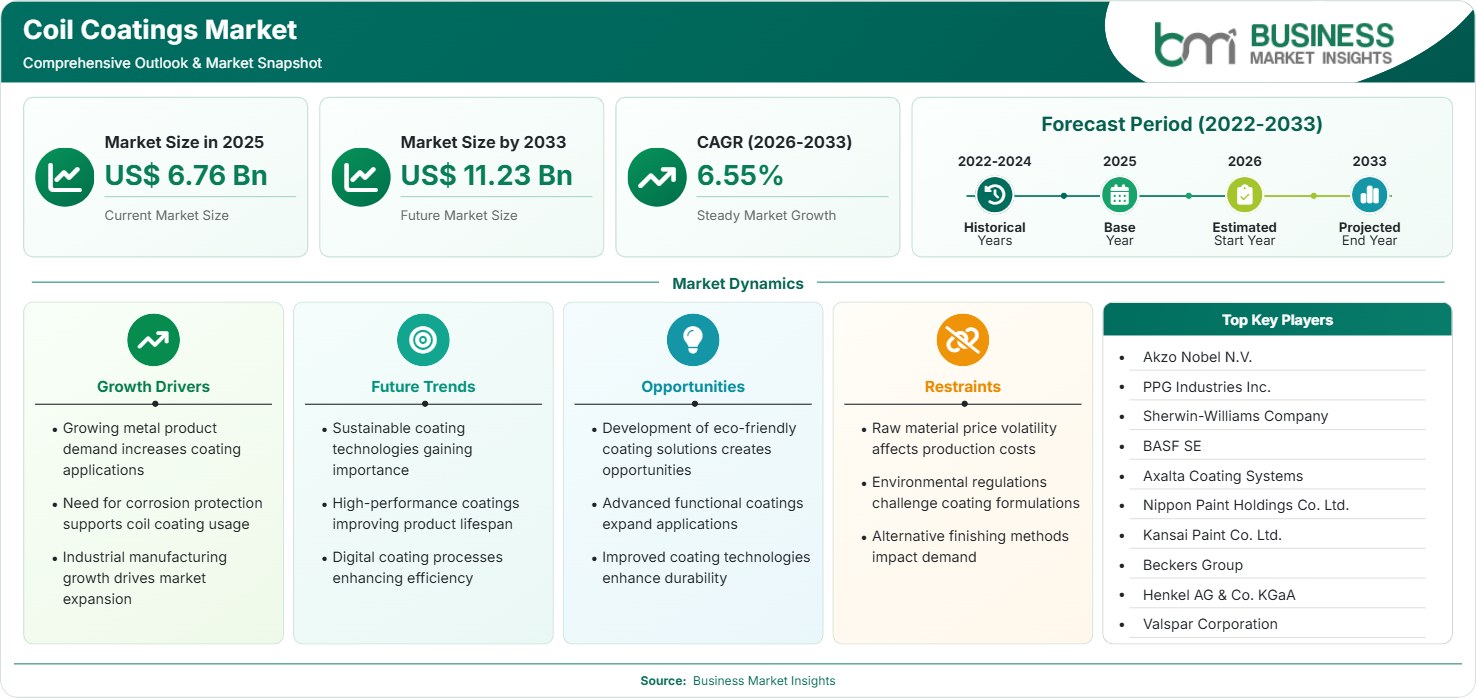
The Coil Coatings Market size was valued at US$ 6.76 billion in 2025 and is projected to reach US$ 11.23 billion by 2033, growing at a CAGR of 6.55% during 2026–2033. Rising demand for coated metals, corrosion protection, durable architectural surfaces, lightweight transportation materials, and environmentally improved coating technologies continues creating opportunities for manufacturers.

Report Coverage
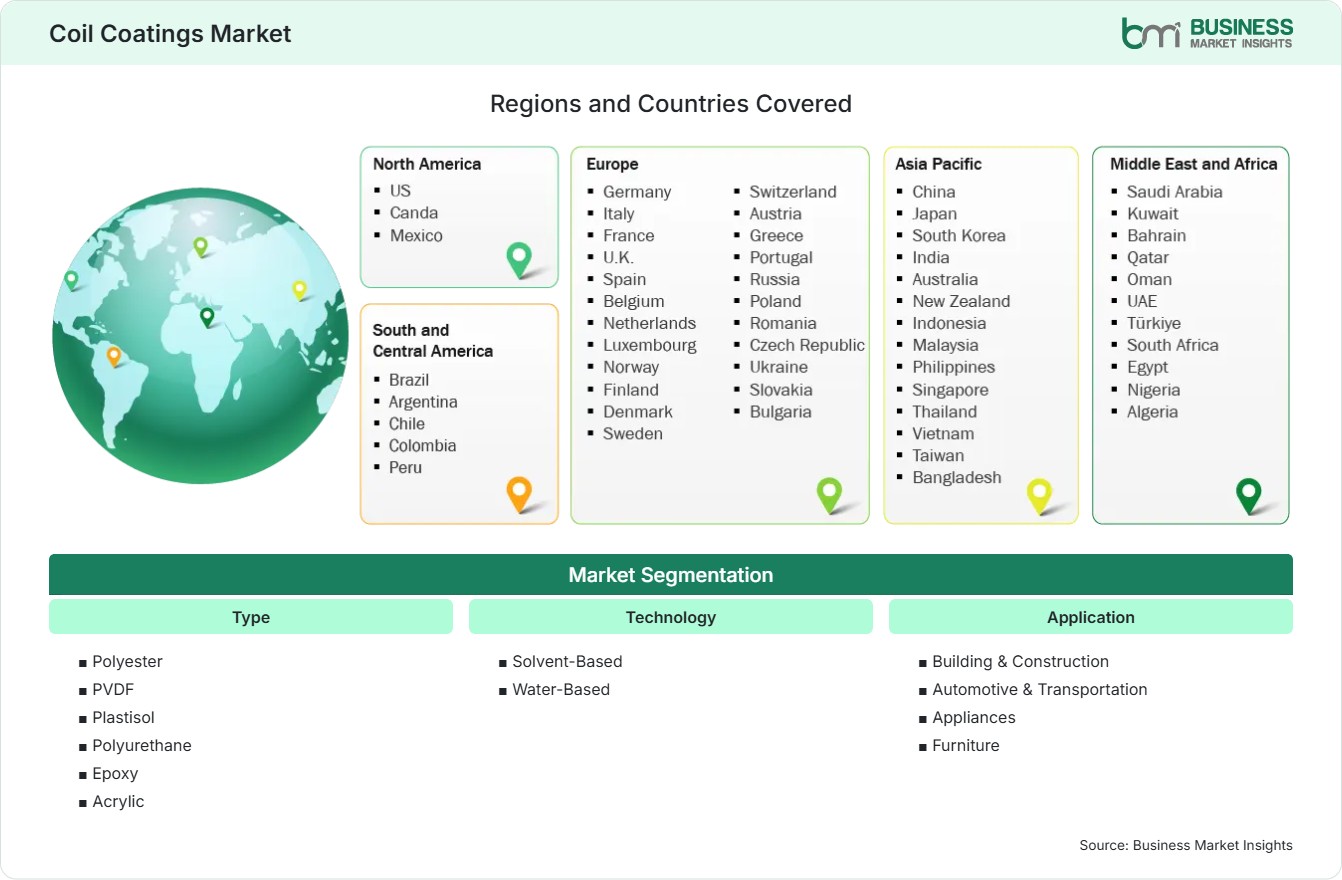
  • Type: Polyester, PVDF, Plastisol, Polyurethane, Epoxy, Acrylic
  • Technology: Solvent-Based, Water-Based
  • Application: Building & Construction, Automotive & Transportation, Appliances, Furniture
US$ 6.76 Bn Market size in 2025
US$ 11.23 Bn Market Size by 2033
6.55% CAGR, 2026 - 2033
2026-2033 Forecast Period

AI Overview

Coil Coatings Market Summary

  • North America Region: North America holds 24%–27% market share in 2025 and is projected to expand at a CAGR of 5.9%–6.4% during 2026–2033, supported by construction refurbishment, automotive production, appliance manufacturing, corrosion protection requirements, and investments in durable pre-painted metal systems. The U.S. remains the regional leader, with a CAGR of 5.8%–6.3%, supported by construction, automotive, appliance, and industrial applications.
  • Fastest Growing Region: Asia Pacific accounts for 43%–46% market share in 2025 and is projected to register a CAGR of 7.1%–7.6%, supported by expanding construction activity, manufacturing capacity, urbanization, infrastructure development, appliance production, and increasing adoption of factory-applied coated steel and aluminum.
  • Leading Segment: Polyester represents 39%–42% market share in 2025 and is anticipated to grow at a CAGR of 6.3%–6.8%, supported by balanced durability, cost efficiency, broad color availability, established processing capabilities, and extensive adoption in building panels, roofing, appliances, and general industrial applications.
  • High Growth Segment: Water-Based coatings account for 18%–21% market share in 2025 and are expected to register a CAGR of 7.2%–7.7%, driven by formulation development, lower solvent exposure, environmental compliance requirements, manufacturing process improvements, and increasing demand for lower-emission coating technologies.
  • Key Market Opportunity: Expansion of sustainable coating formulations, high-performance architectural finishes, lightweight transportation materials, and digitally controlled coil-processing systems creates attractive opportunities for suppliers targeting durability, productivity, regulatory alignment, and differentiated surface performance.
  • Major Market Players: Akzo Nobel N.V., PPG Industries, Inc., The Sherwin-Williams Company, BASF SE, Axalta Coating Systems Ltd., Nippon Paint Holdings Co., Ltd., Kansai Paint Co., Ltd., Beckers Group, Henkel AG & Co. KGaA, and The Valspar Corporation.
Strategic Insights

Coil Coatings Market: Strategic Insights

Coil Coatings Market Strategic Framework
FREE PDF
Request your free sample
Request free sample
Stakeholder View

Key Takeaways

  • The value chain remains closely connected across resin suppliers, pigment and additive producers, coil coaters, metal processors, fabricators, distributors, and end-use manufacturers, making formulation consistency and technical support important competitive factors.
  • Polyester offers the broadest volume opportunity because its combination of processing flexibility, affordability, appearance, and adequate durability supports high-volume construction and appliance applications, while PVDF and polyurethane provide opportunities in higher-performance specifications.
  • Technology development is shifting toward lower-solvent systems, improved curing efficiency, enhanced adhesion, better scratch resistance, and coatings capable of maintaining appearance under demanding weather and mechanical conditions.
  • Asia Pacific provides the strongest investment case because manufacturing expansion, urban development, appliance production, infrastructure requirements, and increasing use of pre-finished metal products create multiple demand channels rather than dependence on one application.
  • Consolidation opportunities are likely to center on specialty formulation capabilities, regional manufacturing access, technical service networks, and technologies that improve production efficiency while reducing environmental and material-management costs.
Geographic Outlook

Coil Coatings Market Regional Highlights

North America Coil Coatings Market

North America represents 24%–27% Coil Coatings Market share in 2025 and is projected to register a CAGR of 5.9%–6.4% during 2026–2033. Demand is supported by construction, appliances, transportation, refurbishment, and industrial manufacturing. Buyers increasingly prioritize consistent appearance, corrosion resistance, processing efficiency, and longer service life. The regional opportunity is concentrated in replacement demand, premium architectural systems, durable appliance finishes, and modernization of coil-processing operations. U.S. production remains the principal regional demand center, supported by diversified downstream manufacturing.

  • Construction applications continue supporting demand for pre-finished roofing, wall panels, facades, and structural components requiring consistent appearance and reliable weather resistance.
  • Appliance manufacturers favor coil-coated metals because factory-applied finishes provide repeatable color, efficient processing, and attractive surfaces across refrigerators, washers, dryers, and related equipment.
  • Automotive and transportation applications create opportunities for coatings delivering adhesion, forming resistance, scratch protection, and consistent appearance across increasingly lightweight metal components.
  • Replacement and refurbishment projects support premium coating demand where longer coating life, color retention, corrosion protection, and reduced maintenance requirements influence purchasing decisions.

US Coil Coatings Market

The United States represents 81%–84% of North American revenue and is projected to grow at a CAGR of 5.8%–6.3% during 2026–2033. Demand remains diversified across construction, appliances, transportation, and industrial manufacturing. Manufacturers increasingly value efficient coil processing, predictable coating thickness, lower production waste, and durable finishes. Domestic production also supports shorter supply chains for major downstream users.

  • Construction remains a major demand contributor, particularly through roofing, siding, architectural panels, and renovation projects requiring durable factory-applied finishes.
  • Appliance production supports recurring demand for coated steel and aluminum, with manufacturers emphasizing consistent appearance, forming performance, and resistance to household-use conditions.
  • Industrial users increasingly seek specialized formulations capable of supporting corrosion resistance, improved surface durability, and efficient high-speed processing.

Europe Coil Coatings Market

Europe accounts for 20%–23% Coil Coatings Market share in 2025 and is projected to expand at a CAGR of 5.5%–6.0% during 2026–2033. Germany remains the leading market, while Poland represents a higher-growth manufacturing opportunity at approximately 6.2%–6.7% CAGR. Demand centers on construction materials, appliances, transportation, industrial equipment, and sustainability-oriented production. Formulation development increasingly emphasizes lower emissions, resource efficiency, long coating life, and compatibility with demanding architectural specifications.

  • Germany maintains a strong position through diversified industrial manufacturing, construction products, appliance production, and established metal-processing capabilities requiring consistent coil finishes.
  • Poland provides attractive growth potential through expanding manufacturing capacity, construction activity, and integration with regional industrial supply chains.
  • European buyers increasingly prioritize coatings that reduce environmental burdens while maintaining adhesion, appearance, corrosion resistance, and production-line efficiency.
  • Premium architectural projects support higher-value finishes where weatherability, color retention, and extended maintenance cycles justify advanced coating technologies.

Asia Pacific Coil Coatings Market

Asia Pacific accounts for 43%–46% Coil Coatings Market share in 2025 and is projected to register the fastest CAGR of 7.1%–7.6% during 2026–2033. China remains the leading market, while India represents a high-growth opportunity at approximately 7.8%–8.3% CAGR. Construction, infrastructure, appliances, transportation, and manufacturing expansion provide multiple demand drivers. Increasing localization of metal processing and downstream fabrication further supports regional consumption of pre-painted steel and aluminum.

  • China maintains the largest regional demand base through extensive construction, appliance manufacturing, transportation production, and metal-processing capacity.
  • India offers strong growth potential as urban development, industrial investment, appliance production, and infrastructure projects increase consumption of coated metal products.
  • Southeast Asian manufacturing hubs provide additional opportunities through industrial relocation, construction expansion, appliance production, and regional supply-chain diversification.
  • Manufacturers increasingly invest in local coating capacity to reduce logistics complexity, improve customer responsiveness, and provide formulations adapted to regional processing conditions.

Rest of World Coil Coatings Market

Rest of World represents 7%–10% Coil Coatings Market share in 2025 and is projected to grow at a CAGR of 6.0%–6.5% during 2026–2033. South and Central America benefit from construction, appliance, and industrial activity, while Middle Eastern demand is linked to architectural applications, infrastructure, and climate-resistant finishes. Brazil leads regional demand, while the United Arab Emirates provides a higher-growth opportunity at approximately 6.8%–7.3% CAGR.

Latin American manufacturers increasingly use coated metal for roofing, facades, appliances, and fabricated products where corrosion protection and reduced finishing requirements improve production efficiency. Middle Eastern buyers place greater emphasis on weather resistance and appearance retention under demanding environmental conditions.

  • Brazil provides the strongest regional demand base through construction materials, manufacturing activity, appliance production, and expanding use of pre-finished metal products.
  • The United Arab Emirates offers premium architectural opportunities where coatings must withstand intense sunlight, heat, dust, and demanding maintenance conditions.
  • Mexico supports industrial demand through manufacturing, construction, appliances, transportation, and integration with broader North American production networks.
  • Regional suppliers can improve competitiveness through localized inventory, technical service, and coating systems adapted to climate-specific performance requirements.
Global Market Geography
FREE PDF
Request your free sample
Request free sample
Segment Analysis

Coil Coatings Market Segmentation

Type

The type segment remains central to product positioning because resin selection determines durability, appearance, flexibility, weatherability, and cost. Polyester represented 39%–42% market share in 2025 and is projected to register a CAGR of 6.3%–6.8% during 2026–2033. The Coil Coatings Market scope continues broadening as customers balance performance requirements against processing economics across construction, appliances, transportation, and industrial applications.

  • Polyester: Provides balanced cost, flexibility, appearance, and durability, supporting extensive use in roofing, wall panels, appliances, and general industrial products where moderate performance is sufficient.
  • PVDF: Targets premium architectural and demanding exterior applications requiring superior weatherability, color retention, ultraviolet resistance, and long-term appearance performance.
  • Plastisol: Offers thick-film protection and strong flexibility, making it suitable for applications requiring enhanced corrosion protection, forming capability, and robust surface coverage.
  • Polyurethane: Combines flexibility, hardness, appearance, and durability, supporting applications where improved surface performance and resistance to mechanical handling are important.
  • Epoxy: Provides strong adhesion and corrosion protection, making it valuable for primers, industrial applications, and systems where substrate protection takes priority.
  • Acrylic: Supports applications requiring attractive appearance, weather resistance, and formulation flexibility, particularly where visual characteristics complement functional coating performance.

Technology

Technology selection increasingly reflects production efficiency, environmental considerations, curing requirements, and customer specifications. Solvent-based systems remain dominant, representing 72%–75% market share in 2025, while water-based formulations are projected to achieve a CAGR of 7.2%–7.7% during 2026–2033 as manufacturers improve formulation performance and process compatibility.

  • Solvent-Based: Maintains strong adoption because established production lines, predictable curing, broad formulation flexibility, and reliable finish quality support high-volume coil coating operations.
  • Water-Based: Gains momentum as manufacturers pursue lower-emission processes, improved workplace conditions, and formulations capable of meeting demanding durability and appearance specifications.

Application

Application demand is diversified across construction, transportation, appliances, furniture, and industrial products. Building and construction represented 52%–55% market share in 2025 and is projected to expand at a CAGR of 6.1%–6.6% during 2026–2033. Diverse downstream requirements continue shaping Coil Coatings Market trends, particularly around durability, appearance, processing speed, and corrosion protection.

  • Building & Construction: Remains the principal application because roofing, siding, wall panels, facades, and architectural components require durable, consistent, factory-applied surface protection.
  • Automotive & Transportation: Uses coil-coated metals where lightweight construction, forming performance, corrosion resistance, appearance, and production efficiency support vehicle and component manufacturing.
  • Appliances: Relies on pre-finished steel and aluminum for consistent appearance, cleanable surfaces, corrosion protection, and efficient manufacturing across household and commercial equipment.
  • Furniture: Uses coated metal for cabinets, shelving, office systems, fixtures, and decorative products requiring repeatable appearance and resistance to routine handling.
Market Forces

Coil Coatings Market Dynamics

Key Market Drivers

Growing metal product demand increases coating applications

Demand for coated steel and aluminum is closely connected to expansion across construction products, appliances, transportation equipment, furniture, and industrial fabrication. Factory-applied coating enables manufacturers to reduce downstream painting requirements while improving consistency, surface appearance, and production efficiency. The Coil Coatings Market growth therefore benefits when downstream manufacturers increase the use of pre-finished metals. Polyester is still highly applicable as far as cost performance ratio is concerned for high volume applications. The higher end systems like PVDF and polyurethane cater to applications where the importance of weatherability, durability, and aesthetic retention are valued more. With the growing use of lightweight metal substrates, there are opportunities for coating manufacturers, since any change in the substrate requires suitable adhesive properties, formability, and corrosion protection.

Need for corrosion protection supports coil coating usage

The protection of metals against corrosion remains one of the most basic considerations in purchasing, as exposed metal products may degrade due to moisture, chemicals, temperature, ultraviolet radiation, and handling. The coil coating process offers a controlled multi-layer process that allows for pretreatment, primer, top coat, and protective qualities to be combined before the formed product reaches the customer. Service life is a consideration that makes more emphasis on the need for coatings that can maintain their effectiveness even under harsh conditions.

Industrial manufacturing growth drives market expansion

Industrial production affects coating needs because coated steel is used in various manufacturing products rather than in a single use category. An increase in appliances, construction parts, transport vehicles, storage units, furniture, and other industrial products increases the potential market size for coil coating. There is an increasing need by producers of efficient methods that limit secondary finishes, handling of product, and uniform appearance. The Coil Coatings Market trends increasingly reflect this manufacturing logic, with suppliers developing systems for different substrates, forming requirements, colors, gloss levels, and environmental conditions.

Key Market Opportunities

Development of eco-friendly coating solutions creates opportunities

Environmental considerations are creating opportunities for suppliers developing water-based, lower-emission, and resource-efficient coating systems without sacrificing durability or processing performance. Coil Coatings Market Forecasts increasingly depend on the ability of manufacturers to balance environmental objectives with customer requirements for adhesion, appearance, corrosion resistance, and production speed. There is potential for waterborne technologies to reduce solvent exposure, while enhanced resins can help address past issues with curing, moisture resistance, and line compatibility. Investment opportunities are not limited to formulations but also include application equipment, curing optimization, waste minimization, and process control. Those suppliers who succeed in achieving similar performance standards but reducing the burden on the environment will be able to distinguish themselves.

Advanced functional coatings expand applications

Functional coatings can expand addressable demand by adding performance characteristics beyond basic color and corrosion protection. Possible developments include better scratch resistance, chemical resistance, anti-fingerprint properties, easier to clean properties, improved thermal performance, and appearance-related characteristics. Such abilities would provide added value for applications in appliances, transportation, architectural goods, and industrial machinery. The investments should be concentrated on formulations that address specific customer issues rather than on creating new features that don’t add value. Cooperation among resin producers, coil painters, metal producers, equipment makers, and manufacturers will help to commercialize these developments faster since the performance of coatings is affected by surface preparation, curing, forming, and use conditions.

Improved coating technologies enhance durability

Advances in application control, curing efficiency, pretreatment compatibility, and coating formulation can improve both product performance and manufacturing economics. Improved process control will help decrease coating variations, avoid waste, and ensure consistency in high-speed manufacturing processes. Increased durability will create opportunities in areas where maintenance is not readily accessible or environmental conditions are harsh. The suppliers may choose to develop formulations that will help improve adhesion after can formation, ensure color retention under UV radiation, and maintain barrier properties over a long period. Digital monitoring and automated quality control will help in recognizing thickness variations, surface defects, and curing problems in the earlier stages of production.

Market Restraints and Challenges

Raw material price volatility affects production costs

Factor: The coating of coils is formulated using resins, pigments, solvents, additives, and specialty chemicals, the cost of which can be subject to volatility depending on feedstock availability, energy, logistics, and production capacity. Impact: Volatile input costs can squeeze profits, cause problems in setting prices, and place pressure to change formulations or supply arrangements. Companies that produce coatings may find it harder to manage changes in input costs compared to global companies who have more purchasing power. Consumers may become more sensitive to prices when input costs exceed demand for the metal products.

Environmental regulations challenge coating formulations

Factor: The raising of environmental standards can limit product formulation options, lead to the use of low-emission technology, and necessitate further testing or adjustment to the process in order for the product to be commercialized. Impact: The reformulation process will result in additional cost of research, time delay in qualifying the product, need for equipment adjustments, and technical difficulties due to existing solvent-based product formulations that are well optimized in their production process. The customers will have to qualify the new formulation on various substrates, coating equipment, curing cycle, and fabrication process.

Company Analysis

Competitive Landscape

The competitive structure includes diversified coatings companies, specialty formulation providers, and chemical manufacturers serving multiple downstream industries. Coil Coatings Market analysis indicates that competition is shaped by resin technology, application expertise, geographic manufacturing coverage, technical service, product consistency, and the ability to meet increasingly demanding performance requirements.

Company Name

Overview

Products and Services relevant to this market

Akzo Nobel N.V.

Global coatings producer with broad industrial and architectural coating capabilities and extensive international market coverage.

Coil coating systems, primers, topcoats, protective finishes, color solutions, and technical coating support for metal applications.

PPG Industries, Inc.

Diversified coatings manufacturer serving industrial, automotive, aerospace, architectural, and specialty coating customers worldwide.

Coil coatings, primers, protective finishes, architectural metal coatings, color technologies, and application support.

The Sherwin-Williams Company

Major coatings manufacturer with broad industrial and architectural product capabilities serving professional and manufacturing customers.

Metal coatings, primers, finishes, protective systems, color solutions, and technical services for coated metal applications.

BASF SE

Global chemical company supplying coating raw materials and technologies across multiple industrial value chains.

Resins, additives, coating technologies, performance chemicals, formulation components, and solutions supporting coil coating systems.

Axalta Coating Systems Ltd.

Global coatings company focused on industrial, transportation, and performance coating technologies.

Industrial metal coatings, primers, topcoats, protective systems, color technologies, and technical application solutions.

Nippon Paint Holdings Co., Ltd.

Major Asian coatings group with extensive decorative, automotive, industrial, and protective coating operations.

Industrial coatings, metal finishes, primers, topcoats, color solutions, and coating technologies for manufactured metal products.

Kansai Paint Co., Ltd.

Japanese coatings manufacturer with diversified automotive, industrial, and protective coating capabilities.

Industrial metal coatings, protective finishes, primers, topcoats, color systems, and technical coating solutions.

Beckers Group

Specialist coatings company with strong focus on industrial coatings and pre-painted metal applications.

Coil coatings, primers, topcoats, specialty finishes, color systems, and technical solutions for metal-processing customers.

Henkel AG & Co. KGaA

Global chemical and materials supplier with strong capabilities in surface treatment and industrial process technologies.

Pretreatment technologies, surface treatments, adhesives, process chemicals, corrosion-management solutions, and coating-support technologies.

The Valspar Corporation

Coatings business serving architectural, industrial, protective, and metal-related applications across multiple markets.

Coil coatings, industrial finishes, primers, topcoats, protective coatings, color solutions, and technical application support.

Trust & Transparency

Research Methodology

The market analysis combines proprietary research with secondary data from government agencies, company disclosures, regulatory filings, industry databases and expert interviews. Market estimates are validated through data triangulation, cross-market benchmarking and analyst review.

View Full Research Methodology

Questions Answered

Frequently Asked Questions

What does the Coil Coatings Market Report cover?

The Market Report covers market size, regional dynamics, technology trends, resin types, applications, competitive positioning, growth opportunities, restraints, strategic priorities, and the outlook for manufacturers serving coated steel and aluminum value chains.

How can coating manufacturers protect margins?

Manufacturers can improve margins through formulation optimization, procurement diversification, reduced material waste, improved line efficiency, specialty products, technical services, and differentiated finishes. Moving from commodity products toward specification-driven solutions can also reduce direct price competition.

Which application offers the broadest opportunity?

Building and construction provides the broadest opportunity because coated steel and aluminum are extensively used in roofing, siding, wall panels, facades, and related architectural products. Appliance and transportation applications provide additional diversification.

Why are water-based technologies gaining attention?

Water-based systems provide manufacturers with an alternative pathway for reducing solvent-related burdens while maintaining functional coating performance. Their adoption depends on formulation quality, curing conditions, application-line compatibility, drying requirements, and the ability to meet customer durability specifications.

What determines the selection of a coil coating resin?

Selection depends on required durability, corrosion resistance, flexibility, appearance retention, forming performance, substrate, processing conditions, environmental exposure, and total coating cost. Polyester is generally suited to broad applications, while PVDF and polyurethane can address higher-performance requirements.

Access the Full Coil Coatings Market Report

Get segment-level forecasts, regional estimates, competitive benchmarking, company profiles and downloadable Excel datasets.

Access the full Coil Coatings Market Report
350 pages PDF & Excel | 2026-08-19