
Waterborne Coatings Market Outlook: Size, Share, Trends, Growth Analysis, Competitive Landscape & Forecast, 2026-2033

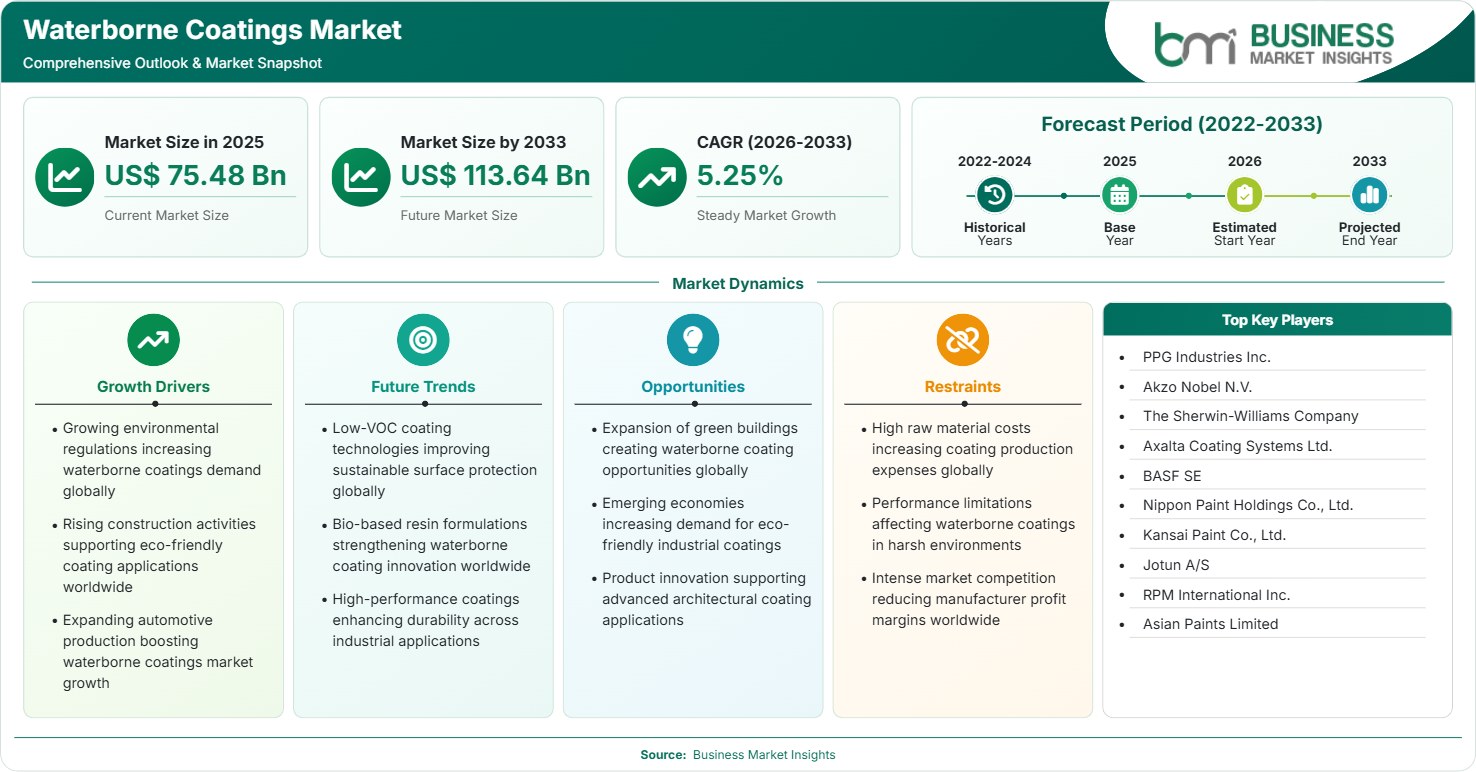
The Waterborne Coatings Market size was valued at US$ 75.48 billion in 2025 and is projected to reach US$ 113.64 billion by 2033, growing at a CAGR of 5.25% during 2026–2033. Growing environmental regulations, rising construction activities, and expanding automotive production continue driving demand, while green buildings, eco-friendly industrial coatings, and product innovation create long-term market opportunities.

Report Coverage
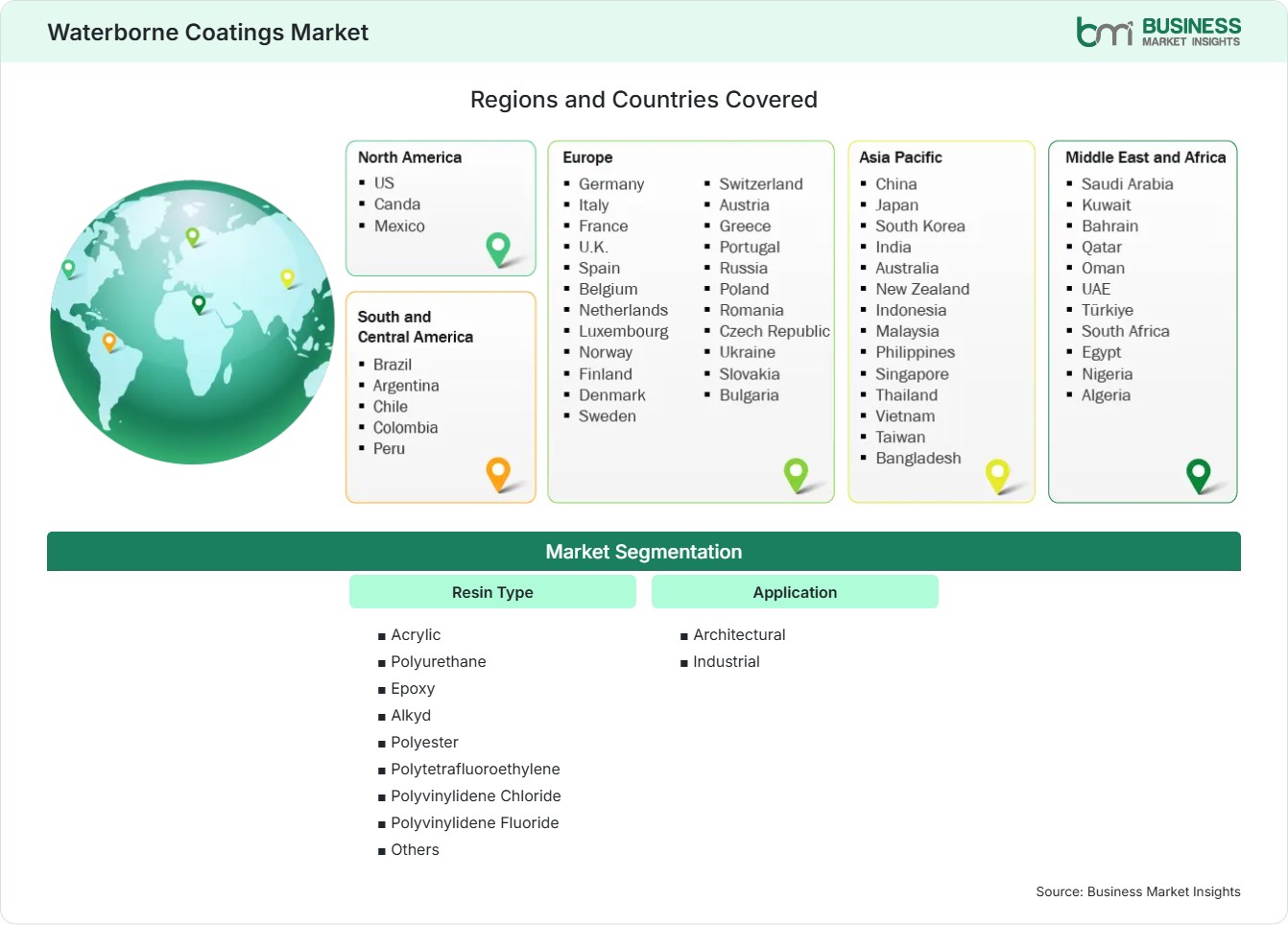
  • Resin Type: Acrylic, Polyurethane , Epoxy, Alkyd, Polyester, Polytetrafluoroethylene , Polyvinylidene Chloride , Polyvinylidene Fluoride , Others
  • Application: Architectural, Industrial
US$ 75.48 Bn Market size in 2025
US$ 113.64 Bn Market Size by 2033
5.25% CAGR, 2026 - 2033
2026-2033 Forecast Period

AI Overview

Waterborne Coatings Market Summary

  • North America Region: North America accounts for 29%–32% market share in 2025 and is projected to expand at a 4.8%–5.2% CAGR during 2026–2033. Strict environmental regulations, strong renovation activity, and increasing adoption of low-VOC coating technologies continue supporting regional demand. The United States leads the region with a 4.9%–5.3% CAGR, driven by infrastructure modernization, automotive manufacturing, and sustainable construction investments.
  • Fastest Growing Region: Asia Pacific represents 40%–43% market share in 2025 while registering a 6.2%–6.7% CAGR through 2033. Expanding manufacturing, rapid urbanization, infrastructure development, and increasing environmental compliance continue accelerating regional demand.
  • Leading Segment: Acrylic accounts for 33%–36% market share in 2025 and is expected to grow at a 5.3%–5.7% CAGR. Excellent weather resistance, durability, cost efficiency, and broad architectural applications continue supporting segment leadership.
  • High Growth Segment: Industrial represents 44%–47% market share in 2025 and is forecast to expand at a 5.8%–6.2% CAGR. Expanding industrial production, automotive manufacturing, protective coating requirements, and sustainability initiatives continue driving segment growth.
  • Key Market Opportunity: Increasing adoption of sustainable coating technologies, stricter emission standards, green infrastructure projects, advanced resin development, and circular manufacturing practices continue creating attractive long-term opportunities worldwide.
  • Major Market Players: PPG Industries Inc., Akzo Nobel N.V., The Sherwin-Williams Company, Axalta Coating Systems Ltd., BASF SE, Nippon Paint Holdings Co., Ltd., Kansai Paint Co., Ltd., Jotun A/S, RPM International Inc., and Asian Paints Limited.
Strategic Insights

Waterborne Coatings Market: Strategic Insights

Waterborne Coatings Market Strategic Framework
FREE PDF
Request your free sample
Request free sample
Stakeholder View

Key Takeaways

  • Integrated resin suppliers, coating formulators, raw material providers, and distribution partners are strengthening supply chain resilience while enabling manufacturers to meet tightening environmental standards and rising demand for sustainable coating solutions.
  • Acrylic resin continues generating the largest revenue contribution, while industrial applications present the strongest long-term growth opportunity owing to expanding manufacturing, infrastructure investment, and automotive production worldwide.
  • Continuous innovation in low-VOC formulations, high-performance resins, antimicrobial coatings, and faster-curing technologies is improving coating durability, application efficiency, and regulatory compliance across architectural and industrial applications.
  • Asia Pacific offers the most attractive investment potential because of rapid urbanization, expanding manufacturing industries, infrastructure development, and increasing government initiatives promoting environmentally friendly coating technologies.
  • Strategic acquisitions, regional production capacity expansion, and investments in advanced waterborne technologies continue strengthening competitive positioning while helping manufacturers address evolving customer requirements and sustainability objectives.
Geographic Outlook

Waterborne Coatings Market Regional Highlights

North America Waterborne Coatings Market

North America accounts for 29%–32% of global revenue in 2025 and is projected to expand at a 4.8%–5.2% CAGR through 2033. The Waterborne Coatings Market share remains significant because of strict VOC regulations, mature construction markets, and increasing adoption of sustainable coating technologies. Continued investments in infrastructure renovation and industrial modernization support stable regional demand.

  • Environmental regulations continue encouraging manufacturers to replace solvent-based coatings with waterborne alternatives across construction, industrial equipment, and transportation applications.
  • Infrastructure renovation projects and commercial construction activities support increasing consumption of durable, low-emission architectural coating products.
  • Automotive manufacturers continue adopting waterborne technologies to improve environmental compliance while maintaining coating quality and production efficiency.
  • Advanced coating research and manufacturing investments strengthen regional competitiveness through improved product performance and regulatory compliance.

US Waterborne Coatings Market

The United States contributes approximately 82%–85% of North American demand and is projected to grow at a 4.9%–5.3% CAGR through 2033. Strong residential renovation, industrial production, and automotive manufacturing continue supporting long-term market expansion. Increasing investment in sustainable construction further accelerates adoption of environmentally responsible coating solutions.

  • Federal and state environmental regulations continue encouraging wider adoption of waterborne coating systems across multiple industrial sectors.
  • Growing residential remodeling and commercial construction projects strengthen demand for high-performance architectural coatings with lower environmental impact.
  • Investments in advanced manufacturing technologies improve coating quality, production efficiency, and product innovation across domestic industries.

Europe Waterborne Coatings Market

Europe contributes 24%–27% of global revenue in 2025 and is expected to register a 5.0%–5.4% CAGR through 2033. Germany remains the leading regional market because of its strong manufacturing sector, while Poland records comparatively faster growth supported by industrial expansion, infrastructure investment, and increasing environmental compliance.

  • Germany leads regional demand through advanced industrial manufacturing, automotive production, and strong adoption of sustainable coating technologies.
  • Poland demonstrates faster expansion owing to increasing construction activity, manufacturing investment, and modernization of industrial facilities.
  • Stringent environmental regulations continue accelerating the transition toward low-VOC and waterborne coating formulations.
  • Manufacturers continue investing in innovative resin technologies and sustainable production processes to strengthen long-term competitiveness.

Asia Pacific Waterborne Coatings Market

Asia Pacific accounts for 40%–43% of global revenue in 2025 and is projected to expand at a 6.2%–6.7% CAGR through 2033. Rapid urbanization, expanding industrial production, infrastructure development, and increasing environmental awareness continue driving regional demand. China remains the leading market because of its extensive manufacturing base and construction sector, while India records comparatively faster growth supported by rising infrastructure investment, industrialization, and growing adoption of environmentally friendly coating technologies.

  • China continues leading regional consumption through large-scale construction projects, automotive manufacturing, and strong investments in sustainable coating technologies.
  • India is projected to witness the fastest regional growth owing to expanding infrastructure development, industrial manufacturing, urban housing projects, and stricter environmental standards.
  • Rising investments in green buildings and environmentally responsible industrial facilities continue increasing adoption of waterborne coating solutions across multiple end-use sectors.
  • Manufacturers continue expanding regional production facilities and research capabilities to introduce high-performance, low-VOC coating products tailored to local market requirements.

Rest of World Waterborne Coatings Market

Rest of World represents 8%–11% of global revenue in 2025 and is anticipated to register a 5.3%–5.7% CAGR through 2033. South & Central America benefits from growing residential construction and industrial investment, while the Middle East & Africa experiences increasing demand through infrastructure development and commercial building projects. Brazil leads regional consumption, whereas Saudi Arabia demonstrates comparatively faster growth driven by industrial diversification and sustainable construction initiatives.

  • Brazil maintains regional leadership through expanding construction activities, industrial manufacturing, and increasing adoption of environmentally compliant coating technologies.
  • Saudi Arabia records comparatively stronger growth owing to infrastructure megaprojects, industrial expansion, and government initiatives supporting sustainable building materials.
  • Rising commercial construction, transportation infrastructure, and manufacturing investments continue supporting long-term demand for waterborne coating systems.
  • Manufacturers strengthen regional distribution networks and local production capabilities to improve product availability and address evolving regulatory and customer requirements.
Global Market Geography
FREE PDF
Request your free sample
Request free sample
Segment Analysis

Waterborne Coatings Market Segmentation

Resin Type

The Resin Type segment accounted for 52%–55% of market revenue in 2025 and is projected to grow at a 5.3%–5.7% CAGR through 2033. Continuous innovation in environmentally friendly resin technologies, stricter VOC regulations, and expanding construction and industrial applications continue supporting segment development. The Waterborne Coatings Market scope continues expanding through high-performance, durable, and sustainable resin formulations.

  • Acrylic: Acrylic remains the leading resin because of its excellent weather resistance, color retention, cost-effectiveness, and extensive use across architectural and decorative coating applications.
  • Polyurethane (PU): Polyurethane coatings provide superior abrasion resistance, flexibility, and chemical durability, making them suitable for demanding industrial and protective coating applications.
  • Epoxy: Epoxy resins continue gaining adoption across industrial flooring, protective coatings, and infrastructure projects requiring excellent adhesion and corrosion resistance.
  • Alkyd: Alkyd-based waterborne coatings remain widely utilized for wood finishes and decorative applications owing to their smooth finish and reliable durability.
  • Polyester: Polyester resins support industrial coating applications requiring strong mechanical performance, weather resistance, and long service life.
  • Polytetrafluoroethylene (PTFE): PTFE-based coatings provide excellent non-stick characteristics, chemical resistance, and high-temperature performance across specialized industrial applications.
  • Polyvinylidene Chloride (PVDC): PVDC coatings are utilized where enhanced barrier performance and chemical resistance are required for specialized industrial surfaces.
  • Polyvinylidene Fluoride (PVDF): PVDF coatings continue expanding across premium architectural and industrial applications because of outstanding UV stability, weather resistance, and long-term durability.
  • Others: Other specialty resin systems support niche industrial applications requiring customized performance characteristics, advanced protection, and application-specific coating solutions.

Application

The Application segment represented 45%–48% of global revenue in 2025 and is anticipated to expand at a 5.8%–6.2% CAGR through 2033. The Waterborne Coatings Market trends increasingly reflect stronger demand from sustainable construction, industrial modernization, and environmentally compliant manufacturing, encouraging broader adoption across both architectural and industrial coating applications.

  • Architectural: Architectural coatings continue recording substantial demand owing to residential construction, commercial buildings, renovation projects, and increasing preference for low-VOC decorative coating solutions.
  • Industrial: Industrial applications remain the fastest-growing segment because of expanding automotive manufacturing, machinery production, protective coating requirements, and rising environmental compliance across manufacturing industries.
Market Forces

Waterborne Coatings Market Dynamics

Key Market Drivers

Growing environmental regulations increasing waterborne coatings demand globally

Stringent environmental regulations limiting volatile organic compound emissions continue accelerating adoption of waterborne coating technologies across developed and emerging economies. The Waterborne Coatings Market growth is supported by increasingly rigorous environmental standards governing architectural, automotive, and industrial coatings. Manufacturing processes are constantly upgrading solvent-based products with water-based counterparts in order to meet air quality standards and minimize emissions within the workplace setting. The constant investment in modern resins, efficiencies in manufacturing, and environmental-friendly formulations improves product performance without sacrificing durability and therefore makes its application possible within multiple end-use markets around the globe.

Rising construction activities supporting eco-friendly coating applications worldwide

Urbanization, development of commercial infrastructure, and housing construction will lead to a constant rise in demand for eco-friendly coatings. Building certifications and sustainable building practices have prompted architects and constructors to use water-based paints, which reduce the emission levels and improve indoor air quality. Public investments for infrastructure development, transport facilities, health care facilities, and education in many countries ensure the sustained demand for high-end architectural paints. The constant renovation activities in mature countries will also provide a boost to the demand from replacements along with environmental compliance.

Expanding automotive production boosting waterborne coatings market growth

The world’s automotive manufacturers keep expanding their usage of water-based coating systems to enhance environmental compliance while ensuring high-quality finishes. The growth in production volume, electric vehicles, and innovations in automotive coating technologies keeps propelling the growth of the market. Water-based coatings ensure good appearance, good protection against corrosion, and efficiencies in operations while cutting back on solvent emission in production processes. The automotive suppliers keep working with the coating producers to come up with tough, light weight, and sustainable coatings.

Key Market Opportunities

Expansion of green buildings creating waterborne coating opportunities globally

Global investment in green buildings continues creating attractive opportunities for environmentally friendly coating manufacturers. Waterborne Coatings Market Forecasts indicate sustained demand from residential, commercial, institutional, and infrastructure projects pursuing energy efficiency and sustainability certifications. Owners of buildings have increasingly emphasized the need for materials that reduce emissions while improving indoor air quality and meeting environmental regulations. Manufacturers of coatings have been consistently launching new and innovative types of coatings that feature increased durability, are antimicrobial, and weather-resistant.

Emerging economies increasing demand for eco-friendly industrial coatings

Industrialization, growth of manufacturing units, and environmental policies that are being implemented in developing countries have increased the requirement of environmentally friendly coating materials. The governments are encouraging the industries to cut down their emissions by adopting clean manufacturing processes. Industrialists are expanding their factories within the region, improving their distribution channel, and designing cost-effective coating materials according to the needs of the industry in that region. This offers ample chances for coating companies to enter into this region.

Product innovation supporting advanced architectural coating applications

Innovation in products allows manufacturers to enhance the longevity of their products, resistance to stains and microbes, protection from weather, and efficiency in application. Resin technology and nanotechnology, along with functional additives, is continuously making improvements in coating performance while emitting very little VOCs. The increasing number of companies investing in R&D in order to provide high quality coatings for residential, commercial, and institutional buildings supports the continuous growth in the market through innovation.

Market Restraints and Challenges

High raw material costs increasing coating production expenses globally

Factor: Rising prices of resins, pigments, additives, specialty chemicals, and packaging materials continue increasing manufacturing costs across the coating value chain. Impact: Companies are under pressure of margins, higher prices for their products, as well as higher procurement risks, especially in periods of disruptions in the supply chain. Cost increase also influences research expenditure and production planning, making companies unable to be flexible with pricing in competitive environments. Companies keep implementing long-term procurement strategies, production improvement, and formula development to offset volatility in raw materials.

Performance limitations affecting waterborne coatings in harsh environments

Factor: Certain waterborne coating formulations may exhibit lower resistance to extreme temperatures, aggressive chemicals, and highly corrosive environments compared with specialized solvent-based alternatives. Impact: Application continues to be restricted to certain heavy industrial and marine uses, where exceptional strength is a crucial requirement. Companies continue to invest in research aimed at improving the qualities of resin, hybrid materials, and additives in an effort to enhance corrosion resistance, adhesion, and weathering characteristics.

Company Analysis

Competitive Landscape

The Waterborne Coatings Market analysis reflects strong competition driven by technological innovation, sustainable product development, production capacity expansion, and regional market penetration. Leading manufacturers continue investing in advanced resin technologies, environmentally compliant formulations, and strategic partnerships to strengthen competitive positioning across architectural and industrial applications.

Company Name

Overview

Products and Services relevant to this market

PPG Industries Inc.

Global coatings manufacturer offering innovative technologies for construction, transportation, and industrial applications with extensive international operations.

Waterborne architectural coatings, industrial coatings, automotive coatings, protective coatings, and specialty surface solutions.

Akzo Nobel N.V.

International paints and coatings company focused on sustainable technologies and environmentally responsible coating innovations.

Decorative paints, waterborne industrial coatings, marine coatings, powder coatings, and protective coating solutions.

The Sherwin-Williams Company

Leading coatings producer serving residential, commercial, industrial, and automotive markets through an extensive distribution network.

Architectural paints, industrial waterborne coatings, protective coatings, automotive finishes, and specialty coating products.

Axalta Coating Systems Ltd.

Global supplier specializing in high-performance coating technologies for transportation and industrial applications.

Waterborne automotive coatings, industrial coatings, refinish products, and performance coating technologies.

BASF SE

Chemical company developing advanced coating raw materials and sustainable resin technologies for multiple industries.

Waterborne resins, coating additives, industrial coatings, automotive coatings, and specialty chemical solutions.

Nippon Paint Holdings Co., Ltd.

Global paint manufacturer expanding environmentally friendly coating technologies across residential and industrial sectors.

Decorative paints, industrial coatings, automotive coatings, waterborne technologies, and protective coating systems.

Kansai Paint Co., Ltd.

International coatings producer focused on sustainable innovation across automotive and industrial applications.

Waterborne automotive coatings, decorative paints, industrial coatings, and protective coating products.

Jotun A/S

Global coatings supplier serving marine, infrastructure, industrial, and decorative markets with advanced coating technologies.

Protective coatings, decorative paints, industrial coatings, marine coatings, and environmentally compliant coating systems.

RPM International Inc.

Manufacturer of specialty coatings and building materials serving commercial and industrial customers worldwide.

Specialty coatings, construction coatings, sealants, waterproofing products, and industrial surface protection solutions.

Asian Paints Limited

Leading decorative coatings company expanding sustainable coating technologies across residential and commercial markets.

Waterborne decorative paints, industrial coatings, protective coatings, waterproofing products, and construction chemical solutions.

Trust & Transparency

Research Methodology

The market analysis combines proprietary research with secondary data from government agencies, company disclosures, regulatory filings, industry databases and expert interviews. Market estimates are validated through data triangulation, cross-market benchmarking and analyst review.

View Full Research Methodology

Questions Answered

Frequently Asked Questions

How are leading companies strengthening their market position?

Manufacturers continue investing in advanced resin technologies, sustainable formulations, production capacity expansion, strategic partnerships, research and development, and regional manufacturing facilities to improve product performance and meet evolving environmental regulations.

What does the market report cover?

The Waterborne Coatings Market Report provides detailed analysis of market size, segmentation, regional performance, competitive landscape, company profiles, market dynamics, opportunities, restraints, recent developments, and forecasts through 2033.

Which resin type dominates the market?

Acrylic remains the leading resin segment because of its excellent weather resistance, durability, cost-effectiveness, and broad use in architectural, decorative, and protective coating applications.

Which region is expected to witness the fastest market growth?

Asia Pacific is projected to register the fastest growth through 2033 because of rapid urbanization, expanding manufacturing industries, infrastructure investment, and increasing adoption of environmentally friendly coating technologies.

What factors are driving demand for waterborne coatings globally?

Growing environmental regulations, increasing construction activities, expanding automotive production, rising industrial sustainability initiatives, and stronger adoption of low-VOC coating technologies are driving demand across architectural and industrial applications.

Access the Full Waterborne Coatings Market Report

Get segment-level forecasts, regional estimates, competitive benchmarking, company profiles and downloadable Excel datasets.

Access the full Waterborne Coatings Market Report
350 pages PDF & Excel | 2026-08-31
Similar Research

Related Market Reports