
Automotive Coatings Market Outlook: Size, Share, Trends, Growth Analysis, Competitive Landscape & Forecast, 2026-2033

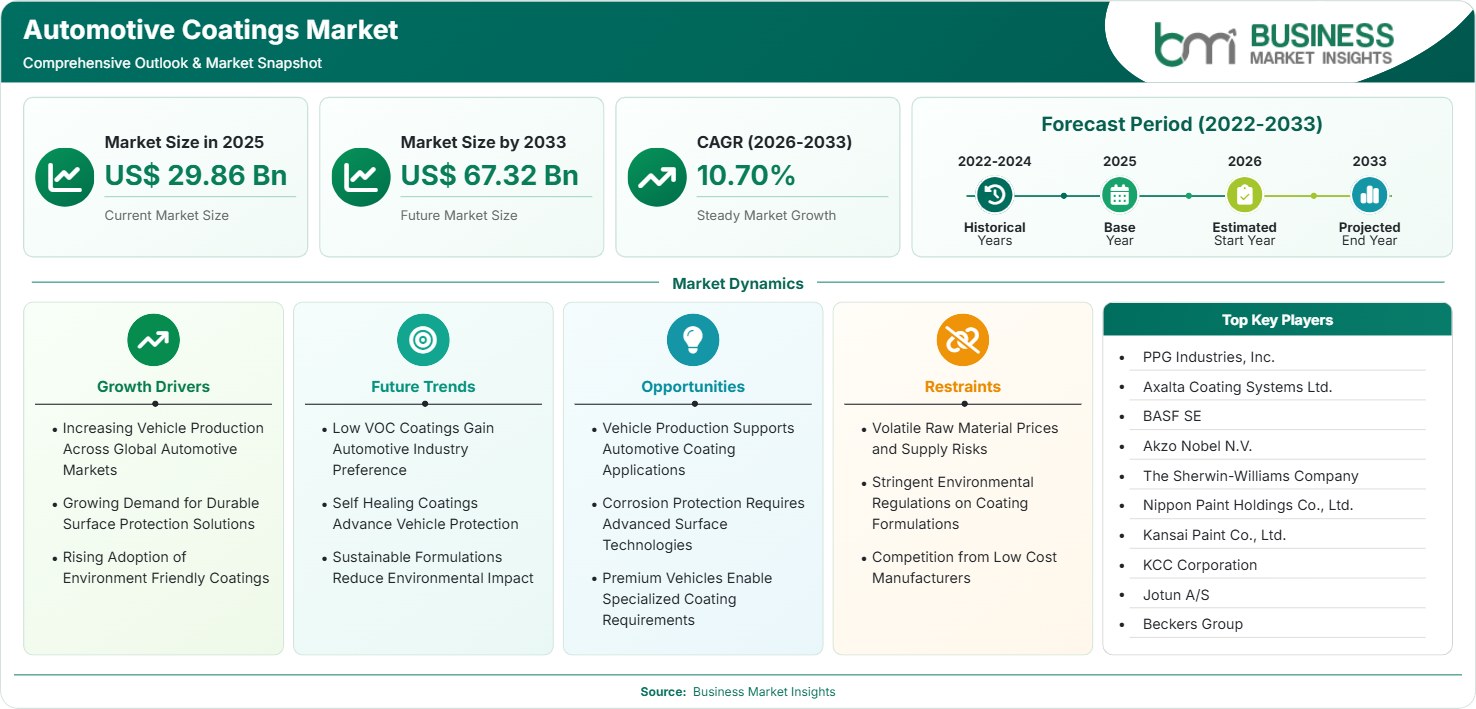
The Automotive Coatings Market size was valued at US$ 29.86 Billion in 2025 and is projected to reach US$ 67.32 Billion by 2033, growing at a CAGR of 10.7% during 2026–2033. Rising vehicle production, accelerating electric vehicle adoption, stricter emission regulations, and demand for durable, lightweight, and sustainable coating technologies are creating substantial opportunities across OEM and refinish applications.

Report Coverage
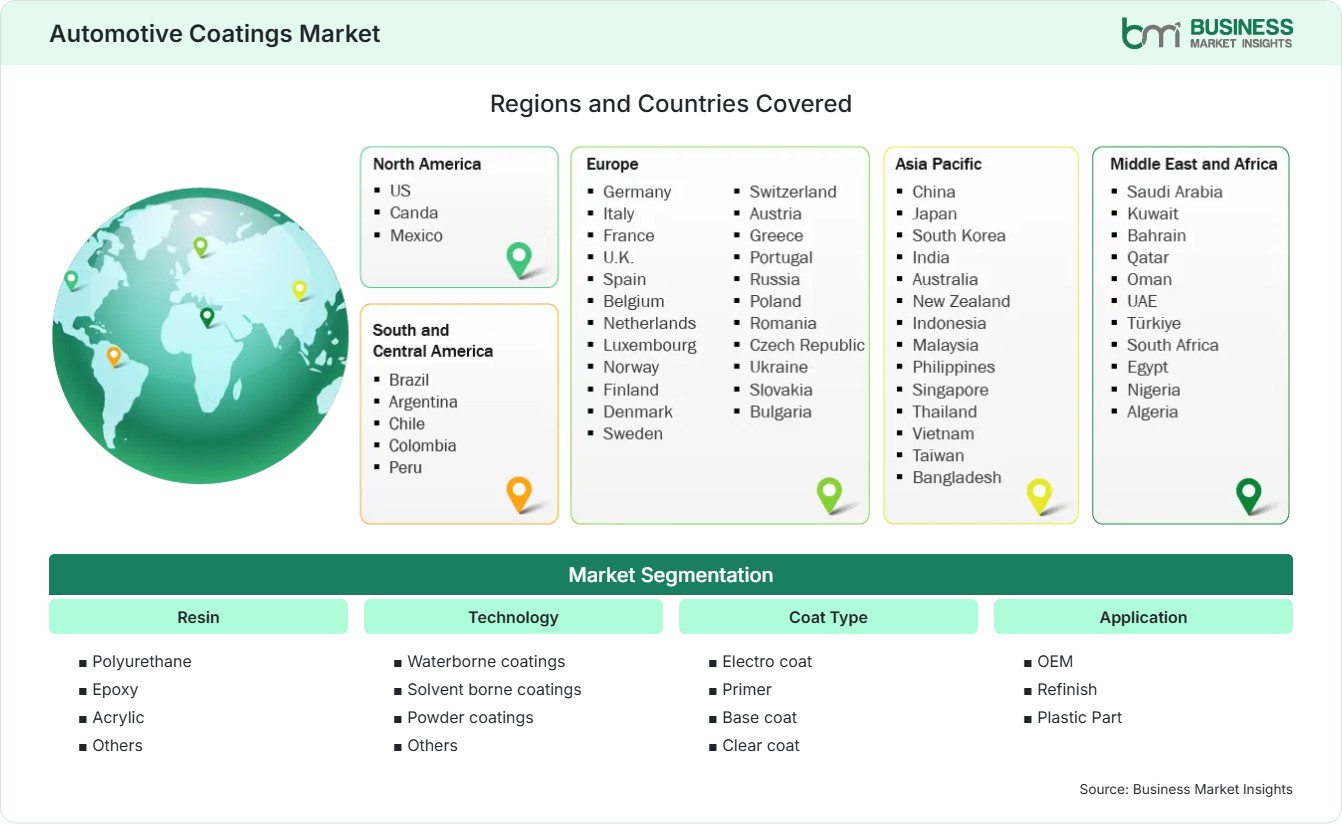
  • Resin: Polyurethane, Epoxy, Acrylic, Others
  • Technology: Waterborne coatings, Solvent borne coatings, Powder coatings, Others
  • Coat Type: Electro coat, Primer, Base coat, Clear coat
  • Application: OEM, Refinish, Plastic Part
US$ 29.86 Bn Market size in 2025
US$ 67.32 Bn Market Size by 2033
10.70% CAGR, 2026 - 2033
2026-2033 Forecast Period

AI Overview

Automotive Coatings Market Summary

  • North America Region: Holds a market share of 22%–25% in 2025, growing at a CAGR of 8.8%–9.4% during 2026–2033. Growth is supported by advanced OEM manufacturing, premium vehicle demand, sustainable coating adoption, corrosion protection requirements, and increasing investments in EV production facilities across regional automotive hubs. US market benefits from EV investments, advanced coating technologies, and refinish demand, expanding at 9.0%–9.6% CAGR.
  • Fastest Growing Region: Asia Pacific holds a market share of 45%–48% in 2025, growing at a CAGR of 12.2%–12.9% during 2026–2033. Vehicle manufacturing expansion, EV production leadership, industrialization, localized coating supply chains, and rising passenger vehicle ownership continue driving regional demand growth and innovation investments.
  • Leading Segment: OEM accounts for 65%–68% share in 2025 and is projected to expand at 10.2%–10.9% CAGR. Increasing vehicle assembly volumes, automation in paint shops, quality requirements, sustainability mandates, and growing production of electric vehicles support long-term segment expansion globally.
  • High Growth Segment: Waterborne coatings account for 35%–38% share in 2025 and are expected to advance at 11.8%–12.5% CAGR. Regulatory pressure on VOC emissions, improved application performance, OEM sustainability targets, and technology advancements encourage adoption across developed and emerging markets.
  • Key Market Opportunity: Expansion of EV manufacturing requires specialized thermal management, lightweight substrate compatibility, and battery protection coatings, creating premium product opportunities, higher margins, innovation partnerships, and long-term revenue diversification.
  • Major Market Players: PPG Industries, Inc.; Axalta Coating Systems Ltd.; BASF SE; Akzo Nobel N.V.; The Sherwin-Williams Company; Nippon Paint Holdings Co., Ltd.; Kansai Paint Co., Ltd.; KCC Corporation; Jotun A/S; Beckers Group.
Strategic Insights

Automotive Coatings Market: Strategic Insights

Automotive Coatings Market Strategic Framework
FREE PDF
Request your free sample
Request free sample
Stakeholder View

Key Takeaways

  • The value chain is becoming increasingly integrated as resin suppliers, coating formulators, OEMs, and paint-shop technology providers collaborate to optimize manufacturing efficiency and sustainability outcomes.
  • Waterborne technologies and OEM applications offer the strongest medium-term upside, supported by environmental regulations, vehicle production growth, and EV platform expansion.
  • Innovation is shifting toward multifunctional coatings capable of providing corrosion protection, enhanced aesthetics, scratch resistance, thermal insulation, and lightweight material compatibility.
  • Asia Pacific presents the most compelling expansion opportunity due to automotive production concentration, industrial policy support, and rising domestic vehicle consumption.
  • Strategic acquisitions and technology partnerships are increasing as global suppliers seek access to specialized coating technologies, regional distribution networks, and sustainability capabilities.
  • Digital color management, AI-assisted formulation development, and predictive maintenance technologies are emerging as differentiators for premium coating suppliers.
Geographic Outlook

Automotive Coatings Market Regional Highlights

North America Automotive Coatings Market

North America accounts for 22%–25% of the Automotive Coatings Market share in 2025 and is forecast to expand at 8.8%–9.4% CAGR through 2033. Regional demand is driven by vehicle customization, strong refinish activity, growth in EV manufacturing, and adoption of environmentally compliant coating technologies. The United States dominates consumption, while Mexico benefits from automotive production relocation and export-oriented manufacturing. Investments in automated paint shops and advanced coating systems continue strengthening regional competitiveness and supporting premium product adoption across vehicle categories.

  • EV manufacturing investments increase demand for battery-compatible coating systems and advanced corrosion protection solutions.
  • Premium vehicle sales encourage adoption of specialty coatings with enhanced appearance retention and scratch resistance.
  • Refinish channels benefit from aging vehicle fleets and growing repair activities across commercial and passenger vehicles.
  • Sustainability regulations accelerate transition toward waterborne and low-emission coating technologies.

US Automotive Coatings Market

The United States represents approximately 72%–76% of North American demand and is projected to register a 9.0%–9.6% CAGR through 2033. Large-scale automotive production, strong aftermarket spending, and growing investment in EV facilities support market expansion. Advanced manufacturing infrastructure enables adoption of automated painting technologies and digital quality-control systems. Rising demand for high-performance coatings in light trucks, SUVs, and luxury vehicles further strengthens supplier opportunities across OEM and refinish segments.

  • Federal and state sustainability standards encourage low-VOC formulation development and broader waterborne coating implementation.
  • Growth in electric vehicle manufacturing expands demand for thermal-management and substrate-specific coating technologies.
  • High consumer expenditure on vehicle maintenance supports steady refinish coating consumption.
  • Automation investments improve coating efficiency, consistency, and material utilization across manufacturing facilities.

Europe Automotive Coatings Market

Europe holds a 21%–24% share in 2025 and is expected to grow at 8.5%–9.2% CAGR. Stringent environmental policies, premium vehicle production, and advanced manufacturing standards shape regional demand patterns. Germany remains the leading market, while Eastern European manufacturing hubs support volume growth. The region continues investing in sustainable paint-shop operations and resource-efficient technologies. Demand for innovative coatings is reinforced by electric vehicle production and increasing use of lightweight automotive materials requiring specialized surface treatments.

  • Germany leads regional consumption, supported by premium automotive manufacturing and strong export activity.
  • Poland and Hungary rank among faster-growing production locations, supported by automotive investments.
  • Circular economy initiatives promote development of environmentally responsible coating formulations.
  • OEMs increasingly prioritize coatings that reduce energy consumption during application and curing.

Asia Pacific Automotive Coatings Market

Asia Pacific holds a 45% to 48% share in 2025 and is projected to grow at the fastest rate, with a 12.2% to 12.9% CAGR. China continues to be the world’s largest automobile manufacturing hub; however, India and Southeast Asia provide rapid production growth. Increased penetration of passenger cars, improved supply chain management, and the rise of electric vehicles are driving demand. Asia Pacific attracts major manufacturing investments for coatings owing to cost efficiency and a large consumer base. Market share growth in Asia Pacific region becomes dominant due to its production size.

  • China remains the leading country owing to dominant vehicle manufacturing capacity and EV production leadership.
  • India represents one of the fastest-growing markets, supported by production incentives and rising vehicle ownership.
  • Increasing localization reduces supply chain risks and enhances coating availability.
  • Expansion of OEM production stimulates demand for advanced primer, base coat, and electro coat systems.
  • Rapid industrialization supports new production facilities and technology deployment.

Rest of World Automotive Coatings Market

Rest of World makes up 9%–11% market share in 2025 and is expected to grow at a 9.6%–10.3% CAGR until 2033. South and Central America gain an advantage due to the automotive assembly and trade ties of Brazil and Mexico. As for the Middle East and Africa, demand is driven by industrial diversification, infrastructure development, and an increasing number of vehicles. While less extensive than other markets, they present good options for greenfield business expansion and distribution network development.

  • Brazil leads South American demand due to established vehicle production and aftermarket activity.
  • Argentina demonstrates growth potential supported by industrial modernization initiatives.
  • Saudi Arabia and the UAE drive Middle Eastern demand through manufacturing diversification strategies.
  • South Africa remains a key African automotive production center serving regional markets.
  • Rising vehicle ownership strengthens long-term consumption of maintenance and refinish coatings.
Global Market Geography
FREE PDF
Request your free sample
Request free sample
Segment Analysis

Automotive Coatings Market Segmentation

Resin

Resin technology constitutes a considerable part of product formulation needs. It captures 30%-33% market share in 2025 and grows at a CAGR of 10.5%-11.2%. The scope of the Automotive Coatings market under resin technology is growing as manufacturers focus on durability, adhesion performance, and chemical resistance.

  • Polyurethane: Delivers excellent durability, gloss retention, weather resistance, and scratch protection, making it a preferred option for high-performance vehicle finishing applications.
  • Epoxy: Widely used where corrosion protection and strong substrate adhesion are critical, particularly within primer systems and protective coating layers.
  • Acrylic: Supports color stability, appearance quality, and processing efficiency, making it suitable for passenger vehicle coating applications requiring premium aesthetics.

Technology

Technological choice affects compliance with environmental regulations and efficiency. This category accounts for 34%–37% market share by 2025 and grows at a CAGR of 11.2%–11.9%. Trends within the Automotive Coatings Market increasingly include the adoption of eco-friendly technologies that reduce VOC emissions while maintaining performance and production productivity.

  • Waterborne coatings: Rapidly gaining acceptance owing to environmental compliance advantages, improved formulation technology, and strong OEM sustainability commitments.
  • Solvent-borne coatings: Continue serving applications requiring proven performance, process familiarity, and compatibility with established manufacturing facilities.
  • Powder coatings: Benefit from minimal waste generation, material efficiency, and strong durability characteristics across selected automotive component applications.

Coat Type

Coat type specifications depend on the need for protection, looks, and functional efficiency. The market holds 27% to 30% market share in 2025 and witnesses 10.4% to 11.0% CAGR. Innovations in each layer have improved coating performance and resistance.

  • Electro coat: Provides foundational corrosion resistance and uniform coverage, making it essential for long-term vehicle durability requirements.
  • Primer: Enhances substrate adhesion while improving surface preparation and protective coating system performance.
  • Base coat: Delivers vehicle color characteristics and appearance differentiation while supporting brand-specific design requirements.
  • Clear coat: Improves gloss retention, UV resistance, and scratch protection, extending vehicle appearance quality throughout ownership.

Application

Application will continue to be the largest segment, with 65%–68% market share, and is projected to grow at a CAGR of 10.2%–10.9%. According to the Automotive Coatings Market report, OEM requirements still dominate owing to the high volumes of vehicle production and coating applications.

  • OEM: Generates the greatest demand through vehicle manufacturing operations requiring comprehensive multilayer coating systems and consistent quality standards.
  • Refinish: Benefits from collision repair activity, vehicle aging, customization preferences, and expanding automotive service networks.
  • Plastic Part: Increasingly important as vehicle lightweighting strategies expand the use of plastic substrates requiring specialized coating technologies.
Market Forces

Automotive Coatings Market Dynamics

Key Market Drivers

Expansion of Global Vehicle and EV Production

The increasing manufacture of automobiles is another major driver for demand in the market. The world’s automotive production continues to shift toward electric cars, which have unique coating needs for their battery housings, lightweight materials, and thermal systems. Growth in the market is highly correlated with investment by OEMs in new assembly plants, particularly in Asia. The increased consumer preference for vehicles has led to greater demand for multiple-layer coatings, such as electrocoat, primer, and clear coat. Automotive Coatings Market trends also reflect increasing technical requirements for corrosion resistance and durability as vehicle lifecycles lengthen. These factors collectively strengthen demand for coatings throughout the automotive manufacturing ecosystem.

Stricter Environmental Regulations Supporting Innovation

Authorities regulating in North America, Europe, and Asia have been getting increasingly stringent with VOC emission regulations. This is because such requirements compel manufacturers to adopt waterborne coatings, powder coatings, and high solids technology at a much faster pace. In addition to compliance with emission levels, sustainability has evolved in its application to purchasing decisions at some of the world’s top vehicle manufacturers. Organizations that can produce low-emission products will have the upper hand and, in doing so, will help OEMs achieve their environmental objectives. There has been continued investment in technology related to resin chemistry, curing methods, and minimal-waste processes. These trends ensure growth in market value by shifting demand toward more efficient coatings.

Demand for Premium Vehicle Appearance and Protection

Consumers are becoming more concerned about the aesthetics, longevity, and finish quality of automobiles. Advanced finishes help maintain gloss, provide color uniformity and UV resistance, and resist scratching. Both luxury car makers and regular companies are developing advanced finishes that will require advanced coating systems. The other aspect is consumer acceptance of keeping the car looking good for longer through refinishing. Increased expectations for product performance have spurred the development of coating formulations and technologies. As automotive design becomes more differentiated, demand grows for customized color solutions and surface treatments that enhance both functionality and brand appeal.

Key Market Opportunities

Specialized EV Coating Platforms

The increasing production of electric vehicles opens new possibilities for coatings beyond their typical application. Battery packs must be protected from thermal damage and fire and require lightweight substrates, necessitating coating innovations. Manufacturers of coatings for electric vehicles will benefit from premium prices and close relationships with original equipment manufacturers. The Automotive Coatings Market forecasts highlight that value is driven by differentiating technology rather than volume. With the emergence of new electric vehicle platforms from automotive manufacturers, coating companies can get involved early in the development cycle, thereby strengthening customer relationships and driving more specification sales worldwide.

Growth Potential in Emerging Manufacturing Hubs

There are nations such as India, Vietnam, Indonesia, Saudi Arabia, and Mexico where investments in the automotive industry can be made due to incentive schemes. The rise in manufacturing capacity results in increased demand for paint and technical services that would become available in the region. Regional presence helps improve responsiveness and lower logistics costs. An increase in vehicle ownership within the country increases consumption potential across both the original equipment manufacturer and refinish segments. Such countries are relatively unexplored for capturing early market positions and establishing durable customer relationships.

Digitalization and Smart Paint-Shop Solutions

Automation, artificial intelligence, and process analytics are changing coating application efficiency. Intelligent paint plants minimize material waste, ensure uniform quality, and reduce energy use. Color-matching technology through digital systems increases client satisfaction in refinish operations. Coating suppliers tend to combine their offerings with software-based services and process optimization know-how. In this way, they can generate additional value for themselves outside the sale of materials. Predictive maintenance and real-time monitoring solutions help improve operational efficiency and are therefore popular among manufacturers striving to cut costs.

Market Restraints and Challenges

Raw Material Price Volatility

Factor: The coatings manufacturing sector is very dependent on petrochemical products, specialty chemicals, pigments, and car resins. Impact: Price volatility creates inconsistent margins and makes future buying hard to plan. Usually, companies experience problems passing on higher prices to their clients, particularly when under contracts with fixed supplies. Any disruptions in the supply chains of titanium dioxide, solvents, and resin raw materials can significantly affect manufacturing economics. Price volatility is an obstacle to making ambitious pricing strategies and investment plans. These pressures require suppliers to strengthen sourcing diversification, inventory management, and formulation flexibility to maintain competitiveness.

Complex Regulatory Compliance Requirements

Factor: There are considerable differences in environmental, occupational safety, and chemical registration requirements among various locations. Impact: Compliance expenses are higher. Organizations conducting business around the globe must modify their products and manufacturing processes to comply with multiple regulatory schemes simultaneously. Small suppliers often struggle to meet regulations due to significant compliance costs, which can hamper commercialization efforts. Continuous reformulation of products makes the process even more difficult. Maintaining competitiveness while satisfying evolving regulations remains a persistent challenge across the industry.

Company Analysis

Competitive Landscape

The Automotive Coatings Market analysis shows competition centered on sustainability, OEM relationships, global manufacturing networks, and advanced formulation capabilities.

Company Name

Overview

Products and Services relevant to this market

PPG Industries, Inc.

Global coatings leader with extensive automotive OEM and refinish presence across major vehicle-producing regions.

OEM coatings, refinish systems, electro coats, color management solutions, specialty automotive finishes.

Axalta Coating Systems Ltd.

Focuses on performance coatings and advanced color technologies serving global automotive customers.

OEM coatings, refinish paints, powder coatings, digital color matching solutions.

BASF SE

Major chemical manufacturer with strong research capabilities and automotive coating technologies.

Waterborne coatings, refinish products, OEM coatings, sustainable coating formulations.

Akzo Nobel N.V.

International coatings supplier known for premium automotive finishing technologies.

Vehicle refinishing systems, OEM coatings, color solutions, sustainable coating products.

The Sherwin-Williams Company

Diversified coatings company serving industrial and transportation sectors worldwide.

Automotive coatings, primers, refinish coatings, protective and specialty finishes.

Nippon Paint Holdings Co., Ltd.

Leading Asian coatings supplier with strong automotive industry participation.

Automotive OEM coatings, refinish products, performance coating technologies.

Kansai Paint Co., Ltd.

Significant supplier with strong presence across Asian automotive markets.

Vehicle coatings, industrial coatings, refinish systems, low-emission products.

KCC Corporation

Korean coatings producer serving automotive and industrial manufacturing sectors.

Automotive topcoats, primers, electro coats, specialty coatings.

Jotun A/S

International coatings company with expanding industrial coatings capabilities.

Protective coatings, specialty automotive-related coating technologies and services.

Beckers Group

Specialist coatings provider recognized for innovation and sustainability initiatives.

Coil and specialty coatings, advanced surface technologies for transportation applications.

Trust & Transparency

Research Methodology

The market analysis combines proprietary research with secondary data from government agencies, company disclosures, regulatory filings, industry databases and expert interviews. Market estimates are validated through data triangulation, cross-market benchmarking and analyst review.

View Full Research Methodology

Questions Answered

Frequently Asked Questions

What role do coatings play in electric vehicles?

Coatings support battery protection, thermal management, lightweight material compatibility, corrosion resistance, and exterior appearance, making them essential across EV manufacturing processes.

How does the Automotive Coatings Market Report help stakeholders?

It provides insight into regional opportunities, segment performance, competitive positioning, technology shifts, investment priorities, and emerging demand patterns across automotive applications.

Why are waterborne coatings gaining popularity?

Waterborne coatings help reduce VOC emissions while providing strong performance characteristics, making them attractive for manufacturers seeking regulatory compliance and sustainability improvements.

Which region offers the strongest long-term opportunities?

Asia Pacific offers the strongest opportunities due to its dominant automotive production base, expanding EV manufacturing ecosystem, and growing vehicle ownership across developing economies.

What is driving demand for advanced automotive coatings?

Growth is being driven by higher vehicle production, electric vehicle manufacturing, environmental regulations, demand for premium aesthetics, and increasing requirements for corrosion protection and durability.

Access the Full Automotive Coatings Market Report

Get segment-level forecasts, regional estimates, competitive benchmarking, company profiles and downloadable Excel datasets.

Access the full Automotive Coatings Market Report
350 pages PDF & Excel | 2026-09-16
Similar Research

Related Market Reports