Market Summary
Executive Summary and Global Market Analysis
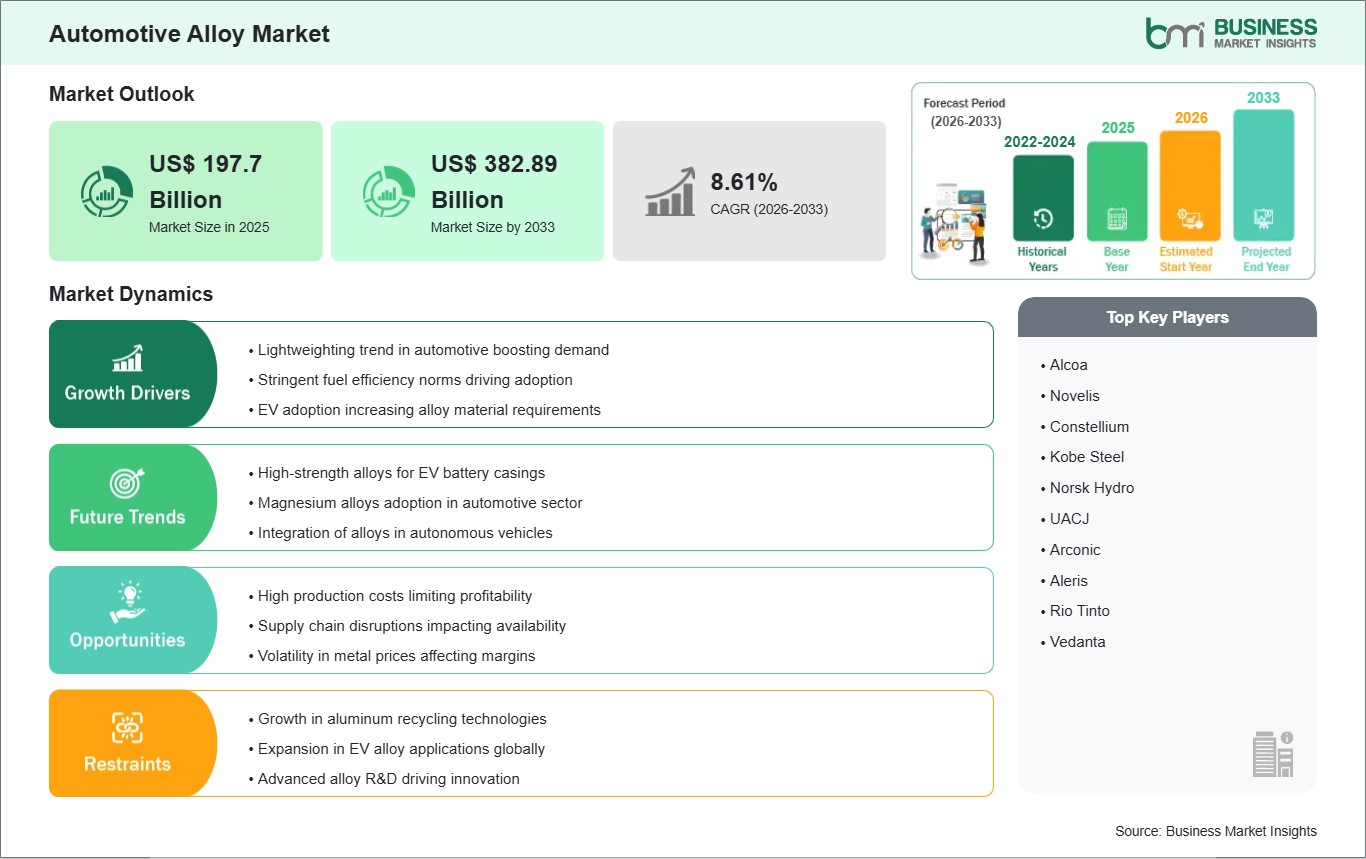
Automotive alloys are specialized metal materials used in vehicle manufacturing to improve strength, durability, corrosion resistance, and weight reduction. Common automotive alloys include aluminum, magnesium, titanium, and steel alloys, which are widely used in engine components, wheels, body panels, and structural parts. These materials help manufacturers improve fuel efficiency, enhance vehicle performance, and meet safety requirements. The market is growing as automotive companies focus on lightweight vehicle designs, increasing production of electric vehicles, and stricter regulations related to emissions and fuel economy. The demand for advanced materials is also rising as manufacturers seek to improve vehicle efficiency without compromising strength and durability.
There are some challenges that could slow market growth. The production of advanced alloys often involves high manufacturing costs and complex processing techniques. Fluctuations in raw material prices can affect profitability and increase supply chain uncertainty. Lightweight materials such as magnesium and titanium alloys can be expensive compared to traditional steel alloys, limiting their adoption in cost-sensitive vehicle segments. In addition, manufacturers must balance weight reduction goals with safety and performance requirements, which can increase development costs and engineering complexity. These factors may create barriers to broader market adoption.
Even with these challenges, the market is expected to grow as the automotive industry moves toward lighter, more efficient, and sustainable vehicles. New opportunities are emerging through the development of low-carbon alloys, recycled metal solutions, and advanced manufacturing technologies. Electric vehicles are creating significant demand for lightweight materials that help extend driving range and improve energy efficiency. Research into high-strength alloys and innovative metal processing methods is also supporting the development of next-generation automotive components. These advancements are expected to strengthen the long-term outlook for the Automotive Alloy market.
Segment Analysis
Automotive Alloy Market Segmentation
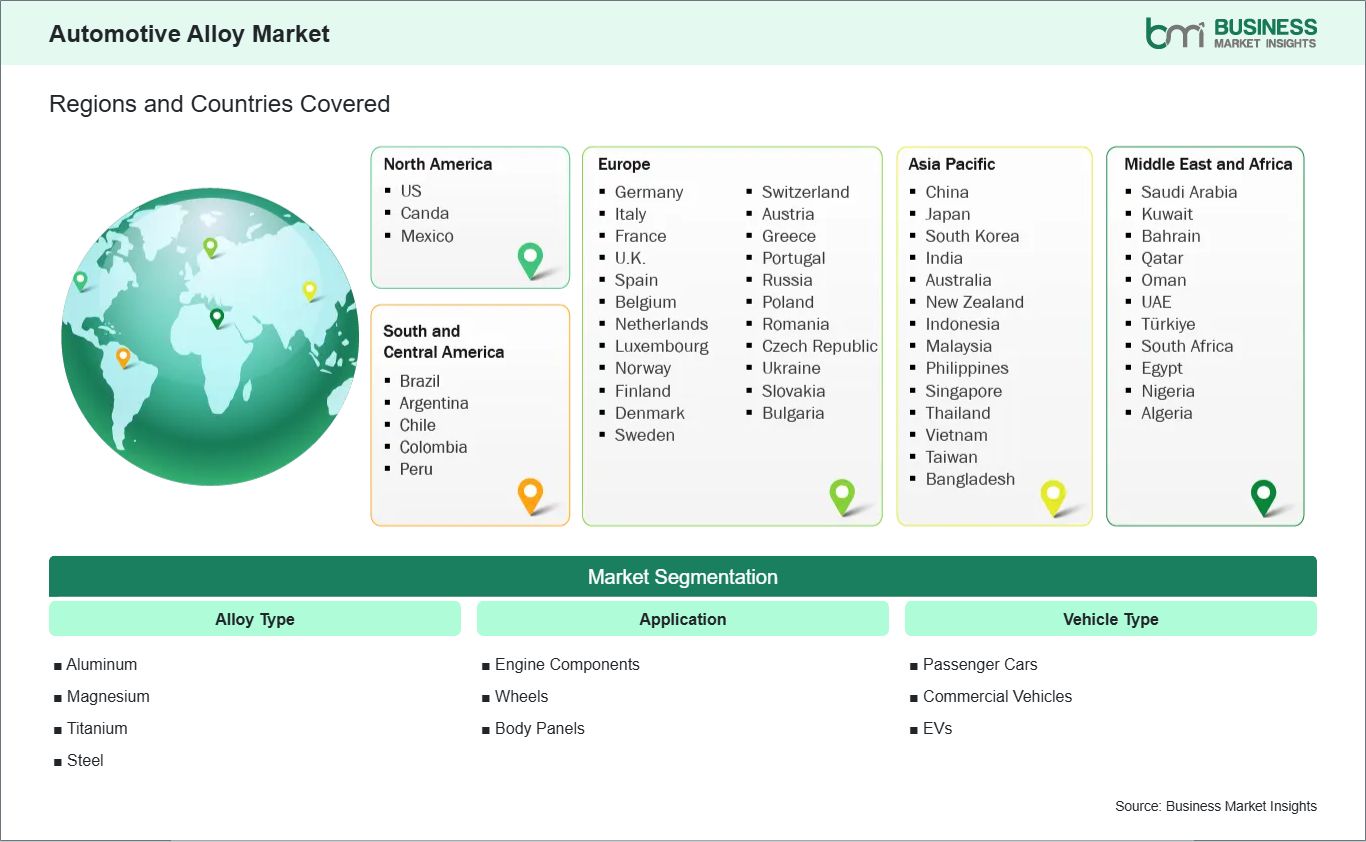
The Automotive Alloy market is segmented based on alloy type, application, and vehicle type, reflecting the diverse material requirements across modern vehicle manufacturing.
By Alloy Type
- Aluminum: Widely used for lightweight vehicle structures and improved fuel efficiency
- Magnesium: Preferred for applications requiring significant weight reduction and high strength-to-weight ratio
- Titanium: Used in high-performance components due to excellent strength, durability, and corrosion resistance
- Steel: Remains a major material for structural applications because of its strength, affordability, and versatility
By Application
- Engine Components: Used to improve performance, durability, and thermal efficiency
- Wheels: Supports lightweight vehicle design and enhanced driving performance
- Body Panels: Helps reduce vehicle weight while maintaining structural integrity and safety
By Vehicle Type
- Passenger Cars: Largest demand segment driven by high production volumes and fuel-efficiency requirements
- Commercial Vehicles: Uses durable alloys to improve performance and operational efficiency
- EVs: Increasing adoption of lightweight alloys to extend driving range and improve battery efficiency
Market Forces
Automotive Alloy Market Drivers and Opportunities
Growing Demand for Lightweight and Fuel-Efficient Vehicles
The demand for automotive alloys is increasing as vehicle manufacturers focus on reducing vehicle weight to improve fuel efficiency and meet environmental regulations. Lightweight materials such as aluminum and magnesium alloys help lower overall vehicle mass, contributing to reduced fuel consumption and lower emissions. Governments across many regions continue to introduce stricter emission standards, encouraging manufacturers to adopt advanced materials that support regulatory compliance.
The growing popularity of electric vehicles is further strengthening demand for lightweight alloys because reducing vehicle weight can improve battery performance and driving range. Automotive manufacturers are increasingly replacing traditional materials with advanced alloys in body structures, wheels, and engine components. As competition within the automotive industry intensifies, manufacturers are also focusing on improving vehicle performance, safety, and sustainability. These trends continue to support the adoption of innovative alloy solutions across multiple vehicle categories and applications.
Advancements in Sustainable and High-Performance Alloy Technologies
The Automotive Alloy market is creating new opportunities through the development of sustainable materials and advanced alloy technologies. Manufacturers are investing in recycled metal solutions and low-carbon production processes to reduce environmental impact and support sustainability objectives. Growing interest in circular economy practices is encouraging the use of recycled aluminum and other secondary materials in automotive production.
Technological advancements are also improving the performance of automotive alloys through enhanced strength, corrosion resistance, and durability. Research into advanced alloy compositions and manufacturing methods is enabling the production of lighter and stronger components for next-generation vehicles. Electric vehicle manufacturers are particularly interested in materials that support lightweight construction while maintaining safety and structural performance. As sustainability and innovation become increasingly important across the automotive sector, advanced alloy technologies are expected to create significant long-term growth opportunities for the market.
Size and Share Analysis
Automotive Alloy Market Size and Share Analysis
The Automotive Alloy market size is expected to reach US$ 382.89 billion by 2033 from US$ 197.7 billion in 2025. The market is estimated to record a CAGR of 8.61% from 2026 to 2033.
By alloy type, aluminum accounts for a significant share due to its lightweight properties, corrosion resistance, and widespread use in vehicle structures and body components. Steel continues to maintain strong demand because of its affordability and structural strength, while magnesium and titanium alloys are gaining attention in high-performance and lightweight vehicle applications.
By application, body panels dominate the market owing to increasing efforts to reduce vehicle weight without compromising safety. Engine components continue to witness strong demand for improved thermal and mechanical performance, while alloy wheels are experiencing growing adoption due to their contribution to vehicle efficiency and aesthetics.
Report Coverage
Automotive Alloy Market Report Coverage and Deliverables
The "Automotive Alloy Market Size and Forecast (2022-2033)" report provides a detailed analysis of the market covering below areas:
- Market size and forecast at global, regional, and country levels for all the key market segments covered under the scope
- Market trends, as well as market dynamics such as drivers, restraints, and key opportunities
- Market analysis covering key market trends, global and regional framework, major players, regulations, and recent market developments
- Industry landscape and competition analysis covering market concentration, heat map analysis, prominent players, and recent developments for the market
- Detailed company profiles, including SWOT analysis
Geographic Insights
Automotive Alloy Market Geographic Insights
The Automotive Alloy Market shows diverse regional adoption patterns influenced by vehicle manufacturing activity, lightweight material adoption, and increasing focus on fuel efficiency and sustainability.
North America, being a developed region, has a well-established automotive industry and a high rate of adoption of advanced materials in vehicle manufacturing. The region comprises the United States and Canada, where manufacturers are investing in lightweight vehicle designs and electric vehicle production. The region focuses on improving fuel efficiency, reducing emissions, and enhancing vehicle performance through the use of advanced alloys. It has strong manufacturing infrastructure and research capabilities, enabling consistent adoption of aluminum, steel, and other specialized alloys across automotive applications.
Asia Pacific is growing significantly, driven by expanding automotive production and increasing demand for passenger and electric vehicles. The region comprises countries such as China, India, and Japan, where large-scale vehicle manufacturing and industrial development are creating strong demand for automotive alloys. The region focuses on improving manufacturing efficiency and supporting lightweight vehicle production. The growth of electric vehicle manufacturing, expanding metal processing capabilities, and supportive government initiatives are contributing to the expansion of the Automotive Alloy Market across the region.
Both regions are contributing significantly to the growth of the Automotive Alloy Market, focusing on advanced manufacturing technologies, increasing vehicle production, and rising demand for lightweight and high-performance materials.
Industry Activity
Recent Developments
The Automotive Alloy Market is analyzed using a mix of primary and secondary research sources, including corporate publications, industry associations, and verified databases. This approach ensures accurate tracking of innovation trends and strategic developments influencing the market.
- In April 2025, Nemak and Hydro strengthened their collaboration to accelerate the adoption of low-carbon aluminum solutions for automotive applications. The partnership focuses on increasing the use of post-consumer scrap and developing foundry alloy products with a lower carbon footprint for vehicle manufacturing. The initiative reflects the industry's growing focus on sustainable alloy technologies and circular economy practices.
- In June 2025, RUSAL announced the commercial production of new low-carbon Primary Equivalent Foundry Alloys (PEFA) for the automotive industry. The alloys contain recycled metal content and are designed for automotive applications such as alloy wheels and structural components. The development supports growing demand for sustainable automotive alloy solutions while improving circularity in vehicle manufacturing.
Trust & Transparency
Research Methodology
The market analysis combines proprietary research with secondary data from government agencies, company disclosures, regulatory filings, industry databases and expert interviews. Market estimates are validated through data triangulation, cross-market benchmarking and analyst
review.
View Full Research Methodology
Key Sources Referred:
World Bank - Global Trade IndicatorsWorld Trade Organization (WTO)International Monetary Fund (IMF)International Trade Administration (ITA)Company WebsitesCompany Annual ReportsCompany Investor Presentations