Market Summary
Executive Summary and Global Market Analysis
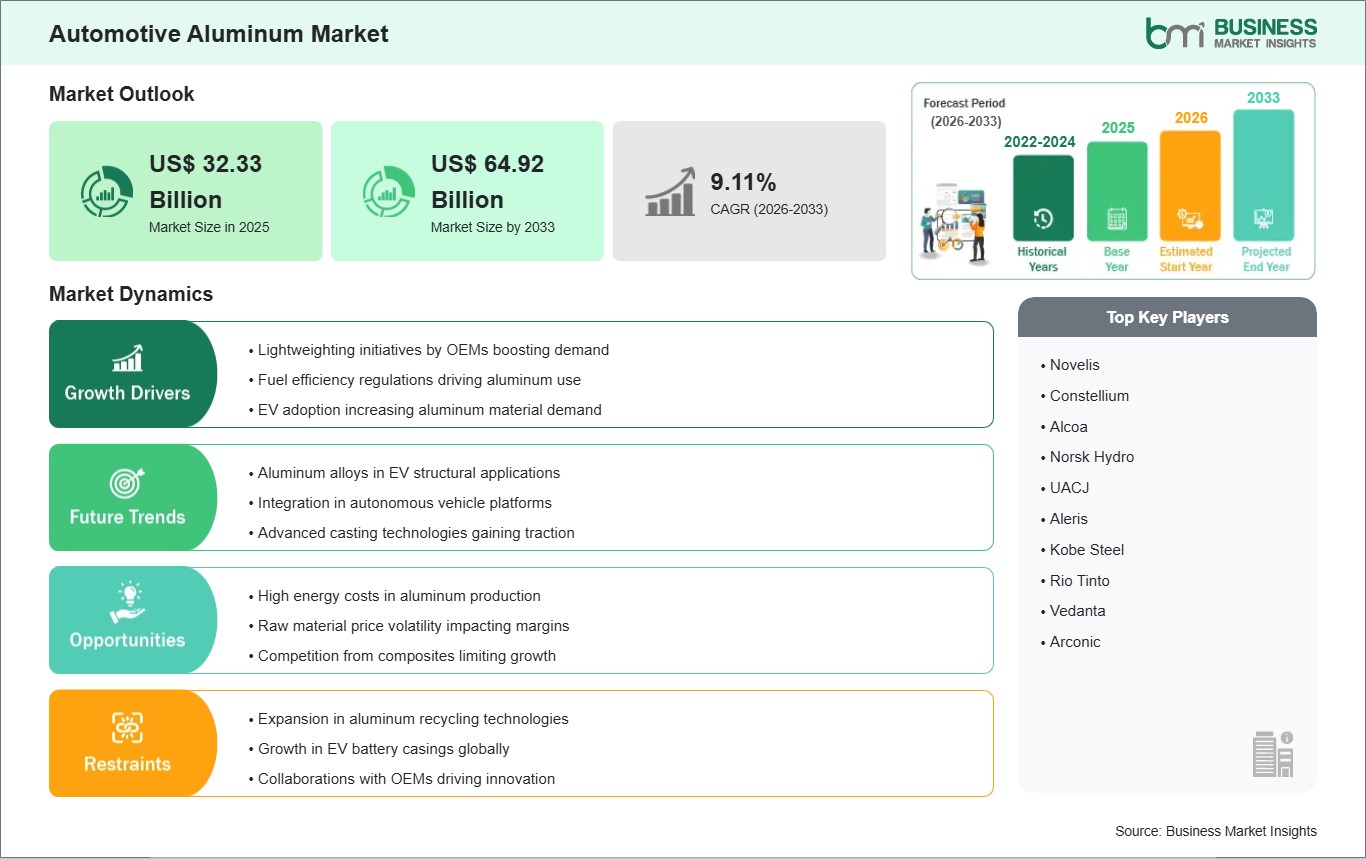
Automotive aluminum is widely used in vehicle manufacturing to reduce weight, improve fuel efficiency, and enhance overall vehicle performance. It is available in various forms such as cast aluminum, rolled aluminum, and extruded aluminum, each designed for specific automotive applications. These materials are commonly used in engines, wheels, body panels, and chassis components. The market is growing as automotive manufacturers focus on lightweight vehicle designs, stricter fuel economy regulations, and increasing production of electric vehicles. The demand for aluminum continues to rise because it offers a combination of strength, corrosion resistance, and recyclability that supports modern vehicle development.
There are some challenges that could slow market growth. Aluminum production is energy intensive, and fluctuations in raw material and energy costs can affect manufacturing expenses. The higher cost of aluminum compared to traditional steel can limit adoption in some cost-sensitive vehicle segments. Automotive manufacturers also face technical challenges when integrating aluminum into complex vehicle structures, requiring specialized joining and fabrication techniques. Supply chain disruptions and volatility in global commodity markets may further affect material availability and pricing. These factors can create challenges for manufacturers seeking to expand aluminum usage across vehicle platforms.
Even with these challenges, the market is expected to grow as the automotive industry moves toward lighter, more efficient, and environmentally sustainable vehicles. New opportunities are emerging through advancements in aluminum processing technologies, recycling methods, and alloy development. Electric vehicle manufacturers are increasingly using aluminum to improve battery efficiency and extend driving range. Research into high-strength aluminum materials is also supporting the development of safer and more durable vehicle structures. As sustainability and vehicle efficiency remain key priorities, automotive aluminum is expected to play an increasingly important role in future vehicle manufacturing.
Segment Analysis
Automotive Aluminum Market Segmentation
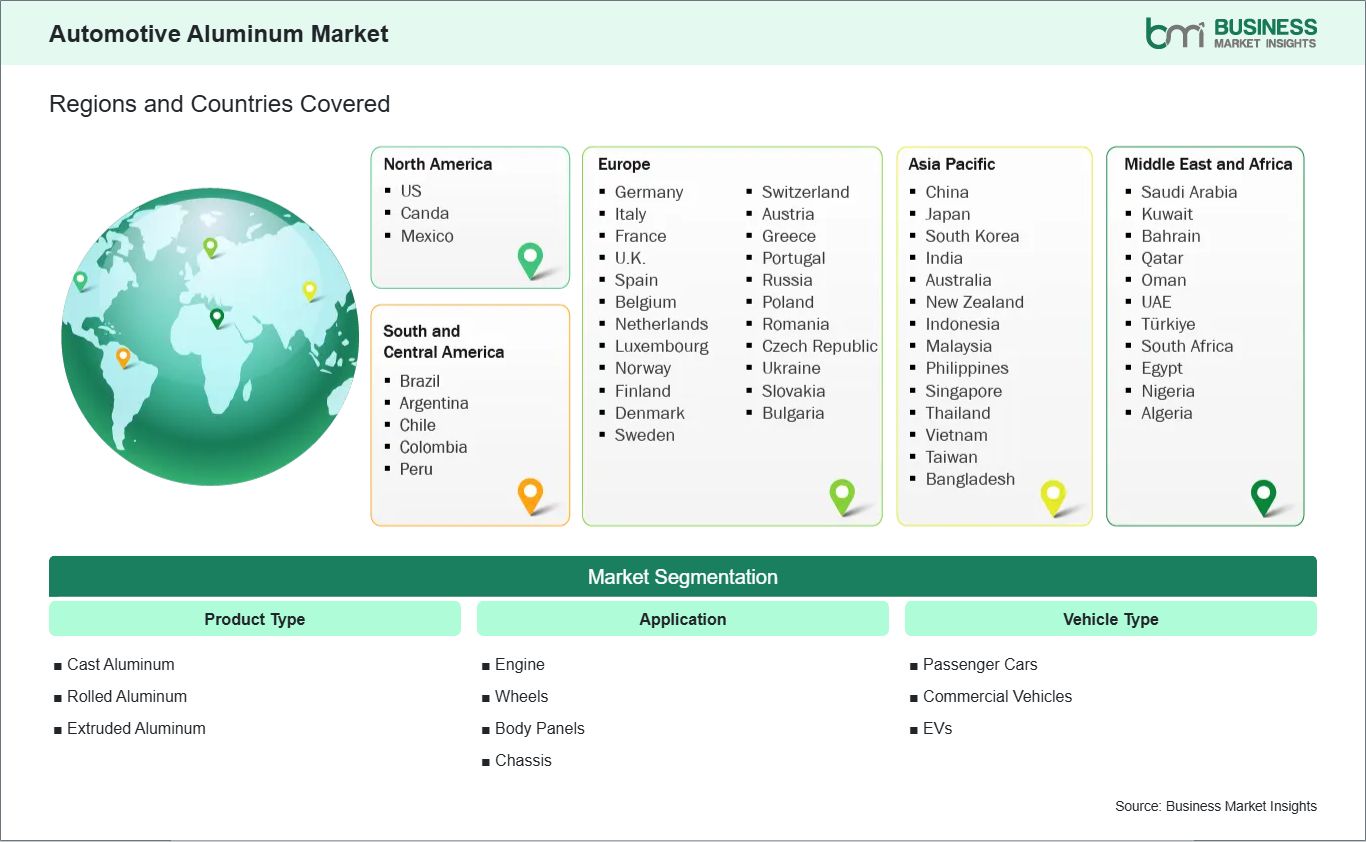
The Automotive Aluminum market is segmented based on product type, application, and vehicle type, reflecting the growing use of lightweight materials across modern vehicle manufacturing.
By Product Type
- Cast Aluminum: Widely used for complex automotive components requiring strength and durability
- Rolled Aluminum: Preferred for body structures and panels due to its lightweight characteristics and formability
- Extruded Aluminum: Used in structural applications that require high strength and design flexibility
By Application
- Engine: Supports lightweight engine designs and improved thermal performance
- Wheels: Enhances fuel efficiency and vehicle handling through weight reduction
- Body Panels: Reduces overall vehicle mass while maintaining structural integrity
- Chassis: Provides strength and durability for vehicle frameworks and structural systems
By Vehicle Type
- Passenger Cars: Represents the largest demand segment due to high production volumes and efficiency requirements
- Commercial Vehicles: Uses aluminum to improve payload capacity and fuel economy
- EVs: Increasing adoption driven by the need for lightweight materials that enhance battery performance and driving range
Market Forces
Automotive Aluminum Market Drivers and Opportunities
Rising Demand for Lightweight Vehicles and Emission Reduction
The demand for automotive aluminum is increasing as vehicle manufacturers focus on reducing vehicle weight to improve fuel efficiency and meet tightening environmental regulations. Lightweight materials help lower fuel consumption and reduce emissions while maintaining vehicle safety and performance standards. Governments across major automotive markets continue to implement regulations aimed at improving fuel economy and reducing carbon emissions, encouraging manufacturers to incorporate aluminum into vehicle designs.
The growing production of electric vehicles is also contributing to higher aluminum demand. Lightweight vehicle structures help improve battery efficiency and extend driving range, making aluminum an attractive material for electric mobility solutions. Automotive manufacturers are increasingly replacing heavier materials with aluminum in body panels, chassis systems, and powertrain components. As sustainability and energy efficiency become more important across the automotive industry, the use of automotive aluminum is expected to continue expanding across multiple vehicle categories and applications.
Advancements in Recycling and High-Strength Aluminum Technologies
The Automotive Aluminum market is creating new opportunities through innovations in recycling processes and advanced aluminum alloys. The automotive industry is placing greater emphasis on sustainable manufacturing practices, leading to increased use of recycled aluminum in vehicle production. Recycling aluminum requires significantly less energy compared to primary production, supporting environmental goals and reducing manufacturing costs.
At the same time, research into high-strength and advanced aluminum alloys is improving material performance and expanding potential applications. These innovations allow manufacturers to achieve greater weight reduction while maintaining durability and crash performance. Electric vehicle development is creating additional opportunities for specialized aluminum products that improve energy efficiency and structural integrity. Advances in manufacturing technologies, including precision casting and extrusion techniques, are further enhancing product capabilities. As the industry focuses on sustainability, lightweighting, and performance improvements, advanced aluminum solutions are expected to generate significant growth opportunities for the market.
Size and Share Analysis
Automotive Aluminum Market Size and Share Analysis
The Automotive Aluminum market size is expected to reach US$ 64.92 billion by 2033 from US$ 32.33 billion in 2025. The market is estimated to record a CAGR of 9.11% from 2026 to 2033.
By product type, cast aluminum accounts for a significant share due to its widespread use in engine components, transmission housings, and structural parts. Rolled aluminum continues to witness strong demand in body panel applications, while extruded aluminum is gaining importance in chassis systems and structural components that require strength and design flexibility.
By application, body panels dominate the market owing to increasing efforts to reduce vehicle mass and improve efficiency. Engine applications continue to generate substantial demand because of aluminum's thermal properties and lightweight characteristics, while chassis and wheel applications are expanding as manufacturers focus on enhancing vehicle performance and durability.
Report Coverage
Automotive Aluminum Market Report Coverage and Deliverables
The "Automotive Aluminum Market Size and Forecast (2022-2033)" report provides a detailed analysis of the market covering below areas:
- Market size and forecast at global, regional, and country levels for all the key market segments covered under the scope
- Market trends, as well as market dynamics such as drivers, restraints, and key opportunities
- Market analysis covering key market trends, global and regional framework, major players, regulations, and recent market developments
- Industry landscape and competition analysis covering market concentration, heat map analysis, prominent players, and recent developments for the market
- Detailed company profiles, including SWOT analysis
Geographic Insights
Automotive Aluminum Market Geographic Insights
The Automotive Aluminum Market shows diverse regional adoption patterns influenced by vehicle production levels, lightweight material demand, environmental regulations, and advancements in automotive manufacturing technologies.
North America, being a developed region, has a well-established automotive industry and a high rate of adoption of lightweight materials in vehicle production. The region comprises the United States and Canada, where manufacturers are investing in fuel-efficient and electric vehicle technologies. The region focuses on reducing vehicle emissions and improving energy efficiency through the use of advanced aluminum components. Strong manufacturing infrastructure, technological capabilities, and recycling systems support the widespread use of automotive aluminum across passenger cars, commercial vehicles, and electric vehicles.
Asia Pacific is growing significantly, driven by increasing vehicle production and expanding automotive manufacturing capabilities. The region comprises countries such as China, India, and Japan, where rising demand for fuel-efficient vehicles and rapid growth in electric mobility are creating strong opportunities for aluminum applications. The region focuses on improving manufacturing efficiency and supporting sustainable transportation initiatives. Expanding automotive supply chains, increasing industrial investments, and growing adoption of advanced materials continue to support market growth across the region.
Both regions are contributing significantly to the growth of the Automotive Aluminum Market, focusing on lightweight vehicle development, expanding electric vehicle production, and increasing adoption of sustainable manufacturing practices.
Industry Activity
Recent Developments
The Automotive Aluminum Market is analyzed using a mix of primary and secondary research sources, including corporate publications, industry associations, and verified databases. This approach ensures accurate tracking of innovation trends and strategic developments influencing the market.
- In January 2026, Norsk Hydro and Mercedes-Benz successfully scaled their strategic supply partnership, integrating low-carbon aluminum into the structural chassis and body panel stampings of new electric vehicle programs. The specialized alloy matrix blends renewable-energy primary aluminum with at least 25% post-consumer recycled scrap, dropping production-phase emissions down to a fraction of the historical global average. The commercial rollout demonstrates the rapid transition from experimental foundry testing to full-scale vehicle assembly line integration to comply with upcoming global environmental regulations.
- In April 2025, Nemak and Hydro strengthened their collaboration to advance low-carbon aluminum solutions for automotive manufacturing. The partnership focuses on increasing the use of post-consumer scrap and developing more sustainable foundry alloys for vehicle production. The initiative supports growing industry demand for lightweight and environmentally responsible aluminum materials used in automotive applications.
Trust & Transparency
Research Methodology
The market analysis combines proprietary research with secondary data from government agencies, company disclosures, regulatory filings, industry databases and expert interviews. Market estimates are validated through data triangulation, cross-market benchmarking and analyst
review.
View Full Research Methodology
Key Sources Referred:
World Bank - Global Trade IndicatorsWorld Trade Organization (WTO)International Monetary Fund (IMF)International Trade Administration (ITA)Company WebsitesCompany Annual ReportsCompany Investor Presentations