
Optical Coatings Market Outlook: Size, Share, Trends, Growth Analysis, Competitive Landscape & Forecast, 2026–2033

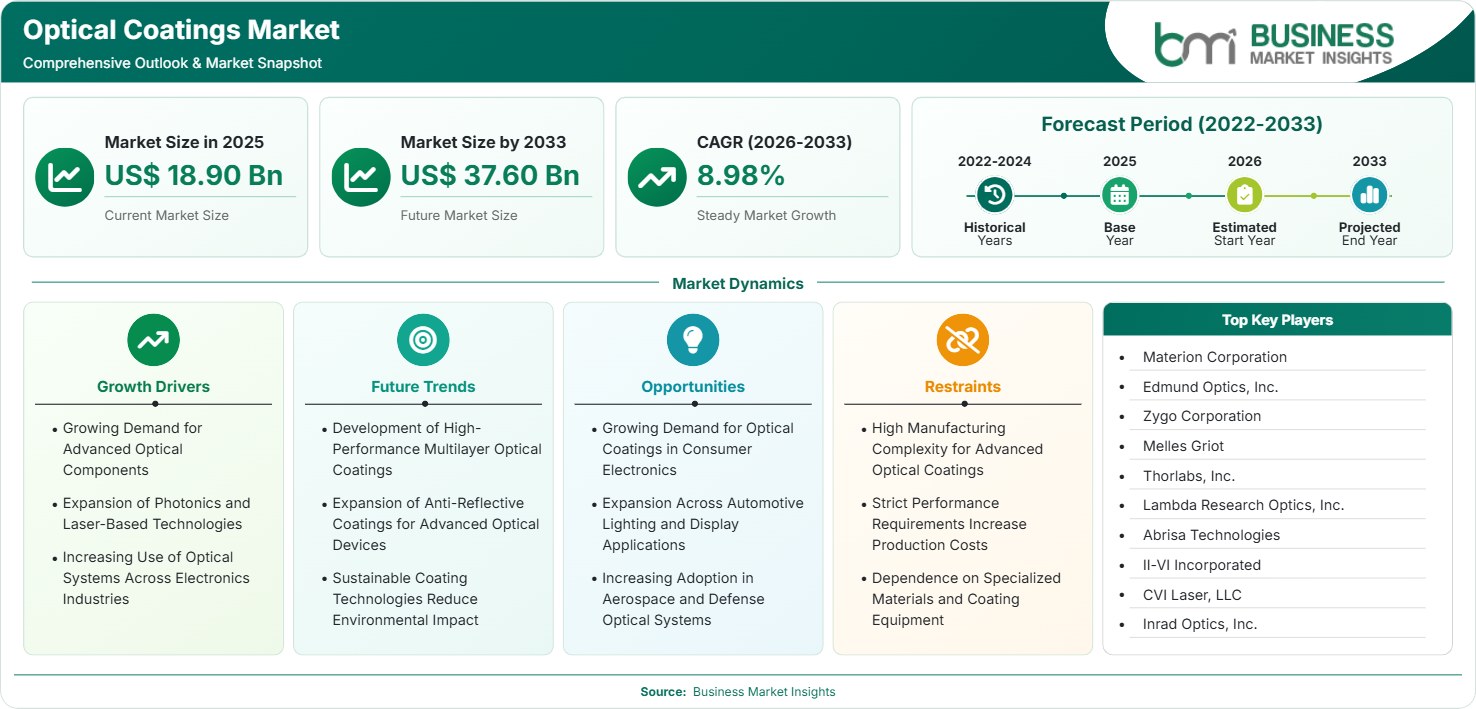
The Optical Coatings Market size was valued at US$ 18.90 Billion in 2025 and is projected to reach US$ 37.60 Billion by 2033, growing at a CAGR of 8.98% during 2026–2033, driven by photonics expansion, advanced optical components, electronics miniaturization, laser systems, automotive displays, and aerospace applications.

Report Coverage
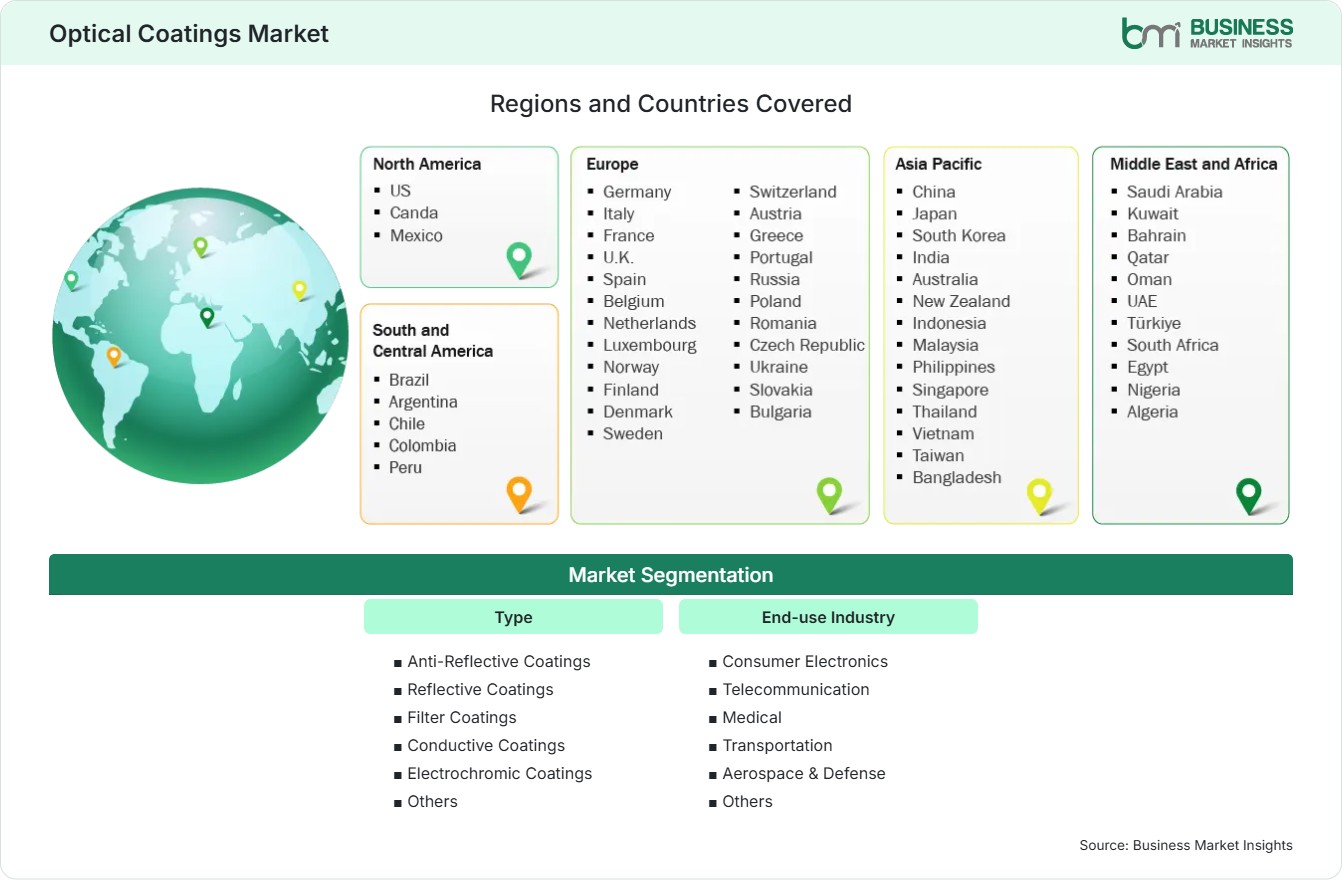
  • Type: Anti-Reflective Coatings, Reflective Coatings, Filter Coatings, Conductive Coatings, Electrochromic Coatings, Others
  • End-use Industry: Consumer Electronics, Telecommunication, Medical, Transportation, Aerospace & Defense, Others
US$ 18.90 Bn Market size in 2025
US$ 37.60 Bn Market Size by 2033
8.98% CAGR, 2026 - 2033
2026-2033 Forecast Period

AI Overview

Optical Coatings Market Summary

  • North America Region: North America holds a modeled 31%–34% Optical Coatings Market share in 2025 and expands at a 8.2%–8.8% CAGR, supported by photonics development, defense optics, laser systems, and demand for high-performance optical components across established technology manufacturing ecosystems. The US market remains dominant, with a 8.3%–8.9% CAGR through 2033, supported by aerospace optics, defense systems, photonics research, and advanced instrumentation.
  • Fastest Growing Region: Asia Pacific holds a modeled 28%–32% share in 2025 and expands at a 10.0%–10.8% CAGR, supported by electronics manufacturing, telecommunications infrastructure, automotive displays, imaging technologies, semiconductor-related optical systems, and expanding photonics production capabilities.
  • Leading Segment: Anti-Reflective Coatings hold a modeled 34%–38% share in 2025 and expand at a 9.0%–9.6% CAGR, supported by optical transmission requirements, imaging performance, display applications, sensors, laser systems, and increasing integration of coated optical surfaces.
  • High Growth Segment: Consumer Electronics holds a modeled 27%–31% share in 2025 and expands at a 9.8%–10.5% CAGR, supported by display technologies, camera modules, sensors, wearable devices, optical interfaces, and demand for improved light transmission and visual performance.
  • Key Market Opportunity: Suppliers can capture value through advanced multilayer coatings, durable optical surfaces, customized deposition, wavelength-specific performance, and integrated solutions for displays, sensors, lasers, imaging, and aerospace optics.
  • Major Market Players: Materion Corporation, Edmund Optics, Inc., Zygo Corporation, Melles Griot, Thorlabs, Inc., Lambda Research Optics, Inc., Abrisa Technologies, II-VI Incorporated, CVI Laser, LLC, Inrad Optics, Inc.
Strategic Insights

Optical Coatings Market: Strategic Insights

Optical Coatings Market Strategic Framework
FREE PDF
Request your free sample
Request free sample
Stakeholder View

Key Takeaways

  • The value chain is moving toward application-specific coating solutions, increasing the importance of optical design support, substrate engineering, deposition expertise, quality control, and downstream component integration.
  • Anti-reflective coatings provide the strongest broad-based opportunity because they serve multiple optical architectures where improved transmission, reduced glare, and controlled surface reflection directly influence system performance.
  • Technology development is progressing toward multilayer and wavelength-selective structures that deliver tighter optical characteristics while maintaining adhesion, environmental durability, and repeatability across increasingly demanding substrates.
  • Asia Pacific provides the strongest expansion opportunity as electronics, telecommunications, automotive technologies, displays, imaging systems, and photonics manufacturing continue to broaden regional requirements for coated optical components.
  • Competitive positioning increasingly depends on specialized process capabilities rather than coating availability alone, encouraging investment in deposition equipment, process automation, coating design, metrology, and application engineering.
  • Suppliers that combine customized coating development with scalable production and consistent quality can strengthen relationships with OEMs and optical-component manufacturers seeking reliable performance across increasingly complex assemblies.
Geographic Outlook

Optical Coatings Market Regional Highlights

North America Optical Coatings Market

North America holds a modeled 31%–34% share in 2025 and North America Optical Coatings Market forecast to grow at a 8.2%–8.8% CAGR through 2033. Demand is supported by established aerospace, defense, medical optics, laser, imaging, and precision-instrumentation industries. The United States represents the principal regional market, while Canada contributes through specialized optical and industrial applications.

  • Aerospace and defense applications favor coatings capable of maintaining optical performance under demanding environmental conditions, increasing requirements for durability, adhesion, spectral control, and process consistency.
  • Medical and imaging equipment manufacturers require precisely controlled optical surfaces, supporting demand for customized anti-reflective, filter, and wavelength-specific coating solutions.
  • Laser and photonics applications support higher-value coating requirements where surface losses, spectral response, and damage resistance directly influence component performance.
  • Specialized suppliers benefit from close collaboration with optical-component manufacturers because application-specific coating requirements often require iterative design, testing, and process optimization.

US Optical Coatings Market

The US Optical Coatings Market represents a modeled 89%–92% share of North American demand in 2025 and expands at a 8.3%–8.9% CAGR through 2033. Demand is concentrated across aerospace, defense, photonics, medical optics, laser systems, imaging, and advanced instrumentation. Customers increasingly require customized coating architectures rather than standardized surface treatments.

  • Aerospace and defense procurement supports specialized coatings where transmission, reflection control, durability, and environmental stability are critical to optical-system performance.
  • Photonics and laser manufacturers require coatings engineered for specific wavelengths and power conditions, increasing demand for application-specific process development and testing.
  • Medical and imaging equipment applications support consistent demand for high-quality optical surfaces that improve transmission, contrast, imaging performance, and system reliability.

Europe Optical Coatings Market

Europe Optical Coatings Market holds a modeled 22%–25% share in 2025 and expands at a 7.8%–8.5% CAGR through 2033. Germany, France, the United Kingdom, Italy, and the Netherlands represent important demand centers, supported by precision engineering, photonics, automotive technologies, medical equipment, aerospace, and industrial optics. Germany remains a leading market, while the Netherlands and selected Central European economies provide stronger growth opportunities.

  • Germany maintains strong demand through precision optics, industrial lasers, automotive technologies, medical equipment, and specialized manufacturing requiring controlled optical surfaces.
  • The United Kingdom and France support aerospace, defense, photonics, and scientific instrumentation applications requiring specialized coating architectures and high process reliability.
  • The Netherlands benefits from advanced photonics and precision technology ecosystems, creating opportunities for sophisticated coatings used in high-performance optical assemblies.
  • European sustainability priorities are increasing attention to efficient material utilization, longer coating life, process optimization, and reduced manufacturing waste.

Asia Pacific Optical Coatings Market

Asia Pacific Optical Coatings Market holds a modeled 28%–32% share in 2025 and expands at a 10.0%–10.8% CAGR through 2033. China, Japan, South Korea, Taiwan, and India represent major demand centers, supported by electronics manufacturing, telecommunications, displays, imaging, automotive technologies, and expanding photonics capabilities. China remains a leading market, while India and Southeast Asia provide higher-growth opportunities.

  • China supports extensive coating demand through electronics, displays, imaging components, telecommunications equipment, automotive systems, and domestic optical-component manufacturing.
  • Japan and South Korea emphasize precision optical performance across electronics, imaging, medical equipment, displays, and advanced industrial technologies requiring controlled surface characteristics.
  • India provides expanding opportunities as electronics manufacturing, telecommunications, medical technologies, and industrial photonics broaden the requirement for coated optical components.
  • Southeast Asian manufacturing hubs are attracting electronics and technology production, increasing regional demand for optical components and specialized coating services.

Rest of World Optical Coatings Market

Rest of World holds a modeled 14%–18% share in 2025 and expands at a 8.5%–9.4% CAGR through 2033. South and Central America benefit from telecommunications, medical equipment, industrial imaging, automotive technologies, and specialized manufacturing applications. Brazil and Mexico remain important demand centers because of their established industrial bases and technology supply chains. Regional adoption is increasingly influenced by requirements for improved optical performance in imaging, sensing, lighting, and communications equipment. Middle East and Africa provide additional opportunities through telecommunications infrastructure, healthcare modernization, security systems, industrial technologies, and aerospace-related applications. The United Arab Emirates, Saudi Arabia, and South Africa represent important markets.

  • Brazil supports demand across medical, industrial, telecommunications, and imaging applications, creating opportunities for suppliers offering reliable coatings through established optical-component channels.
  • Mexico benefits from electronics and automotive manufacturing, increasing requirements for optical surfaces used in sensing, lighting, imaging, displays, and related components.
  • Saudi Arabia and the United Arab Emirates provide opportunities through advanced communications, security, healthcare, and technology infrastructure requiring specialized optical components.
  • South Africa remains an important regional market for industrial optics, healthcare technologies, communications, and specialized instrumentation requiring controlled optical performance.
Global Market Geography
FREE PDF
Request your free sample
Request free sample
Segment Analysis

Optical Coatings Market Segmentation

Type

Anti-Reflective Coatings hold a modeled 34%–38% share in 2025 and expand at a 9.0%–9.6% CAGR through 2033, supported by broad optical applications requiring higher transmission and reduced reflection. Reflective and filter coatings serve specialized optical functions, while conductive and electrochromic coatings gain relevance as optical systems increasingly combine light management with electrical or variable-transmission functionality.

  • Anti-Reflective Coatings: Reduce surface reflection and improve optical transmission, supporting displays, lenses, imaging systems, sensors, lasers, and precision optical components.
  • Reflective Coatings: Control and enhance reflected light for mirrors, optical assemblies, laser systems, lighting components, and applications requiring engineered reflectance.
  • Filter Coatings: Provide selective wavelength transmission or rejection, supporting imaging, sensing, spectroscopy, telecommunications, and optical systems requiring controlled spectral response.
  • Conductive Coatings: Combine optical performance with electrical functionality, supporting transparent conductive surfaces, displays, sensors, and specialized electronic-optical components.
  • Electrochromic Coatings: Enable variable optical transmission through electrically controlled optical response, supporting smart glazing, displays, and emerging adaptive optical applications.

End-use Industry

Consumer Electronics holds a modeled 27%–31% share in 2025 and expands at a 9.8%–10.5% CAGR through 2033, supported by displays, cameras, sensors, wearable devices, and compact optical modules. Telecommunication applications remain important as optical connectivity and photonic components require controlled transmission and reflection characteristics.

  • Consumer Electronics: Uses optical coatings across displays, cameras, sensors, lenses, and compact optical modules where transmission, glare reduction, durability, and visual performance are essential.
  • Telecommunication: Requires precisely engineered optical surfaces for photonic components, communication systems, filters, and interfaces where controlled transmission and wavelength response support system efficiency.
  • Medical: Applies specialized coatings to imaging equipment, diagnostic instruments, surgical optics, and medical devices requiring transmission quality, cleanability, durability, and precise optical performance.
  • Transportation: Uses coatings across lighting, sensing, imaging, displays, and optical components where glare management, environmental resistance, and consistent optical characteristics are important.
  • Aerospace & Defense: Requires high-performance coatings for optical systems exposed to demanding operating conditions, emphasizing durability, spectral control, transmission, reflection, and environmental stability.
Market Forces

Optical Coatings Market Dynamics

Key Market Drivers

Growing Demand for Advanced Optical Components

The optical systems are becoming smaller, more efficient and specialized, and hence there is growing demand for coating technologies that enhance transmission, reflectance, spectral performance, and robustness to the environment. With optical components being used more closely in the design of imaging, sensing, communication, laser, and display devices, the performance of coatings starts to affect the overall efficiency of the system. Thus, manufacturers are focusing on multilayered coatings, process control, and uniform coating layers to fulfill the challenging requirements of optical components. Optical Coatings Market trend is consequently linked to the increasing functional importance of coated surfaces within optical assemblies.

Expansion of Photonics and Laser-Based Technologies

Photonics and laser technologies require carefully controlled optical surfaces because transmission losses, reflection behavior, wavelength response, and surface damage can influence overall system performance. The expanding use of lasers across industrial processing, communications, medical equipment, sensing, imaging, and scientific applications is therefore creating demand for specialized coating solutions. This trend is also encouraging greater use of multilayer coating designs where several optical characteristics must be controlled simultaneously. Suppliers with broad deposition capabilities can serve multiple application categories while improving equipment utilization and manufacturing flexibility.

Increasing Use of Optical Systems Across Electronics Industries

The electronics industry is including optical functionalities in displays, cameras, sensors, imaging modules, communication gear, and interactive equipment, adding to the list of components that need engineering for their optical surfaces. This is placing additional demands on manufacturers to develop coatings that offer good optical performance along with durability, size, and substrate compatibility. Anti-reflective coatings can increase light transmittance and visual performance, whereas filter and conductive coatings may be used to meet more specific functional needs. This drives the Optical Coatings Market trend towards scalable deposition systems, thinner coatings, and improved environmental stability.

Key Market Opportunities

Growing Demand for Optical Coatings in Consumer Electronics

Consumer electronics presents a broad range of opportunities since there is an increasing need for surface modification that would help improve light transmission, reduce light reflection, increase durability, or manage the spectral response. Miniaturization of products adds technical challenges since the coatings should work uniformly on small surfaces with sometimes complicated geometry. It would be possible to create value through the development of coating technologies that would combine optical accuracy and high throughput. The most promising opportunities will arise in the areas where coating performance has direct influence on the end-user characteristics of the product.

Expansion Across Automotive Lighting and Display Applications

The automotive industry is adopting more intelligent lighting systems, sensors, imagers, and displays that open up new possibilities in terms of optical surface treatments. Coatings can aid in managing light, glare protection, transmissivity, reflectivity, environmental endurance, and visual uniformity on optical surfaces used in the automotive industry. It is not only in relation to the traditional lighting but advanced driver assistance systems, cameras, sensors, interior displays, and electronic interfaces need consistent optical functionality under varying environmental conditions. Suppliers can benefit by developing coatings compatible with manufacturing processes and automotive substrates while meeting stringent durability expectations.

Increasing Adoption in Aerospace and Defense Optical Systems

Opportunities in aerospace and defense systems include optical coatings that maintain performance under challenging environmental conditions, enabling the delivery of high-value coatings to customers. Imaging, sensing, targeting, navigation, surveillance, and communication optical systems may have special requirements concerning their transmission, reflection, spectral properties, and environmental resistance. Suppliers of coatings can make a difference by offering special multilayer coatings, special surface treatment techniques, substrate compatibility, and process control. Opportunities encourage aerospace and defense systems, which require investment in deposition equipment and metrology, and lead to expansion to other industries such as medical, industrial, photonics, and precision instrumentation.

Market Restraints and Challenges

High Manufacturing Complexity for Advanced Optical Coatings

Factor: Advanced optical coatings often require tightly controlled multilayer deposition, precise thickness management, substrate preparation, process monitoring, and specialized equipment, increasing manufacturing complexity. Impact: Greater process complexity can raise production time, qualification requirements, yield risks, and technical barriers, particularly for customized coating structures and demanding optical applications. Manufacturers must maintain consistent deposition conditions and surface quality while managing different substrate materials and geometries.

Strict Performance Requirements Increase Production Costs

Factor: High-performance optical applications require precise transmission, reflection, wavelength response, adhesion, environmental durability, and surface-quality specifications, increasing testing and quality-control requirements. Impact: Higher performance thresholds raise production costs and can reduce the economic viability of coating solutions in price-sensitive applications. Customers increasingly expect consistent optical characteristics across production batches, making process variation costly because rejected components can affect downstream manufacturing yields.

Company Analysis

Competitive Landscape

The Optical Coatings Market analysis suggests that competition is becoming more dependent on coating accuracy, deposition technology, application engineering, materials expertise, optical metrology, customization, and meeting stringent customer requirements. Companies providing optical coatings to advanced photonics, lasers, aerospace, medical, electronics, and imaging sectors can establish themselves through reliability and technical assistance.

Company Name

Overview

Products and Services relevant to this market

Materion Corporation

Advanced materials company with capabilities spanning specialty materials and precision optical applications requiring controlled material performance.

Optical coatings, thin-film technologies, precision optical materials, specialty materials, and coating solutions for demanding applications.

Edmund Optics, Inc.

Optical technology supplier providing components, imaging products, and manufacturing capabilities for diverse optical applications.

Anti-reflective coatings, optical filters, reflective coatings, coated lenses, mirrors, and customized optical solutions.

Zygo Corporation

Precision optical technology company focused on metrology, optical components, and high-performance optical systems.

Optical coatings, precision optics, interferometric components, optical metrology, and specialized coated optical assemblies.

Melles Griot

Established optical technology brand associated with precision optics, laser components, and optical systems.

Optical coatings, lenses, mirrors, laser optics, optical components, and specialized coating configurations.

Thorlabs, Inc.

Integrated photonics supplier offering optical components, systems, instrumentation, and supporting technologies for research and industrial applications.

Coated optics, mirrors, lenses, filters, laser optics, optical components, and photonics systems.

Lambda Research Optics, Inc.

Optical coating specialist providing customized thin-film solutions for precision optical applications.

Anti-reflective coatings, reflective coatings, filter coatings, beamsplitter coatings, and customized thin-film solutions.

Abrisa Technologies

Optical coating and glass fabrication specialist serving precision applications requiring customized optical surfaces.

Optical coatings, anti-reflective treatments, filter coatings, conductive coatings, glass fabrication, and customized optical components.

II-VI Incorporated

Advanced photonics and optical technology company serving communications, industrial, semiconductor, and defense-related applications.

Optical coatings, precision optics, photonic components, laser optics, specialty materials, and engineered optical solutions.

CVI Laser, LLC

Precision optical manufacturer specializing in laser optics and optical components for demanding photonics applications.

Laser optics, anti-reflective coatings, reflective coatings, optical filters, precision substrates, and customized optical assemblies.

Inrad Optics, Inc.

Precision optics manufacturer serving laser, defense, research, and industrial applications requiring engineered optical components.

Optical coatings, laser optics, mirrors, windows, prisms, filters, and customized precision optical components.

Trust & Transparency

Research Methodology

The market analysis combines proprietary research with secondary data from government agencies, company disclosures, regulatory filings, industry databases and expert interviews. Market estimates are validated through data triangulation, cross-market benchmarking and analyst review.

View Full Research Methodology

Questions Answered

Frequently Asked Questions

What is the role of customization in optical coating supply?

Customization allows coating suppliers to tailor spectral response, durability, substrate compatibility, and surface characteristics to individual optical assemblies. This can strengthen customer relationships where standardized coatings cannot meet precise system requirements.

Which applications offer the strongest premium coating potential?

Aerospace, defense, laser, medical, imaging, and specialized photonics applications generally provide stronger opportunities for differentiated coatings because performance requirements are more demanding and customers place greater emphasis on reliability and precision.

How does substrate material affect coating development?

Substrate properties influence adhesion, thermal behavior, surface preparation, deposition compatibility, and durability. Coating processes must therefore be matched to the optical and physical characteristics of the underlying material.

Why are multilayer coatings gaining importance in Optical Coatings Market report?

Multilayer architectures allow manufacturers to control several optical characteristics simultaneously, enabling more precise wavelength response, specialized performance than simpler coating structures.

What factors determine the selection of an optical coating?

Selection depends on wavelength range, substrate material, required transmission or reflectance, and the performance requirements of the final optical assembly.

Access the Full Optical Coatings Market Report

Get segment-level forecasts, regional estimates, competitive benchmarking, company profiles and downloadable Excel datasets.

Access the full Optical Coatings Market Report
350 pages PDF & Excel | 2026-08-20