
Flat Glass Coatings Market Outlook: Size, Share, Trends, Growth Analysis, Competitive Landscape & Forecast, 2026-2033

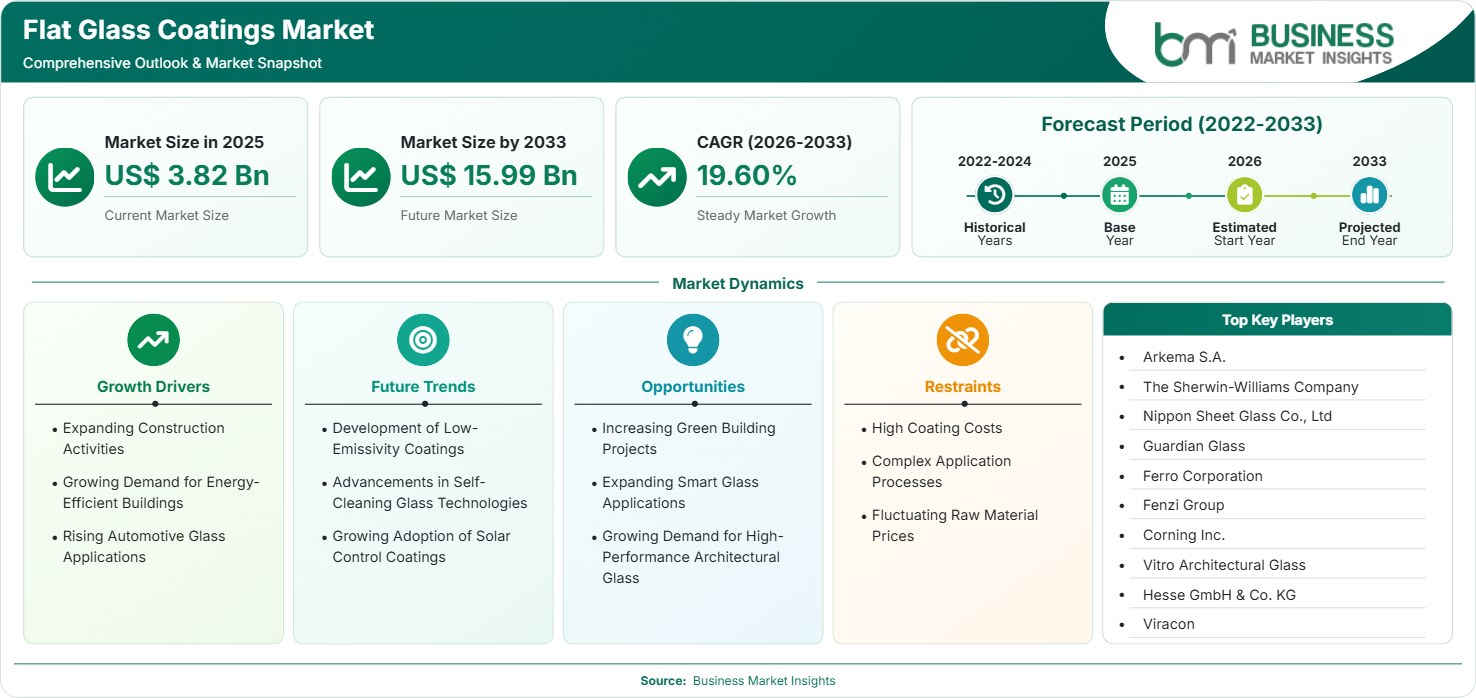
The Flat Glass Coatings Market size was valued at US$ 3.82 Billion in 2025 and is projected to reach US$ 15.99 Billion by 2033, growing at a CAGR of 19.60% during 2026–2033, supported by construction modernization, energy-efficient glazing, solar applications, automotive glass innovation, and demand for durable multifunctional coatings.

Report Coverage
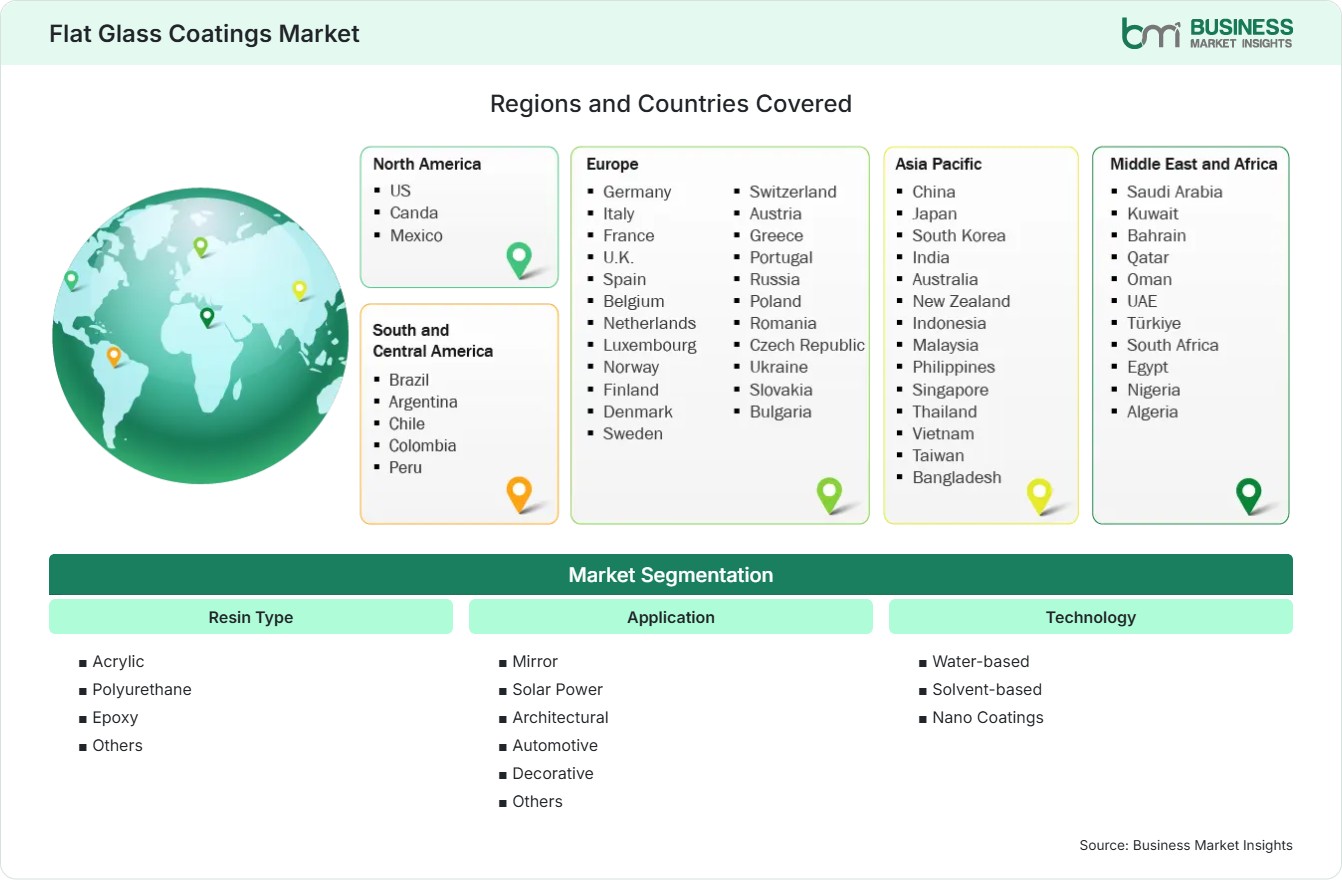
  • Resin Type: Acrylic, Polyurethane, Epoxy, Others
  • Application: Mirror, Solar Power, Architectural, Automotive, Decorative, Others
  • Technology: Water-based, Solvent-based, Nano Coatings
US$ 3.82 Bn Market size in 2025
US$ 15.99 Bn Market Size by 2033
19.60% CAGR, 2026 - 2033
2026-2033 Forecast Period

AI Overview

Flat Glass Coatings Market Summary

  • North America Region: North America holds a modeled market share of 28%–32% in 2025, growing at a modeled CAGR of 18.5%–20.0% during 2026–2033, influenced by architectural renovation, advanced glazing, solar installations, automotive applications, and demand for durable surface protection. The US market is projected to expand at 18.7%–20.2% CAGR, supported by commercial construction modernization and premium coated-glass adoption.
  • Fastest Growing Region: Asia Pacific accounts for a modeled 30%–34% share in 2025, with a modeled CAGR of 21.0%–23.0% during 2026–2033, supported by expanding construction, solar manufacturing, automotive production, urban development, and increasing adoption of performance-enhancing glass technologies.
  • Leading Segment: Architectural applications represent a modeled 30%–34% share in 2025, advancing at a modeled CAGR of 18.5%–20.5% during 2026–2033, driven by energy management, facade performance, aesthetic flexibility, durability requirements, and increasing specification of coated glass.
  • High Growth Segment: Nano Coatings represent the high-growth technology segment, with a modeled CAGR of 22.0%–24.0% during 2026–2033 and an estimated 12%–16% share in 2025, supported by multifunctionality, thin-film performance, surface protection, self-cleaning characteristics, and premium glazing applications.
  • Key Market Opportunity: Coating suppliers can capture value by combining multifunctional performance, lower environmental impact, application efficiency, and customization for architectural, solar, automotive, and decorative glass requirements across rapidly developing construction ecosystems.
  • Major Market Players: Arkema S.A.; The Sherwin-Williams Company; Nippon Sheet Glass Co., Ltd.; Guardian Glass; Ferro Corporation; Fenzi Group; Corning Incorporated; Vitro Architectural Glass; Hesse GmbH & Co. KG; Viracon.
Strategic Insights

Flat Glass Coatings Market: Strategic Insights

Flat Glass Coatings Market Strategic Framework
FREE PDF
Request your free sample
Request free sample
Stakeholder View

Key Takeaways

  • Value addition is present in resin producers, formulators, glass processors, coatings applicators, equipment makers, architectural engineers, automakers, and customers. Thus, competitive advantage will involve formulation skills as well as substrate processing skills.
  • The architectural and solar markets are promising expansion opportunities since the coatings can improve functionality without changing anything about the glass substrates themselves. Suppliers that have the ability to customize their optical, protective, and energy management properties will be able to fulfill higher value specs.
  • Technology development focuses on multi-functional systems incorporating durability, optical properties, anti-reflectivity, surface protection, and maintenance. The use of nanotechnology-based formulations becomes a key differentiator here.
  • The Asia Pacific region offers the strongest modeled expansion opportunity due to construction activity, automaker, solar installation, and urban infrastructure that provide several demand paths for coated flat glass.
  • Investments are expected to focus on formulation capability, specialty resins incorporation, application technology, regional centers of competence, and coating capabilities.
Geographic Outlook

Flat Glass Coatings Market Regional Highlights

North America Flat Glass Coatings Market

North America represents a modeled 28%–32% share in 2025, with a CAGR of 18.5%–20.0% during 2026–2033. The region benefits from architectural refurbishment, commercial glazing upgrades, premium automotive applications, and solar-related demand. Procurement increasingly emphasizes coating durability, consistency, and compatibility with sophisticated glazing systems. Market share is supported by established technical capabilities, while Flat Glass Coatings Market growth increasingly reflects demand for multifunctional and performance-oriented surfaces.

  • Architectural refurbishment supports demand for coatings that improve appearance, durability, and functional glazing performance across commercial and institutional buildings.
  • Automotive applications create opportunities for specialized coatings requiring strong adhesion, optical consistency, abrasion resistance, and compatibility with advanced glazing manufacturing processes.
  • Solar applications encourage development of coatings that improve optical behavior, surface durability, and long-term performance under demanding operating conditions.
  • Premium building projects increasingly favor customized glass treatments, allowing formulation specialists to compete through performance differentiation rather than price alone.

US Flat Glass Coatings Market

The US represents a modeled 22%–26% share of North American demand in 2025, expanding at a CAGR of 18.7%–20.2% during 2026–2033. Buyers increasingly evaluate coating systems through durability, processing compatibility, optical performance, and lifecycle value. The market structure favors suppliers capable of supporting large processors while also providing specialized formulations for differentiated glazing applications and project-specific performance requirements.

  • Commercial and institutional refurbishment creates recurring opportunities for coated glass where surface functionality and aesthetic consistency influence material selection and replacement decisions.
  • Advanced automotive glazing requires coatings with controlled optical properties and reliable adhesion, increasing demand for technically differentiated formulation and process support.
  • Solar-related applications broaden the addressable market by creating demand for coatings designed around optical transmission, surface protection, and long-term environmental exposure.

Europe Flat Glass Coatings Market

Europe accounts for a modeled 24%–28% of the Flat Glass Coatings Market share in 2025, with a CAGR of 17.5%–19.5% through 2033. Germany, France, Italy, and the United Kingdom provide important demand centers, while Germany and Italy offer stronger modeled expansion within specialty architectural and industrial applications.

  • Germany remains an important market for technically advanced architectural glazing, where performance specifications create opportunities for premium coating formulations and specialized surface treatments.
  • Italy offers opportunities across architectural, decorative, and automotive applications, supported by demand for visually differentiated glass products and customized finishing solutions.
  • France and the United Kingdom provide refurbishment-led opportunities where improved glazing functionality can support renovation strategies without requiring complete structural replacement.
  • European manufacturers can differentiate through water-based formulations, process efficiency, lower material consumption, and customized coating systems aligned with changing procurement priorities.

Asia Pacific Flat Glass Coatings Market

Asia Pacific holds a modeled 30%–34% share in 2025, with the strongest regional CAGR of 21.0%–23.0% during 2026–2033. China, India, Japan, and South Korea represent major demand centers, while India and Southeast Asian economies provide strong expansion opportunities. Construction development, solar manufacturing, automotive production, and urban infrastructure create multiple application pathways.

  • China provides substantial demand across architectural, solar, automotive, and decorative applications, encouraging suppliers to combine scale economics with specialized performance characteristics.
  • India offers strong opportunities through construction expansion, urban development, renewable-energy applications, and increasing preference for higher-performance building materials.
  • Japan and South Korea provide technologically demanding applications where optical control, surface durability, precision processing, and specialized formulation capabilities influence supplier selection.
  • Southeast Asia represents an emerging opportunity as industrial development and construction investment broaden the addressable base for coated flat glass.

Rest of World Flat Glass Coatings Market

South and Central America represent a developing opportunity for architectural, automotive, decorative, and solar applications, while the Middle East and Africa provide demand linked to construction, commercial development, and specialized glazing. The combined region represents a modeled 10%–14% share in 2025, expanding at 16.0%–18.5% CAGR through 2033. Brazil, Mexico, the United Arab Emirates, and Saudi Arabia offer important application opportunities.

  • Brazil and Mexico provide diversified demand across construction and automotive applications, creating opportunities for suppliers with flexible formulations and established regional distribution capabilities.
  • Gulf markets favor premium architectural glazing where coatings can support appearance, durability, solar-control requirements, and specialized facade performance.
  • Saudi Arabia and the United Arab Emirates provide opportunities for high-value architectural applications connected with large-scale commercial and infrastructure development.
  • South American adoption can broaden as local glass processors increasingly seek differentiated products capable of competing beyond basic commodity glazing.
Global Market Geography
FREE PDF
Request your free sample
Request free sample
Segment Analysis

Flat Glass Coatings Market Segmentation

Resin Type

Resin Type represents a core formulation decision affecting adhesion, durability, flexibility, chemical resistance, and application behavior. Acrylic systems hold a modeled 34%–38% share in 2025, while the segment is expected to expand at a 18.0%–20.0% CAGR through 2033. Flat Glass Coatings Market scope increasingly favors formulations optimized for specific substrates, environments, and processing requirements across architectural and industrial applications.

  • Acrylic: Provides versatile adhesion, appearance, weatherability, and formulation flexibility, supporting architectural and decorative glass applications where consistent surface quality remains commercially important.
  • Polyurethane: Offers flexibility, abrasion resistance, and durable surface performance, making it suitable for demanding applications requiring robust protective characteristics and extended service performance.
  • Epoxy: Delivers strong adhesion and chemical resistance, supporting specialized industrial and protective applications where substrate bonding and environmental resistance outweigh formulation simplicity.

Application

Application demand is led by architectural uses, representing a modeled 30%–34% share in 2025, with the segment projected to expand at a 18.5%–20.5% CAGR through 2033. Flat Glass Coatings Market trends increasingly favor application-specific functionality, particularly where coatings improve appearance, protection, optical behavior, or energy-related performance across buildings, vehicles, and solar systems.

  • Mirror: Coatings support reflective surfaces, protection, appearance retention, and resistance to environmental exposure, creating opportunities across residential, hospitality, commercial, and decorative applications.
  • Solar Power: Demand centers on coatings supporting optical performance, surface protection, and durability, helping solar-oriented glass maintain functional characteristics under extended environmental exposure.
  • Architectural: Architectural glazing uses coatings for appearance, durability, surface functionality, optical control, and differentiated facade performance across commercial and residential construction.
  • Automotive: Automotive applications require precise adhesion, optical consistency, abrasion resistance, and compatibility with increasingly sophisticated glass-processing and vehicle-design requirements.
  • Decorative: Decorative glass uses specialized finishes to create differentiated visual effects, surface characteristics, and design flexibility across interiors, furniture, retail environments, and premium spaces.

Technology

Technology selection influences environmental profile, application efficiency, curing behavior, production economics, and final coating performance. Water-based systems hold a modeled 38%–42% share in 2025, while technology demand is projected to expand at a 18.0%–20.0% CAGR through 2033. Flat Glass Coatings Market trends increasingly favor technology platforms combining process efficiency with application-specific performance and reduced formulation complexity.

  • Water-based: Supports efficient application and reduced reliance on solvent-heavy formulations, making it increasingly relevant where processing conditions and environmental considerations influence purchasing decisions.
  • Solvent-based: Provides established formulation characteristics, strong film formation, and application versatility, retaining relevance where specific performance requirements require proven coating behavior.
  • Nano Coatings: Enable thin functional layers with specialized surface properties, supporting premium applications requiring advanced optical, protective, self-cleaning, or durability characteristics.
Market Forces

Flat Glass Coatings Market Dynamics

Key Market Drivers

Expanding Construction Activities

Global construction activity continues to increase due to rapid urbanization, infrastructure expansion, commercial real estate development, and residential housing investments. Modern constructions are increasingly featuring high-performance glazed systems which are able to increase the energy efficiency, comfort levels inside and sustainability of buildings. Coated flat glasses are used in order to provide better insulation, sun protection and durability. Authorities invest in intelligent cities, transport systems and sustainable buildings which need high-performance façades. Commercial builders use coated glass since they allow obtaining certificates for green buildings and reaching energy saving targets.

Growing Demand for Energy-Efficient Buildings

Owners and developers of buildings consider energy efficient materials as a way to cut down on costs and meet the ever-changing environmental laws. Energy efficient glass coatings have been used in the management of heat gains and insulation. Sustainable development programs in North America, Europe, and Asia Pacific regions are promoting the use of advanced glazing in the development of buildings. The Flat Glass Coatings Market trends include the demand for low emissivity, solar control, and multifunctional coating technologies to assist in achieving performance requirements of buildings.

Rising Automotive Glass Applications

The automotive industry increasingly utilizes advanced glazing technologies to improve safety, passenger comfort, vehicle efficiency, and aesthetics. The coating of automotive glass provides benefits in terms of increased UV protection, temperature control, reduced glare, and enhanced visibility while aiding in the process of weight optimization in vehicles. EV makers have been especially concentrating on providing improved comfort and efficiency in vehicles by adopting new technologies in glazing. The Flat Glass Coatings Market Forecast continues to be linked to the increased production of automobiles and heightened demands for advanced vehicle characteristics from customers.

Key Market Opportunities

Increasing Green Building Projects

Global emphasis on sustainable construction and carbon reduction strategies continues to create significant opportunities for advanced coated glass solutions. Energy efficiency of buildings, which will keep operational expenses low while enhancing their ecological performance, is receiving attention from governments, developers, and infrastructure investors. Coated glass products provide insulation benefits, manage daylighting, and reduce energy usage. Increasing preference for green building rating systems has increased the need for high-performance glazing products. Flat Glass Coatings Market Forecasts show that there will be constant chances for the producers of coated glass products providing energy saving and ecological solutions. Investments in smart cities, net-zero buildings, and sustainable urban infrastructure in the future will fuel the demand for premium coated glass products globally.

Expanding Smart Glass Applications

The increasing use of smart glass systems opens up a lot of possibilities for manufacturers of coating solutions in order to move towards high value-added products. Dynamic glazing systems which regulate light transmittance, solar heat gain, and privacy demands can now make use of advanced coating techniques. The market is growing in terms of office, hospital, shopping mall, airport, and luxury housing applications. Technological innovations in the area of electrochromic, photochromic, and thermochromic glass systems have brought about new demands for advanced coatings to be used. With the increasing presence of intelligent building management systems, there will certainly be high demands for smart glass solutions.

Growing Demand for High-Performance Architectural Glass

The trend towards designing buildings that are more aesthetic, sustainable, and energy-efficient is growing, and there is increasing need for high-quality coated glass. Contemporary buildings need glass that will provide thermal insulation, ultraviolet protection, solar shading, durability, and aesthetically pleasing appearance at the same time. Architects and developers use innovative coatings to meet these needs and comply with growing environmental regulations. Flat Glass Coatings Market demand for large glass facades, multi-purpose projects, and iconic projects is also expected to boost the growth prospects for coated glass. Innovation in the chemistry of the coatings and use of nanotechnology will bring new opportunities for development.

Market Restraints and Challenges

High Coating Costs

Factor: Advanced coating technologies require specialized raw materials, sophisticated production equipment, precision application methods, and extensive quality-control processes. Impact: High costs of manufacture and installation can limit use within construction projects that are cost-conscious and among smaller end-users. High-performance coatings are known to be more expensive than their counterparts in many cases, especially those used in energy-saving or multi-functional glazing. Costs of acquisition may affect purchasing decisions and the choice of materials used in the course of the construction process. While there are long-term efficiency benefits in creating value, cost factors still present a major issue.

Complex Application Processes

Factor: Application of advanced flat glass coatings requires controlled manufacturing environments, technical expertise, specialized equipment, and stringent process management to ensure consistent performance. Impact: Complexity in manufacturing may lead to higher operating expenses and problems related to scalability. Varying parameters during the deposition process may influence optical transparency, adhesion, durability, and performance of a coating. Additionally, consumers demand guarantees of reliability before using any product. These factors may lead to extended manufacturing cycles and limit access to the market for firms that cannot produce such products.

Company Analysis

Competitive Landscape

The Flat Glass Coatings Market analysis indicates competition across diversified chemical companies, glass manufacturers, architectural-glass specialists, coating formulators, and surface-treatment providers. Competitive differentiation depends on formulation expertise, substrate compatibility, application technology, technical support, geographic reach, and the ability to address specialized end-use specifications.

Company Name

Overview

Products and Services relevant to this market

Arkema S.A.

Global specialty materials company with formulation capabilities supporting performance-oriented coating technologies and advanced surface applications.

Specialty resins, coating materials, formulation technologies, performance additives, and solutions supporting architectural and industrial glass coating requirements.

The Sherwin-Williams Company

Coatings-focused company with broad expertise in protective, architectural, industrial, and specialty surface technologies.

Coating formulations, protective finishes, surface treatment technologies, application support, and specialized systems relevant to glass-processing environments.

Nippon Sheet Glass Co., Ltd.

Global glass manufacturer with capabilities spanning architectural, automotive, and specialty glazing applications.

Coated glass products, architectural glazing, automotive glass, performance surfaces, and integrated glass solutions for specialized applications.

Guardian Glass

Glass manufacturer focused on architectural and specialty glazing solutions requiring differentiated performance and appearance characteristics.

Architectural coated glass, high-performance glazing solutions, solar-control products, and specialty glass technologies for building applications.

Ferro Corporation

Materials and coatings specialist associated with functional surface technologies and glass-related applications.

Glass coatings, specialty materials, decorative systems, surface treatments, and formulation technologies supporting glass appearance and performance.

Fenzi Group

Specialist supplier focused on chemical formulations and technologies for glass processing and finishing applications.

Glass coatings, insulating-glass sealants, decorative products, mirror coatings, and specialized chemical solutions for flat glass processing.

Corning Incorporated

Advanced materials company with expertise in specialty glass and engineered surface technologies.

Specialty glass, surface-engineered materials, functional coatings, and advanced glass solutions for demanding technical applications.

Vitro Architectural Glass

Architectural glass specialist serving applications requiring performance, aesthetics, and functional glazing characteristics.

Coated architectural glass, solar-control glazing, decorative glass, high-performance facade products, and customized glass solutions.

Hesse GmbH & Co. KG

Specialist coatings company with expertise in surface-finishing technologies and formulation development.

Coatings, finishes, protective surface systems, specialty formulations, and application technologies relevant to glass and related substrates.

Viracon

Architectural glass specialist focused on high-performance glazing and customized glass solutions for building applications.

Architectural coated glass, insulated glazing, solar-control products, specialty finishes, and customized performance-oriented glass solutions.

Trust & Transparency

Research Methodology

The market analysis combines proprietary research with secondary data from government agencies, company disclosures, regulatory filings, industry databases and expert interviews. Market estimates are validated through data triangulation, cross-market benchmarking and analyst review.

View Full Research Methodology

Questions Answered

Frequently Asked Questions

What does the Flat Glass Coatings Market Report help stakeholders evaluate?

The report helps stakeholders assess application priorities, resin selection, technology positioning, regional opportunities, competitive capabilities, adoption barriers, and strategic pathways for developing differentiated coating solutions.

Why are architectural applications commercially important?

Architectural applications combine large potential glass volumes with diverse performance requirements. Coatings can add functionality, aesthetics, durability, and optical characteristics, enabling processors to differentiate products and address higher-value construction specifications.

Which technology offers the strongest strategic potential?

Nano Coatings offer attractive strategic potential because they can provide specialized functionality through thin layers. Their opportunity is strongest in premium applications where customers value surface protection, optical characteristics, durability, or multifunctional performance.

How can manufacturers improve coating process efficiency?

Manufacturers can improve efficiency through controlled substrate preparation, automated application, optimized viscosity, consistent curing conditions, and formulation customization. Process monitoring can reduce defects and rework while supporting consistent coating thickness and appearance.

What factors determine coating selection for flat glass?

Coating selection depends on substrate type, required optical characteristics, adhesion, durability, application process, curing conditions, environmental exposure, and end-use requirements. Architectural, automotive, solar, mirror, and decorative applications can require substantially different formulation characteristics.

Access the Full Flat Glass Coatings Market Report

Get segment-level forecasts, regional estimates, competitive benchmarking, company profiles and downloadable Excel datasets.

Access the full Flat Glass Coatings Market Report
350 pages PDF & Excel | 2026-08-19