
Architectural Coatings Market Outlook: Size, Share, Trends, Growth Analysis, Competitive Landscape & Forecast, 2026-2033

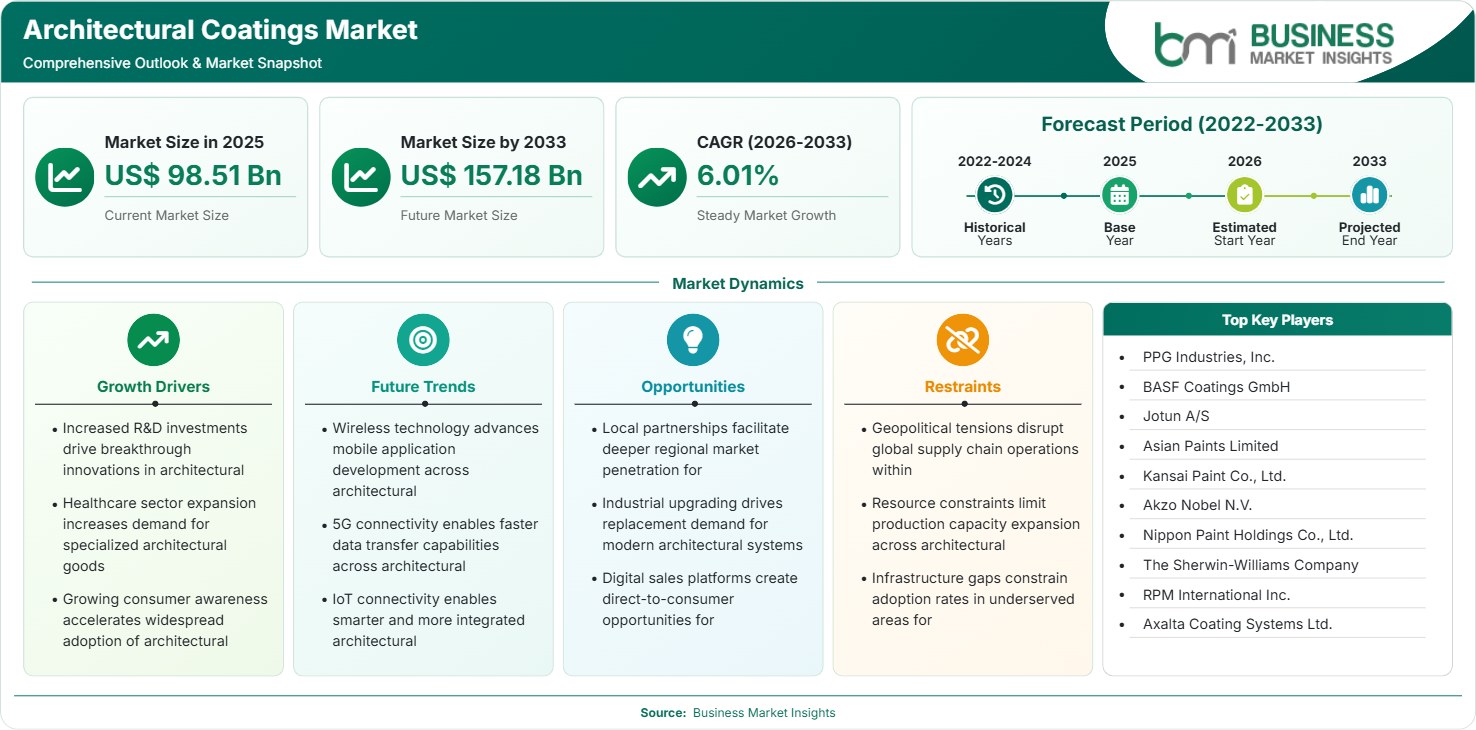
The Architectural Coatings Market size was valued at US$ 98.51 Billion in 2025 and is projected to reach US$ 157.18 Billion by 2033, growing at a CAGR of 6.01% during 2026–2033. Rising residential construction, renovation spending, sustainable coating adoption, smart building investments, and demand for durable low-VOC solutions continue creating significant growth opportunities across developed and emerging economies.

Report Coverage
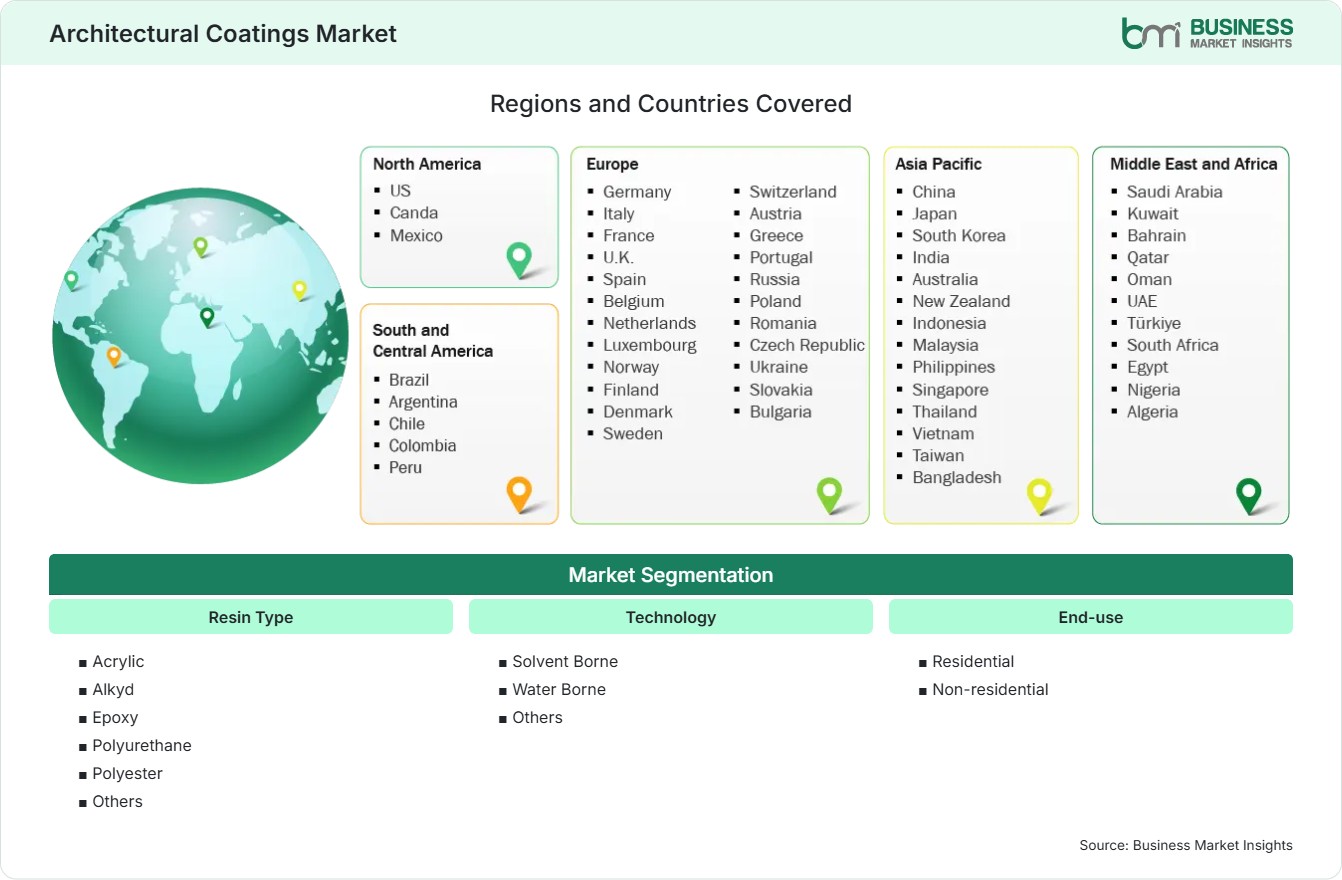
  • Resin Type: Acrylic, Alkyd, Epoxy, Polyurethane, Polyester, Others
  • Technology: Solvent Borne, Water Borne, Others
  • End-use: Residential, Non-residential
US$ 98.51 Bn Market size in 2025
US$ 157.18 Bn Market Size by 2033
6.01% CAGR, 2026 - 2033
2026-2033 Forecast Period

AI Overview

Architectural Coatings Market Summary

  • North America Region: North America holds a market share of 30%–33% in 2025, growing at a CAGR of 5.2%–5.8% during 2026–2033, supported by remodeling activity, energy-efficient building programs, premium coating demand, infrastructure upgrades, and stricter environmental standards encouraging advanced water-borne formulations and durable protective solutions across residential and commercial projects. The U.S. market benefits from renovation investments, sustainable construction initiatives, and strong premium paint demand, advancing at approximately 5.3%–5.9% CAGR.
  • Fastest Growing Region: Asia Pacific accounts for 38%–41% share in 2025 and expands at a CAGR of 7.0%–7.8% during 2026–2033, driven by urbanization, housing development, smart city investments, rising middle-class spending, industrial expansion, and increasing adoption of environmentally compliant decorative and protective coating technologies.
  • Leading Segment: Acrylic resin coatings command 34%–38% share in 2025 and grow at a CAGR of 6.2%–6.8% during 2026–2033, supported by weather resistance, color retention, low maintenance requirements, compatibility with sustainable formulations, and broad utilization across exterior and interior construction applications.
  • High Growth Segment: Water-borne technology represents 42%–46% share in 2025 and advances at a CAGR of 7.2%–8.0% during 2026–2033, fueled by tightening VOC regulations, sustainability targets, healthier indoor environments, improved formulation performance, and growing preference among contractors, architects, and residential consumers.
  • Key Market Opportunity: Accelerating green building certifications, net-zero construction initiatives, advanced antimicrobial coatings, heat-reflective technologies, and digital color customization platforms are creating new revenue streams while strengthening product differentiation strategies globally.
  • Major Market Players: PPG Industries, Inc.; BASF Coatings GmbH; Jotun A/S; Asian Paints Limited; Kansai Paint Co., Ltd.; Akzo Nobel N.V.; Nippon Paint Holdings Co., Ltd.; The Sherwin-Williams Company; RPM International Inc.; Axalta Coating Systems Ltd.
Strategic Insights

Architectural Coatings Market: Strategic Insights

Architectural Coatings Market Strategic Framework
FREE PDF
Request your free sample
Request free sample
Stakeholder View

Key Takeaways

  • The industry value chain is becoming increasingly integrated, with resin suppliers, additive manufacturers, coating formulators, distributors, contractors, and construction companies collaborating to improve supply reliability and performance consistency.
  • Water-borne formulations and premium decorative products offer substantial growth potential as regulatory pressure and consumer awareness encourage replacement of conventional solvent-intensive alternatives across residential and commercial projects.
  • Product innovation is shifting toward antimicrobial surfaces, self-cleaning technologies, heat-reflective coatings, and digitally customized color solutions that enhance building efficiency and user experience.
  • India, Vietnam, Indonesia, Saudi Arabia, and the United Arab Emirates present compelling opportunities due to expanding urban populations, infrastructure investments, and increasing construction expenditures.
  • Strategic acquisitions remain an important growth mechanism as major manufacturers seek geographic expansion, advanced technology portfolios, specialty coating capabilities, and stronger distribution networks.
  • Sustainability-driven procurement practices among developers and institutional buyers are increasing demand for certified low-VOC, recyclable, and environmentally compliant coating solutions across project categories.
Geographic Outlook

Architectural Coatings Market Regional Highlights

North America Architectural Coatings Market

North America accounted for approximately 30%–33% of global demand in 2025 and is projected to expand at a CAGR of 5.2%–5.8% through 2033. The region benefits from strong renovation spending, mature construction markets, and growing adoption of premium coatings. The Architectural Coatings Market share remains supported by investments in residential refurbishment, commercial modernization, and energy-efficient building upgrades. Environmental regulations continue encouraging adoption of low-VOC products, while professional contractor demand supports premium and specialty coating categories throughout the region.

  • Residential remodeling activity remains a major demand generator, particularly across aging housing stock where repainting cycles, insulation upgrades, and aesthetic enhancements increase coating consumption and premium product adoption.
  • Sustainability initiatives are encouraging wider use of water-borne and low-emission formulations, supporting innovation among manufacturers seeking compliance with evolving environmental performance standards and green construction specifications.
  • Commercial property renovation projects continue generating demand for durable interior and exterior coatings designed to improve building appearance, lifecycle performance, and operational efficiency.
  • Digital color selection platforms and smart retail channels are improving customer engagement, enabling manufacturers and distributors to strengthen market penetration and brand differentiation strategies.
  • Infrastructure modernization programs are creating opportunities for specialized coating systems capable of delivering enhanced durability, weather resistance, and long-term maintenance savings.

US Architectural Coatings Market

The United States represented approximately 78%–82% of North American Architectural Coatings Market demand in 2025 and is anticipated to register a CAGR of 5.3%–5.9% through 2033. Strong housing renovation activity, rising homeowner spending, and investments in commercial property upgrades continue supporting consumption. The country remains a key innovation center for advanced coating technologies, sustainability initiatives, and digital retail transformation. Increasing preference for premium decorative products, coupled with energy-efficient building requirements, strengthens long-term demand fundamentals across residential and non-residential applications.

  • Home improvement expenditures continue supporting repainting activity, especially within suburban housing markets where aesthetic upgrades and maintenance requirements drive recurring product demand.
  • Green building programs are accelerating adoption of low-emission coatings designed to improve indoor environmental quality and support sustainability certification objectives.
  • Professional contractor networks remain highly influential in purchasing decisions, encouraging manufacturers to expand premium offerings and technical support capabilities.
  • Technological advancements in formulation chemistry are improving durability, stain resistance, and application efficiency, supporting value-added product differentiation across competitive segments.

Europe Architectural Coatings Market

Europe held approximately 24%–27% of global Architectural Coatings Market demand in 2025 and is forecast to expand at a CAGR of 5.0%–5.6% during the assessment period. Sustainability regulations, renovation programs, and energy-efficiency mandates continue influencing purchasing behavior. The region maintains a strong position in premium decorative coatings and environmentally responsible product development. Germany remains the leading national market, while Eastern European countries demonstrate faster expansion. Continuous investment in sustainable construction practices contributes positively to overall market performance and competitive innovation.

  • Germany maintains leadership with strong renovation activity, advanced manufacturing capabilities, and consistent demand for premium decorative and protective coating solutions across residential and commercial applications.
  • Poland and Romania are among the fastest-growing national markets, supported by infrastructure development, housing construction, and increasing investments in urban modernization projects.
  • Regulatory frameworks emphasizing VOC reduction continue encouraging innovation in water-borne technologies and environmentally compliant formulations throughout the regional industry.
  • Energy-efficiency retrofitting initiatives across residential and commercial buildings are supporting demand for advanced coatings that enhance thermal performance and durability.
  • Growing preference for sustainable construction materials is influencing procurement decisions among developers, architects, and institutional buyers across key European economies.

Asia Pacific Architectural Coatings Market

Asia Pacific accounted for approximately 38%–41% of global Architectural Coatings Market demand in 2025 and is projected to expand at a CAGR of 7.0%–7.8% through 2033. Rapid urbanization, expanding middle-class populations, and extensive residential construction activity continue supporting regional consumption. China remains the largest market, while India represents the fastest-growing major economy. Strong government investment in infrastructure, affordable housing programs, and smart city development contributes to sustained demand momentum. The region also benefits from expanding local manufacturing capacity and increasing adoption of environmentally compliant coating technologies.

  • China continues leading regional demand through large-scale residential development, commercial construction projects, and renovation activity supported by urban redevelopment initiatives and infrastructure investments.
  • India is projected to achieve the highest growth rate within the region, supported by housing demand, rising disposable incomes, and expanding urban infrastructure development programs.
  • Water-borne technology adoption is accelerating as governments strengthen environmental regulations and encourage manufacturers to introduce sustainable coating alternatives.
  • Expanding retail distribution networks and digital sales channels are improving product accessibility across both metropolitan and secondary urban centers.
  • Foreign direct investment in construction and real estate sectors continues generating opportunities for premium decorative and specialty coating manufacturers.

Rest of World Architectural Coatings Market

Rest of World represented approximately 8%–11% of global Architectural Coatings Market demand in 2025 and is anticipated to expand at a CAGR of 6.1%–6.7% through 2033. South & Central America benefit from residential development and commercial renovation activities, while Middle East & Africa markets gain support from infrastructure expansion and tourism-related construction projects.

Saudi Arabia leads growth within the Middle East, whereas Brazil remains the largest South American market. Rising urbanization, public infrastructure investments, and growing awareness of sustainable construction materials continue supporting long-term market development across both regions.

  • Brazil maintains regional leadership through residential construction demand, urban redevelopment initiatives, and expanding renovation expenditures across major metropolitan areas.
  • Saudi Arabia is among the fastest-growing national markets, supported by Vision 2030 projects, commercial development, and large-scale infrastructure investments.
  • Tourism, hospitality, and mixed-use developments are increasing demand for decorative and protective coatings across several Gulf Cooperation Council countries.
  • Growing construction activity in South Africa and the United Arab Emirates supports consumption of premium and weather-resistant coating solutions.
  • Public infrastructure modernization and increasing private-sector participation continue creating favorable conditions for market expansion across emerging economies.
Global Market Geography
FREE PDF
Request your free sample
Request free sample
Segment Analysis

Architectural Coatings Market Segmentation

Resin Type

Resin type remains a fundamental performance differentiator across coating formulations. This segment accounted for approximately 34%–38% market share in 2025 for acrylic-based systems, while leading product categories are expected to expand at 6.2%–6.8% CAGR through 2033. The Architectural Coatings Market scope continues broadening as manufacturers develop resins offering improved durability, weather resistance, sustainability, and compatibility with advanced application technologies across residential and non-residential construction environments.

  • Acrylic: Acrylic formulations are widely preferred due to excellent weather resistance, color retention, UV stability, and compatibility with water-borne technologies, making them suitable for interior and exterior decorative applications.
  • Alkyd: Alkyd coatings maintain relevance in specialty decorative and maintenance applications where adhesion performance, gloss retention, and surface penetration characteristics remain important purchasing considerations.
  • Epoxy: Epoxy-based products are utilized where enhanced chemical resistance, durability, and surface protection are required, particularly within commercial facilities, institutional buildings, and demanding environmental conditions.
  • Polyurethane: Polyurethane coatings offer superior abrasion resistance, weatherability, and long-term performance, supporting demand in premium decorative and high-traffic building applications.
  • Polyester: Polyester resin systems are increasingly adopted in specialized architectural finishes requiring enhanced flexibility, color consistency, and durable protective characteristics across diverse climatic conditions.

Technology

Technology selection is increasingly influenced by environmental regulations, performance expectations, and lifecycle cost considerations. Water-borne technologies accounted for approximately 42%–46% Architectural Coatings Market share in 2025 and are projected to expand at a 7.2%–8.0% CAGR through 2033, making them the fastest-growing category. The transition toward sustainable formulations continues accelerating as manufacturers prioritize lower emissions, regulatory compliance, and improved indoor air quality across construction projects.

  • Solvent Borne: Solvent-borne coatings continue serving applications requiring robust adhesion, rapid curing characteristics, and reliable performance under challenging environmental and substrate conditions.
  • Water Borne: Water-borne technologies benefit from tightening environmental standards, lower VOC emissions, improved user safety, and increasing acceptance among contractors and residential consumers.

End-use

End-use demand is shaped by construction activity, renovation cycles, consumer preferences, and institutional investment patterns. Residential applications represented approximately 58%–62% market share in 2025 and are expected to maintain steady expansion at a 5.8%–6.4% CAGR through 2033. Ongoing housing development, remodeling activity, and rising aesthetic expectations continue influencing purchasing behavior. Emerging Architectural Coatings Market trends indicate stronger adoption of premium decorative solutions, sustainable products, and digitally customized color offerings.

  • Residential: Residential demand is supported by housing construction, renovation spending, aesthetic enhancement projects, and growing consumer preference for premium coatings offering durability and environmental benefits.
  • Non-residential: Commercial, institutional, hospitality, healthcare, and educational facilities increasingly require advanced coating solutions that combine appearance enhancement, durability, and maintenance efficiency.
Market Forces

Architectural Coatings Market Dynamics

Key Market Drivers

Expansion of Residential Construction and Renovation Activities

Residential construction remains one of the strongest demand catalysts across global building materials industries. On the basis of various housing and construction indices of prominent nations, expenditure on home improvements is still increasing due to the requirement for repair and improvement of the existing structures. Housing projects in Asia Pacific, North America, and certain Middle Eastern nations also add more motivation to the demands. Ownership aspirations and urban migration are likely to fuel the demand in the coming years. The resulting Architectural Coatings Market growth is reinforced by recurring repainting cycles, aesthetic upgrades, and demand for higher-performance products that enhance durability, visual appeal, and long-term asset value.

Growing Adoption of Sustainable and Low-VOC Coatings

Environmental regulations and green building standards are significantly influencing product development strategies across the coating industry. Governments and regulatory agencies increasingly encourage reduced volatile organic compound emissions and environmentally responsible manufacturing practices. Such green certification standards as LEED and BREEAM encourage the use of materials with low emissions during construction processes. The manufacturers are reacting to this situation by making investments in technologies such as water-borne products, biobased components, and formulation chemistry. Sustainable purchasing behaviors in the areas of commercial development, institutions, and residential end users further fuel the process of change on the market.

Urbanization and Infrastructure Modernization Programs

Rapid urban population growth is generating substantial demand for residential buildings, commercial facilities, transportation infrastructure, and public institutions. The United Nations foresees continuous growth of cities within the developing world, especially within Asia and Africa, which will help maintain construction work over the coming years. There is heavy investment in terms of infrastructure development, building affordable homes, healthcare centers, and education institutions. The need will be for high-quality coating systems that can withstand exposure to the environment without deteriorating aesthetically and functionally. Growth in urban infrastructure will directly lead to an increase in demand for coatings.

Key Market Opportunities

Growth Potential from Green Building and Net-Zero Construction

Carbon reduction initiatives at a global level are paving the way for many possibilities for coating companies. More focus on net-zero and energy-efficient buildings by governments, builders, and institutional investors has created demand for sustainable products. Reflective coating technology, thermal management technologies, and environmentally-friendly decoration systems have become integral parts of sustainable architecture. The International Energy Agency continually stresses the importance of energy-efficient building materials to reduce emissions. These innovations provide lucrative opportunities for manufacturers that can offer a unique set of sustainable solutions. Long-term Architectural Coatings Market Forecasts indicate that the market for environmentally conscious products will keep growing in both residential and commercial building industries.

Emergence of Smart and Functional Coating Technologies

Functional coatings are moving beyond aesthetics toward performance-enhancing applications that improve building operation and occupant experience. Antimicrobial coatings, self-cleaning materials, anti-graffiti materials, and heat reflective materials are among the advanced materials that are now becoming common in the health care industry, education institutions, hotels, and other commercial buildings. More and more attention is now being given to such materials because of the growing awareness about the importance of hygiene and lifecycle cost savings. Research & Development are making it possible to add more functions to the material itself. Those companies that can add several beneficial functions to their materials can make good profits due to high prices.

Digital Color Platforms and Direct-to-Consumer Channels

Digital transformation is redefining the way consumers and professionals judge, choose, and purchase coatings. Visualization technology, artificial intelligence-based color-matching tools, and online consultancy are enhancing consumer engagement and reducing purchase cycles. The use of direct-to-consumer sales techniques and omnichannel distribution strategies enables producers to have more exposure of their products and increase visibility of their brands. With the current acceptance of the use of technology by consumers such as homeowners, contractors, and architects, there exists an opportunity for producers to provide customized solutions and campaigns via digital platforms. With the changing demands of consumers, firms will stand to gain from their investments in digital platforms.

Market Restraints and Challenges

Raw Material Price Volatility and Supply Chain Disruptions

Factor: The manufacture of architectural coatings relies largely on petrochemical by-products, additives, pigments, solvents, and resins that are affected by energy prices, geopolitical changes, transport issues, and global supply/demand discrepancies. The variability of the cost of the raw materials creates an uncertainty environment for companies trying to secure their margins and purchasing practices.

Impact: Cost fluctuations could potentially hurt profits, make negotiations of long-term contracts more difficult, and place additional pressure on pricing within the entire supply chain network. Smaller producers may have a higher vulnerability level due to the lack of purchasing power, and their customers may also hesitate about making purchases due to fast price fluctuations.

Stringent Regulatory Compliance Requirements

Factor: The environmental agencies in large countries have been introducing more stringent laws on issues such as the emissions of VOCs, the use of chemicals, labeling of products, waste management, and manufacturing procedures. Compliance with these laws involves constant reformulation, certification costs, testing, among others.

Impact: The intricacy of regulation leads to higher development expenses and longer time frames needed to launch products on the market. Businesses working in several regions will have to deal with different sets of standards and regulations. Small companies may be faced with problems related to limited resources and inability to innovate and compete. While regulations promote sustainability, compliance costs can influence profit margin negatively.

Company Analysis

Competitive Landscape

The competitive environment remains characterized by product innovation, sustainability-focused investments, geographic expansion, and portfolio diversification. Current Architectural Coatings Market analysis indicates that leading manufacturers are strengthening their positions through advanced formulation development, digital customer engagement initiatives, strategic partnerships, and capacity expansion programs targeting high-growth construction markets.

Company Name

Overview

Products and Services relevant to this market

PPG Industries, Inc.

Global coatings manufacturer with extensive presence across decorative, protective, and specialty coatings markets supported by strong R&D capabilities.

Interior paints, exterior paints, primers, specialty coatings, color technologies, sustainable coating solutions, and contractor-focused services.

BASF Coatings GmbH

Major coatings business leveraging chemical expertise and advanced formulation technologies to serve diverse construction and industrial sectors.

Architectural coating ingredients, binders, resins, sustainable coating technologies, performance additives, and formulation support services.

Jotun A/S

International coatings company recognized for decorative, marine, and protective coating solutions across global markets.

Decorative paints, exterior coatings, interior finishes, premium wall coatings, protective solutions, and color design services.

Asian Paints Limited

Leading decorative coatings producer with strong distribution networks and broad product portfolios across residential markets.

Decorative paints, waterproofing solutions, texture finishes, premium interior coatings, exterior paints, and color consultancy services.

Kansai Paint Co., Ltd.

Established coatings manufacturer serving decorative, industrial, and automotive sectors with innovation-focused product development.

Architectural paints, eco-friendly coatings, specialty finishes, decorative solutions, and building protection products.

Akzo Nobel N.V.

Global coatings leader known for premium decorative brands, sustainability initiatives, and extensive international operations.

Decorative paints, sustainable coatings, color management solutions, interior finishes, exterior coatings, and professional services.

Nippon Paint Holdings Co., Ltd.

Major Asian coatings manufacturer with expanding global footprint and strong decorative coatings expertise.

Architectural coatings, antimicrobial solutions, decorative paints, premium finishes, and environmentally responsible products.

The Sherwin-Williams Company

One of the world's largest coatings companies with vertically integrated operations and extensive retail presence.

Interior paints, exterior paints, primers, specialty coatings, contractor services, and digital color selection platforms.

RPM International Inc.

Diversified coatings company operating multiple specialty brands serving construction and maintenance applications.

Building maintenance coatings, sealants, specialty finishes, restoration solutions, and protective architectural products.

Trust & Transparency

Research Methodology

The market analysis combines proprietary research with secondary data from government agencies, company disclosures, regulatory filings, industry databases and expert interviews. Market estimates are validated through data triangulation, cross-market benchmarking and analyst review.

View Full Research Methodology

Questions Answered

Frequently Asked Questions

Why is this Architectural Coatings Market Report valuable for stakeholders?

The Architectural Coatings Market Report provides strategic insights into regional opportunities, competitive positioning, technology evolution, regulatory developments, growth segments, and investment priorities, enabling informed business planning and market-entry decisions.

What factors differentiate premium architectural coating products?

Premium products typically offer superior durability, color retention, stain resistance, weather protection, washability, and longer maintenance intervals. These characteristics help reduce lifecycle costs while improving visual appearance and occupant satisfaction.

How do sustainability regulations influence industry development?

Environmental regulations encourage manufacturers to reduce VOC emissions, improve product safety, and develop eco-friendly formulations. These requirements accelerate innovation in water-borne, low-emission, and energy-efficient coating technologies across global construction markets.

Which technology segment is expected to expand the fastest during the forecast period?

Water-borne coatings are expected to demonstrate the strongest expansion due to tightening environmental regulations, lower VOC emissions, improved indoor air quality requirements, and increasing acceptance among contractors, developers, and homeowners.

What are the primary applications of architectural coatings?

Architectural coatings are primarily used on residential, commercial, institutional, and public infrastructure buildings. They provide decorative finishes, weather protection, moisture resistance, UV durability, and surface preservation while enhancing building aesthetics and lifecycle performance.

Access the Full Architectural Coatings Market Report

Get segment-level forecasts, regional estimates, competitive benchmarking, company profiles and downloadable Excel datasets.

Access the full Architectural Coatings Market Report
350 pages PDF & Excel | 2026-08-31