
Wax Emulsion Market Outlook: Size, Share, Trends, Growth Analysis, Competitive Landscape & Forecast, 2026-2033

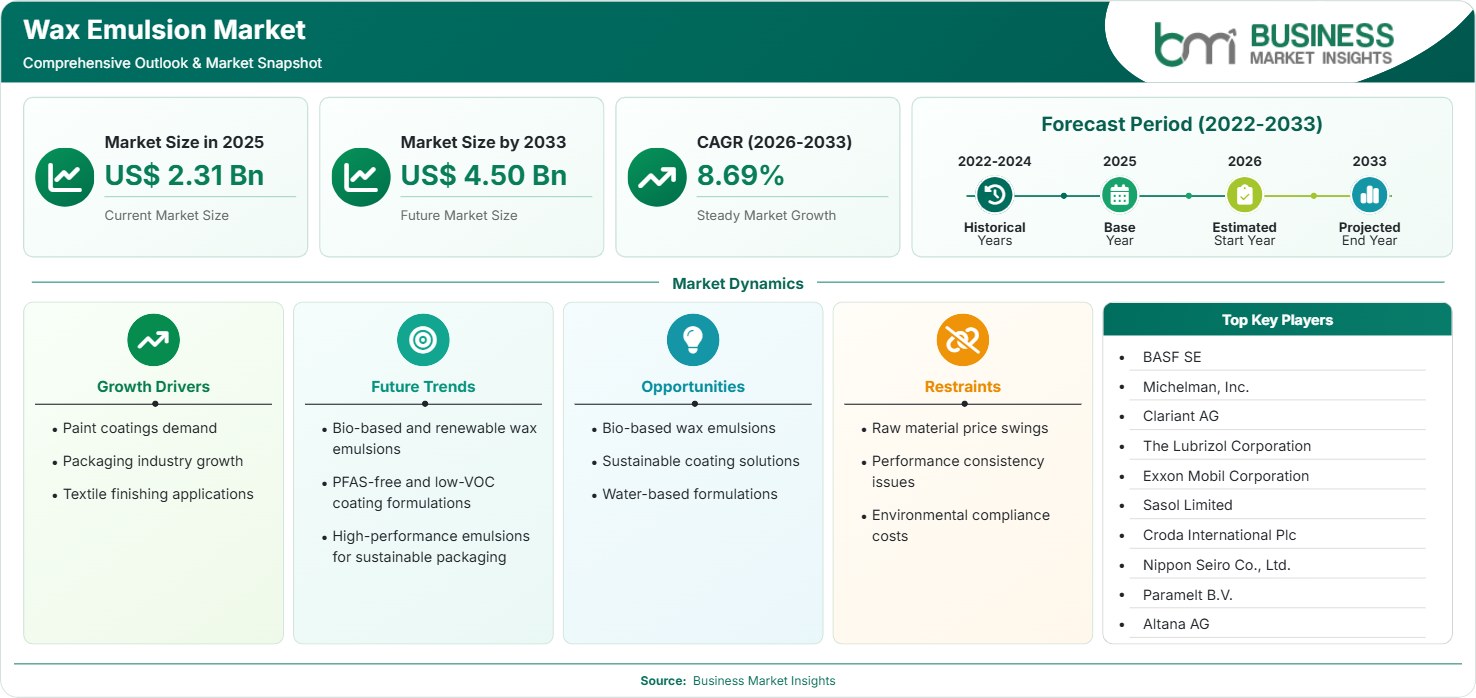
The Wax Emulsion Market size was valued at US$ 2.31 billion in 2025 and is projected to reach US$ 4.50 billion by 2033, growing at a CAGR of 8.69% during 2026–2033. Growth is driven by rising paint coatings demand, packaging industry expansion, textile finishing applications, bio-based wax emulsions, sustainable coating solutions, and water-based formulations.

Report Coverage
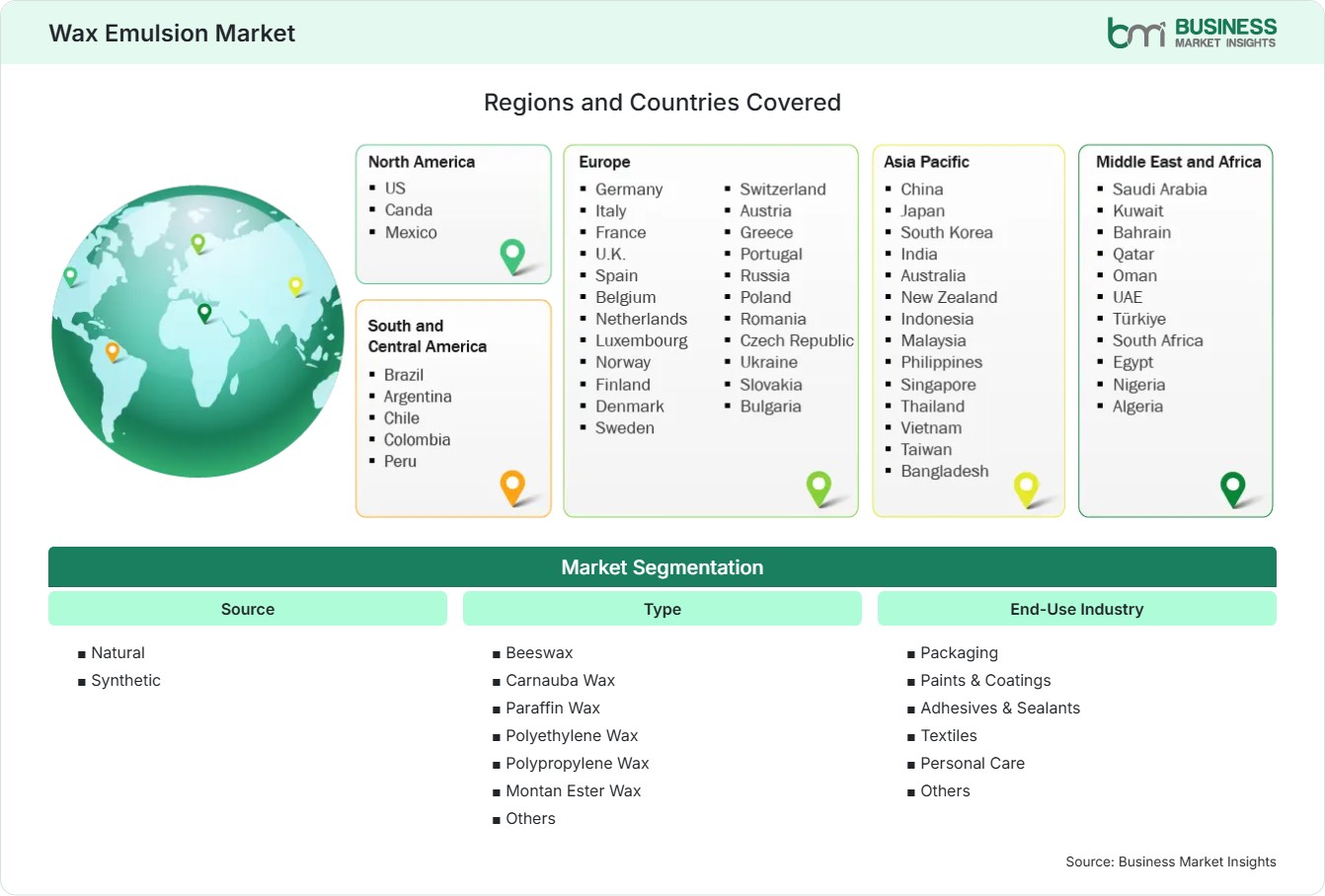
  • Source: Natural, Synthetic
  • Type: Beeswax, Carnauba Wax, Paraffin Wax, Polyethylene Wax, Polypropylene Wax, Montan Ester Wax, Others
  • End-Use Industry: Packaging, Paints & Coatings, Adhesives & Sealants, Textiles, Personal Care, Others
US$ 2.31 Bn Market size in 2025
US$ 4.50 Bn Market Size by 2033
8.69% CAGR, 2026 - 2033
2026-2033 Forecast Period

AI Overview

Wax Emulsion Market Summary

  • North America Region: North America holds an estimated 28%–32% wax emulsion market share in 2025, growing at 8.2%–8.8% CAGR during 2026–2033. Demand is supported by packaging innovation, industrial coatings, water-based formulations, and sustainability initiatives. The US market remains the largest contributor, growing at an estimated 8.3%–8.9% CAGR through 2033 due to coating technology adoption and packaging applications.
  • Fastest Growing Region: Asia Pacific represents an estimated 38%–42% share in 2025, expanding at a 9.2%–9.8% CAGR during 2026–2033. Growth is supported by packaging manufacturing expansion, textile production, construction coatings demand, and increasing adoption of sustainable materials.
  • Leading Segment: Synthetic wax sources account for an estimated 58%–62% share in 2025, growing at a 8.4%–9.0% CAGR during 2026–2033. Broad availability, consistent performance, and industrial coating applications support segment leadership.
  • High Growth Segment: Natural wax sources represent an estimated 38%–42% share in 2025, expanding at a 9.0%–9.7% CAGR during 2026–2033. Demand is increasing due to sustainable product preferences, bio-based formulations, and environmentally conscious coating solutions.
  • Key Market Opportunity: Bio-based wax emulsions, sustainable coating solutions, and water-based formulations are creating opportunities for manufacturers developing environmentally friendly products for packaging, coatings, textiles, and personal care industries.
  • Major Market Players: BASF SE, Michelman, Inc., Clariant AG, The Lubrizol Corporation, Exxon Mobil Corporation, Sasol Limited, Croda International Plc, Nippon Seiro Co., Ltd., Paramelt B.V., Altana AG.
Strategic Insights

Wax Emulsion Market: Strategic Insights

Wax Emulsion Market Strategic Framework
FREE PDF
Request your free sample
Request free sample
Stakeholder View

Key Takeaways

  • The wax emulsion value chain includes wax suppliers, chemical manufacturers, formulation specialists, coating producers, and end-use industries requiring functional surface modification solutions.
  • Packaging, paints and coatings, and textile applications represent major growth areas due to increasing demand for protective, durable, and sustainable coating technologies.
  • Innovation is shifting toward bio-based wax emulsions, improved dispersion technologies, and water-based formulations designed to meet environmental and performance requirements.
  • Asia Pacific offers strong investment potential due to expanding packaging production, textile manufacturing, construction activity, and industrial coating demand.
  • Strategic collaborations between chemical companies and formulation developers are increasing to create customized wax emulsion solutions for specialized applications.
  • Sustainability regulations and customer preferences are encouraging manufacturers to diversify raw material sources and develop renewable wax-based products.
Geographic Outlook

Wax Emulsion Market Regional Highlights

North America Wax Emulsion Market

North America accounts for an estimated 28%–32% share in 2025, supported by established coating industries, packaging demand, and increasing preference for water-based formulations. The region is projected to grow at 8.2%–8.8% CAGR during 2026–2033. The United States remains the leading contributor due to advanced chemical manufacturing, industrial coating applications, and demand for sustainable formulation technologies.

  • The United States drives regional demand through packaging and specialty coating applications.
  • Manufacturers are adopting water-based wax formulations to meet sustainability requirements.
  • Paint producers are integrating wax emulsions for improved durability and surface performance.
  • Personal care applications support demand for specialized wax-based formulations.

US Wax Emulsion Market

The US represents an estimated 82%–86% share of North America's Wax Emulsion Market in 2025 and is expected to expand at 8.3%–8.9% CAGR through 2033. Growth is supported by packaging innovation, industrial coatings, sustainable chemical solutions, and increasing adoption of advanced formulation technologies.

  • Packaging companies are increasing use of wax emulsions for protective surface coatings.
  • Coating manufacturers are developing low-VOC and water-based product solutions.
  • Industrial applications continue supporting demand for performance-enhancing additives.

Europe Wax Emulsion Market

Europe represents an estimated 24%–28% share in 2025, growing at 8.0%–8.6% CAGR during 2026–2033. Regional demand is supported by sustainability regulations, advanced coatings industries, packaging innovation, and adoption of renewable materials. Germany, France, the United Kingdom, and Italy remain important markets due to strong chemical manufacturing capabilities.

  • Germany supports demand through industrial coatings and specialty chemical production.
  • France is expanding sustainable packaging and bio-based formulation adoption.
  • The United Kingdom is increasing demand for environmentally compliant coating solutions.
  • European manufacturers are investing in renewable wax technologies and water-based products.

Asia Pacific Wax Emulsion Market

Asia Pacific represents an estimated 38%–42% share in 2025 and records the fastest growth at a 9.2%–9.8% CAGR during 2026–2033. Regional expansion is supported by packaging industry growth, textile manufacturing, construction coatings, and industrial development. China, India, Japan, and Southeast Asian economies are major contributors.

  • China leads demand through packaging production and coating industry expansion.
  • India is increasing wax emulsion adoption through textile and construction applications.
  • Japan supports growth through advanced coatings and specialty formulations.
  • Southeast Asian markets benefit from manufacturing expansion and packaging demand.
  • Regional producers are investing in sustainable chemical solutions.

Rest of World Wax Emulsion Market

Latin America, the Middle East, and Africa collectively represent an estimated 6%–10% share in 2025, expanding at 8.3%–9.0% CAGR through 2033. Growth is supported by industrial development, packaging demand, construction activities, and increasing adoption of functional coatings. Brazil, Mexico, UAE, and South Africa represent emerging opportunities.

  • Brazil is expanding wax emulsion usage through packaging and coatings industries.
  • Mexico benefits from manufacturing growth and industrial coating applications.
  • Middle Eastern markets are adopting advanced coatings for infrastructure projects.
  • South Africa is developing specialty chemical and industrial applications.
  • Regional demand is supported by increasing construction and packaging activities.
Global Market Geography
FREE PDF
Request your free sample
Request free sample
Segment Analysis

Wax Emulsion Market Segmentation

Source

The Source segment represents a critical classification within the Wax Emulsion Market, accounting for an estimated 92%–96% share in 2025 and expanding at 8.5%–9.1% CAGR during 2026–2033. Source selection is influenced by sustainability goals, performance requirements, cost considerations, and application-specific properties. Synthetic wax emulsions maintain strong adoption due to consistent quality and industrial scalability, while natural alternatives are gaining attention due to renewable material preferences. Increasing demand for environmentally responsible formulations is encouraging manufacturers to develop advanced wax dispersion technologies across coatings, packaging, and specialty applications.

  • Natural: Natural wax emulsions support sustainable formulations using renewable resources and are increasingly adopted in eco-friendly coatings, personal care, and specialty applications.
  • Synthetic: Synthetic wax emulsions provide consistent performance, controlled properties, durability, and cost efficiency for industrial coatings, packaging, and manufacturing applications.

Type

The Type segment accounts for an estimated 84%–88% share in 2025 and is projected to grow at 8.4%–9.0% CAGR during 2026–2033. Different wax types offer specific characteristics including hardness, gloss enhancement, water resistance, and abrasion protection. Paraffin and polyethylene wax emulsions maintain significant industrial adoption, while natural wax categories such as beeswax and carnauba wax benefit from sustainability-driven demand. The Wax Emulsion Market trends indicate increasing customization of wax formulations to meet performance requirements across coatings, adhesives, textiles, and personal care industries.

  • Beeswax: Beeswax emulsions are used in premium formulations requiring natural characteristics, smooth texture, protective properties, and applications in personal care and specialty coatings.
  • Carnauba wax: Carnauba wax emulsions provide high gloss, hardness, and durability, supporting applications in coatings, polishes, packaging, and consumer products.
  • Paraffin wax: Paraffin wax emulsions offer cost-effective water resistance and surface protection, supporting widespread use in coatings, packaging, and industrial applications.
  • Polyethylene wax: Polyethylene wax emulsions deliver abrasion resistance, slip properties, and durability for paints, coatings, plastics, and industrial formulations.
  • Polypropylene wax: Polypropylene wax emulsions provide enhanced hardness, compatibility, and surface performance in specialized coating and polymer-related applications.
  • Montan ester wax: Montan ester wax emulsions support high-performance applications requiring gloss improvement, lubrication properties, and enhanced surface characteristics.

End-Use Industry

The End-Use Industry segment represents an estimated 78%–82% share in 2025 and is expected to expand at 8.7%–9.3% CAGR through 2033. Rising demand for protective coatings, sustainable packaging materials, textile processing solutions, and specialty formulations is supporting adoption during wax emulsion market forecasts. Packaging and paints & coatings remain major application areas due to the need for enhanced surface performance, moisture resistance, and durability. Increasing industrial development and sustainability initiatives are expanding usage across multiple sectors globally.

  • Packaging: Packaging applications use wax emulsions for barrier coatings, improved surface protection, printability enhancement, and moisture resistance in paper and board products.
  • Paints & coatings: Paint and coating manufacturers utilize wax emulsions to improve gloss, scratch resistance, durability, slip properties, and surface finish quality.
  • Adhesive & sealants: Adhesive and sealant applications use wax emulsions to improve flexibility, moisture resistance, processing performance, and product stability.
  • Textiles: Textile industries adopt wax emulsions for finishing treatments that enhance softness, water repellency, surface protection, and fabric performance.
  • Personal care: Personal care manufacturers use wax emulsions in formulations requiring texture improvement, stability enhancement, and smooth application characteristics.
Market Forces

Wax Emulsion Market Dynamics

Key Market Drivers

Paint coatings demand accelerates wax emulsion adoption

The increase in the use of paints and coatings is leading to an increase in demand for wax emulsions because of their potential to enhance various surface attributes including strength, gloss, and resistance features. Paint and coating suppliers are incorporating wax emulsions in their products to improve their performances while being compliant with environmental standards. Waterborne coating systems have been getting more attention from the industry sectors in order to lower solvent emissions and achieve sustainable results. The Wax Emulsion Market growth is being driven by construction, infrastructural activities, and increasing high performance coating demands.

Packaging industry growth increases functional coating demand

Growth in the packaging industry is leading to increased demand for wax emulsion in various applications such as paper, board, and flexible packaging. The use of wax-based coatings provides features such as moisture resistance, good surface finish, printability, and protection which are needed by the packaging industry. Increased growth in e-commerce, packaged food products, and sustainable packaging is motivating the packaging companies to focus more on developing better coatings. The use of wax emulsions assists in moving towards the water-based coating in the packaging industry.

Textile finishing applications support market expansion

Wax emulsions have been used by textile producers to enhance the attributes of textile such as softness, smoothness, hydrophobic properties, and surface resistance. Textile finishings done with wax emulsions make it possible for the development of qualities in the textiles needed for use in the fashion industry as well as for other industrial purposes. The rising demand for performance additives due to the increase in production of textiles in developing countries has promoted the use of wax emulsions in the production process.

Key Market Opportunities

Bio-based wax emulsions create sustainable product opportunities

The wax emulsion derived from biological materials presents a huge potential, as companies move to adopt renewable sources over their non-renewable counterparts. With increasing sustainability initiatives within the packaging, coatings, personal care, and consumer goods industries, there is an increased demand for eco-friendly wax products. Companies are increasingly adopting advanced formulations for eco-friendly wax that performs at par but without environmental concerns. The Wax Emulsion Market Outlook is impacted by rising demand for sustainable additives, regulatory restrictions on traditional chemicals, and the need for environmentally friendly products among consumers.

Sustainable coating solutions drive formulation innovation

The development of sustainable coatings presents new avenues for wax emulsion producers since environmentally friendly coatings are increasingly in demand. Both waterborne and renewable coatings have started to gain traction in packaging, paints, textiles, and industrial segments. Wax emulsions can be used to enhance the performance of coatings as well as meet new environmental requirements. Producers are working on creating products that are easier to disperse, more durable, and compatible with sustainable coatings. The trend toward implementing circular economy principles and reducing chemical emissions may push producers into developing more advanced formulas for their products.

Water-based formulations expand application potential

The growth of water-based formulations is being fueled by their use in place of solvent-based formulations in many industries. There are many advantages that wax emulsions offer in water-based formulations such as superior surface protection, lubricity and aesthetics. Many industries are now relying on water-based technology due to environmental considerations. The development of formulation chemistry has enhanced the process efficiency and stability of formulations. With many industries moving towards environment-friendly technology, there are more uses anticipated for wax emulsions in the future.

Market Restraints and Challenges

Raw material price swings affect production economics

Factor: Wax emulsion production depends on raw materials including natural waxes, petroleum-derived waxes, and specialty chemical additives that experience market price fluctuations.

Impact: Raw material volatility can increase manufacturing costs, affect pricing strategies, and create uncertainty for producers and customers. Companies must manage supply chains, diversify sourcing strategies, and optimize formulations to maintain profitability and consistent product availability.

Performance consistency issues limit application expansion

Factor: Variations in wax composition, particle size distribution, formulation compatibility, and processing conditions can affect emulsion performance.

Impact: Inconsistent product performance may restrict adoption in high-value applications requiring precise quality standards. Manufacturers must invest in quality control, formulation optimization, and advanced production technologies to ensure reliable performance across different end-use industries.

Company Analysis

Competitive Landscape

The competitive environment of the market is characterized by chemical manufacturers, specialty additive producers, and formulation technology companies developing customized solutions for coatings, packaging, textiles, adhesives, and personal care applications. Companies are focusing on sustainable formulations, bio-based materials, water-based technologies, and application-specific performance improvements. The Wax Emulsion Market analysis indicates that competitive differentiation is increasingly based on product consistency, renewable raw material integration, technical support capabilities, and expansion into environmentally compliant coating systems.

Company Name

Overview

Products and Services relevant to this market

BASF SE

Global chemical company providing specialty materials and formulation solutions.

Wax emulsions, coating additives, surface modifiers, industrial formulation solutions.

Michelman, Inc.

Specialty chemical company focused on sustainable coating and surface treatment technologies.

Water-based wax emulsions, barrier coatings, packaging additives, industrial coatings.

Clariant AG

Specialty chemicals producer developing performance additives and sustainable solutions.

Wax dispersions, coating additives, polymer additives, specialty formulation products.

The Lubrizol Corporation

Advanced specialty chemical company serving industrial and consumer markets.

Wax emulsions, surface modifiers, coating additives, performance chemicals.

Exxon Mobil Corporation

Energy and chemical company producing specialty wax-based materials.

Polyethylene waxes, synthetic wax products, industrial wax formulations.

Sasol Limited

Integrated chemical company producing synthetic and specialty wax materials.

Synthetic wax emulsions, Fischer-Tropsch wax products, industrial applications.

Croda International Plc

Specialty chemicals company focused on sustainable ingredient technologies.

Natural wax solutions, specialty additives, personal care and coating ingredients.

Nippon Seiro Co., Ltd.

Japanese wax manufacturer specializing in industrial wax technologies.

Paraffin wax emulsions, specialty wax products, industrial coating solutions.

Paramelt B.V.

Specialty materials company providing wax and adhesive solutions.

Wax emulsions, hot melts, coatings, packaging and adhesive technologies.

Altana AG

Specialty chemicals company providing surface technology solutions.

Coating additives, wax dispersions, surface protection technologies.

Industry Activity

Recent Developments

May 2026

Rallychem showcased its SAMWAX waterborne wax emulsion portfolio at the 9th Annual Waterborne Emulsions and Dispersions Technology Forum, highlighting wax emulsion solutions that improve abrasion resistance, scratch resistance, anti-blocking performance, and surface feel for coatings applications.

April 2026

Lubrizol launched its Micro Dispersions range, a new family of high-solids, water-based wax additives that combine the benefits of traditional wax dispersions and wax emulsions. The products provide enhanced surface protection, abrasion resistance, and formulation efficiency for coatings, inks, and other specialty surface applications.

March 2026

Indian Emulsifiers Ltd. expanded into the U.S. market through its wholly owned subsidiary, Polaris Specialty Chemicals Inc., strengthening its global presence in specialty chemicals, including wax emulsions for cosmetics, personal care, textiles, paints, and coatings industries.

April 2025

Clariant launched Ceridust 1310, a micronized rice bran wax blend developed as a sustainable alternative to carnauba wax for printing ink applications. The bio-based wax additive enhances rub resistance, matting performance, and formulation consistency while reducing reliance on seasonal natural wax supplies.

Trust & Transparency

Research Methodology

The market analysis combines proprietary research with secondary data from government agencies, company disclosures, regulatory filings, industry databases and expert interviews. Market estimates are validated through data triangulation, cross-market benchmarking and analyst review.

View Full Research Methodology

Questions Answered

Frequently Asked Questions

What challenges affect wax emulsion adoption?

Major challenges include raw material price fluctuations, formulation consistency requirements, supply chain uncertainties, and the need to maintain performance across diverse application environments.

How are packaging applications influencing demand?

In the wax emulsion market report, packaging applications are increasing in demand through the need for moisture barriers, improved printability, surface protection, and functional coatings for paper, board, and flexible packaging materials.

Why are water-based wax emulsions becoming important?

Water-based wax emulsions are gaining importance because they support lower-emission formulations, improve sustainability performance, and replace solvent-based solutions in coatings and industrial applications.

Which wax source is gaining popularity?

Natural wax sources are gaining popularity due to increasing sustainability preferences, renewable material adoption, and demand for environmentally responsible formulations across multiple industries.

What industries are driving Wax Emulsion Market growth?

The market is driven by paints and coatings, packaging, textiles, adhesives, sealants, and personal care industries requiring improved surface protection, durability, moisture resistance, and finish quality.

Access the Full Wax Emulsion Market Report

Get segment-level forecasts, regional estimates, competitive benchmarking, company profiles and downloadable Excel datasets.

Access the full Wax Emulsion Market Report
350 pages PDF & Excel | 2026-07-31