
Railway Lubricants Market Outlook: Size, Share, Trends, Growth Analysis, Competitive Landscape & Forecast, 2026-2033

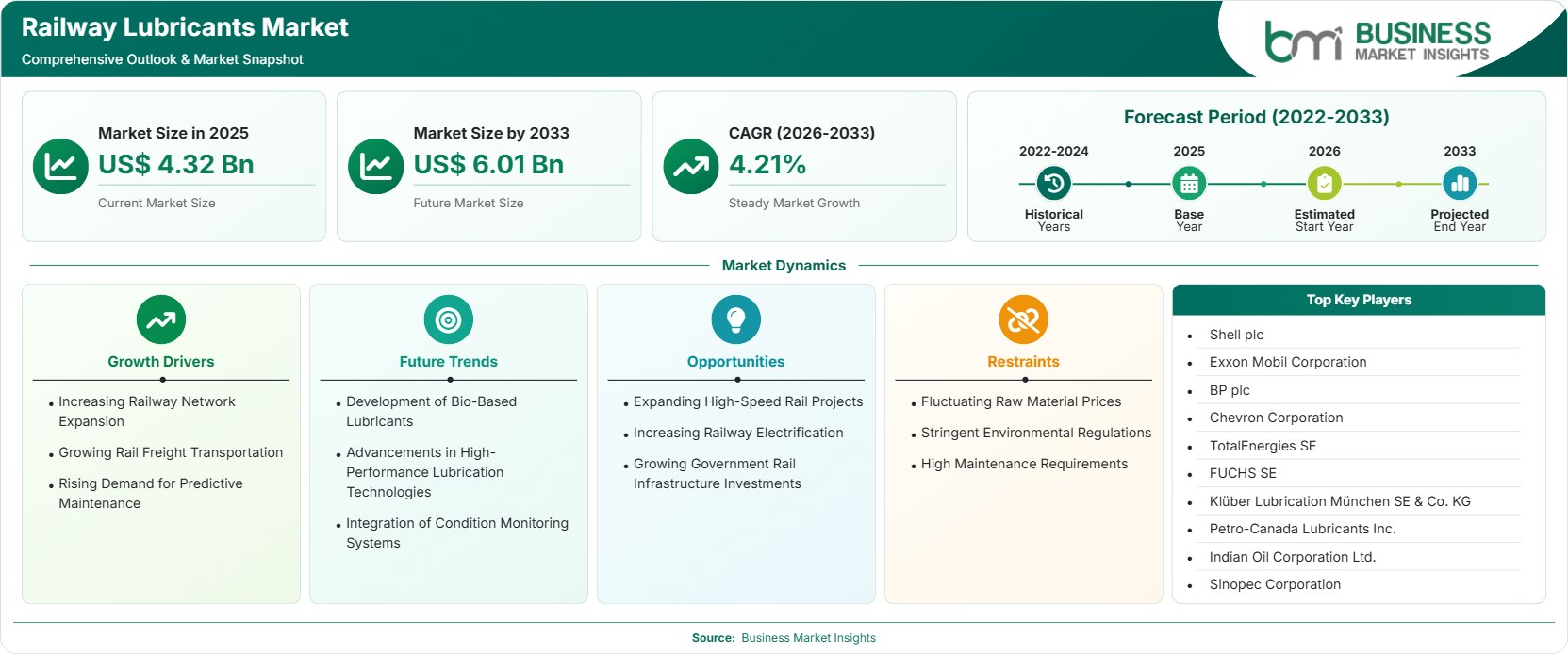
The Railway Lubricants Market size was valued at US$ 4.32 Billion in 2025 and is projected to reach US$ 6.01 Billion by 2033, growing at a CAGR of 4.21% during 2026–2033. Increasing railway network expansion, rising rail freight transportation, and growing demand for predictive maintenance are supporting market development, while railway electrification and infrastructure modernization create long-term opportunities.

Report Coverage
  • Type: Synthetic, Bio-Based
  • End-User: Passenger Rail, Freight Rail
  • Application: Rail Mobility, Rail Infrastructure
US$ 4.32 Bn Market size in 2025
US$ 6.01 Bn Market Size by 2033
4.21% CAGR, 2026 - 2033
2026-2033 Forecast Period

01 AI Overview

Railway Lubricants Market Summary

  • North America Region: North America holds 28%–31% market share in 2025 and is projected to grow at a 3.9%–4.4% CAGR during 2026–2033. Expanding freight rail operations, modernization of rail infrastructure, and predictive maintenance adoption continue supporting lubricant demand across passenger and cargo transportation networks. The U.S. accounts for the largest regional revenue, advancing at a CAGR of 4.0%–4.5% through investments in freight corridors and maintenance facilities.
  • Fastest Growing Region: Asia Pacific accounts for 34%–37% market share in 2025 and is forecast to expand at a 4.8%–5.3% CAGR through 2033. High-speed rail development, railway electrification, expanding freight corridors, and government infrastructure spending continue creating sustained demand for advanced railway lubrication solutions.
  • Leading Segment: Synthetic lubricants represent 62%–65% market share in 2025 and are anticipated to register a 4.5%–5.0% CAGR. Longer service intervals, superior thermal stability, reduced equipment wear, and compatibility with high-speed rail operations continue supporting widespread adoption.
  • High Growth Segment: Rail Mobility accounts for 67%–70% market share in 2025 while expanding at a 4.7%–5.2% CAGR during the forecast period. Increasing locomotive modernization, fleet expansion, and operational efficiency initiatives continue strengthening lubricant consumption across rolling stock applications.
  • Key Market Opportunity: Growing investments in railway electrification, digital maintenance platforms, and high-speed rail infrastructure are encouraging demand for high-performance lubricants that improve equipment reliability, efficiency, lifecycle performance, and sustainability.
  • Major Market Players: Shell plc, Exxon Mobil Corporation, BP p.l.c., Chevron Corporation, TotalEnergies SE, FUCHS SE, Klüber Lubrication München SE & Co. KG, Petro-Canada Lubricants Inc., Indian Oil Corporation Limited, and China Petroleum & Chemical Corporation (Sinopec).
02 Strategic Insights

Railway Lubricants Market: Strategic Insights

Railway Lubricants Market Strategic Framework
FREE PDF
Request your free sample
Request free sample
03 Stakeholder View

Key Takeaways

  • The market value chain is evolving through stronger collaboration among base oil suppliers, additive manufacturers, lubricant formulators, railway operators, maintenance contractors, and rolling stock manufacturers, improving product performance and supply chain resilience.
  • Synthetic lubricants and rail mobility applications present the strongest commercial opportunities as operators increasingly prioritize extended maintenance intervals, improved equipment reliability, and reduced operating costs across expanding railway networks.
  • Product innovation is centered on high-performance synthetic formulations, biodegradable lubricants, automated lubrication systems, and digital condition-monitoring technologies that improve asset utilization while supporting sustainability and predictive maintenance initiatives.
  • Asia Pacific offers the most attractive long-term investment opportunity due to continuous railway expansion, high-speed rail development, freight corridor modernization, and sustained government infrastructure spending across major economies.
  • Strategic partnerships, long-term supply agreements, and localized production investments are becoming increasingly important as lubricant manufacturers seek to strengthen customer relationships, improve regional availability, and support evolving railway maintenance requirements.
  • Companies investing in environmentally responsible lubricant technologies, advanced additive chemistry, and digital maintenance integration are expected to strengthen their competitive positioning as railway operators focus on operational efficiency, equipment longevity, and lifecycle cost optimization.
04 Geographic Outlook

Railway Lubricants Market Regional Highlights

North America Railway Lubricants Market

North America accounted for 28%–31% of global revenue in 2025 and is expected to register a 3.9%–4.4% CAGR through 2033. Demand is supported by one of the world's largest freight rail networks, ongoing locomotive modernization, and increasing investment in predictive maintenance technologies. The Railway Lubricants Market share remains strong because of continuous maintenance spending and established rail logistics networks.

  • Freight rail operators continue investing in synthetic lubricants that reduce wear under heavy-load operations while extending maintenance intervals and improving fleet availability across long-distance cargo transportation networks.
  • Automated lubrication systems are increasingly deployed for wheel flanges, rail curves, and switch components, lowering maintenance costs while improving operational safety and minimizing unnecessary lubricant consumption.
  • Digital maintenance platforms integrated with condition monitoring enable operators to optimize lubricant replacement schedules, improving equipment reliability and reducing unexpected service interruptions across railway operations.
  • Sustainability initiatives encourage greater adoption of environmentally compatible lubricants that comply with evolving environmental regulations without compromising mechanical performance or equipment protection.

US Railway Lubricants Market

The United States Railway Lubricants Market represented 74%–77% of North American revenue in 2025 and is projected to expand at a 4.0%–4.5% CAGR during the forecast period. Strong freight transportation activity, railway infrastructure renewal, and advanced maintenance practices continue driving lubricant consumption. Operators increasingly adopt premium formulations capable of supporting higher equipment utilization while reducing lifecycle maintenance costs.

  • Class I freight rail operators continue modernizing locomotive fleets with predictive maintenance systems that optimize lubricant usage and improve operational efficiency across extensive transportation corridors.
  • Investments in rail yard automation and maintenance facilities support wider deployment of high-performance lubricants for locomotives, braking systems, bearings, and rail infrastructure equipment.
  • Environmental compliance initiatives encourage adoption of lower-emission lubricant technologies designed to improve efficiency while minimizing operational impacts across railway maintenance activities.
  • Continued replacement of aging railway assets creates sustained demand for specialized lubrication products that improve component durability and reduce equipment downtime.

Europe Railway Lubricants Market

Europe Railway Lubricants Market captured 24%–27% of the global market in 2025 and is forecast to expand at a 3.8%–4.3% CAGR through 2033. Germany remains the largest regional market, while Poland is projected to record the fastest growth owing to expanding railway modernization programs and freight infrastructure investments.

  • European railway operators continue replacing conventional lubricants with advanced synthetic formulations that provide superior oxidation resistance, longer service intervals, and improved protection for high-speed rolling stock operating under demanding conditions.
  • Rail infrastructure modernization projects across Germany, France, and Italy continue increasing demand for specialized lubricants used in switches, bearings, rails, and braking systems to improve operational reliability.
  • Growing adoption of environmentally acceptable lubricants supports compliance with stricter European environmental regulations while reducing ecological impact across railway maintenance activities and infrastructure operations.
  • Digital maintenance strategies integrating real-time asset monitoring enable railway companies to optimize lubricant consumption, minimize maintenance downtime, and improve long-term fleet availability throughout regional rail networks.

Asia Pacific Railway Lubricants Market

Asia Pacific Railway Lubricants Market accounted for 34%–37% of global revenue in 2025 and is anticipated to register the fastest 4.8%–5.3% CAGR during 2026–2033. Large-scale railway expansion, increasing freight movement, and continuous investment in high-speed rail networks continue supporting lubricant demand. China leads regional revenue generation because of its extensive railway infrastructure, while India is expected to witness the fastest growth driven by network electrification, dedicated freight corridors, and modernization of passenger rail services.

  • China's continued investment in high-speed rail expansion and maintenance facilities increases consumption of premium lubricants designed to improve component durability and operational efficiency across extensive railway networks.
  • India's railway modernization initiatives, including station redevelopment and freight corridor expansion, create strong opportunities for advanced lubrication products supporting locomotives, wagons, and infrastructure equipment.
  • Japan and South Korea continue emphasizing predictive maintenance technologies that optimize lubricant performance while improving equipment reliability and reducing lifecycle maintenance costs.
  • Expanding rail freight transportation across Southeast Asia encourages greater adoption of synthetic lubricants capable of delivering reliable performance under varying climatic and operational conditions.

Rest of World Railway Lubricants Market

The Rest of World Railway Lubricants Market share represented 10%–13% of global market revenue in 2025 and is expected to grow at a 3.7%–4.2% CAGR through 2033.

South and Central America continue strengthening railway freight infrastructure to improve mineral, agricultural, and industrial transportation. Brazil leads regional demand, while Chile records the fastest growth owing to mining-related railway investments and logistics modernization initiatives.

The Middle East and Africa are steadily expanding railway infrastructure through national transport diversification strategies. Saudi Arabia remains the largest regional market, whereas the United Arab Emirates demonstrates the fastest growth supported by rail connectivity projects, freight corridor development, and increasing investment in modern maintenance facilities.

  • Freight railway expansion across South and Central America continues increasing demand for heavy-duty lubricants capable of maintaining reliable performance under demanding operational environments.
  • National railway development programs in Gulf countries encourage adoption of premium lubrication technologies supporting high-temperature operating conditions and extended maintenance intervals.
  • Railway operators increasingly implement automated lubrication systems to reduce maintenance costs while improving operational safety across newly commissioned rail infrastructure.
  • Growing public investment in railway modernization and regional connectivity supports long-term opportunities for lubricant suppliers offering advanced, environmentally responsible product portfolios.
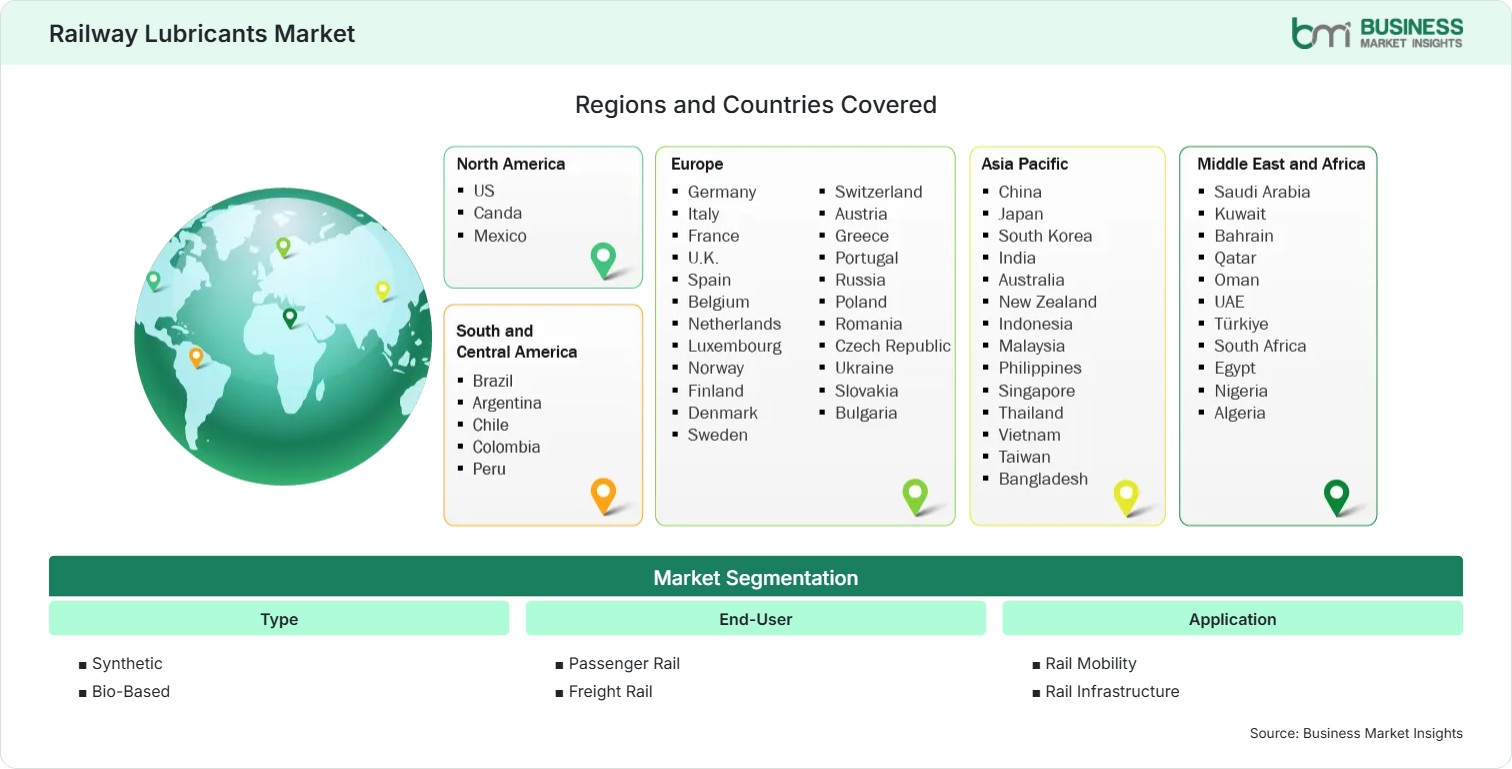
Global Market Geography
FREE PDF
Request your free sample
Request free sample
05 Segment Analysis

Railway Lubricants Market Segmentation

Type

The Type segment accounted for 62%–65% of the global market in 2025 and is projected to expand at a 4.5%–5.0% CAGR through 2033. The Railway Lubricants Market scope continues expanding as railway operators adopt premium lubricant formulations that improve component protection, reduce friction, and support predictive maintenance strategies across modern rail systems.

  • Synthetic: Synthetic lubricants deliver excellent thermal stability, oxidation resistance, and wear protection, making them the preferred choice for high-speed trains, heavy freight locomotives, bearings, gears, and wheel flange lubrication requiring extended service intervals.
  • Bio-Based: Bio-based lubricants are gaining wider acceptance as railway operators pursue environmentally responsible maintenance practices. Their biodegradability and reduced ecological impact support compliance with evolving environmental regulations while maintaining dependable lubrication performance.

End-User

The End-User segment represented 29%–32% market share in 2025 and is anticipated to register a 4.3%–4.8% CAGR during the forecast period. Rising passenger mobility, expanding freight transportation, and increasing railway modernization programs continue supporting lubricant demand across both operational segments. Continuous fleet expansion and infrastructure upgrades strengthen long-term lubricant consumption throughout the railway ecosystem.

  • Passenger Rail: Passenger rail operators increasingly utilize advanced lubricants to improve rolling stock reliability, minimize maintenance downtime, reduce component wear, and support smooth operations across metro, regional, and high-speed rail networks.
  • Freight Rail: Freight rail applications require high-performance lubricants capable of operating under heavy loads, extended travel distances, and demanding environmental conditions while reducing equipment wear and improving locomotive availability.

Application

The Application segment held 67%–70% of market revenue in 2025 and is forecast to grow at a 4.7%–5.2% CAGR through 2033. Increasing investments in rolling stock modernization, automated maintenance, and rail infrastructure upgrades continue supporting adoption of specialized lubrication products. The Railway Lubricants Market trends increasingly reflect the industry's shift toward predictive maintenance, digital monitoring, and premium lubrication technologies that improve operational efficiency while lowering lifecycle maintenance costs.

  • Rail Mobility: Rail mobility applications account for the largest lubricant consumption due to continuous operation of locomotives, passenger coaches, multiple units, and freight wagons requiring reliable lubrication for engines, gearboxes, bearings, and braking systems.
  • Rail Infrastructure: Rail infrastructure utilizes specialized lubricants for switches, crossings, rails, wheel flanges, and maintenance equipment, helping reduce friction, minimize wear, improve operational safety, and extend infrastructure service life.
06 Market Forces

Railway Lubricants Market Dynamics

Key Market Drivers

Increasing Railway Network Expansion

Expansion of railway infrastructure across developed and emerging economies continues to generate consistent demand for specialized lubricants. Investment made in new passenger routes, freight railway lines, metro systems, and inter-country transport infrastructure to enhance mobility and improve logistics efficiency. In line with global railway development trends, there are certain countries that continue to emphasize on rail transport as an eco-friendly means of transportation, which promotes increased spending on maintenance in the network expansion process. Such ongoing investment in infrastructure will promote the Railway Lubricants Market growth due to increased demand for lubricants in all kinds of machinery involved.

Growing Rail Freight Transportation

Freight trains are still considered among the most effective means to transport raw materials and finished goods in bulk over long distances. The rise in transport of minerals, agriculture produce, chemicals, automobile parts, and manufactured goods will ensure an increase in the use of locomotives and trains. With more frequent use of trains, the need for superior lubricants to reduce friction, protect mechanical parts, and increase the time period between maintenance becomes essential. Increased investment in freight corridors will increase demand for lubricants and enhance efficiency in regional and international freight networks.

Rising Demand for Predictive Maintenance

The use of predictive maintenance technology is now common among railroad companies and combines sensors, condition monitoring, and digital asset management system for better maintenance practices. The use of high-performance lubricants has become an important component in the maintenance practices since it helps in extending the life of the machines and enhances consistent performance of operations. Regular monitoring of the condition of the lubricants helps in minimizing failures that lead to increased costs and optimization of replacement schedule.

Key Market Opportunity

Expanding High-Speed Rail Projects

Large investments made into the construction of high speed rail lines are presenting constant business opportunities for lubricant producers providing their products specially engineered for harsh environments. Special lubricants are needed for the functioning of these rail lines as they should be able to ensure continuous performance at increased speeds, high temperatures, and long operating periods. Railway Lubricants Market Forecasts state that companies that have application-specific products, longer drain intervals, and wear prevention technologies will benefit from growing purchases of the said products.

Increasing Railway Electrification

Railway electrification programs are accelerating across both developed and developing economies as governments seek cleaner, more energy-efficient transportation systems. While electrified locomotives do not use diesel engines, they still utilize specialized lubricants for their wheel bearings, gear boxes, traction mechanisms, couplers, brakes, and other components. Increased electrification leads to increased need for high quality lubricants that possess good oxidation stability, anti-corrosion properties, and extended life.

Growing Government Rail Infrastructure Investments

Public investment in railway modernization remains one of the strongest long-term growth opportunities for lubricant suppliers. The national governments have allocated huge budget towards the development of railway corridors, upgrading railway stations, logistics infrastructure for rail freight and maintenance facilities that contribute to improved economic connectivity and sustainable transport. All these developments create increased lubricant requirements during the construction phase, commissioning phase and even the operation of the rail systems.

Market Restraints and Challenges

Fluctuating Raw Material Prices

Factor: Railway lubricant manufacturers depend on base oils, synthetic fluids, and performance additives whose prices are influenced by crude oil volatility, supply chain disruptions, refining capacity, and geopolitical developments.

Impact: Price fluctuations increase production costs and complicate long-term procurement planning for manufacturers and railway operators. Sudden increases in raw material costs may compress profit margins or require contract renegotiations, particularly for long-term supply agreements. Companies increasingly diversify sourcing strategies, improve inventory planning, and develop higher-efficiency formulations to reduce sensitivity to raw material price volatility while maintaining product performance and customer competitiveness.

Stringent Environmental Regulations

Factor: Environmental regulations governing lubricant composition, disposal practices, emissions, and ecological protection continue becoming more stringent across major railway markets.

Impact: Compliance requires manufacturers to invest in research, reformulate products, and adopt more sustainable production processes while maintaining performance standards demanded by railway operators. These additional development and certification costs may extend product commercialization timelines. However, regulatory requirements also encourage innovation in biodegradable and environmentally acceptable lubricants, creating opportunities for companies capable of combining regulatory compliance with superior equipment protection and long operational life.

07 Company Analysis

Competitive Landscape

The competitive environment is shaped by product innovation, long-term supply agreements, and investments in sustainable lubrication technologies that improve equipment reliability and reduce maintenance costs. The Railway Lubricants Market analysis indicates that manufacturers are strengthening their portfolios through advanced synthetic formulations, bio-based lubricants, technical service capabilities, and digital condition-monitoring support.

Company Name

Overview

Products and Services Relevant to this Market

Shell plc

Global energy company with a broad industrial lubricants portfolio supporting railway operators through advanced lubrication technologies and technical maintenance services.

Synthetic railway lubricants, axle bearing oils, gear oils, greases, rail curve lubricants, condition-monitoring support, and maintenance optimization solutions.

Exxon Mobil Corporation

International lubricant manufacturer providing premium industrial solutions focused on equipment reliability, operational efficiency, and extended service life across railway applications.

Synthetic lubricants, gearbox oils, hydraulic fluids, compressor oils, greases, bearing lubricants, and maintenance support for rolling stock and infrastructure.

BP p.l.c.

Diversified energy company offering high-performance lubricant solutions for demanding railway operating conditions across passenger and freight transportation systems.

Industrial lubricants, rail greases, gear lubricants, hydraulic oils, specialty fluids, and asset performance support services.

Chevron Corporation

Global supplier of industrial lubricants designed to improve equipment protection, operational efficiency, and lifecycle performance for railway assets.

Engine oils, gear oils, greases, hydraulic lubricants, synthetic formulations, and maintenance solutions for railway equipment.

TotalEnergies SE

International energy company supplying advanced lubricant technologies supporting railway maintenance, sustainability initiatives, and operational reliability.

Synthetic lubricants, biodegradable greases, industrial oils, rail maintenance lubricants, and technical lubrication services.

FUCHS SE

Independent lubricant manufacturer specializing in customized industrial lubrication technologies for transportation and heavy industrial applications.

Railway greases, specialty lubricants, synthetic oils, wheel flange lubricants, switch lubricants, and maintenance consulting.

Klüber Lubrication München SE & Co. KG

Specialty lubricant producer recognized for application-specific products supporting railway efficiency and extended component life.

High-performance greases, synthetic lubricants, bearing oils, gear lubricants, rail switch lubrication, and technical engineering support.

Petro-Canada Lubricants Inc.

Manufacturer of premium lubricants designed for harsh operating environments requiring long equipment life and reliable performance.

Synthetic lubricants, industrial oils, hydraulic fluids, greases, and railway maintenance products for locomotives and infrastructure.

Indian Oil Corporation Limited

Leading integrated energy company supplying industrial lubricants supporting India's expanding railway infrastructure and maintenance operations.

Rail engine oils, industrial lubricants, greases, specialty oils, maintenance products, and technical support services.

China Petroleum & Chemical Corporation (Sinopec)

Major global energy and lubricant producer supporting railway modernization through high-performance industrial lubrication products.

Railway lubricants, synthetic oils, greases, industrial fluids, specialty maintenance products, and technical lubrication solutions.

10 Trust & Transparency

Research Methodology

The market analysis combines proprietary research with secondary data from government agencies, company disclosures, regulatory filings, industry databases and expert interviews. Market estimates are validated through data triangulation, cross-market benchmarking and analyst review.

View Full Research Methodology

11 Questions Answered

Frequently Asked Questions

How does the Railway Lubricants Market Report support business decision-making?

The report provides detailed insights into market dynamics, regional opportunities, competitive positioning, segmentation trends, and investment priorities, helping stakeholders formulate informed growth and expansion strategies.

How are sustainability initiatives influencing product development?

Manufacturers are developing biodegradable and environmentally compatible lubricant formulations that comply with stricter environmental regulations while maintaining high performance, equipment protection, and long operational life.

Why is Asia Pacific the fastest-growing regional market?

Rapid railway expansion, government-funded infrastructure projects, dedicated freight corridors, and increasing investment in high-speed rail systems continue driving lubricant consumption throughout the region.

Which lubricant type accounts for the largest market share?

Synthetic lubricants lead the market because they provide superior thermal stability, oxidation resistance, extended service intervals, and enhanced wear protection for locomotives, bearings, gears, and other critical railway components.

What factors are increasing demand for railway lubricants?

Growing railway infrastructure investments, expanding freight transportation, predictive maintenance adoption, and increasing deployment of high-speed rail systems continue supporting demand for advanced railway lubricant solutions across global transportation networks.

Access the Full Railway Lubricants Market Report

Get segment-level forecasts, regional estimates, competitive benchmarking, company profiles and downloadable Excel datasets.

Access the full Railway Lubricants Market Report
350 pages PDF & Excel | 2026-08-12