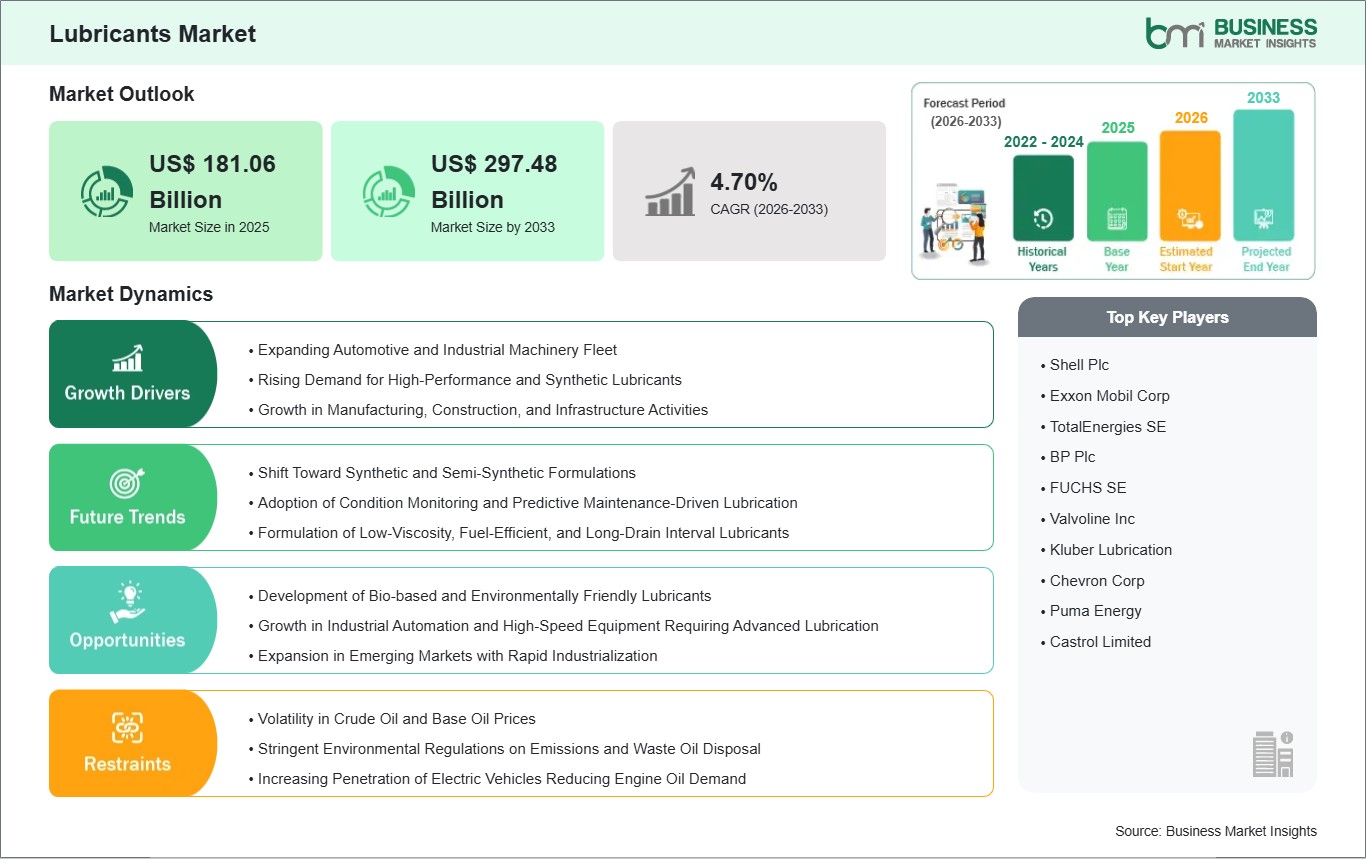
The Lubricants market size is expected to reach US$ 297.48 billion by 2033 from US$ 181.06 billion in 2025. The market is estimated to record a CAGR of 4.7% from 2026 to 2033.
In the automotive, industrial machinery, manufacturing, and energy industries, the use of lubricants would be very important, bearing in mind that they provide friction reduction and wear protection, among other thermal stability to the different applications of the lubricants. They should be noted to be used in engines, gear systems, hydraulic systems, metalworking, and machinery maintenance, among other commercial and industrial processes. Lubricant strengths encompass the fact that they can be used to obtain improved performance in equipment, they can be designed to suit the requirements of a given operating environment, and they can be deployed in a wide variety of end-use industries. The market is growing due to the increasing demand for automotive vehicles, industrial machinery, and energy-efficient systems, and due to the enhancement of industrialization and mechanization. In addition, its applications are increasing because the number of applications in the renewable energy sector has increased, the additive technology has improved, and high-performance machinery is being produced all over the world, hence fuelling the market change.
The rise is, however, hampered by market dynamics of the crude oil prices, strict environmental laws, and the likely environmental effects of the discharge of the lubricants. The other problem that the industry has to contend with is complying with local production legislations, safety standards, environmental protection norms, and proper recycling and waste management standards. Nevertheless, it is possible to state that the market will have a high potential because of the increased need for high-performance lubricants, the increased importance of machinery performance and industry development, and the priorities of eco-friendly and biodegradable products. Long-term growth of the lubricants market across the globe will be achieved through technological innovation, sustained research and development, enabling regulatory laws, and a transition to green and efficient lubricant formulations.

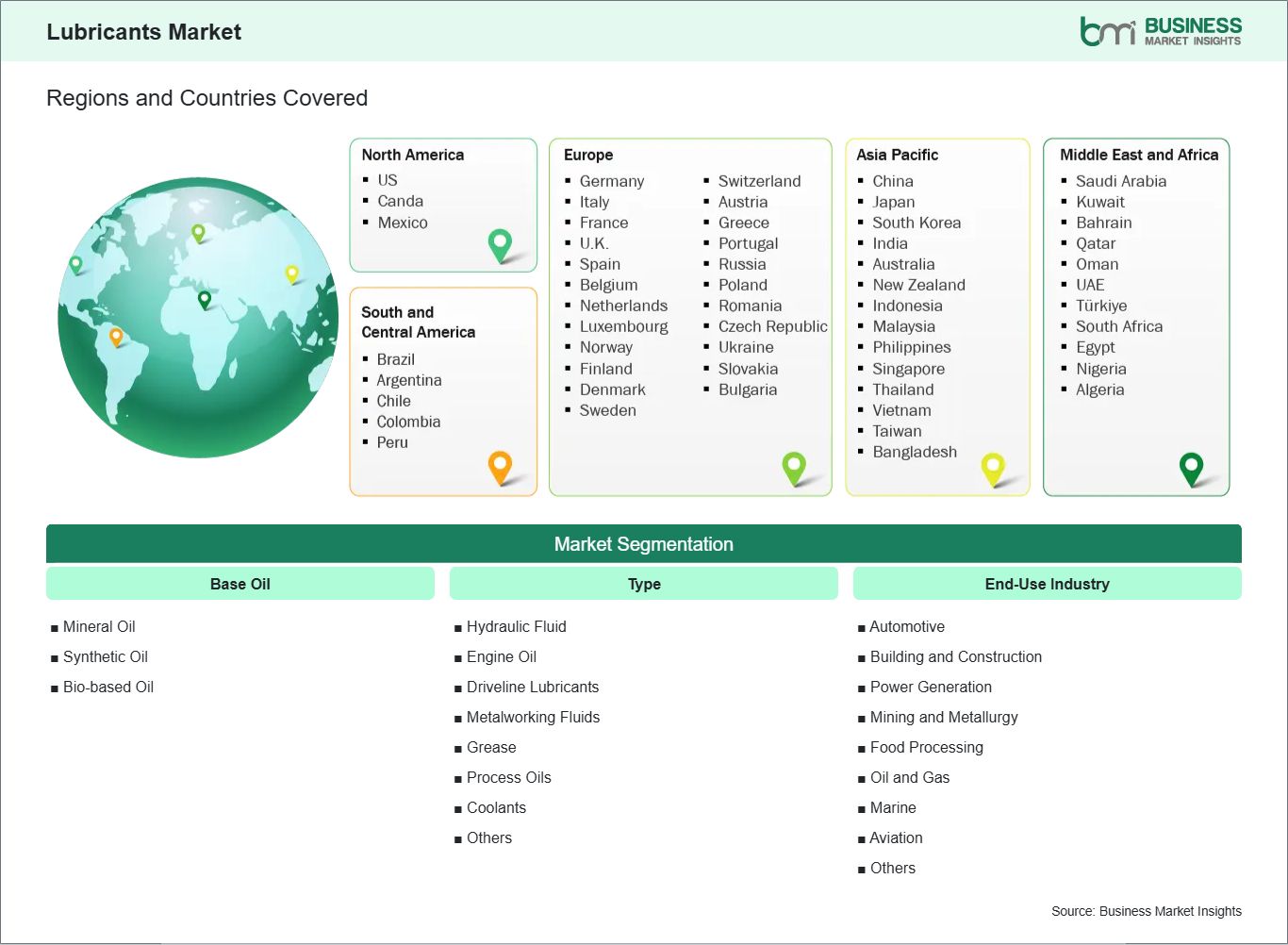
Key segments that contributed to the derivation of the lubricants market analysis are base oil, type, and end-use industry.
Lubricants are widely applied in engines, gears, hydraulic equipment, and industrial equipment. The demand for lubricants has been steadily increasing in the past few years because of the growth of the automobile sector, industrialization, and the mechanization of the world. Lubricants are used to reduce friction, wear, and tear, enhance thermal stability, and enhance the performance of machines in general. They have direct influence on the performance of the machinery, its life span, and the costs of maintaining the machinery. Advanced engines, heavy-duty industrial equipment, and precision machinery also need high-quality lubricants to enhance the reliability of the operations and their energy efficiency, and safety.
The continuous growth in the automotive manufacturing, industrial automation, and infrastructure machinery is considered one of the most important dynamics of the global lubricants market. Industrial and automotive processes of large scale depend on the high-performance lubricants that are consistent and of high performance. Asia-Pacific, North America, and Europe are among the regions that require high standards of machine efficiency and adherence to regulations, which facilitates the utilization of high-quality lubricant products. Moreover, new lubricant formulations, additive technology, and techniques of producing lubricants are improving productivity and machine safeguarding. The condition of the industrialization process and the development of the automobile industry remain the factors that promote the demand for lubricants in the world market.
Regulatory pressure, environmental protection concerns, and performance benefits are driving the widespread adoption of lubricants in sustainable and environmentally friendly industrial operations. Green lubricants, biodegradable, low-emission, and efficient lubricants are necessary to minimize environmental impact, ensure that environmental requirements are met, and increase energy efficiency in machine and engine work. They are used to reduce carbon footprint, eliminate soil and water pollution, as well as achieve sustainability goals.
The trend towards more environmentally friendly industrial processes and increased environmental standards has stimulated the shift towards the use of eco-friendly lubricants among the automotive, manufacturing, and energy industries. These lubricants help maintain the level of operational efficiency without reducing the performance even under the conditions of high pressure and extreme temperatures. Their adoption is further increased by government campaigns, environmental campaigns, and the increasing awareness of sustainable industrial practices. The increased ecological compliance, cost-saving through decreased energy usage, and sustainability in the long run are some of the factors that have necessitated the increased attraction to advanced and eco-friendly lubricants in the world market.

| Report Attribute | Details |
|---|---|
| Market size in 2025 | US$ 181.06 Billion |
| Market Size by 2033 | US$ 297.48 Billion |
| Global CAGR (2026 - 2033) | 4.70% |
| Historical Data | 2022 - 2024 |
| Forecast period | 2026-2033 |
| Segments Covered | By Base Oil
|
|
Regions and Countries Covered
| |
| North America | US, Canada, Mexico |
| Europe | Belgium, Austria, Finland, Denmark, Greece, Poland, Romania, Russia, Ukraine, Czech Republic, Slovakia, Bulgaria, Italy, Luxembourg, Germany, Switzerland, France, Netherlands, Norway, Portugal, Spain, Sweden, United Kingdom |
| Asia-Pacific | Australia, China, India, Japan, South Korea, Indonesia, Malaysia, Philippines, Singapore, Thailand, Vietnam, Bangladesh, New Zealand, Taiwan |
| South and Central America | Brazil, Argentina, Peru, Chile, Colombia |
| Middle East and Africa | Bahrain, Kuwait, Oman, Qatar, Saudi Arabia, United Arab Emirates, Turkiye, South Africa, Egypt, Algeria, Nigeria |
| Market leaders and key company profiles |
|
The Lubricants Market Size and Forecast (2022-2033) report provides a detailed analysis of the market covering below areas:
The geographical scope of the Lubricants market report is divided into five regions: North America, Asia Pacific, Europe, Middle East & Africa, and South & Central America. The Lubricants market in the Asia Pacific is expected to grow significantly during the forecast period.
The Asia-Pacific Lubricants market is segmented into China, Japan, South Korea, India, Australia, New Zealand, Indonesia, Malaysia, the Philippines, Singapore, Thailand, Vietnam, Taiwan, Bangladesh, and the Rest of Asia. Asia Pacific also has one of the fastest-growing lubricant markets since the automotive, industrial machinery, energy, and manufacturing industries are still developing. The key markets are those such as China and India because of the quick urbanization, rising industrial production, increasing car ownership, and expanding construction of infrastructure activities. The industry of manufacturing and blending of lubricants is also formed in the area due to minimal production costs, a skilled workforce, and the high level of domestic demand. Asian Pacific Governments are helping the industry by providing favorable policies, infrastructures, and incentives to the local production and R&D programs.
They have also launched programs to facilitate high-performance, green, and sustainable lubricant solutions to the automotive and industrial sectors. Equally, the Government of Japan has initiated programs in efforts to promote the use of high-tech, environmentally friendly, and innovative lubricants. The high rate of industrialization, the focus on quality assurance, and government policies regarding the long-term sustainability, operational efficiency, and compliance with the regulatory requirements in the end-use industries are the factors that accelerate the integration of lubricants in the region.

The Lubricants market is evaluated by gathering qualitative and quantitative data post-primary and secondary research, which includes important corporate publications, association data, and databases. A few of the key developments in the lubricants market are:
The Lubricants Market is valued at US$ 181.06 Billion in 2025, it is projected to reach US$ 297.48 Billion by 2033.
As per our report Lubricants Market, the market size is valued at US$ 181.06 Billion in 2025, projecting it to reach US$ 297.48 Billion by 2033. This translates to a CAGR of approximately 4.70% during the forecast period.
The Lubricants Market report typically cover these key segments-
The historic period, base year, and forecast period can vary slightly depending on the specific market research report. However, for the Lubricants Market report:
The Lubricants Market is populated by several key players, each contributing to its growth and innovation. Some of the major players include:
The Lubricants Market report is valuable for diverse stakeholders, including:
Essentially, anyone involved in or considering involvement in the Lubricants Market value chain can benefit from the information contained in a comprehensive market report.
Please tell us your area of interest
(Market Segments/ Regions and Countries/ Companies)