
Bio Lubricants Market Outlook: Size, Share, Trends, Growth Analysis, Competitive Landscape & Forecast, 2026-2033

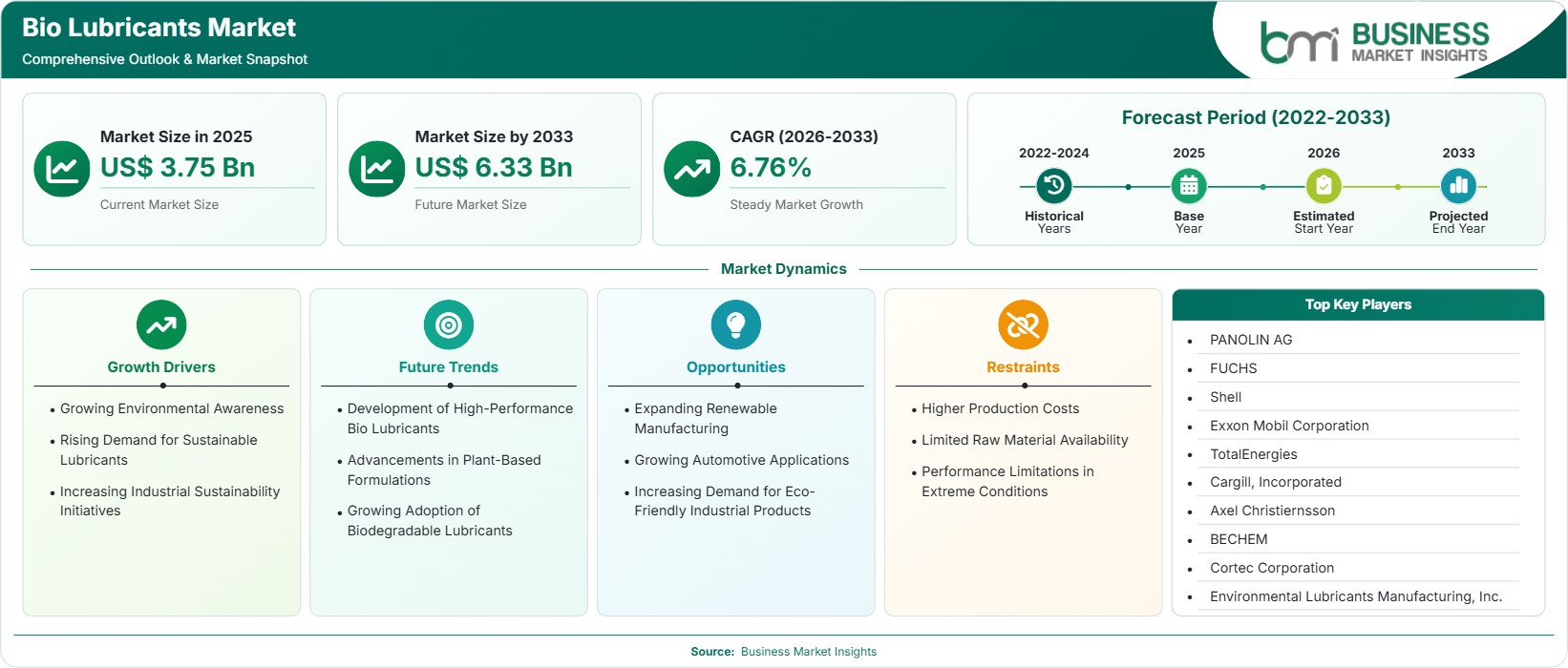
The Bio Lubricants Market size was valued at US$ 3.75 Billion in 2025 and is projected to reach US$ 6.33 Billion by 2033, growing at a CAGR of 6.76% during 2026–2033, driven by sustainability mandates, biodegradable formulations, industrial efficiency, renewable feedstocks, and environmentally sensitive applications.

Report Coverage
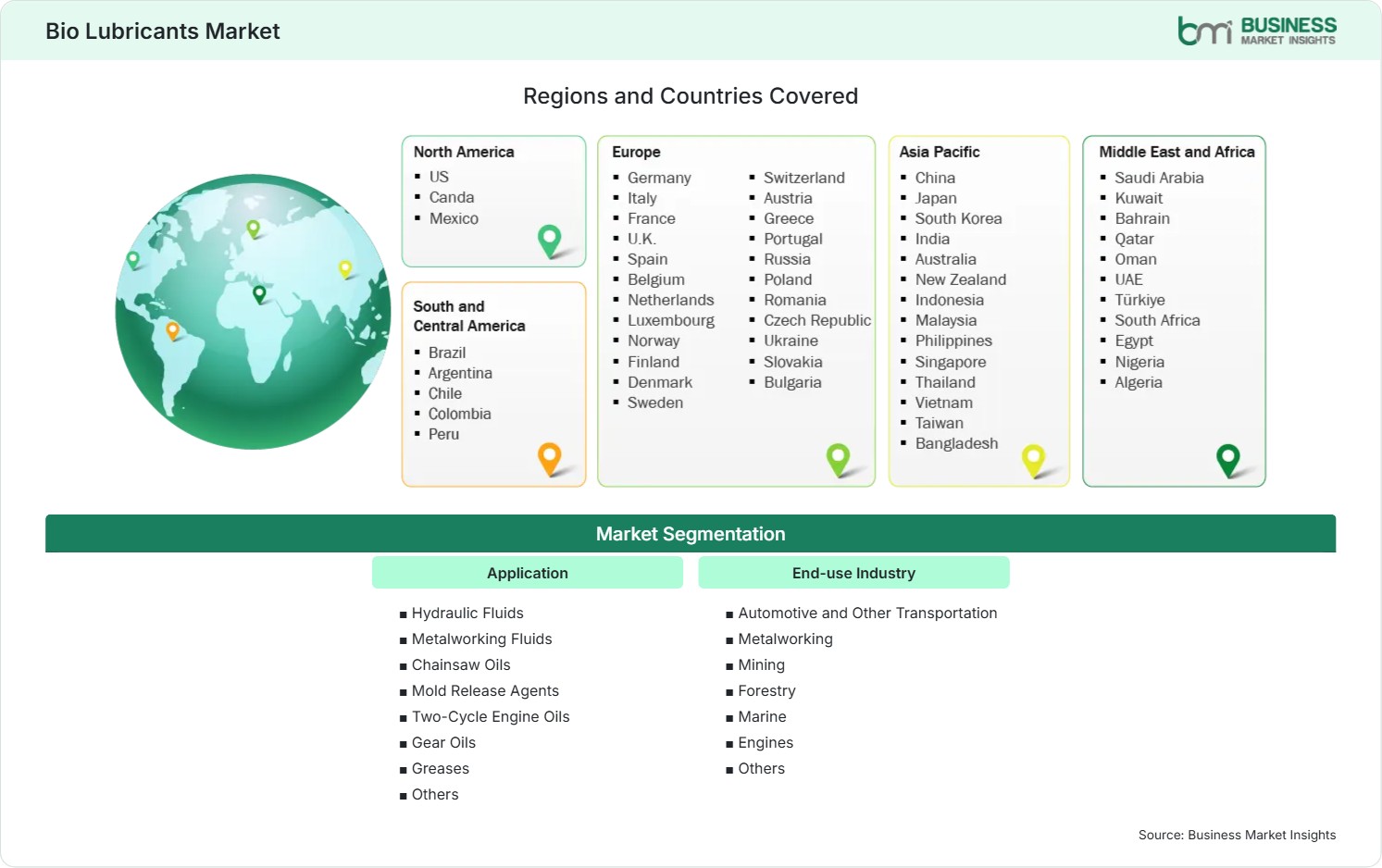
  • Application: Hydraulic Fluids, Metalworking Fluids, Chainsaw Oils, Mold Release Agents, Two-Cycle Engine Oils, Gear Oils, Greases, Others
  • End-use Industry: Automotive and Other Transportation, Metalworking, Mining, Forestry, Marine, Engines, Others
US$ 3.75 Bn Market size in 2025
US$ 6.33 Bn Market Size by 2033
6.76% CAGR, 2026 - 2033
2026-2033 Forecast Period

01 AI Overview

Bio Lubricants Market Summary

  • North America Region: North America holds a 31%–34% share in 2025, growing at a 6.5%–7.0% CAGR during 2026–2033. Strong industrial adoption, forestry equipment demand, biodegradable fluid mandates, and lifecycle efficiency priorities support premium formulations across hydraulic, gear, grease, chainsaw applications. The U.S. market advances at a 6.6%–7.1% CAGR, supported by environmental regulations and industrial demand.
  • Fastest Growing Region: Asia Pacific holds a 27%–30% share in 2025, advancing at a 7.4%–8.0% CAGR during 2026–2033. Asia Pacific demand benefits from industrial expansion, environmental regulation, machinery exports, renewable feedstock availability, and growing preference for lower-impact lubricants in manufacturing and transportation.
  • Leading Segment: Hydraulic Fluids account for a 28%–32% share in 2025, advancing at a 6.9%–7.4% CAGR during 2026–2033. Hydraulic Fluids lead adoption as mobile equipment, forestry machinery, marine systems, and environmentally sensitive operations increasingly prioritize biodegradable performance, leak-risk reduction, and equipment protection.
  • High Growth Segment: Chainsaw Oils represent a 10%–13% share in 2025, expanding at an 8.0%–8.7% CAGR during 2026–2033. Chainsaw Oils offer high-growth potential because forestry certification, watershed protection, equipment efficiency, and biodegradable formulation requirements encourage substitution of conventional petroleum-derived oils.
  • Key Market Opportunity: Growth opportunities center on renewable feedstocks, environmentally acceptable lubricants, low-viscosity formulations, and specialized fluids for electric mobility, industrial machinery, marine equipment, forestry, and construction.
  • Major Market Players: PANOLIN AG, FUCHS SE, Shell plc, Exxon Mobil Corporation, TotalEnergies SE, Cargill, Incorporated, Axel Christiernsson International AB, Carl Bechem GmbH, Cortec Corporation, and Environmental Lubricants Manufacturing, Inc.
02 Strategic Insights

Bio Lubricants Market: Strategic Insights

Bio Lubricants Market Strategic Framework
FREE PDF
Request your free sample
Request free sample
03 Stakeholder View

Key Takeaways

  • Integration is increasing within the industry value chain, where feedstock suppliers, ester producers, lubricant blenders, and OEMs are working together in order to increase consistency, sustainability compliance, and supply security.
  • Hydraulic systems used in marine operations, forestry operations, and environmentally sensitive hydraulic operations have the most commercial potential because of increasing environmental compliance and environmental liability concerns.
  • Product innovation is shifting toward high-performance synthetic esters, longer drain intervals, improved oxidative stability, and compatibility with modern industrial equipment operating under demanding conditions.
  • Asia Pacific offers one of the most compelling investment environments due to industrial expansion, infrastructure spending, renewable manufacturing development, and increasing adoption of environmentally preferred industrial products.
  • Strategic partnerships, portfolio expansion, and specialty lubricant acquisitions are accelerating as established lubricant producers strengthen their presence in renewable and biodegradable product categories.
04 Geographic Outlook

Bio Lubricants Market Regional Highlights

North America Bio Lubricants Market

North America accounted for approximately 34%–37% of revenue in 2025 and is projected to expand at a 6.1%–6.5% CAGR through 2033. The Bio Lubricants Market share remains strongest in sectors operating near environmentally sensitive waterways, protected ecosystems, and regulated industrial sites requiring reduced environmental risk and improved biodegradability characteristics.

  • Federal and state-level environmental policies are encouraging adoption of biodegradable lubricants in sensitive applications where leakage risks and soil contamination concerns are increasingly scrutinized.
  • Forestry operators are transitioning toward renewable lubricants to support sustainability objectives, reduce remediation costs, and improve environmental compliance across public and private land operations.
  • Marine operators continue adopting environmentally acceptable lubricants to meet sustainability requirements while supporting equipment performance and maintenance objectives.
  • Infrastructure modernization projects are increasing utilization of hydraulic equipment, creating opportunities for environmentally preferable fluid alternatives across construction activities.
  • Corporate sustainability reporting requirements are influencing procurement decisions, encouraging industrial operators to integrate renewable lubricant solutions into operational strategies.

US Bio Lubricants Market

The United States represents approximately 78%–82% of North American demand and is forecast to expand at a 6.2%–6.6% CAGR through 2033. Strong industrial activity, extensive construction fleets, and advanced sustainability programs continue supporting adoption. Public infrastructure investment, agricultural mechanization, and increased awareness regarding environmental performance contribute to market expansion.

  • Construction and agricultural equipment operators increasingly prefer biodegradable hydraulic fluids in environmentally sensitive operating environments.
  • Leading lubricant manufacturers continue investing in product development focused on performance enhancements and renewable feedstock utilization.
  • ESG-driven procurement policies among industrial organizations are encouraging greater adoption across maintenance and operational applications.
  • Renewable product promotion programs and sustainability commitments continue supporting long-term penetration across multiple industrial sectors.

Europe Bio Lubricants Market

Europe held approximately 29%–32% Bio Lubricants Market share during 2025 and is expected to advance at a 6.4%–6.8% CAGR through 2033. Germany maintains the leading position due to strong industrial activity and advanced manufacturing capabilities, while the Nordic countries and France demonstrate accelerated adoption. European demand is supported by renewable resource utilization initiatives, corporate sustainability goals, and widespread acceptance of environmentally preferable industrial products.

  • Germany remains the largest regional market due to extensive manufacturing activities and established industrial lubricant consumption patterns.
  • Nordic countries exhibit strong adoption rates because forestry and marine industries prioritize environmentally compatible lubricant solutions.
  • France and the Netherlands are expanding renewable industrial product utilization through sustainability and environmental policy initiatives.
  • Regional manufacturers continue developing advanced ester technologies optimized for performance, durability, and biodegradability requirements.
  • Growing emphasis on circular economy principles strengthens long-term demand for renewable lubricant products across industries.

Asia Pacific Bio Lubricants Market

Asia Pacific represented approximately 24%–27% of global revenue in 2025 and is projected to register the fastest expansion at a 7.8%–8.3% CAGR through 2033. China remains the largest market due to manufacturing scale and industrial output, while India exhibits the strongest expansion potential because of infrastructure development and sustainability initiatives. The region continues experiencing notable Bio Lubricants Market growth across transportation, marine, and industrial applications.

  • China leads regional demand through large-scale manufacturing operations and increasing environmental compliance requirements.
  • India is emerging as a high-growth market supported by industrial expansion, infrastructure development, and sustainability initiatives.
  • Southeast Asian economies are increasing adoption within marine and port-related operations where environmental considerations remain important.
  • Rising domestic production capacity is improving product availability and supporting broader industrial adoption.
  • Government initiatives promoting sustainable industrial development continue encouraging investment across renewable product categories.

Rest of World Bio Lubricants Market

Rest of World accounted for approximately 10%–13% of Bio Lubricants Market revenue in 2025 and is projected to expand at a 6.7%–7.2% CAGR through 2033. South and Central America benefit from agricultural activities and renewable-resource availability, while Middle East and Africa markets are gradually expanding through industrial diversification initiatives.

  • Brazil remains a leading adopter because of strong agricultural equipment utilization and increasing sustainability objectives.
  • Mining operations across Latin America are exploring biodegradable lubricant alternatives to reduce environmental risks.
  • Middle Eastern industrial diversification programs are supporting adoption of advanced specialty lubricants.
  • Marine and port infrastructure investments are creating opportunities for environmentally acceptable lubricant products.
  • Growing awareness regarding environmental protection is supporting gradual penetration across industrial end-use sectors.
Global Market Geography
FREE PDF
Request your free sample
Request free sample
05 Segment Analysis

Bio Lubricants Market Segmentation

Application

The application segment represents the core demand structure for renewable lubricant consumption. Hydraulic fluids accounted for the largest share at approximately 28%–31% in 2025 and are projected to expand at a 6.5%–6.9% CAGR through the forecast period. Increasing environmental regulations, adoption across industrial and mobile equipment, and growing requirements for biodegradable performance continue shaping the segment. The Bio Lubricants Market scope is expanding as end users seek sustainable alternatives capable of delivering operational efficiency and environmental compliance.

  • Hydraulic Fluids: Widely adopted in construction, agriculture, forestry, and industrial machinery due to leakage risks in environmentally sensitive areas. Growing sustainability requirements and equipment modernization continue supporting demand across multiple operating environments.
  • Metalworking Fluids: Increasingly utilized in machining and fabrication operations seeking reduced environmental impact and improved workplace safety. Advanced formulations offer lubrication performance while supporting sustainable manufacturing objectives and regulatory compliance.
  • Chainsaw Oils: Strongly adopted within forestry applications where direct environmental exposure is common. Enhanced biodegradability characteristics and sustainability initiatives among forestry operators continue driving product selection and replacement demand.
  • Mold Release Agents: Used across manufacturing activities requiring efficient separation performance and surface quality consistency. Renewable formulations are gaining traction as producers prioritize environmentally responsible production processes and sustainability benchmarks.
  • Two-Cycle Engine Oils: Utilized in recreational, agricultural, and utility equipment. Growing awareness regarding emissions, environmental stewardship, and renewable products supports adoption within specialized engine applications.
  • Gear Oils: Demand is rising within industrial machinery and transportation systems where sustainability objectives complement operational performance requirements. Product innovation continues improving load-carrying performance and equipment protection capabilities.
  • Greases: Increasing deployment in heavy equipment, marine systems, and industrial operations. Enhanced water resistance, biodegradability, and maintenance performance strengthen market acceptance across demanding applications.

End-use Industry

The end-use industry segment demonstrates expanding adoption across sectors with direct environmental exposure and sustainability obligations. Automotive and Other Transportation accounted for approximately 24%–27% share in 2025, while Marine is expected to remain the fastest-growing industry with a CAGR of 8.0%–8.5% through 2033. Growing procurement requirements, environmental compliance frameworks, and operational sustainability goals continue reinforcing adoption patterns. The Bio Lubricants Market share is increasingly influenced by industry-specific environmental performance requirements and lifecycle cost considerations.

  • Automotive and Other Transportation: Fleet operators are gradually incorporating renewable lubricant formulations to support sustainability targets, reduce environmental impact, and align maintenance operations with evolving regulatory expectations.
  • Metalworking: Manufacturers increasingly prioritize lubricants that improve workplace environmental performance while maintaining machining efficiency, equipment longevity, and compliance with sustainability-oriented procurement standards.
  • Mining: Adoption remains concentrated in environmentally sensitive extraction locations where reducing contamination risks is critical. Sustainability programs and regulatory requirements continue supporting utilization in selected applications.
  • Forestry: Forestry operators actively deploy biodegradable lubricants to minimize ecological impact in conservation areas and commercial forests while supporting operational performance requirements.
  • Marine: Vessel operators increasingly utilize environmentally acceptable lubricants to comply with environmental regulations and support sustainable fleet-management strategies in coastal and offshore operations.
  • Engines: Renewable engine lubricants continue gaining attention as technology advancements improve oxidation stability, wear protection, and compatibility with modern equipment requirements.
06 Market Forces

Bio Lubricants Market Dynamics

Key Market Drivers

Growing Environmental Awareness

Environmental awareness among industrial operators, governments, and consumers is significantly reshaping lubricant procurement strategies. Products are increasingly assessed in terms of their biodegradability, toxicity and environmental footprint throughout the entire lifecycle of the product rather than just being concerned about their operational efficiency. Industrial sectors like forestry, agriculture, maritime transport, and construction are coming under increasing scrutiny regarding their efforts to minimize risks of contamination in the event of an unintentional oil leakage. Bio Lubricants Market trends are driving the product replacement process and significantly boosting the adoption rate among the mature industries.

Rising Demand for Sustainable Lubricants

Large industrial enterprises are actively pursuing sustainability and decarbonization objectives across procurement, manufacturing, and maintenance activities. Renewable lubricants are aligned for addressing these needs since they minimize the reliance on lubricants from petroleum sources and at the same time contribute to environmental performance goals. The need for lubricants which achieve an acceptable balance between biodegradability and oxidation resistance and wear is becoming important for equipment users. This trend is increasing commercial adoption in the areas of transport, manufacturing, marine, and construction along with sustained for Bio Lubricants Market growth in different applications.

Increasing Industrial Sustainability Initiatives

Industrial sustainability initiatives have moved from voluntary commitments to measurable operational objectives across numerous sectors. The manufacturing sector, mining companies, logistics firms, and utility companies have set objectives for environmental performance related to resource efficiency and pollution control. The use of renewable lubricants contributes towards achieving these objectives through reducing ecological impacts from leakage and lubricant disposal. Sustainability considerations are more prevalent in public infrastructure spending projects and thus increasing demand for renewable lubricants. In addition, there is increased pressure from global sustainability objectives set by corporations towards the adoption of eco-preferable products by suppliers within industrial supply chains.

Key Market Opportunities

Expanding Renewable Manufacturing

Investments in renewable manufacturing infrastructure are creating substantial growth opportunities for producers and suppliers. The development of bio-refinery facilities, advanced ester plants, and integrated feedstock processing facilities helps improve production efficiency and strengthens the supply chain. Such innovations help commercialize high-quality products that are able to compete with existing lubricants on an equal footing. Production capacity expansion in various manufacturing regions will lead to lower costs in the long term and secure supply chains. Development of new generation renewable production technologies ensures positive Bio Lubricants Market Forecasts and offers opportunities for long-term investors, specialty chemical firms, and lubricant manufacturers.

Growing Automotive Applications

Automotive manufacturers and fleet operators are exploring broader integration of renewable lubricants to support sustainability objectives and reduce lifecycle environmental impact. Developments in the area of lubricant formulation have led to the improvement of properties like thermal stability, resistance to oxidation, and compatibility with equipment, allowing for increased possibilities of adoption within multiple modes of transportation. Commercial vehicle fleets, municipal transportation departments, and specialized vehicle operators have been considering greener maintenance options. The development of sustainable mobility systems and the emergence of low-emission transportation systems allow for new applications of such products.

Increasing Demand for Eco-Friendly Industrial Products

Industrial customers are increasingly prioritizing environmentally responsible products throughout procurement and maintenance operations. This development goes even further and involves greases, hydraulic oils, coolants, and special industrial chemicals. Manufacturers of those products who succeed in ensuring environmental performance along with operational reliability will definitely enjoy better customer retention and premium pricing. The increase in demand is especially apparent within environmentally sensitive industries like maritime transport, forestry, agriculture, and public works. Favorable legislation, combined with a tendency towards green industrial products purchasing, provides an excellent platform for innovations and commercialization.

Market Restraints and Challenges

Higher Production Costs

Factor: Renewable feedstocks, advanced processing requirements, and specialized formulation technologies typically result in production costs exceeding those of many conventional petroleum-based alternatives.

Impact: High product prices may limit usage by those who are highly sensitive to prices, especially in developing countries or in industrially oriented segments that are highly cost-oriented. Purchase committees may give more weight to initial costs than to environmental considerations throughout the life cycle of the product, thus delaying conversions. Although technology developments and economies of scale have been bringing down cost differences, cost continues to be a major issue in achieving commercial success.

Limited Raw Material Availability

Factor: Production depends heavily on renewable feedstocks derived from agricultural and biological resources. Availability may fluctuate due to weather patterns, agricultural productivity, competing end-use industries, and changing commodity market dynamics.

Impact: The constraints of the supply chain can lead to instability in prices of raw materials, insecurity of procurement, and production planning problems for the makers of lubricants. The insecurity of raw material supplies can lead to constraints in capacity expansion and profitability along the value chain. Additionally, the companies can face higher sourcing costs when there is agricultural turmoil or there is intense competition from renewable fuels and chemicals.

07 Company Analysis

Competitive Landscape

The competitive landscape is characterized by major lubricant companies, specialty formulators, renewable feedstock suppliers, and environmentally focused manufacturers. Bio Lubricants Market analysis indicates that differentiation increasingly rests on formulation performance, environmental certification, supply reliability, technical services, and application-specific product development.

Company Name

Overview

Products and Services relevant to this market

PANOLIN AG

Swiss specialist recognized for biodegradable lubrication technologies serving environmentally sensitive industrial and mobile equipment applications.

Biodegradable hydraulic fluids, gear oils, greases, forestry lubricants, marine products, and environmentally acceptable lubricant solutions.

FUCHS SE

Global lubricant producer developing circular and renewable-material technologies alongside conventional high-performance lubrication platforms.

Bio-based and circular lubricant technologies, hydraulic fluids, automotive oils, industrial lubricants, and specialty formulations.

Shell plc

Global energy and lubricant company with an expanded biodegradable portfolio integrating PANOLIN technologies into its lubricant offering.

Shell PANOLIN biodegradable fluids, hydraulic oils, greases, marine lubricants, industrial products, and lubrication monitoring services.

Exxon Mobil Corporation

Major lubricant producer with broad industrial and transportation lubrication capabilities and extensive formulation expertise.

Industrial lubricants, hydraulic fluids, gear oils, greases, automotive lubricants, and specialty products supporting sustainability-oriented applications.

TotalEnergies SE

Integrated energy and lubricant producer offering biodegradable products across industrial, automotive, marine, and equipment applications.

Biodegradable hydraulic fluids, gear oils, engine lubricants, greases, and specialty eco-friendly formulations.

Cargill, Incorporated

Bioindustrial supplier combining renewable raw materials, ester technologies, additives, and formulation expertise for lubricant manufacturers.

Priolube ester base oils, Perfad friction modifiers, Emkarox fluids, chain oils, metalworking ingredients, and EV lubricant components.

Axel Christiernsson International AB

European grease specialist serving industrial customers with advanced grease technologies and environmentally adapted formulation capabilities.

Lubricating greases, calcium-based technologies, specialty greases, and environmentally oriented industrial lubrication products.

Carl Bechem GmbH

German specialty lubricant manufacturer serving industrial, automotive, and manufacturing customers with application-focused solutions.

Bio-based lubricants, metalworking fluids, industrial oils, greases, hydraulic fluids, and specialty lubrication technologies.

Cortec Corporation

U.S. developer of corrosion-control and environmentally responsible products serving industrial and infrastructure applications.

Biodegradable lubricants, corrosion-inhibiting products, specialty oils, greases, and environmentally responsible industrial lubrication solutions.

Environmental Lubricants Manufacturing, Inc.

U.S. specialist focused on renewable-resource lubricants designed for environmentally sensitive applications.

Bio-based hydraulic fluids, greases, gear oils, chain lubricants, and specialty environmentally acceptable formulations.


10 Trust & Transparency

Research Methodology

The market analysis combines proprietary research with secondary data from government agencies, company disclosures, regulatory filings, industry databases and expert interviews. Market estimates are validated through data triangulation, cross-market benchmarking and analyst review.

View Full Research Methodology

11 Questions Answered

Frequently Asked Questions

What insights are covered in a Bio Lubricants Market Report?

A comprehensive report typically evaluates market size, demand trends, competitive positioning, regional outlooks, application analysis, end-use sectors, technology developments, sustainability drivers, and long-term strategic opportunities.

What are the major growth opportunities for manufacturers?

Key opportunities include renewable manufacturing expansion, marine lubricant adoption, advanced ester technology development, industrial sustainability initiatives, and environmentally acceptable products for sensitive operating environments.

Which region is expected to grow fastest during the forecast period?

Asia Pacific is projected to record the fastest expansion, supported by industrialization, infrastructure development, environmental awareness initiatives, and increasing investment in sustainable manufacturing and industrial products.

How are bio lubricants different from conventional lubricants?

Bio lubricants are primarily produced from renewable resources and are designed to offer improved biodegradability and lower environmental impact. Modern formulations increasingly provide performance characteristics comparable to conventional petroleum-based alternatives in several industrial applications.

What industries generate the strongest demand for Bio Lubricants Market?

Demand is strongest from forestry, marine, agriculture, construction, mining, and industrial manufacturing sectors. These industries frequently operate in environmentally sensitive locations where biodegradability, environmental compliance, and contamination risk reduction are important purchasing considerations.

Access the Full Bio Lubricants Market Report

Get segment-level forecasts, regional estimates, competitive benchmarking, company profiles and downloadable Excel datasets.

Access the full Bio Lubricants Market Report
350 pages PDF & Excel | 2026-08-20