Bio Based Chemicals Market Regional Highlights
North America Bio Based Chemicals Market
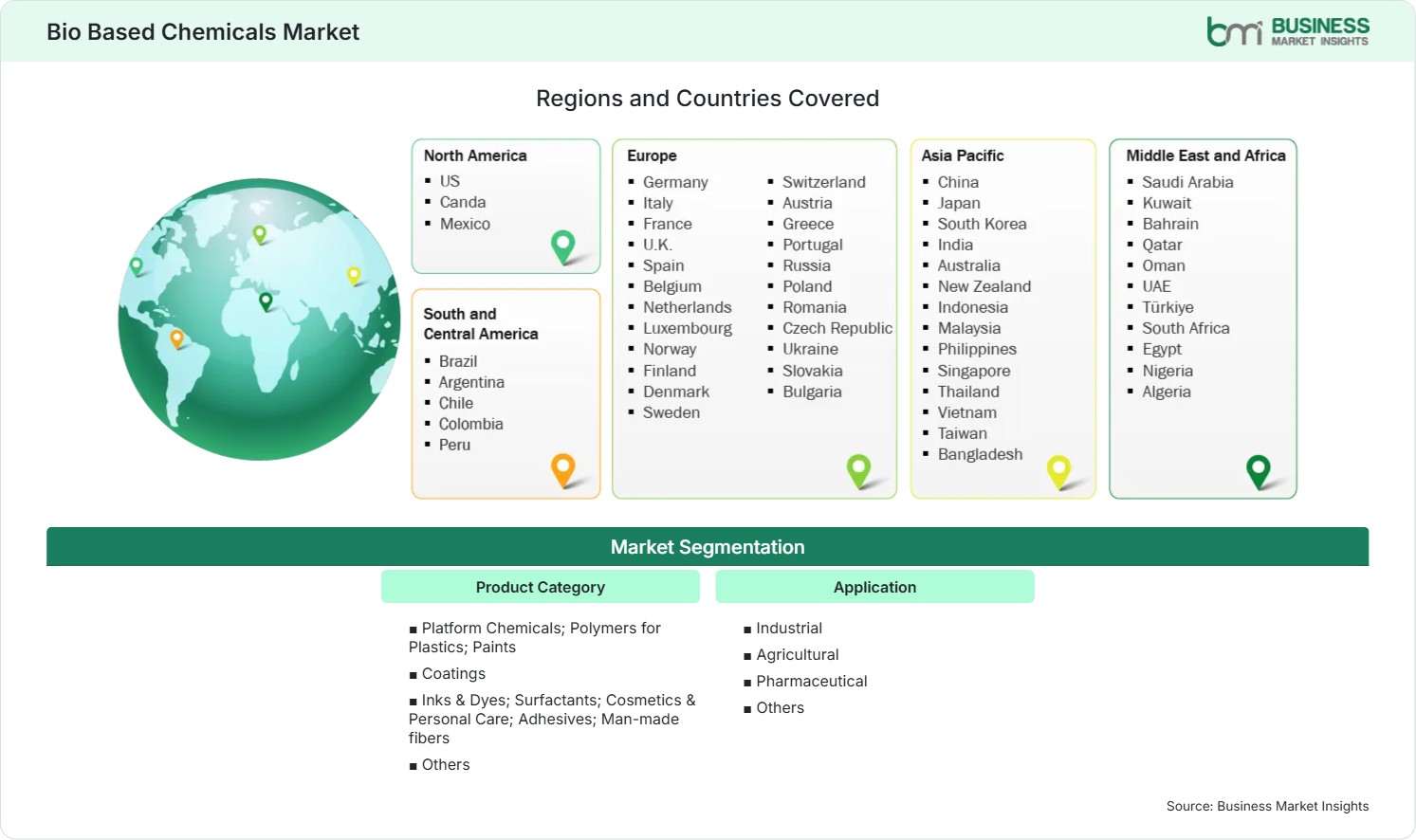
North America represented approximately 27%–30% of the 2025 Bio Based Chemicals Market demand and is modeled to grow at a 9.8%–10.7% CAGR through 2033. The region combines abundant agricultural feedstocks, established chemical manufacturing infrastructure, advanced biotechnology, and strong corporate decarbonization programs. The United States dominates regional demand, while Canada contributes through biofuels, forest-derived materials, industrial biotechnology, and the development of renewable feedstocks. Bio based solvents, polymers, surfactants, coatings, and agricultural inputs are creating practical substitution opportunities across established industrial value chains.
- U.S. chemical producers are increasingly evaluating renewable feedstocks for solvents, polymers, surfactants, specialty intermediates, and additives where existing production equipment can support gradual substitution.
- Agricultural biotechnology can create additional commercial demand by means of biological crop protection, renewable crop inputs, fermentation-derived ingredients, and less damaging agricultural formulations.
- Customer preference is growing for products that have independently verified carbon footprints and whose renewable feedstocks can be traced.
- Canada has available opportunities in the areas of chemicals derived from forests, biorefineries, renewable carbon, specialty materials, and the integration of agricultural and industrial biomass systems.
US Bio Based Chemicals Market
The U.S. represented approximately 23%–26% of the global Bio Based Chemicals Market demand in 2025 and is modeled to expand at a 9.7%–10.6% CAGR through 2033. Its market advantage comes from the availability of agricultural feedstocks, strong biotechnology research, mature specialty-chemical manufacturing, and great downstream demand across consumer goods, industrial materials, agriculture, and personal care. ADM's existing industrial-biosolutions platform illustrates how agricultural processing infrastructure can be converted into solvents, polymers, and specialty chemical intermediates for established industrial customers.
- Bio-based solvents are being used in a variety of products for homes, in personal care items, in fragrances, in coatings, and in industrial processing since solvent alternatives derived from plants are able to offer proven functional performance.
- The U.S. chemical sector has strong potential for drop-in alternatives because many customers prefer renewable-content substitution without changing manufacturing lines or finished-product specifications.
- It is increasingly important for biotechnology partnerships to improve fermentation yields, to develop new platform molecules, and to reduce conversion costs so that commercial production becomes viable.
Europe Bio Based Chemicals Market
Europe represented approximately 30%–33% of the 2025 Bio Based Chemicals Market demand and is modeled to grow at a 9.7%–10.6% CAGR through 2033. Germany, France, Italy, the Netherlands, Belgium, and the Nordic countries form major technology and manufacturing hubs. Germany is modeled around 10.0%–10.9% growth, while France and the Netherlands offer strong specialty-chemical and bioeconomy ecosystems. European policy emphasizes circularity, carbon reduction, renewable feedstocks, and sustainable product design, increasing demand for measurable bio-based content and lower-carbon production routes.
- In order to reduce the intensity of their use of fossil feedstocks while at the same time keeping their present production assets, increasing numbers of European chemical producers are making use of biomass-balance models, which allows for quicker acceptance by their customers than is the case with entirely new production platforms.
- Demand from the electrical infrastructure, coatings, industrial cleaning, and specialty applications sectors is causing a rise in the use of renewable solvents and natural esters.
- Customers in the pharmaceutical, personal-care, and specialty chemicals sectors place great importance on documented sustainability, which in turn provides opportunities for high-purity and traceable renewable chemical grades.
- The regulations in Europe may speed up the process of adoption but will also lead to greater requirements for certification, reporting, chain-of-custody, and lifecycle assessment on the part of suppliers.
Asia Pacific Bio Based Chemicals Market
Asia Pacific represented approximately 25%–29% of the 2025 Bio Based Chemicals Market demand and is modeled to expand at an 11.2%–12.2% CAGR through 2033. China, Japan, India, South Korea, Southeast Asia, and Australia provide the largest opportunities. China provides manufacturing scale, Japan offers advanced materials and biotechnology capabilities, while India combines agricultural feedstock availability with expanding specialty-chemical production. India is projected to grow at 11.5%–12.6%, supported by sustainable manufacturing and rising domestic demand for specialty materials and consumer products.
- China has great potential in the areas of bio-based polymers, surfactants, solvents, packaging materials, and specialty chemicals since the scale of downstream manufacturing is able to facilitate quick commercialization.
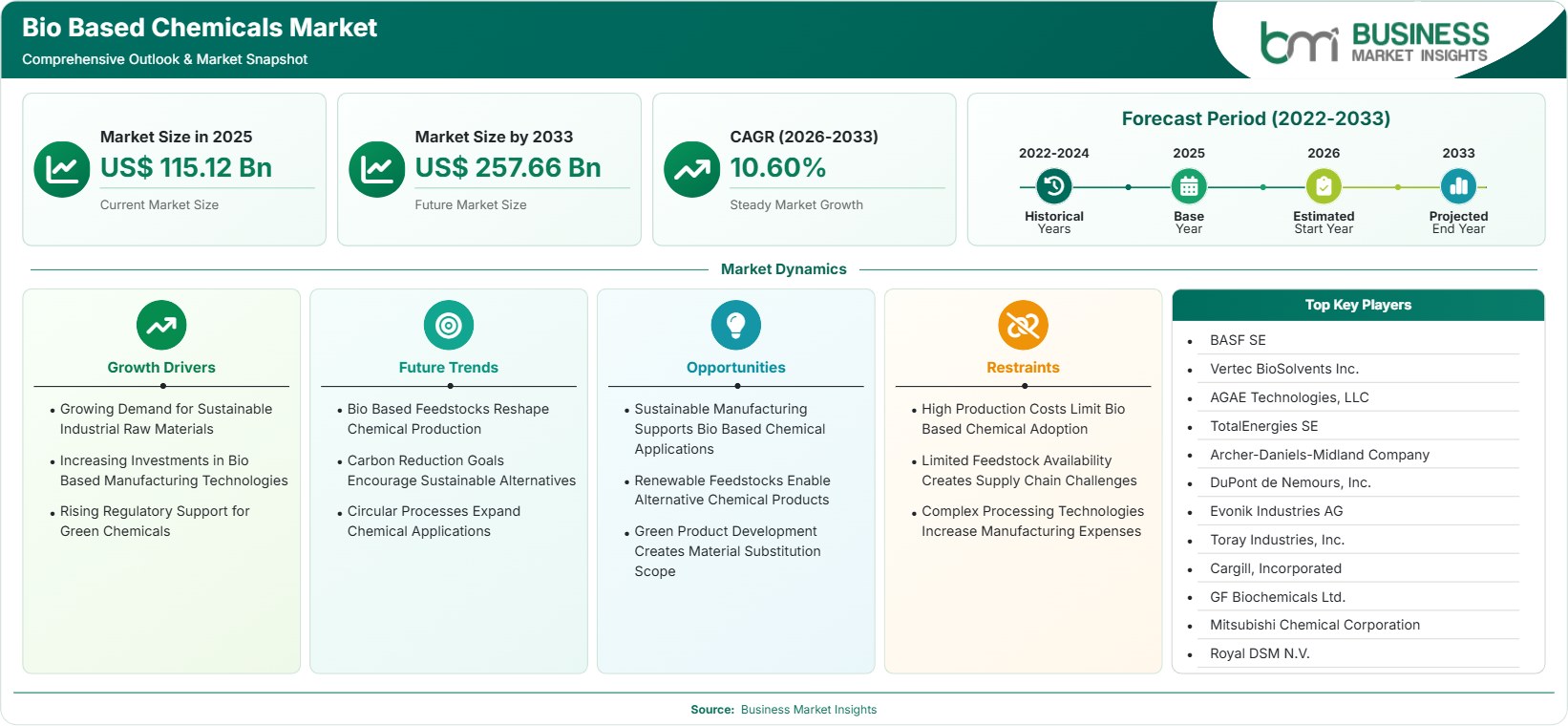
- Japan is advancing its bio-based fibers, polymers, materials, and chemical technologies, with companies including Toray and Mitsubishi Chemical playing a role in more high-value applications.
- India offers feedstock and manufacturing possibilities in the areas of fermentation chemicals, solvents, polymers, agricultural inputs, and personal-care ingredients.
- Although concerns about traceability and land use still exist, Southeast Asia has advantages due to its biomass resources, plantation-based feedstocks, palm-derived chemistry, and growing investment in chemical manufacturing.
Rest of World Bio Based Chemicals Market
South and Central America represented approximately 9%–11% of 2025 demand and are modeled at a 9.6%–10.8% CAGR through 2033. Brazil leads the regional opportunity because of its agricultural scale, sugarcane industry, established biofuel infrastructure, and growing biotechnology ecosystem. Argentina, Colombia, and Chile offer selective potential in agricultural inputs, solvents, biorefineries, and specialty chemicals. Feedstock availability provides a structural cost advantage in selected applications.
The Middle East and Africa represented approximately 10%–12% of demand and are modeled at a 8.7%–9.8% CAGR. Gulf states are investing in diversification, renewable energy, circular materials, and downstream chemical manufacturing, while Africa provides longer-term opportunities through agricultural residues, biomass, and biotechnology.
- Brazil has great potential in the area of chemicals derived from sugar, fermentation products, renewable solvents, polymers, and integrated biorefineries that use agricultural residues.
- Latin American agricultural supply chains can create cost advantages for bio-based chemicals when feedstock processing is integrated with existing sugar, starch, vegetable oil, or forestry systems.
- Gulf countries can develop renewable-chemical projects around industrial diversification, circular carbon, waste utilization, and downstream specialty manufacturing.
- African markets offer longer-term opportunities for distributed biomass processing, agricultural chemicals, renewable solvents, and specialty ingredients, where local feedstock resources can reduce reliance on imported fossil inputs.