
Natural Bio Based Resin Market Outlook: Size, Share, Trends, Growth Analysis, Competitive Landscape & Forecast, 2026-2033

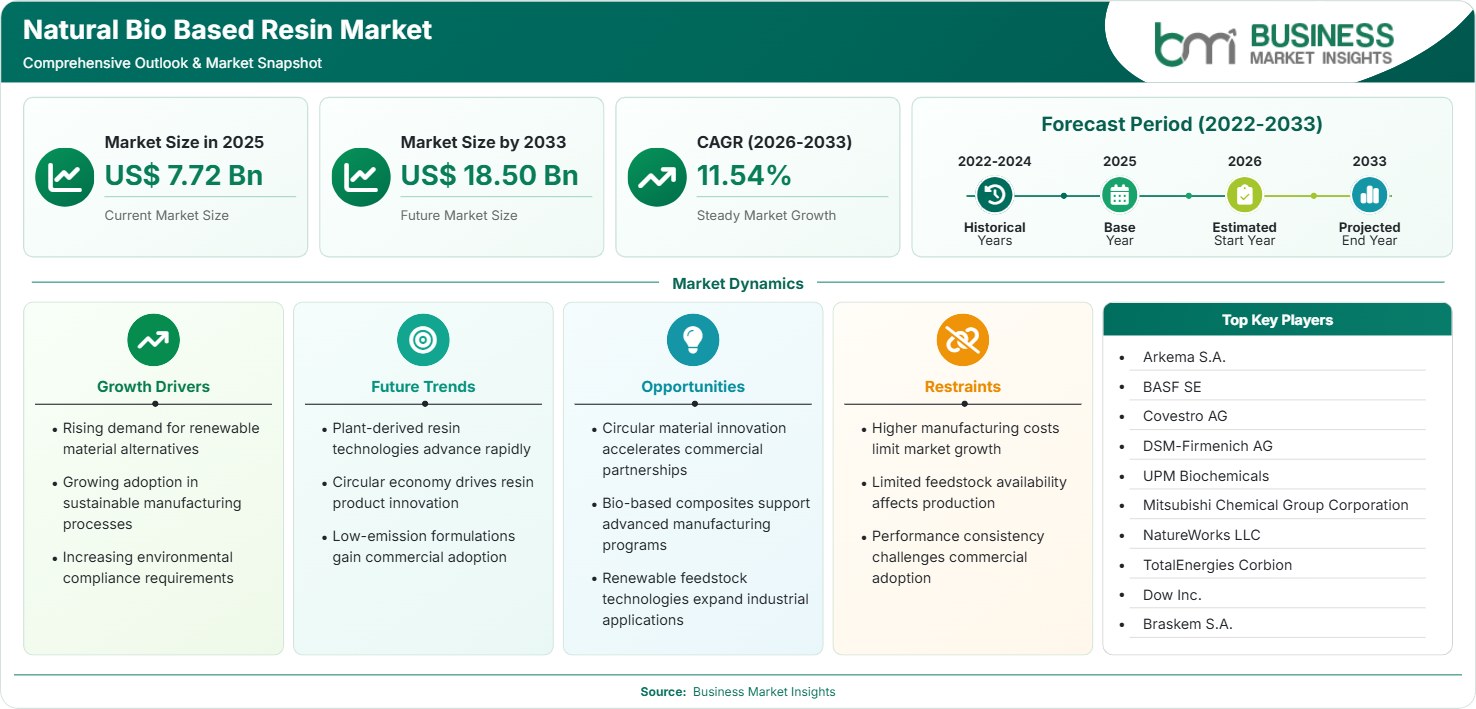
The Natural Bio Based Resin Market size was valued at US$ 7.72 billion in 2025 and is projected to reach US$ 18.5 billion by 2033, growing at a CAGR of 11.54% during 2026–2033. Rising demand for renewable material alternatives, sustainable manufacturing adoption, and increasing environmental compliance requirements are accelerating investments in bio-based polymer technologies.

Report Coverage
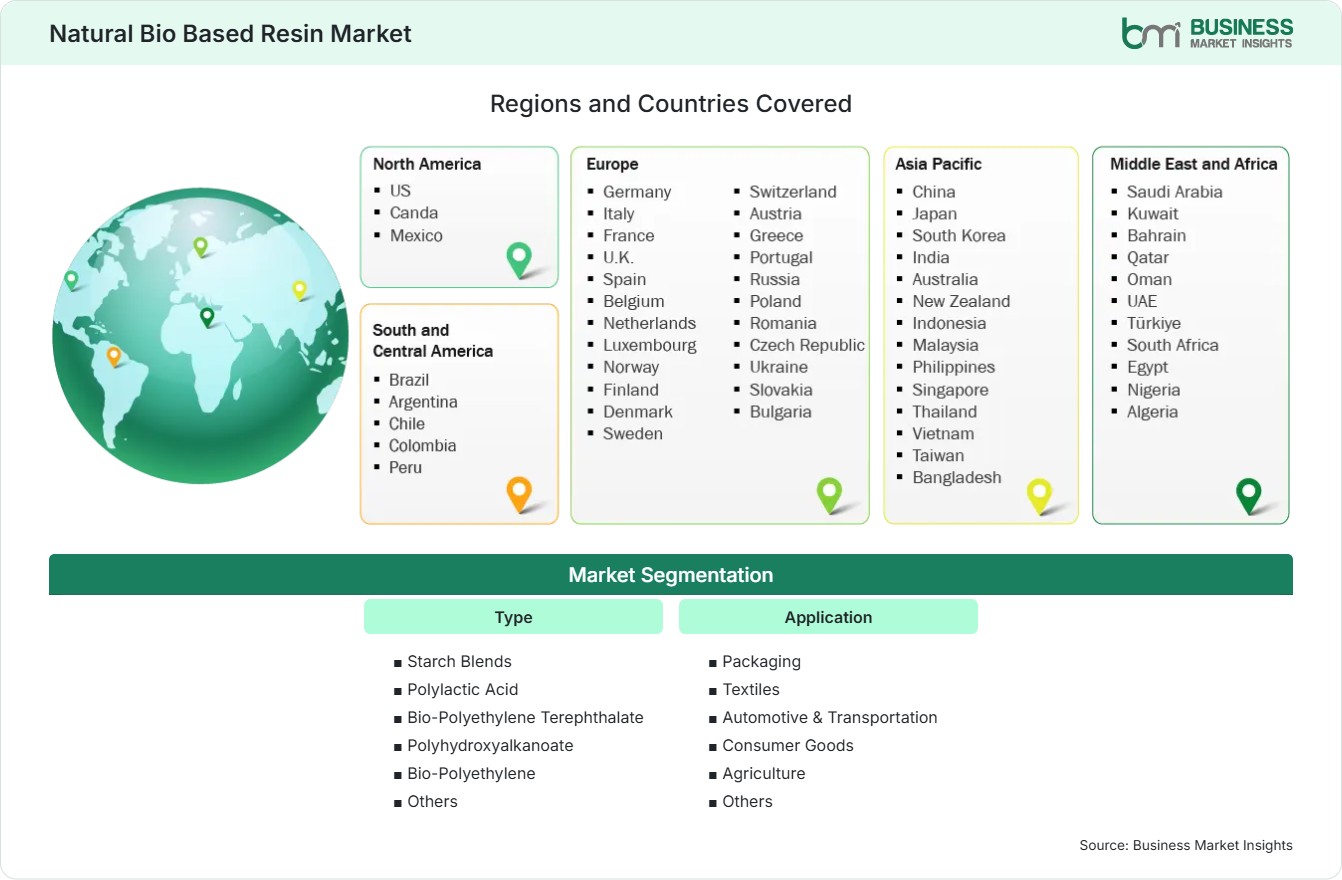
  • Type: Starch Blends, Polylactic Acid, Bio-Polyethylene Terephthalate, Polyhydroxyalkanoate, Bio-Polyethylene, Others
  • Application: Packaging, Textiles, Automotive & Transportation, Consumer Goods, Agriculture, Others
US$ 7.72 Bn Market size in 2025
US$ 18.50 Bn Market Size by 2033
11.54% CAGR, 2026 - 2033
2026-2033 Forecast Period

AI Overview

Natural Bio Based Resin Market Summary

  • North America Region: North America holds 32%–35% market share in 2025 and is projected to grow at a CAGR of 10.8%–11.4% during 2026–2033. Growth is supported by sustainable packaging demand, corporate decarbonization targets, and increasing adoption of renewable polymers. The U.S. market is advancing at a CAGR of 11.0%–11.6%, driven by industrial innovation and regulatory focus on reducing fossil-based plastics.
  • Fastest Growing Region: Asia Pacific represents 38%–41% market share in 2025 and is expected to register a CAGR of 12.2%–12.8% through 2026–2033. Expanding manufacturing capacity, rising environmental awareness, and investments in renewable feedstock production are supporting regional adoption.
  • Leading Segment: Polylactic Acid accounts for 34%–37% market share in 2025 and is expected to grow at a CAGR of 11.6%–12.1%, supported by strong demand in packaging, consumer products, and compostable material applications.
  • High Growth Segment: Automotive & Transportation captures 18%–21% market share in 2025 and is projected to expand at a CAGR of 12.0%–12.6%, driven by lightweight material adoption, vehicle electrification, and sustainable component development.
  • Key Market Opportunity: Development of recyclable bio-based polymers, renewable feedstock integration, and advanced composite materials is creating opportunities for manufacturers targeting sustainable packaging, mobility, and industrial applications.
  • Major Market Players: Arkema S.A., BASF SE, Covestro AG, DSM-Firmenich AG, UPM Biochemicals, Mitsubishi Chemical Group Corporation, NatureWorks LLC, TotalEnergies Corbion, Dow Inc., and Braskem S.A.
Strategic Insights

Natural Bio Based Resin Market: Strategic Insights

Natural Bio Based Resin Market Strategic Framework
FREE PDF
Request your free sample
Request free sample
Stakeholder View

Key Takeaways

  • The market ecosystem is shifting from conventional resin production toward integrated renewable supply chains involving feedstock suppliers, chemical producers, compounders, and end-use manufacturers.
  • Packaging remains a major opportunity area as brands increasingly adopt compostable and renewable materials to meet consumer expectations and sustainability commitments.
  • Innovation is moving toward advanced bio-based composites, improved mechanical properties, and hybrid resin systems that expand applications beyond traditional packaging.
  • Asia Pacific provides strong investment potential due to growing polymer manufacturing capabilities, renewable resource availability, and increasing adoption of sustainable production practices.
  • Strategic collaborations, technology partnerships, and capacity expansions are becoming common as companies compete to strengthen positions in emerging bio-material markets.
  • Regulatory pressure on plastic waste reduction is encouraging long-term investments in renewable polymers and accelerating commercialization of next-generation resin technologies.
Geographic Outlook

Natural Bio Based Resin Market Regional Highlights

North America Natural Bio Based Resin Market

North America represents 32%–35% Natural Bio Based Resin Market share in 2025 and is projected to expand at a CAGR of 10.8%–11.4% during 2026–2033. The region benefits from strong sustainability initiatives, advanced chemical manufacturing capabilities, and increasing demand from packaging and transportation sectors. Companies are investing in renewable materials to support carbon reduction goals while maintaining product performance across industrial applications.

  • Sustainable packaging initiatives continue increasing demand for renewable resin solutions among food, beverage, and consumer product manufacturers.
  • Automotive suppliers are exploring bio-based materials to reduce component weight and improve sustainability performance.
  • Corporate carbon reduction commitments are encouraging partnerships between resin producers and material technology developers.
  • Research investments are improving bio-based resin durability, processing efficiency, and commercial scalability.

US Natural Bio Based Resin Market

The United States contributes 82%–85% of North American demand and is expected to grow at a CAGR of 11.0%–11.6% during 2026–2033. Strong industrial infrastructure, innovation capabilities, and sustainability-focused manufacturing strategies continue supporting adoption across packaging, automotive, and consumer applications.

  • Packaging companies are increasing adoption of renewable materials to improve environmental performance.
  • Chemical producers are expanding bio-based polymer development through research collaborations.
  • Automotive manufacturers are evaluating sustainable resin alternatives for interior and lightweight components.
  • Government sustainability initiatives continue supporting renewable material investments.

Europe Natural Bio Based Resin Market

Europe accounts for 27%–30% market share in 2025 and is anticipated to grow at a CAGR of 10.9%–11.5% during the forecast period. Strong environmental regulations, circular economy targets, and demand for sustainable materials continue driving regional adoption. Germany leads consumption, while France and the Netherlands show strong growth through renewable chemical investments.

  • Circular economy policies encourage adoption of renewable and recyclable resin technologies.
  • Manufacturers are investing in low-carbon material solutions for industrial applications.
  • Sustainable packaging regulations are increasing demand for bio-based polymers.
  • Chemical companies are expanding renewable feedstock processing capabilities.

Asia Pacific Natural Bio Based Resin Market

Asia Pacific holds 38%–41% market share in 2025 and records the highest 12.2%–12.8% CAGR through 2026–2033. Rising manufacturing activity, availability of agricultural resources, and increasing environmental awareness are accelerating adoption. China, Japan, and India are key markets due to expanding polymer industries and growing sustainability investments.

  • Renewable feedstock availability supports regional production expansion.
  • Packaging manufacturers are adopting bio-based materials to meet sustainability requirements.
  • Automotive production growth is increasing demand for lightweight sustainable materials.
  • Government initiatives are encouraging domestic renewable material development.

Rest of World Natural Bio Based Resin Market

The Rest of World region accounts for 7%–10% market share in 2025 and is expected to expand at a CAGR of 11.2%–11.8% during 2026–2033. Latin America, the Middle East, and Africa are gradually adopting bio-based materials through renewable resource development and sustainability-focused industrial investments.

  • Brazil benefits from agricultural feedstock availability and expanding renewable chemical industries.
  • Middle Eastern countries are exploring diversification beyond traditional petrochemical materials.
  • Emerging markets are increasing sustainable packaging adoption across consumer sectors.
  • Local manufacturing investments are improving availability of renewable resin solutions.
Global Market Geography
FREE PDF
Request your free sample
Request free sample
Segment Analysis

Natural Bio Based Resin Market Segmentation

Type

The type segment defines the performance characteristics, application suitability, and commercial adoption of renewable resin solutions across industries. It accounted for 34%–37% market share in 2025 and is projected to grow at a CAGR of 11.6%–12.1% during 2026–2033. Increasing demand for low-carbon materials, improved processing capabilities, and enhanced mechanical performance is expanding the Natural Bio Based Resin Market scope across packaging, mobility, and industrial applications.

  • Starch Blends: Used in compostable packaging, agricultural films, and disposable products due to renewable sourcing, biodegradability advantages, and compatibility with sustainable material development initiatives.
  • Polylactic Acid: Widely adopted in packaging, consumer goods, and food service applications because of its compostability, transparency, processability, and suitability for replacing conventional petroleum-based plastics.
  • Bio-Polyethylene Terephthalate: Increasingly utilized in beverage bottles, packaging films, and containers as manufacturers seek renewable alternatives with similar performance characteristics to conventional PET materials.
  • Polyhydroxyalkanoate: Gains attention for biodegradable applications requiring improved environmental performance, including packaging, medical products, and specialty materials requiring natural decomposition capabilities.
  • Bio-Polyethylene: Used in flexible packaging, containers, and consumer products due to renewable feedstock compatibility while maintaining durability, moisture resistance, and processing characteristics similar to traditional polyethylene.

Application

The application segment continues expanding as industries adopt renewable materials to reduce environmental impact while maintaining product functionality. It represented 42%–45% market share in 2025 and is expected to register a CAGR of 11.8%–12.4% through 2026–2033. Increasing Natural Bio Based Resin Market trends indicate broader utilization across packaging, transportation, consumer goods, and industrial sectors as manufacturers seek alternatives to fossil-based polymers.

  • Packaging: Represents the largest application area due to rising demand for sustainable films, containers, food packaging, and compostable solutions from brands targeting reduced plastic dependency.
  • Textiles: Adoption is increasing as manufacturers explore renewable fibers and polymer-based materials for apparel, technical textiles, and sustainable fabric production.
  • Automotive & Transportation: Growing use in interior components, lightweight parts, and composite materials is driven by vehicle manufacturers seeking improved sustainability performance and reduced environmental impact.
  • Consumer Goods: Applied in household products, electronics accessories, personal care packaging, and durable goods where renewable materials enhance product sustainability positioning.
  • Agriculture: Utilized in mulch films, agricultural products, and biodegradable materials that support reduced plastic waste and improved environmental compatibility in farming applications.
Market Forces

Natural Bio Based Resin Market Dynamics

Key Market Drivers

Rising demand for renewable material alternatives

Environmental issues that include plastic wastes, carbon dioxide, and fossil fuel dependency have prompted industries to consider the use of renewable resins. The packaging industry, the automobile industry, and consumer goods firms are looking into bio-based materials to minimize environmental effects without compromising on product quality. As indicated by the European Bioplastics Association, there has been growth in the capacity for bioplastics manufacturing in the world. This transition is supporting Natural Bio Based Resin Market growth by creating demand for materials derived from plant-based feedstocks, agricultural resources, and other renewable sources that align with sustainability objectives across multiple industries.

Growing adoption in sustainable manufacturing processes

Manufacturers are integrating sustainable production practices to improve resource efficiency, reduce emissions, and meet corporate environmental targets. These bio-based resins have become key elements of these approaches as firms look for alternatives which will give them materials that have smaller carbon footprints than their counterparts that use petroleum-based polymers. Improvements in technology used for processing polymers have enhanced compatibility, durability, and scalability of renewable materials. There is an increasing trend of collaboration between industrial users and resin suppliers to design application-based solutions in packaging, transportation, and consumer goods sectors.

Increasing environmental compliance requirements

The introduction of stricter environmental standards, along with the mounting pressure on governments and consumers, is contributing to the adoption of sustainable materials. The policies that target the reduction of plastic waste, increase recycling efficiency, and lower carbon emissions have pushed organizations to research renewable resins as an alternative solution. These changing requirements are contributing to Natural Bio Based Resin Market trends, as producers invest in compliant materials that support circular economy models while meeting performance expectations in demanding applications.

Key Market Opportunities

Circular material innovation accelerates commercial partnerships

The development of circular material systems is creating opportunities for collaboration between resin manufacturers, recyclers, technology providers, and end-use industries. Companies are investing in advanced recycling-compatible bio-based materials that can improve resource efficiency and support closed-loop manufacturing models. Partnerships focused on renewable feedstock integration and improved polymer recovery are helping accelerate commercialization. Natural Bio Based Resin Market Forecasts indicate that continued innovation in circular solutions will create new revenue opportunities for manufacturers developing scalable materials suitable for packaging, automotive components, and industrial applications.

Bio-based composites support advanced manufacturing programs

Demand for lightweight and high-performance materials is encouraging the development of bio-based composite solutions for advanced manufacturing applications. Automotive, aerospace, and industrial equipment producers are exploring renewable composite materials that combine lower environmental impact with improved mechanical properties. These materials provide opportunities to replace conventional composites in selected applications where weight reduction and sustainability are important design considerations. Continued research into fiber reinforcement, resin modification, and processing improvements is expected to expand the commercial potential of bio-based composites across specialized industries.

Renewable feedstock technologies expand industrial applications

Advancements in renewable feedstock processing are improving the availability and performance of bio-based resin technologies. Companies are developing solutions based on agricultural residues, plant oils, and other renewable resources to diversify raw material sources. Improved production methods are helping reduce dependence on limited petroleum resources while supporting consistent resin quality. As feedstock technologies mature, manufacturers can introduce bio-based materials into broader industrial applications including packaging, textiles, automotive components, and consumer products, creating additional growth opportunities across global markets.

Market Restraints and Challenges

Higher manufacturing costs limit market growth

Bio-based resin production often requires specialized technologies, renewable feedstock processing, and additional research investments compared with conventional polymer manufacturing. Factor: Higher production expenses associated with raw material sourcing, processing infrastructure, and limited economies of scale increase overall manufacturing costs. Impact: Elevated pricing can restrict adoption among cost-sensitive industries and create challenges for manufacturers competing against established petroleum-based resin alternatives, particularly in applications where sustainability benefits are not yet fully valued by end users.

Limited feedstock availability affects production

The availability of suitable renewable raw materials remains a challenge for large-scale bio-based resin production. Factor: Dependence on agricultural resources, seasonal variations, land availability, and competing uses for biomass can create supply limitations for manufacturers. Impact: Feedstock constraints may affect production consistency, increase procurement complexity, and slow expansion of manufacturing capacity. Companies are therefore investing in alternative feedstock technologies, waste-derived materials, and diversified sourcing strategies to improve supply reliability and support long-term commercialization.

Company Analysis

Competitive Landscape

The competitive environment is shaped by material innovation, renewable feedstock development, strategic collaborations, and expansion of sustainable polymer portfolios. Natural Bio Based Resin Market analysis highlights that leading companies are focusing on improving resin performance, scaling production capabilities, and developing application-specific solutions for packaging, automotive, textiles, and consumer product industries.

Company Name

Overview

Products and Services Relevant to this Market

Arkema S.A.

Global specialty materials company developing advanced polymers and sustainable solutions for industrial applications.

Bio-based polymers, specialty resins, high-performance materials, renewable material solutions, and polymer technologies.

BASF SE

Leading chemical producer offering sustainable materials, performance polymers, and solutions supporting circular economy initiatives.

Bio-based plastics, sustainable polymer solutions, engineering plastics, additives, and renewable material technologies.

Covestro AG

Global manufacturer focused on innovative polymer materials and climate-neutral material development strategies.

Sustainable polycarbonates, circular polymers, bio-attributed materials, and advanced resin solutions.

DSM-Firmenich AG

Science-based company developing sustainable materials and specialty solutions across nutrition, health, and industrial markets.

Bio-based polymers, renewable material technologies, sustainable coatings, and advanced material solutions.

UPM Biochemicals

Renewable chemicals producer specializing in replacing fossil-based materials with wood-based alternatives.

Bio-monoethylene glycol, renewable functional fillers, lignin-based materials, and sustainable resin components.

Mitsubishi Chemical Group Corporation

Global chemical manufacturer developing high-performance materials and sustainable polymer technologies.

Bio-based polymers, engineering plastics, specialty resins, and environmentally responsible material solutions.

NatureWorks LLC

Producer of Ingeo™ biopolymer materials derived from renewable resources for sustainable applications.

Polylactic acid resins, compostable polymers, packaging materials, and bio-based plastic solutions.

TotalEnergies Corbion

Joint venture specializing in advanced PLA bioplastic production and sustainable polymer solutions.

PLA resins, biodegradable polymers, packaging materials, and compostable material technologies.

Dow Inc.

Global materials science company developing innovative polymer solutions and sustainability-focused material technologies.

Renewable-based polymers, recyclable packaging materials, performance resins, and specialty polymer solutions.

Braskem S.A.

Petrochemical company producing renewable polymers using bio-based feedstocks and sustainable production approaches.

Bio-polyethylene, renewable thermoplastic resins, sustainable plastics, and circular material solutions.

Trust & Transparency

Research Methodology

The market analysis combines proprietary research with secondary data from government agencies, company disclosures, regulatory filings, industry databases and expert interviews. Market estimates are validated through data triangulation, cross-market benchmarking and analyst review.

View Full Research Methodology

Questions Answered

Frequently Asked Questions

What information does the Natural Bio Based Resin Market Report provide?

The Market Report covers market segmentation, regional analysis, competitive developments, technology trends, growth drivers, challenges, and investment opportunities influencing the future direction of renewable resin industries.

Why is Asia Pacific an important market for bio-based resins?

Asia Pacific benefits from expanding manufacturing capacity, renewable resource availability, growing environmental awareness, and increasing investments in sustainable material production infrastructure.

Which industries are creating demand for bio-based resins?

Packaging, automotive, textiles, consumer goods, and agriculture industries are increasingly adopting bio-based resins to improve sustainability performance while maintaining required product functionality.

Which type of bio-based resin has strong commercial adoption?

Polylactic Acid has significant commercial adoption due to its compostability, renewable sourcing, processing compatibility, and suitability for packaging, food service, and consumer product applications.

What factors are driving adoption of bio-based resins?

Increasing sustainability commitments, environmental regulations, demand for renewable materials, and the need to reduce dependence on fossil-based plastics are encouraging industries to adopt bio-based resin alternatives.

Access the Full Natural Bio Based Resin Market Report

Get segment-level forecasts, regional estimates, competitive benchmarking, company profiles and downloadable Excel datasets.

Access the full Natural Bio Based Resin Market Report
350 pages PDF & Excel | 2026-08-07
Similar Research

Related Market Reports