
Encapsulation Resins Market Outlook: Size, Share, Trends, Growth Analysis, Competitive Landscape & Forecast, 2026-2033

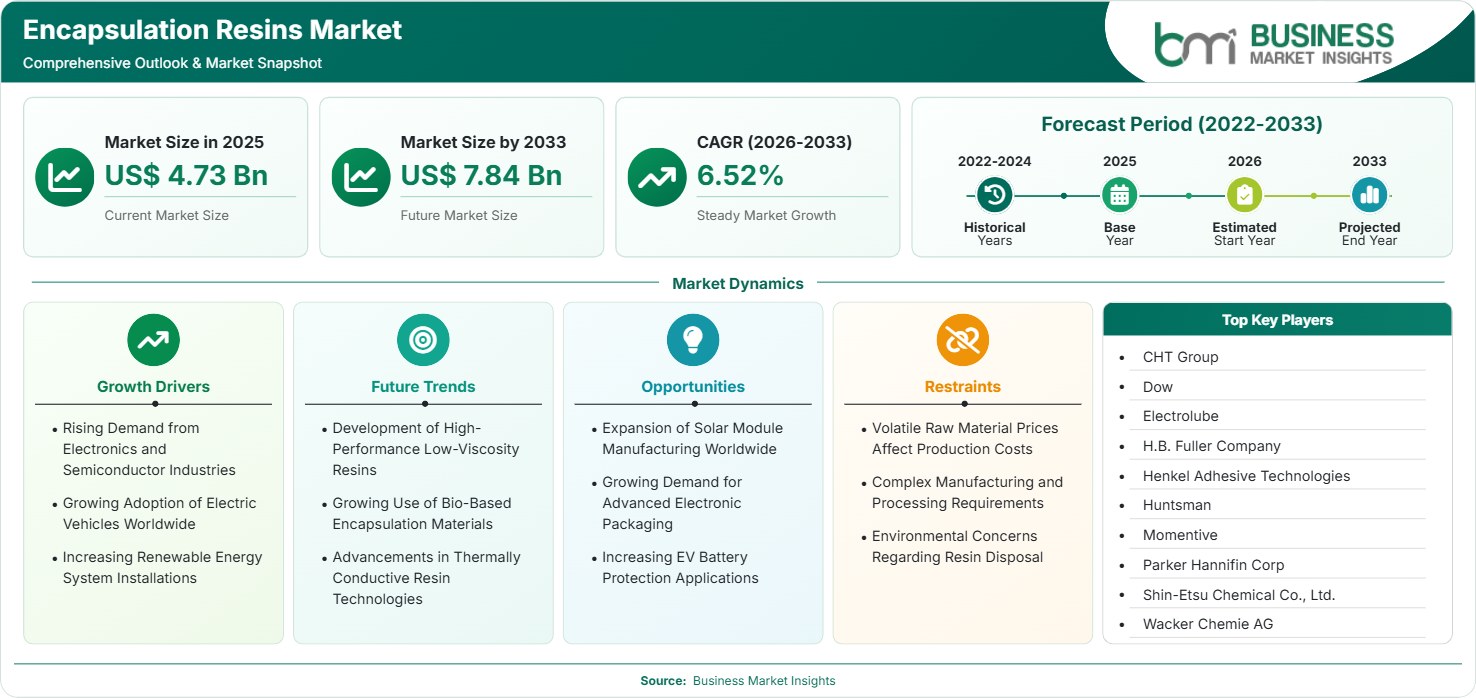
The Encapsulation Resins Market size was valued at US$ 4.73 Billion in 2025 and is projected to reach US$ 7.84 Billion by 2033, growing at a CAGR of 6.52% during 2026–2033. Expansion is supported by semiconductor packaging demand, EV power electronics adoption, renewable energy infrastructure development, and rising requirements for durable insulation and thermal protection solutions across industrial applications.

Report Coverage
  • Type: Epoxy, Polyurethane, Silicone, Others
  • Application: Electronics & Consumer Devices, Automotive & E-Mobility, Industrial & Electrical Equipment, Energy & Utilities Infrastructure, Others
US$ 4.73 Bn Market size in 2025
US$ 7.84 Bn Market Size by 2033
6.52% CAGR, 2026 - 2033
2026-2033 Forecast Period

01 AI Overview

Encapsulation Resins Market Summary

  • North America: North America holds a 28%–31% market share in 2025, growing at a 5.8%–6.2% CAGR during 2026–2033, driven by semiconductor manufacturing investments, automotive electrification, aerospace electronics, and grid modernization initiatives. The U.S. market demonstrates steady expansion through domestic chip manufacturing programs, advanced packaging investments, and EV supply chain localization, with a 5.9%–6.3% CAGR between 2026 and 2033.
  • Fastest Growing Region: Asia Pacific represents a 36%–39% market share in 2025 and is expanding at a 7.2%–7.7% CAGR during 2026–2033, supported by electronics manufacturing concentration, semiconductor capacity additions, battery production growth, renewable energy installations, and industrial automation investments across China, India, South Korea, Japan, and Southeast Asia.
  • Leading Segment: Epoxy formulations account for a 43%–46% market share in 2025 and are projected to grow at a 6.1%–6.5% CAGR during 2026–2033, supported by strong adhesion, electrical insulation performance, chemical resistance, and widespread utilization in semiconductor packages, industrial electronics, transformers, and power modules.
  • High Growth Segment: Automotive & E-Mobility applications represent a 23%–26% market share in 2025 and are estimated to expand at a 7.8%–8.4% CAGR through 2033, driven by increasing EV production, battery safety requirements, high-voltage electronics adoption, and demand for protection against moisture, vibration, and thermal cycling.
  • Key Market Opportunity: Growing investments in advanced semiconductor packaging, artificial intelligence hardware, renewable power systems, and electric mobility create opportunities for customized encapsulation solutions with improved thermal conductivity, reliability, sustainability, and operational performance.
  • Major Market Players: CHT Group, Dow Inc., Electrolube Limited, H.B. Fuller Company, Henkel AG & Co. KGaA, Huntsman Corporation, Momentive Performance Materials Inc., Parker Hannifin Corporation, Shin-Etsu Chemical Co., Ltd., and Wacker Chemie AG.
02 Strategic Insights

Encapsulation Resins Market: Strategic Insights

Encapsulation Resins Market Strategic Framework
FREE PDF
Request your free sample
Request free sample
03 Stakeholder View

Key Takeaways

  • The supply ecosystem is shifting from standardized resin supply toward application-specific solutions, with material producers increasingly collaborating with electronics manufacturers, semiconductor companies, automotive suppliers, and energy equipment producers to improve product performance.
  • Automotive electronics, EV battery systems, power modules, and semiconductor packaging offer the strongest growth pathways because these applications require high dielectric protection, thermal stability, mechanical durability, and resistance to harsh operating conditions.
  • Product innovation is moving toward low-stress epoxy systems, thermally conductive silicone materials, environmentally improved polyurethane formulations, and hybrid resin technologies designed for miniaturized electronics and higher power density applications.
  • Asia Pacific provides the strongest expansion potential due to its concentration of electronics manufacturing, semiconductor fabrication capacity, battery supply chains, and renewable energy equipment production. Countries including China, India, South Korea, Japan, and Vietnam remain important investment destinations.
  • Competitive activity is increasingly focused on strategic partnerships, application development centers, and technology acquisitions that improve formulation capabilities and strengthen customer relationships across specialized electronic applications.
  • Sustainability requirements are influencing resin development as manufacturers explore lower-emission production methods, improved recyclability pathways, and safer chemical formulations while maintaining the reliability standards required in critical electronic systems.
04 Geographic Outlook

Encapsulation Resins Market Regional Highlights

North America Encapsulation Resins Market

North America Encapsulation Resins share accounts for a 28%–31% in 2025 and is projected to expand at a 5.8%–6.2% CAGR during 2026–2033. The region benefits from semiconductor investments, aerospace electronics production, EV supply chain development, and industrial automation adoption. The United States remains the primary contributor due to domestic electronics manufacturing initiatives, while Canada supports demand through renewable energy and industrial applications.

  • The region benefits from semiconductor packaging investments and domestic manufacturing expansion, creating consistent demand for high-performance encapsulation materials used in advanced electronic components and power management systems.
  • Automotive electrification initiatives across the United States and Canada are increasing requirements for durable resin systems protecting batteries, sensors, charging equipment, and power electronic modules.
  • Industrial automation, aerospace systems, and defense electronics continue supporting adoption of specialized encapsulation solutions requiring high reliability, thermal resistance, and long service performance.
  • Renewable energy infrastructure modernization is increasing demand for protective materials used in solar inverters, energy storage systems, and electrical equipment operating under demanding environmental conditions.

US Encapsulation Resins Market

The U.S. represents the largest national market within North America, supported by semiconductor investments, electric mobility expansion, and advanced electronics manufacturing. The country contributes approximately 23%–26% of global demand in 2025 and is expected to register a 5.9%–6.3% CAGR during 2026–2033. Government-supported semiconductor capacity development and industrial reshoring initiatives are strengthening domestic demand for reliable encapsulation technologies.

  • Semiconductor fabrication and packaging investments are creating opportunities for epoxy and silicone encapsulation materials used in high-performance electronic applications and advanced component protection.
  • EV manufacturing growth is increasing consumption of encapsulation solutions for battery management systems, charging infrastructure, power converters, and vehicle electronics requiring improved durability.
  • Renewable energy expansion, including solar and energy storage projects, supports adoption of encapsulation materials designed for outdoor exposure and long operational cycles.

Europe Encapsulation Resins Market

Europe Encapsulation Resins Market holds a 22%–25% share in 2025 and is estimated to grow at a 5.5%–6.0% CAGR between 2026 and 2033. Germany leads regional demand through automotive electronics, industrial equipment manufacturing, and renewable energy technologies. France, Italy, and the Netherlands contribute through electronics production and energy transition programs, while Poland and Central European economies represent higher-growth manufacturing locations.

  • Germany remains a leading European market due to automotive electronics production, industrial automation capabilities, and demand for advanced materials supporting vehicle electrification.
  • France and Italy are expanding adoption through renewable energy equipment manufacturing, industrial systems modernization, and increased electronic component integration.
  • The Netherlands supports demand through semiconductor ecosystem development and specialized electronics manufacturing requiring advanced protection materials.
  • Poland and Central Europe present growth opportunities through manufacturing relocation, automotive supply chain expansion, and increasing electronics assembly activities.

Asia Pacific Encapsulation Resins Market

Asia Pacific represents the largest regional market with a 36%–39% share in 2025 and is expected to achieve the highest growth rate at a 7.2%–7.7% CAGR during 2026–2033. The region benefits from semiconductor leadership, electronics manufacturing concentration, EV battery production, and renewable energy deployment. China, Japan, South Korea, India, and Southeast Asian countries remain central to regional expansion.

  • China dominates regional demand through extensive electronics manufacturing, semiconductor capacity, EV production, and renewable energy equipment supply chains requiring encapsulation materials.
  • India is emerging as a high-growth market due to electronics manufacturing incentives, semiconductor ecosystem development, EV adoption, and expanding renewable energy infrastructure.
  • South Korea and Japan maintain strong demand through semiconductor manufacturing, display technologies, automotive electronics, and advanced material innovation capabilities.
  • Southeast Asian economies including Vietnam and Thailand are gaining investment as electronics manufacturers diversify production locations and establish additional assembly capacity.

Rest of World Encapsulation Resins Market

Rest of World Encapsulation Resins Market accounts for a 10%–13% share in 2025 and is projected to grow at a 5.9%–6.5% CAGR from 2026 to 2033. South and Central America are supported by renewable energy projects, industrial modernization, and electronics imports, while the Middle East and Africa benefit from energy infrastructure investments and emerging manufacturing activities. Brazil, Mexico, Saudi Arabia, and the UAE represent important demand centers.

  • Brazil is experiencing increasing adoption through solar energy projects, industrial equipment modernization, and growing requirements for electrical protection materials.
  • Mexico benefits from electronics assembly expansion, automotive manufacturing investments, and supply chain integration with North American production networks.
  • Saudi Arabia and the UAE are creating opportunities through renewable energy development, infrastructure projects, and industrial diversification initiatives.
  • African markets are gradually expanding through electrification programs, renewable energy installations, and increased investment in telecommunications and electrical infrastructure.
  • Central American manufacturing hubs are supporting demand through electronics assembly activities and integration with regional industrial supply chains.
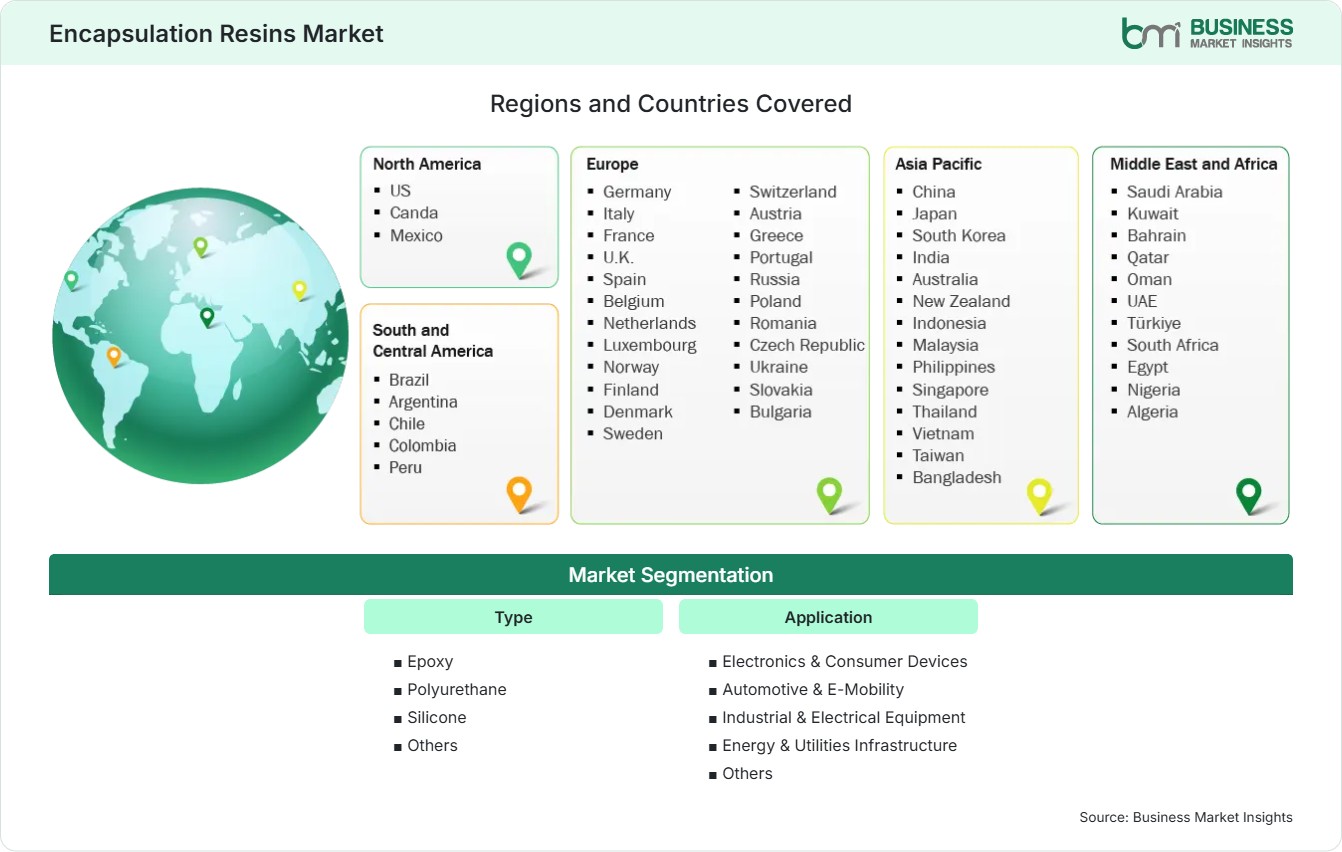
Global Market Geography
FREE PDF
Request your free sample
Request free sample
05 Segment Analysis

Encapsulation Resins Market Segmentation

Type

The Type segment represents the formulation landscape of the Encapsulation Resins Market, with epoxy maintaining leadership due to its strong adhesion, insulation performance, and broad industrial compatibility. The segment accounted for 43%–46% share in 2025 and is projected to expand at a 6.1%–6.5% CAGR between 2026–2034. Increasing demand for compact electronics, power modules, and durable protection systems continues influencing material selection across industries.

  • Epoxy: Epoxy resins dominate through excellent mechanical strength, chemical resistance, and electrical insulation properties. They are widely used in semiconductor packages, industrial electronics, transformers, and automotive power modules.
  • Polyurethane: Polyurethane formulations provide flexibility, impact resistance, and moisture protection. They support applications requiring vibration resistance, outdoor durability, and protection against environmental exposure in electronic assemblies.
  • Silicone: Silicone resins are gaining adoption due to thermal stability, low stress characteristics, and performance under extreme temperatures. They are preferred for LEDs, sensors, power electronics, and demanding automotive applications.

Application

The Application segment reflects expanding demand across electronics, mobility, infrastructure, and industrial systems. Electronics & Consumer Devices represented the largest application category with a 34%–37% share in 2025 and is estimated to grow at a 6.2%–6.6% CAGR through 2034. Increasing component miniaturization, reliability requirements, and higher electronic content across products continue shaping adoption patterns. The Encapsulation Resins Market scope is expanding as manufacturers develop customized materials for diverse application environments.

  • Electronics & Consumer Devices: Demand is supported by smartphones, computing equipment, semiconductor components, wearables, and consumer electronics requiring moisture protection, insulation, and improved component reliability.
  • Automotive & E-Mobility: Growth is driven by electric vehicles, battery management systems, charging infrastructure, and automotive electronics requiring protection from heat, vibration, and environmental conditions.
  • Industrial & Electrical Equipment: Industrial applications utilize encapsulation materials for motors, sensors, control systems, transformers, and automation equipment requiring long-term operational stability.
  • Energy & Utilities Infrastructure: Encapsulation solutions support solar systems, energy storage equipment, power distribution systems, and electrical infrastructure requiring enhanced durability and resistance.
06 Market Forces

Encapsulation Resins Market Dynamics

Key Market Drivers

Rising Demand from Electronics and Semiconductor Industries

Encapsulation resins market growth is driven largely by the increasing use of semiconductors and the assembly of electronic components. As per the latest update from the SEMI industry, global semiconductor manufacturing capacity is increasing due to fabrication and packaging capacity expansion in Asia, North America, and Europe. Growing demands for material that offers insulating, thermal, and mechanical stability owing to the growing complexity and power density of chips are expected to boost the demand for encapsulation resins. Miniaturization, semiconductor reliability standards, and automated assembly-compatible materials have become key trends in the market.

Growing Adoption of Electric Vehicles Worldwide

Electric vehicles have increased demand for encapsulation materials used in batteries, power electronics, charging stations, and automotive control modules. The International Energy Agency noted that global sales of electric vehicles had continued to grow, helped by financial support from governments, environmental policies, and investment in batteries production. Encapsulation materials shield delicate components from vibrations, moisture, temperature changes, and electrical strain. The growth in the Encapsulation Resins Market is being driven by growing use of electronics in automobiles, especially in the battery management system, inverters, and driver assistance systems.

Increasing Renewable Energy System Installations

The installation of renewable energy sources increases the use of encapsulation materials in the production of solar panels, inverters, energy storage solutions, and electrical control devices. According to the International Energy Agency, global additions to the capacity of renewable energy installations continue to hit records due to the transition policies and reduction in the cost of technologies. Encapsulation resins provide improved resistance to humidity, temperature changes, and other outdoor environmental factors. The Encapsulation Resins Market trend are driven by increasing demand for materials for long-life renewable energy infrastructure.

Key Market Opportunities

Expansion of Solar Module Manufacturing Worldwide

Solar manufacturing growth offers a strong opportunity because nations are investing in renewable energy sources. As the manufacture of solar panels grows, there will be a need for encapsulation material that protects the panels from moisture, ultraviolet rays, and heat. Manufacturers that formulate more durable, sustainable, and efficient materials can benefit from this trend. The Encapsulation Resins Market forecasts that more opportunities will arise from those regions that are growing their solar panels manufacturing, which includes Asia Pacific, North America, and Europe.

Growing Demand for Advanced Electronic Packaging

Electronics packaging technology offers chances for resin companies to produce resin products that are low stress, have good thermal conductivity, and high reliability. Artificial intelligence components, computing technology, and advanced semiconductor materials need better ways of handling heat and protecting their components. Material providers who invest in custom-made resins, faster curing processes, and those that work well with advanced packaging technologies may benefit more in the market.

Increasing EV Battery Protection Applications

Protection of EV batteries constitutes an increasing business opportunity in light of manufacturers' attempts to increase safety, longevity, and performance of the product. Special encapsulation materials provide protection against mechanical damage, moisture, and temperature changes of batteries. The development of energy storage systems and electric vehicle infrastructure leads to the creation of new types of resins that are more resistant to fire and better at managing temperature. Those companies that are able to develop application-oriented solutions will find themselves well-positioned for growth.

Market Restraints and Challenges

Volatile Raw Material Prices Affect Production Costs

Factor: Fluctuating prices of petrochemical-based raw materials, including epoxy intermediates, silicones, and polyurethane components, create uncertainty in manufacturing expenses. Impact: Volatility in costs may affect margins on the part of suppliers, increase prices, and affect purchasing by end users. For resin producers, the issues of supply chain flexibility, improved sourcing practices, and alternate recipes need to be addressed in relation to variations in raw materials. This problem is especially applicable to firms that operate in many regions.

Complex Manufacturing and Processing Requirements

Factor: Advanced encapsulation applications require precise formulation control, specialized processing equipment, and application-specific testing procedures. Impact: Increased technical complexity may lead to increased development costs and longer qualification periods, as well as obstacles to new material providers joining certain niches. Reliability testing is frequently a major requirement when electronics or automotive companies accept new materials. Companies need to develop research expertise, application labs, and technical support in order to fulfill the rising demands and maintain constant product quality worldwide.

07 Company Analysis

Competitive Landscape

The Encapsulation Resins Market analysis highlights a competitive environment shaped by global chemical manufacturers, specialty material suppliers, and application-focused solution providers. Companies are strengthening their positions through formulation innovation, regional production expansion, technical partnerships, and investments in advanced electronic protection materials. Competition is influenced by demand for customized resin systems supporting semiconductor packaging, EV electronics, industrial equipment, renewable energy systems, and high-reliability applications.

Company Name

Overview

Products and Services relevant to this market

CHT Group

Specialty chemical manufacturer providing advanced material solutions for industrial and electronic applications.

Silicone, epoxy, polyurethane-based encapsulation materials, coatings, and specialty chemical formulations.

Dow Inc.

Global materials science company supplying high-performance polymers and specialty chemical technologies.

Silicone encapsulants, protective materials, electronic packaging solutions, and thermal management products.

Electrolube Limited

Specialist manufacturer focused on electronic protection and maintenance materials worldwide.

Electronic encapsulation compounds, conformal coatings, thermal management products, and protective resins.

H.B. Fuller Company

Adhesive technology company developing engineered bonding and protection solutions.

Electronic adhesives, encapsulation materials, conductive solutions, and industrial protection systems.

Henkel AG & Co. KGaA

Global adhesive technology provider serving automotive, electronics, and industrial markets.

Electronic encapsulants, semiconductor packaging materials, thermal interface materials, and protective coatings.

Huntsman Corporation

Specialty chemical producer offering advanced polymer and performance material technologies.

Epoxy systems, polyurethane solutions, composite materials, and electronic protection formulations.

Momentive Performance Materials Inc.

Silicone technology company focused on advanced performance materials.

Silicone encapsulants, thermal-resistant materials, and electronic reliability solutions.

Parker Hannifin Corporation

Motion and control technology company serving industrial and aerospace sectors.

Protective materials, sealing solutions, electronic component protection, and engineered systems.

Shin-Etsu Chemical Co., Ltd.

Japanese chemical company producing high-performance silicone and semiconductor materials.

Silicone encapsulants, semiconductor materials, electronic packaging compounds, and specialty polymers.

Wacker Chemie AG

Global chemical manufacturer specializing in silicone and polymer technologies.

Silicone gels, encapsulation materials, electronic protection solutions, and specialty polymers.

10 Trust & Transparency

Research Methodology

The market analysis combines proprietary research with secondary data from government agencies, company disclosures, regulatory filings, industry databases and expert interviews. Market estimates are validated through data triangulation, cross-market benchmarking and analyst review.

View Full Research Methodology

11 Questions Answered

Frequently Asked Questions

5. What does the Encapsulation Resins Market Report identify as future growth areas?

The report identifies advanced semiconductor packaging, EV battery protection, renewable energy systems, and high-performance electronic applications as major areas creating future demand opportunities.

4. How are sustainability requirements affecting resin development?

Manufacturers are focusing on lower-emission production methods, improved chemical safety, recyclable approaches, and energy-efficient processing while maintaining required performance characteristics.

3. Why are electric vehicles increasing encapsulation resin consumption?

Electric vehicles require protection for battery modules, power electronics, sensors, and control systems. Encapsulation materials help improve resistance against moisture, vibration, temperature changes, and electrical stress.

2. Which resin type is widely used across industrial applications?

Epoxy remains widely adopted because of its strong adhesion, mechanical performance, chemical resistance, and compatibility with semiconductor packages, electrical equipment, and automotive electronic systems.

1. What factors are influencing demand for encapsulation materials?

Demand is influenced by semiconductor growth, EV adoption, renewable energy expansion, and increasing electronic component density. Industries require materials that improve insulation, thermal protection, durability, and reliability under demanding operating conditions.

Access the Full Encapsulation Resins Market Report

Get segment-level forecasts, regional estimates, competitive benchmarking, company profiles and downloadable Excel datasets.

Access the full Encapsulation Resins Market Report
350 pages PDF & Excel | 2026-08-05