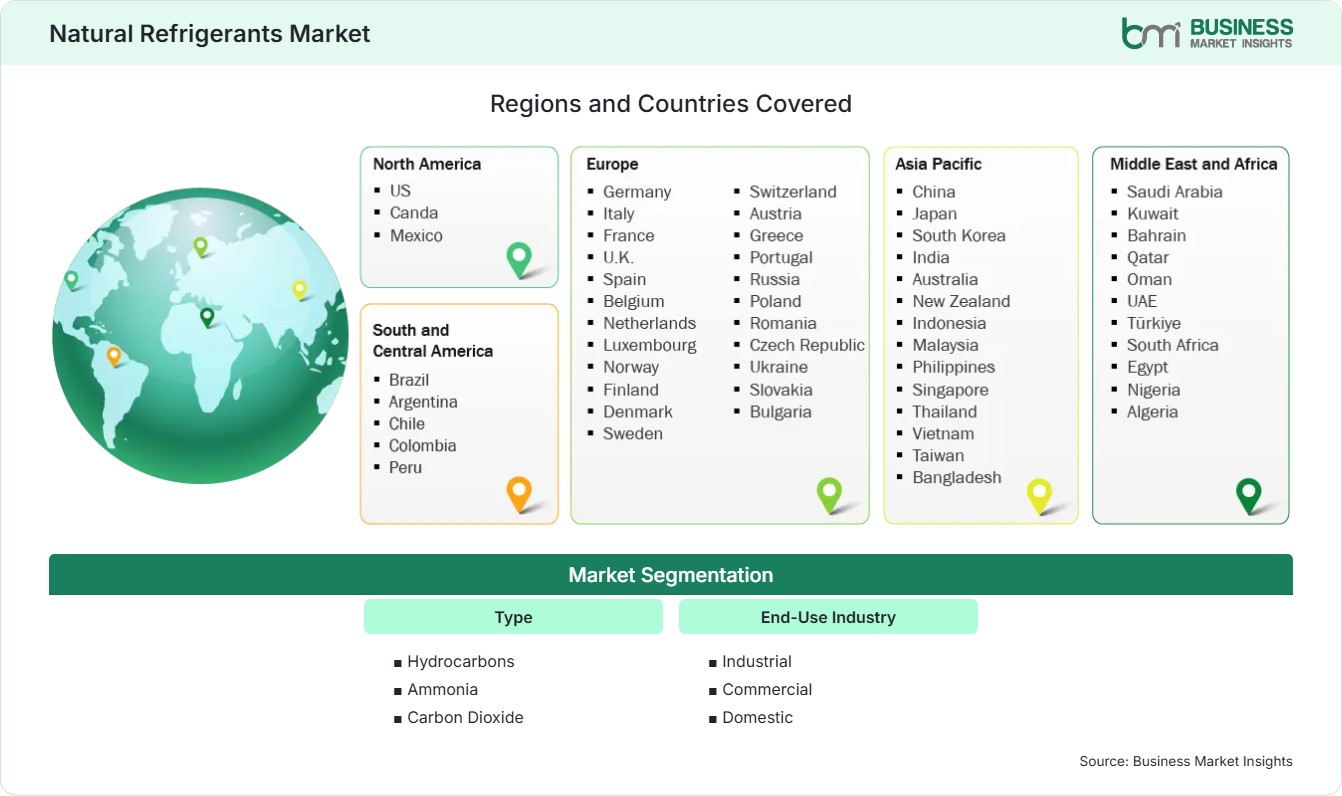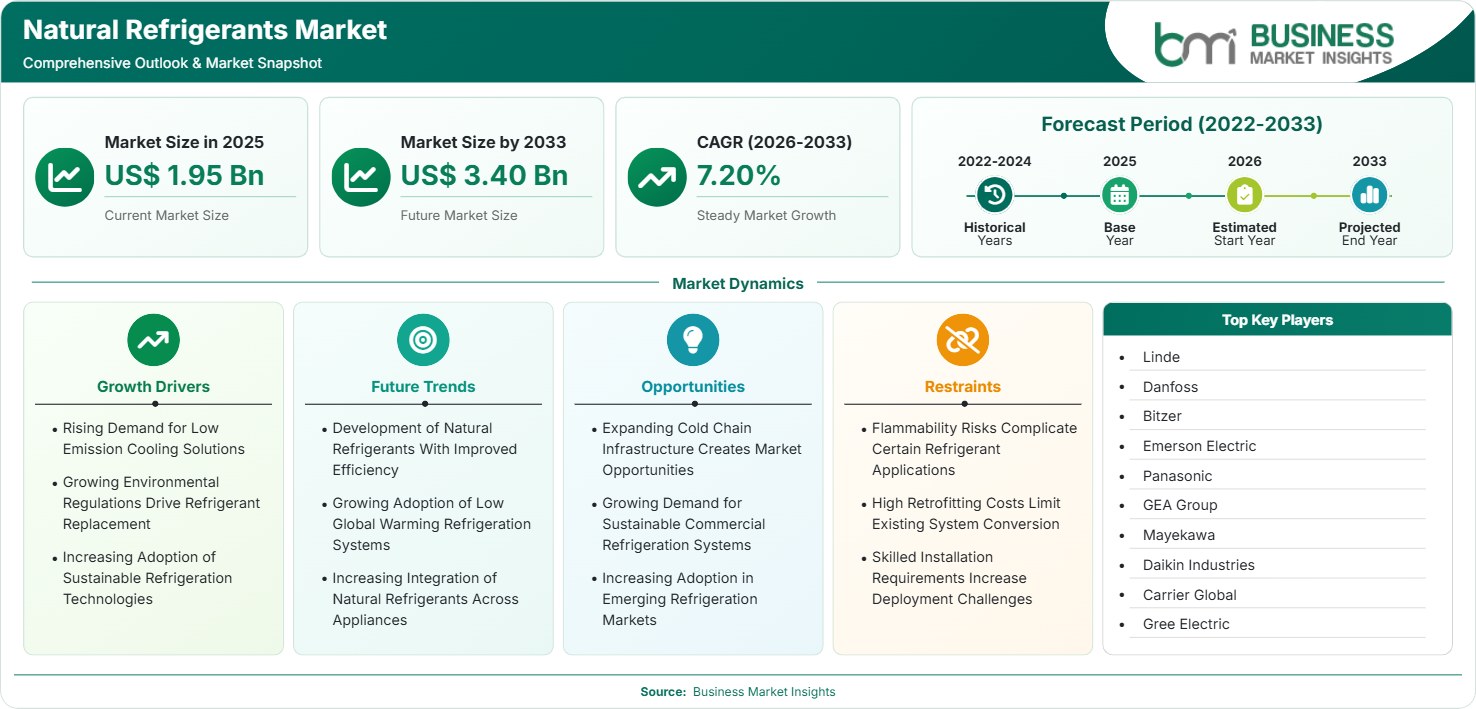
Natural Refrigerants Market Regional Highlights
North America Natural Refrigerants Market
North America represents 27%-30% share in 2025 and is projected to grow at a CAGR of 6.3%-6.9% through 2033. Commercial refrigeration modernization, industrial cooling, food processing, and cold-chain investment support regional adoption.
- Supermarket refrigeration is creating opportunities for carbon dioxide systems as retailers evaluate lower-GWP alternatives alongside energy efficiency, heat recovery, leak management, and increasingly stringent environmental requirements.
- Industrial facilities continue using ammonia where large cooling loads, established operating expertise, and centralized refrigeration architectures support economically viable deployment across food processing and cold storage.
- Cold-chain expansion is strengthening demand for refrigeration equipment capable of maintaining reliable temperature control across warehouses, distribution centers, food processing facilities, and transportation interfaces.
- Retrofit decisions increasingly consider equipment age, refrigerant availability, safety requirements, energy performance, and the cost of replacing compressors, controls, piping, and ancillary components.
US Natural Refrigerants Market
The U.S. accounts for 78%-82% of North American demand in 2025 and expands at a CAGR of 6.2%-6.8%. Commercial refrigeration, industrial cooling, and cold-storage modernization remain principal demand areas.
- Large food retailers are evaluating lower-GWP refrigeration architectures as equipment replacement decisions increasingly incorporate environmental compliance, refrigerant availability, energy efficiency, and long-term operating costs.
- Ammonia remains relevant across industrial refrigeration, particularly food processing and cold storage, where large systems can justify specialized safety procedures and technical maintenance capabilities.
- Carbon dioxide systems are gaining commercial relevance as equipment designs improve efficiency, controls, heat management, and operational flexibility for supermarket and distribution applications.
Europe Natural Refrigerants Market
Europe represents 25%-28% Natural Refrigerants Market share in 2025 and grows at 6.7%-7.3% CAGR. Germany leads regional adoption, while France, Italy, Spain, and the Netherlands provide additional opportunities through commercial and industrial refrigeration modernization.
- Germany benefits from established refrigeration engineering capabilities and strong demand for efficient industrial, commercial, and food-processing systems using ammonia, carbon dioxide, and hydrocarbons.
- France and Italy provide opportunities across food retail, hospitality, food processing, and cold storage as equipment owners prioritize lower-emission refrigeration solutions and regulatory readiness.
- Spain benefits from expanding food distribution and cold-chain requirements, creating demand for efficient refrigeration equipment suitable for supermarkets, warehouses, and processing facilities.
- The Netherlands provides a strong technology and logistics ecosystem, supporting advanced refrigeration applications across food distribution, horticulture, warehousing, and industrial processing.
Asia Pacific Natural Refrigerants Market
Asia Pacific represents 34%-37% share in 2025 and expands at 8.0%-8.7% CAGR, making it the fastest-growing region. China, Japan, India, and Southeast Asia provide substantial opportunities.
- China benefits from extensive food processing, cold storage, retail refrigeration, and industrial cooling requirements, creating opportunities for ammonia, carbon dioxide, and hydrocarbon technologies.
- India is developing rapidly through cold-chain expansion, food processing investment, organized retail, and growing requirements for temperature-controlled storage and distribution infrastructure.
- Japan provides a mature technology environment where equipment efficiency, compact systems, safety, and advanced controls support adoption of lower-emission refrigeration architectures.
- Southeast Asia offers strong potential as food exports, seafood processing, supermarket development, and temperature-controlled logistics increase demand for reliable refrigeration infrastructure.
Rest of World Natural Refrigerants Market
Rest of World accounts for 11%-14% share in 2025 and grows at 6.5%-7.2% CAGR. Latin America provides leading opportunities, while Middle Eastern and African markets develop from smaller installed bases. Latin America benefits from food processing, meat production, supermarkets, and cold-storage expansion. Brazil and Mexico lead regional opportunities, while Chile and Argentina provide additional demand through food exports and temperature-controlled logistics.
Middle Eastern and African markets are developing as food security, modern retail, food processing, and cold-chain requirements increase. Gulf economies provide opportunities for efficient commercial systems, while South Africa remains a comparatively developed refrigeration market.
- Brazil provides opportunities across meat processing, food distribution, supermarkets, and industrial refrigeration, with ammonia remaining relevant for large-scale cooling requirements.
- Mexico benefits from expanding food processing and temperature-controlled logistics, supporting investment in industrial and commercial refrigeration infrastructure.
- Gulf markets require reliable cooling infrastructure for food distribution and commercial applications, creating opportunities for efficient systems designed for demanding climatic conditions.
- South Africa provides a developed base for industrial refrigeration, cold storage, food processing, and commercial applications, supporting continued technology modernization.