Ceramics Market Regional Highlights
North America Ceramics Market
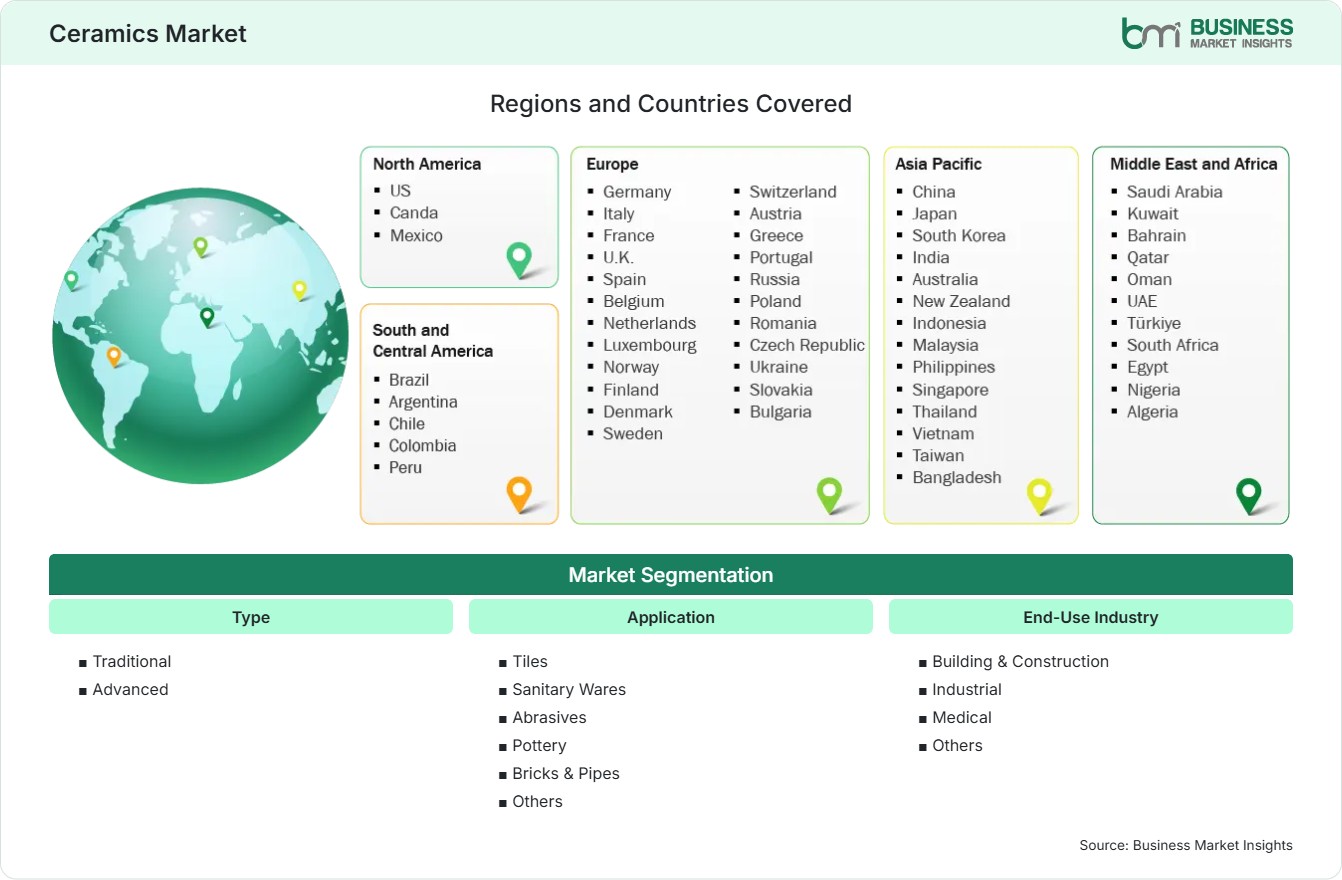
North America holds a 22%–25% share in 2025 and is projected to grow at a 7.4%–8.0% CAGR, according to Ceramics Market Forecasts. Demand is anchored by semiconductor equipment, aerospace, medical technology, industrial machinery, and advanced electronics. The United States dominates regional consumption, while Canada contributes through mining, industrial processing, and infrastructure. Reshoring of critical manufacturing and investment in domestic semiconductor capacity improve the outlook for precision ceramic components, substrates, insulators, and thermal-management products. North American suppliers also benefit from stringent qualification standards that favor established technical expertise and customized engineering capabilities.
- Semiconductor equipment demand is supporting high-purity alumina, silicon carbide, quartz-ceramic alternatives, and precision components, with suppliers emphasizing dimensional stability and contamination control.
- Aerospace applications benefit from ceramic thermal barriers, wear-resistant components, and lightweight materials as aircraft utilization remains strong. IATA reported global passenger traffic growth of 5.3% in 2025.
- Medical applications support ceramic implants, dental components, surgical tools, and wear-resistant surfaces, with demand linked to aging populations and minimally invasive treatment technologies.
- Reshoring and advanced manufacturing investments strengthen domestic demand for engineered ceramics used in robotics, metrology, power electronics, and semiconductor processing.
US Ceramics Market
The US represents approximately 75%–79% of North America's Ceramics Market share in 2025, with a 7.2%–7.8% CAGR during 2026–2033. Domestic demand combines construction materials with high-value technical applications. Semiconductor manufacturing, aerospace modernization, electric mobility, medical devices, defense systems, and energy infrastructure create diversified demand. Federal industrial-policy support for strategic manufacturing is improving the investment case for domestic materials capacity. Suppliers with proprietary formulations, application engineering, and qualified manufacturing processes are positioned to capture higher-value opportunities across electronics, defense, healthcare, and industrial automation.
- Semiconductor equipment is a particularly attractive demand center because ceramic components tolerate plasma, high temperatures, corrosive chemistries, and repeated processing cycles.
- Aerospace and defense applications favor lightweight, hard, thermally stable ceramics for protection, propulsion, sensing, and precision components, supported by sustained aircraft utilization and modernization programs.
- Medical demand is expanding through dental ceramics, orthopedic components, surgical tools, and diagnostic equipment requiring biocompatibility and wear resistance.
Europe Ceramics Market
Europe represents a 20%–23% Ceramics Market share in 2025, expanding at a 7.7%–8.3% CAGR through 2033. Germany, Italy, Spain, and France remain important production and technology centers, while Poland and Central European economies offer higher-growth manufacturing opportunities. European demand is supported by construction renovation, automotive electrification, industrial automation, renewable energy, medical technology, and semiconductor equipment. Energy efficiency is a decisive competitive factor because kiln-intensive production faces elevated operating costs and decarbonization requirements. Advanced ceramic suppliers increasingly differentiate through thermal management, electrification components, medical products, and precision industrial solutions.
- Germany leads advanced ceramic engineering through automotive, medical, electronics, semiconductor, and industrial applications, supported by specialized manufacturers and strong engineering capabilities.
- Italy and Spain remain important traditional ceramic centers, particularly for tiles and sanitary ware, while design-led exports support premium product positioning.
- France benefits from aerospace, energy, healthcare, and industrial applications, creating demand for high-performance alumina, silicon carbide, zirconia, and refractory solutions.
- European decarbonization requirements encourage energy-efficient kilns, alternative fuels, process optimization, recycling, and lower-temperature manufacturing technologies.
Asia Pacific Ceramics Market
Asia Pacific commands a 43%–47% Ceramics Market share in 2025 and records the fastest regional growth at 9.1%–9.7% CAGR through 2033. China, Japan, South Korea, and India form the core demand base, while Vietnam, Thailand, Indonesia, and the Philippines are gaining manufacturing relevance. Electronics, construction, automotive, renewable energy, medical devices, and semiconductor investment create overlapping demand pools. Japan and South Korea emphasize advanced materials, while China and India combine large-scale traditional ceramic production with increasingly sophisticated technical applications and export-oriented manufacturing ecosystems.
- China remains a major ceramic production and consumption center, supported by construction, electronics, industrial machinery, automotive manufacturing, and domestic infrastructure demand.
- Japan leads high-value ceramic innovation in electronics and precision components. Murata's 2026 production investments demonstrate continued capacity expansion for ceramic-based electronic components.
- India offers strong growth potential through housing, sanitation, infrastructure, tiles, sanitary ware, electronics, and industrial manufacturing, although energy costs remain a material operating variable.
- Southeast Asia is attracting production diversification as electronics and automotive manufacturers expand regional supply chains, increasing demand for engineered ceramics and supporting materials.
Rest of World Ceramics Market
Rest of World accounts for a 9%–12% Ceramics Market share in 2025, growing at a 7.0%–7.6% CAGR through 2033. South and Central America benefit from housing, commercial construction, infrastructure, mining, and industrial development. Brazil and Mexico provide the strongest manufacturing bases, while Chile and Colombia offer selected industrial opportunities. The Middle East and Africa present demand from construction, utilities, healthcare, sanitation, and industrial projects. Gulf countries provide premium construction opportunities, while African markets offer longer-term potential as urbanization and basic infrastructure investment increase.
Sanitary ware represents an important development-linked opportunity because access to sanitation remains uneven. WHO reported that 3.4 billion people lacked safely managed sanitation services in 2024, maintaining a substantial infrastructure requirement across developing economies.
- Brazil combines construction, infrastructure, industrial processing, and domestic ceramic production, supporting broad demand across traditional applications.
- Mexico benefits from manufacturing integration with North America, particularly automotive, electronics, construction, and industrial supply chains.
- Gulf markets favor premium architectural tiles, sanitary ware, façades, and specialized construction ceramics linked to large-scale urban development.
- Africa provides long-term potential through housing, sanitation, water infrastructure, healthcare facilities, and industrialization, although financing and energy availability can constrain near-term adoption.