Market Summary
Executive Summary and Global Market Analysis
Ceramic armor denotes a range of protective materials that work through absorbing, distributing, and defending against ballistic impacts using ceramics with extremely high hardness levels, including alumina, silicon carbide, and boron carbide. Such materials are often combined with composite backing materials to produce robust yet relatively lightweight forms of armor used by soldiers, combat machinery, aircrafts, navy vessels, and other security-related equipment.
The global Ceramic Armor market is witnessing significant growth due to the importance placed on mobility, durability, and efficiency in current defense operations. When compared to regular steel-based armor materials, ceramic armor provides much better hardness-to-weight ratio, thus being ideal for future protective applications. Market factors that are fueling this growth include increasing modernization efforts in the field of military, geopolitical tensions, and purchase of advanced forms of personal protective gear in developed and developing countries.
The government is spending a lot on the development of lightweight ballistic armor systems for soldiers, armored vehicles, and aircrafts, leading to an increased demand for ceramic-based products. Besides, the growth in homeland security activities and modernization plans in law enforcement agencies will drive the need for advanced forms of ceramic armor.
Furthermore, the emergence of technological innovations in composite technology, advanced material engineering, and manufacturing precision will drive this industry through improved strength, flexibility, and resistance to multiple shots. However, the market still faces barriers such as the cost of advanced ceramic products, complicated production process, and vulnerability of ceramics under stressed conditions. Additionally, the market will be hampered by supply restrictions of specialized raw materials and stringent qualification criteria in defense procurement activities.
Segment Analysis
Ceramic Armor Market Segmentation
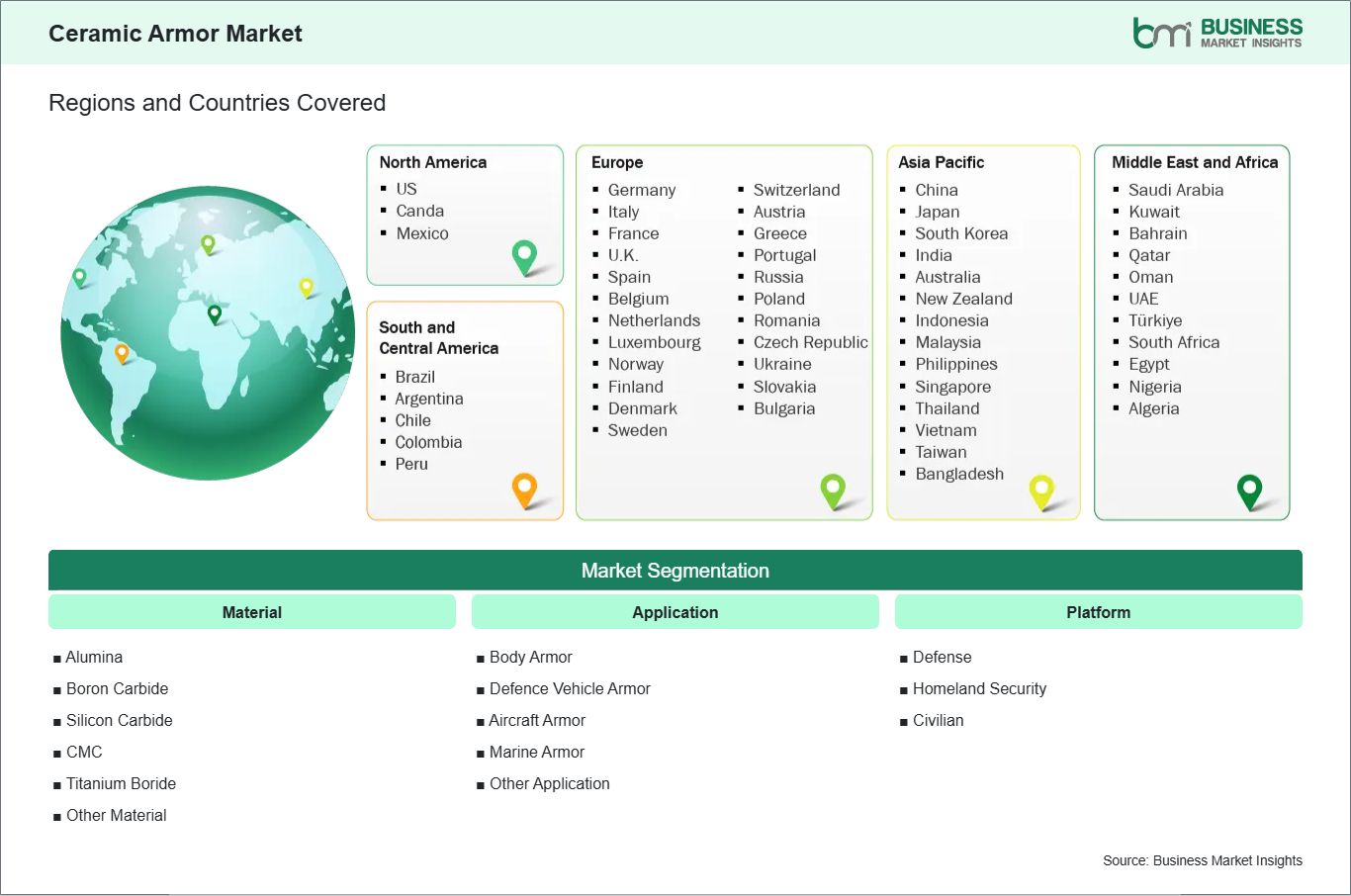
The ceramic armor market is segmented based on material, application, and platform, reflecting the increasing demand for lightweight, high-strength protective solutions across defense, security, and civilian sectors.
By Material
- Alumina: Widely used due to its cost-effectiveness, high hardness, and reliable ballistic protection capabilities.
- Boron Carbide: Offers exceptional hardness and lightweight properties, making it ideal for advanced personal and vehicle armor systems.
- Silicon Carbide: Provides superior impact resistance and reduced weight for military and aerospace protection applications.
- CMC (Ceramic Matrix Composites): Delivers enhanced durability, thermal resistance, and structural strength for high-performance armor solutions.
- Titanium Boride: Known for its extreme hardness and wear resistance in specialized ballistic protection systems.
- Other Material: Includes emerging ceramic compounds and hybrid materials designed for improved multi-threat protection and lightweight performance.
By Application
- Body Armor: Used in personal protective equipment such as bulletproof vests, helmets, and shields for military and law enforcement personnel.
- Defense Vehicle Armor: Applied in armored vehicles, combat tanks, and tactical transport systems to improve survivability against ballistic threats.
- Aircraft Armor: Provides lightweight protective solutions for military aircraft, helicopters, and aerospace components.
- Marine Armor: Used in naval vessels and maritime security platforms for enhanced protection against projectile and explosive threats.
- Other Application: Includes infrastructure protection, security installations, and specialized defense equipment applications.
By Platform
- Defense: Represents the largest segment, driven by increasing military modernization programs and demand for advanced ballistic protection systems.
- Homeland Security: Includes applications in border security, law enforcement, and counter-terrorism operations requiring reliable protective solutions.
- Civilian: Covers personal security, VIP protection vehicles, and commercial applications requiring lightweight armor materials for enhanced safety.
Market Forces
Ceramic Armor Market Drivers and Opportunities
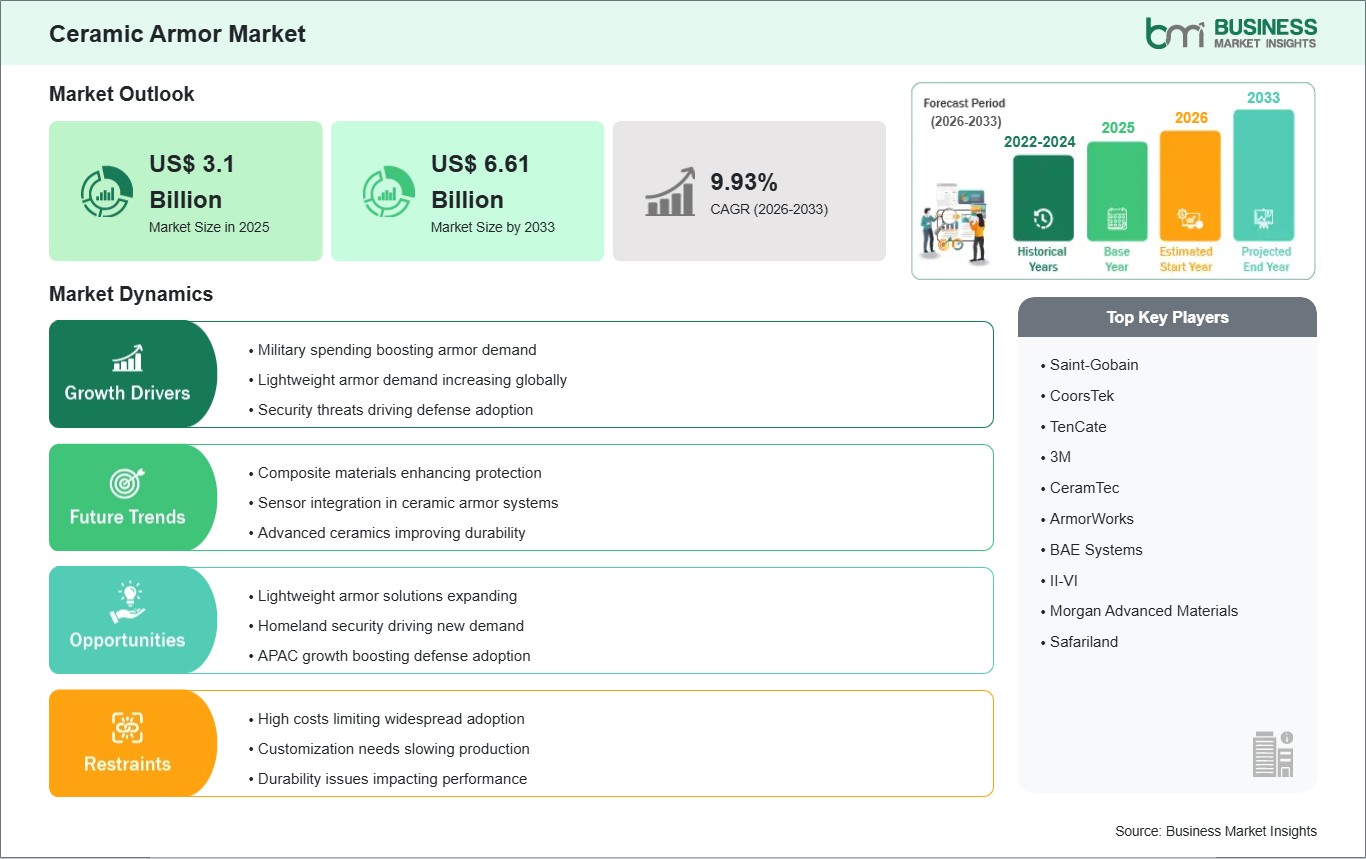
Military Spending Boosting Armor Demand
The ceramic armor market in Western Europe is on the rise owing to rising investments in defense modernization efforts as a result of growing geopolitical instability and NATO preparedness goals. Nations such as Germany, France, Italy, and Poland have continued to invest heavily in procurement of armored vehicles, state-of-the-art body armor technology, and advanced combat equipment. Defense spending in Western Europe was expected to increase by around 8 to 10 percent during 2025, compared to the previous year, with much of the increase allocated to survivability technologies. The appeal of ceramic armor is that it offers good resistance to armor-piercing rounds at lower weight.
The procurement trend is particularly evident in armored personnel carriers, infantry fighting vehicles, and tactical mobility vehicles. Boron carbide and silicon carbide armor systems are experiencing a high level of demand due to the increasing production of German mechanized brigades and modernization efforts through the French Scorpion initiative. Furthermore, naval uses are increasingly being seen as areas of development for ceramic composites to be used in patrolling vessels and amphibious ships to enhance blast resistance while ensuring maneuverability is not compromised. Western Europe-based defense manufacturers have been focusing on establishing localized ceramic production.
The other major growth factor is the growing focus on survivability for soldiers deployed in multinational teams. Exercises performed by the North Atlantic Treaty Organization (NATO) in the Baltic and Nordic countries have led to increased sales of body armor for the troops. Modular body armor suits that provide better mobility have been demanded more frequently by special forces. As the fuel costs and efficiency gain importance in military procurements, the adoption of ceramic armor is expected to grow in Western Europe.
Lightweight Armor Solutions Expanding
The market for ceramic armor products in Western Europe is experiencing significant growth owing to advancements in lightweight technologies suitable for the current needs of mobile warfare. The use of heavy steel-based armor products by the military organizations in Western Europe is being discontinued as they have begun using lighter composite products made out of ceramics offering similar protection against ammunition with much reduced weight. It is imperative for this region, as armies here are keen on rapid deployment, urban warfare, and border mobility.
Advanced ceramic matrix composites able to withstand multi-hits ballistics and maintain lower structural density are being developed by research establishments and defense manufacturers in the UK, Netherlands, and Sweden. The industry estimates show that next-generation ceramic armor will allow to cut the vehicle weight by approximately 35-40% compared to conventional steel armor technology. In the case of the electric and hybrid armored military vehicles which are being actively designed today in Europe, weight reduction and increased energy efficiency are especially important issues.
The commercial aviation and law enforcement industries are providing additional support for market growth. Law enforcement agencies in Europe are implementing ceramic body armor suits for counter-terrorism units and anti-riot squads in metropolitan regions of high-security threats. Besides that, aerospace manufacturers are looking into ceramic shielding for cockpit and unmanned aerial vehicles because of its lightness. Increasing cooperation between defense facilities and private material engineering companies will lead to breakthroughs in nano-ceramics development. With mobility-centric approach dominating in Western Europe's defense sector, ceramic armor will become an integral part of security infrastructure in the years to come.
Size and Share Analysis
Ceramic Armor Market Size and Share Analysis
The Ceramic Armor Market is projected to grow from US$ 3.1 Billion in 2025 to US$ 6.61 Billion by 2033 , registering a CAGR of 9.93% from 2026 to 2033.
By material, alumina accounts for a significant share of the ceramic armor market due to its cost effectiveness, high hardness, and widespread use in personal and vehicle armor systems. Boron carbide is witnessing strong demand owing to its ultra lightweight properties and superior ballistic resistance, making it highly suitable for advanced military body armor applications.
By application, body armor dominates the market as armed forces and law enforcement agencies increasingly invest in lightweight and high performance protective equipment for personnel safety. Defense vehicle armor represents a major segment with rising deployment of armored combat vehicles and tactical transport systems in modern warfare environments.
By platform, the defense segment holds the largest share of the ceramic armor market, supported by rising military expenditure, modernization initiatives, and increasing procurement of advanced ballistic protection systems worldwide. Homeland security is growing consistently due to increasing investments in border security, counter terrorism operations, and law enforcement protection equipment. The civilian segment is also gaining momentum with rising demand for personal safety solutions, armored commercial vehicles, and protective applications for high risk environments.
Report Coverage
Ceramic Armor Market Report Coverage and Deliverables
The "Ceramic Armor Market Size and Forecast (2022and 2033)" report provides a detailed analysis of the market covering below areas:
- The market size and forecast at global, regional, and country levels for all market segments covered under the scope
- The market trends, as well as drivers, restraints, and opportunities
- The market analysis covering key trends, global and regional framework, major players, regulations, and recent developments
- Industry landscape and competition analysis covering market concentration, heat map analysis, prominent players, and recent developments for the ceramic armor market
- Detailed company profiles, including SWOT analysis
Geographic Insights
Ceramic Armor Market Geographic Insights
The ceramic armor market shows diverse regional adoption patterns influenced by increasing defense modernization programs, rising geopolitical tensions, growing demand for lightweight protective solutions, and advancements in material engineering technologies.
North America is a technologically advanced and defense-oriented region and hence contains major players and advanced military equipment in the defense industry. North America includes the countries of the US and Canada, which are making huge investments in future generation body armors, vehicle protection, and aerospace defense equipment technology. This region specializes in creating safety and movement for its soldiers with the use of highly advanced ceramic composite material and armored solutions. It has well-developed defense and industrial sectors, and therefore, the usage of ceramic armor is widespread in military vehicles, aircraft, body armors, naval vessels, and homeland security.
Asia Pacific is growing significantly, driven by rising defense expenditures, increasing border security concerns, and rapid industrial development. The region comprises countries such as China, India, Japan, and South Korea, where governments are actively investing in military modernization programs and advanced protective equipment. The region focuses on improving combat readiness and strengthening domestic defense manufacturing capabilities through the adoption of advanced ceramic armor technologies. The expansion of defense vehicle production, rising procurement of personal protective equipment, and increasing adoption of lightweight armor systems in aerospace and law enforcement sectors are contributing to the growth of the ceramic armor market. Additionally, growing investments in research and development activities, along with advancements in ceramic processing and material technologies, are further accelerating market expansion across the region.
Both areas are making considerable contributions towards the expansion of the ceramic armor industry due to the innovations they make, increased spending in security and defense infrastructure, and the growing need for lightweight yet durable armor.
Industry Activity
Recent Developments
The ceramic armor market is evaluated by gathering qualitative and quantitative data post primary and secondary research, which includes important corporate publications, association data, and databases. A few of the key developments in the ceramic armor market are:
- In March 2022, General Dynamics European Land Systems and ROMARM announced the creation of an industrial consortium in Romania for the local production and assembly of PIRANHA 5 armored vehicles, strengthening Eastern Europe armored vehicle and ceramic armor manufacturing capabilities.
- In May 2023, TriCera announced the development of an advanced ceramic-metal composite armor material designed for ballistic protection applications including military vehicles and police shields, supporting lightweight and high-resistance armor solutions in Eastern Europe.
Trust & Transparency
Research Methodology
The market analysis combines proprietary research with secondary data from government agencies, company disclosures, regulatory filings, industry databases and expert interviews. Market estimates are validated through data triangulation, cross-market benchmarking and analyst
review.
View Full Research Methodology
Key Sources Referred:
World Bank-Global Trade Indicators
World Trade Organization (WTO)
International Monetary Fund (IMF)
International Trade Administration (ITA)
S. Department of Defense (DoD)
NATO Support and Procurement Agency (NSPA)
Stockholm International Peace Research Institute (SIPRI)
International Trade Administration (ITA)
Army Acquisition Support Center
National Institute of Justice (NIJ)
Company Websites
Company Annual Reports
Company Investor Presentations