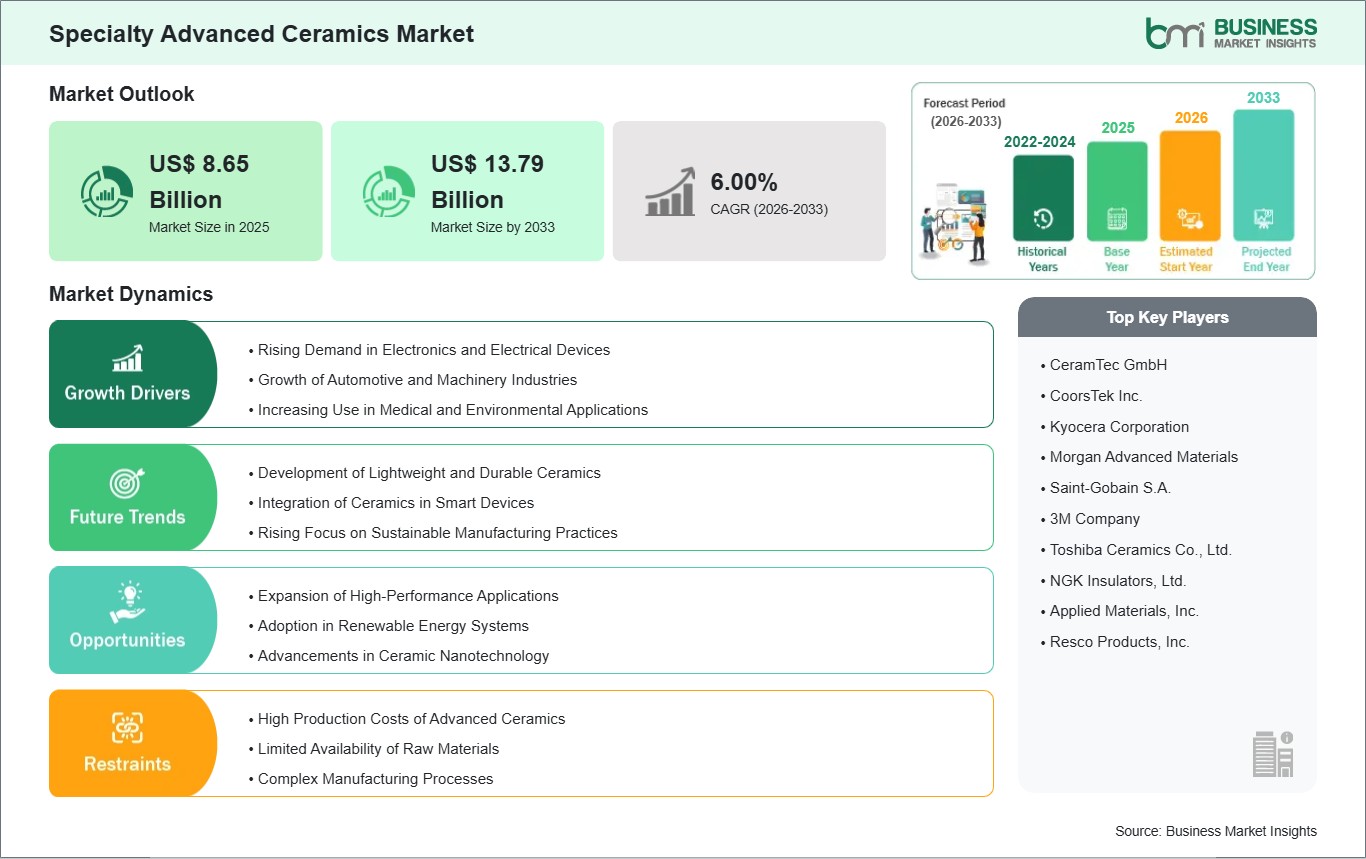
The Specialty Advanced Ceramics Market size is expected to reach US$ 13.79 billion by 2033 from US$ 8.65 billion in 2025. The market is estimated to record a CAGR of 6.00% from 2026 to 2033.
Globally, the supply of specialty advanced ceramics is increasing as demand for these high-performance materials rises. Alumina, titanate, zirconia and silicon-based ceramics are in particularly high demand due to their extraordinarily high thermal stability and chemical resistance and superior mechanical strength compared with standard ceramics. Composite structure ceramics and electrical functional ceramics hold the largest market shares. These ceramics are valued for their adaptability, longevity, and support of sophisticated industrial and electronic systems. Specialty ceramics are vital in everything from insulators, substrates and sensors to cutting tools and biomedical implants. Technological advancements, including nanostructured ceramics and additive manufacturing, are expanding their applications in aerospace, energy, and medical devices. Rising focus on sustainable manufacturing and the integration of ceramics in smart systems further enhance market potential. With growing industrialization and the need for high-performance materials, the specialty advanced ceramics market is expected to sustain strong growth, meeting the demands of modern technological applications across various end-use industries.

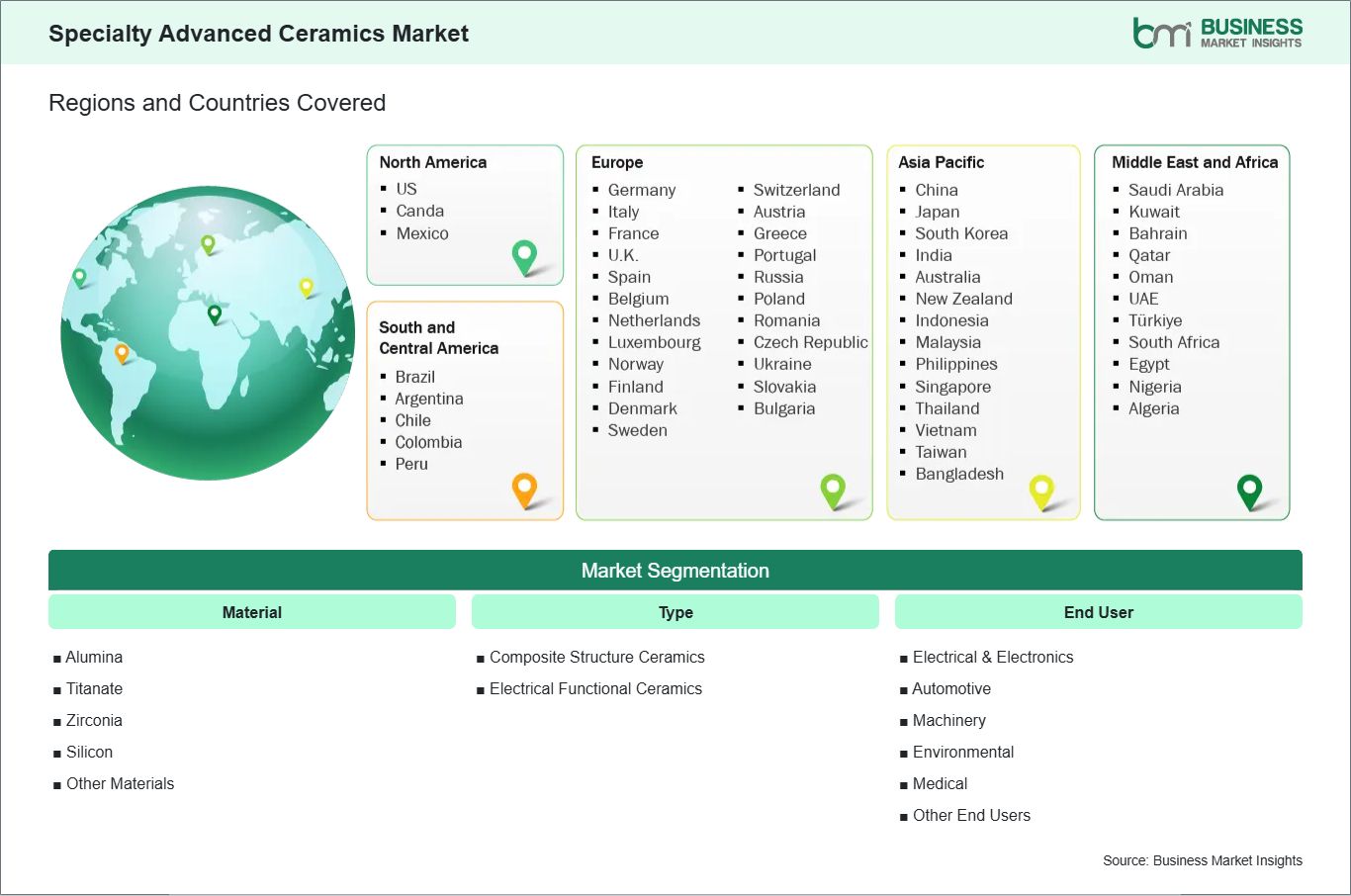
Key segments that contributed to the derivation of the Specialty Advanced Ceramics market analysis are material, type, and end user.
The growing popularity of advance specialty ceramics in electrical and electronic devices is driving the specialty advanced ceramic marketplace forward. Modern electronic components including insulators, substrates, capacitors and semi-conductors consume large amounts of high-performance ceramics because of their ability to provide electrical insulation, thermal stability and/or mechanical strength. High-performance ceramics create devices operating efficiently and with long lives from smart-phones to computers to industrial electronics. The rising demand for miniaturization and high-speed electronic devices has also created a greater need for advanced ceramics with accurately measured material performance properties. Two types of advanced specialty ceramic materials — alumina and zirconia — are the most popular choices when designing advanced electronics because of their very high dielectric strength and thermal conductivity. This increasing complexity of electronic systems in both consumer and industrial applications is prompting the use of these ceramics to ensure enhanced functionality and lifespan.
The growth of the global electronics sector, especially in Asia Pacific, is also contributing to the use of advanced ceramics. The need to invest in electric vehicles, renewable energy systems, and high-performance computing equipment demands components that can operate within high temperature and mechanical stress limits. Thus, as the need for efficient and durable electronic systems grows, specialty advanced ceramics have become indispensable in today`s technology.
The expansion of high-performance applications presents significant opportunities for the specialty advanced ceramics market. Industries such as aerospace, automotive, medical, and energy increasingly rely on ceramics for applications requiring wear resistance, thermal stability, and mechanical strength. Components such as turbine blades, cutting tools, biomedical implants, and electronic substrates benefit from advanced ceramic materials.
Advanced ceramics can provide a means to achieve precision, light weight, and durability in critical applications. In medical devices, for instance, ceramics based on zirconia are employed in implants and surgical devices. In aerospace and energy applications, composite ceramics are employed for thermal insulation and durability in extreme environments. The potential for applying specialty ceramics is wide due to their versatility and properties. The applications are in emerging technologies for high-tech applications.
Moreover, advances in technology for processing ceramics, additive manufacturing, and nanostructured ceramics are opening doors for a wide range of applications. With a focus on improving efficiency, reliability, and sustainability in advanced technologies, specialty advanced ceramics are increasingly being acknowledged for their potential in applications.

The global Specialty Advanced Ceramics market is experiencing steady growth, with market size and share analysis reflecting evolving treatment preferences and competitive dynamics among key players. The report evaluates important subsegments categorized within material, type, and end user, highlighting their respective contributions to overall market performance.
By material, the alumina subsegment dominated the market in 2025 due to its exceptional mechanical strength, chemical and thermal stability, wide availability, and cost-effectiveness, making it highly suitable for diverse industrial, automotive, and electronics applications.
By type, the electrical functional ceramics subsegment dominated the market in 2025 due to its critical role in capacitors, sensors, actuators, and electronic components, offering high dielectric performance, miniaturization capability, and reliability across multiple industries.
By end user, the electrical & electronics subsegment dominated the market in 2025 because of rapid growth in consumer electronics, telecommunication devices, and semiconductor components requiring high-performance ceramics for insulation, heat resistance, and reliable long-term operation.
| Report Attribute | Details |
|---|---|
| Market size in 2025 | US$ 8.65 Billion |
| Market Size by 2033 | US$ 13.79 Billion |
| Global CAGR (2026 - 2033) | 6.00% |
| Historical Data | 2022-2024 |
| Forecast period | 2026-2033 |
| Segments Covered | By Material
|
|
Regions and Countries Covered
| |
| North America | US, Canada, Mexico |
| Europe | Belgium, Austria, Finland, Denmark, Greece, Poland, Romania, Russia, Ukraine, Czech Republic, Slovakia, Bulgaria, Italy, Luxembourg, Germany, Switzerland, France, Netherlands, Norway, Portugal, Spain, Sweden, United Kingdom |
| Asia-Pacific | Australia, China, India, Japan, South Korea, Indonesia, Malaysia, Philippines, Singapore, Thailand, Vietnam, Bangladesh, New Zealand, Taiwan |
| South and Central America | Brazil, Argentina, Peru, Chile, Colombia |
| Middle East and Africa | Bahrain, Kuwait, Oman, Qatar, Saudi Arabia, United Arab Emirates, Turkiye, South Africa, Egypt, Algeria, Nigeria |
| Market leaders and key company profiles |
|
The "Specialty Advanced Ceramics Market Size and Forecast (2022 - 2033)" report provides a detailed analysis of the market covering below areas:
The geographical scope of the Specialty Advanced Ceramics market report is divided into: North America, Asia Pacific, Europe, Middle East & Africa, and South & Central America. North America held the largest share in 2025.
North America dominated the specialty advanced ceramics market in 2025 due to a strong presence of electronics, automotive, and medical device manufacturers, alongside advanced industrial infrastructure and high adoption of automation technologies. The United States, in particular, has significant investments in high-tech manufacturing and research in material science, supporting market growth. Continuous development of electronic components, sensors, and machinery requiring durable and reliable ceramic materials has strengthened regional demand. Additionally, government initiatives supporting advanced manufacturing, innovation, and sustainable materials have accelerated the adoption of specialty ceramics. North America`s focus on electric vehicles, renewable energy systems, and medical device advancements has further driven demand.
The presence of major specialty ceramics manufacturers and ongoing technological innovation in composite and functional ceramics reinforces the region`s leadership. As industries increasingly integrate lightweight, high-performance, and durable materials in advanced applications, North America is expected to maintain its dominant position, driving growth and innovation in the global specialty advanced ceramics market.

The Specialty Advanced Ceramics market is evaluated by gathering qualitative and quantitative data post primary and secondary research.
The Specialty Advanced Ceramics Market is valued at US$ 8.65 Billion in 2025, it is projected to reach US$ 13.79 Billion by 2033.
As per our report Specialty Advanced Ceramics Market, the market size is valued at US$ 8.65 Billion in 2025, projecting it to reach US$ 13.79 Billion by 2033. This translates to a CAGR of approximately 6.00% during the forecast period.
The Specialty Advanced Ceramics Market report typically cover these key segments-
The historic period, base year, and forecast period can vary slightly depending on the specific market research report. However, for the Specialty Advanced Ceramics Market report:
The Specialty Advanced Ceramics Market is populated by several key players, each contributing to its growth and innovation. Some of the major players include:
The Specialty Advanced Ceramics Market report is valuable for diverse stakeholders, including:
Essentially, anyone involved in or considering involvement in the Specialty Advanced Ceramics Market value chain can benefit from the information contained in a comprehensive market report.
Please tell us your area of interest
(Market Segments/ Regions and Countries/ Companies)