
High Strength Glass Market Outlook: Size, Share, Trends, Growth Analysis, Competitive Landscape & Forecast, 2026-2033

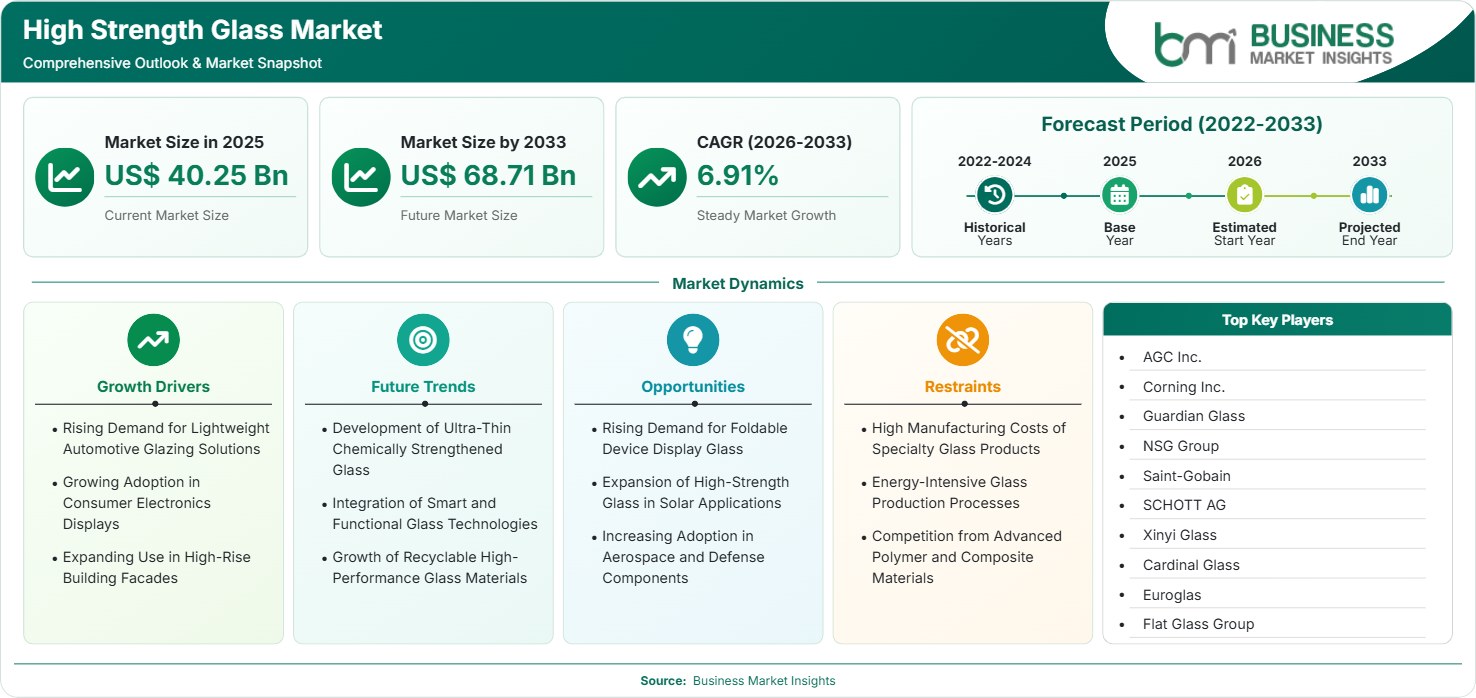
The High Strength Glass Market size was valued at US$ 40.25 Billion in 2025 and is projected to reach US$ 68.71 Billion by 2033, growing at a CAGR of 6.91% during 2026–2033. Rising demand for safety glazing solutions, increasing construction activity, growing adoption in automotive applications, and expanding investments in renewable energy infrastructure are supporting market growth. Opportunities are emerging from high-performance architectural projects, electric vehicle manufacturing, and solar energy installations.

Report Coverage
  • Product Type: Tempered Glass, Laminated Glass, Heat Strengthened Glass, Others
  • End Use: Construction & Architecture, Automotive & Transportation, Solar Energy, Others
US$ 40.25 Bn Market size in 2025
US$ 68.71 Bn Market Size by 2033
6.91% CAGR, 2026 - 2033
2026-2033 Forecast Period

01 AI Overview

High Strength Glass Market Summary

  • North America Region: North America holds a high strength glass market share of 24%–27% in 2025 and is projected to grow at a CAGR of 6.4%–7.4% during 2026–2033. Strong construction activity, growing infrastructure modernization, and increasing adoption of safety glazing solutions continue supporting regional demand. The US market is projected to grow at a CAGR of 6.6%–7.6% through 2033.
  • Fastest Growing Region: Asia Pacific accounts for 37%–40% share in 2025 and is expected to grow at a CAGR of 7.8%–8.8% during the forecast period. Rapid urbanization, infrastructure expansion, and growing automotive production are driving regional growth.
  • Leading Segment: Tempered (Toughened) Glass represents 48%–51% share in 2025 and is projected to grow at a CAGR of 7.0%–8.0% through 2033. High impact resistance, superior safety characteristics, and widespread application across multiple industries continue supporting segment leadership.
  • High Growth Segment: Solar Energy applications hold 16%–19% share in 2025 and are projected to grow at a CAGR of 8.5%–9.5% during 2026–2033 due to increasing global investments in renewable energy infrastructure.
  • Key Market Opportunity: Rising deployment of energy-efficient buildings, electric vehicles, and solar power systems is creating significant opportunities for advanced glass manufacturers.
  • Major Market Players: AGC Inc., Corning Inc., Guardian Glass, NSG Group, Saint-Gobain, SCHOTT AG, Xinyi Glass, Cardinal Glass, Euroglas, and Flat Glass Group.
02 Strategic Insights

High Strength Glass Market: Strategic Insights

High Strength Glass Market Strategic Framework
FREE PDF
Request your free sample
Request free sample
03 Stakeholder View

Key Takeaways

  • Tempered glass remains the largest product category due to its superior safety performance and broad commercial adoption.
  • Construction and architecture continue accounting for the largest share of demand globally.
  • Asia Pacific remains the leading and fastest-growing regional market supported by infrastructure and building activity.
  • Solar energy applications are witnessing accelerated adoption due to expanding renewable power investments.
  • Automotive manufacturers are increasingly utilizing high-strength glazing solutions to improve safety and performance.
  • High strength glass market trends suggest that the energy-efficient, lightweight, and high-durability glass solutions are gaining importance across construction, transportation, and renewable energy sectors.
  • Investments in smart buildings and sustainable infrastructure are creating long-term opportunities for glass manufacturers.
  • Product innovation focused on strength, thermal performance, and sustainability continues shaping competitive dynamics.
04 Geographic Outlook

High Strength Glass Market Regional Highlights

North America High Strength Glass Market

North America accounted for high strength glass market share of 24%–27% in 2025 and is projected to expand at a CAGR of 6.4%–7.4% during 2026–2033. The region remains a significant consumer of high-strength glass due to robust construction activity, infrastructure modernization projects, and growing adoption of advanced glazing materials. Demand is being supported by increasing investment in commercial buildings, residential developments, transportation infrastructure, and energy-efficient construction projects. Building owners and developers are increasingly prioritizing safety, durability, thermal efficiency, and sustainability, encouraging the use of tempered and laminated glass products. The automotive sector also contributes steadily to demand through the use of advanced glazing systems that improve safety and vehicle performance. Innovation in smart glass technologies and energy-saving architectural solutions is expected to create additional growth opportunities across the region.

  • Demand for safety glazing continues increasing across residential and commercial construction.
  • Infrastructure modernization projects are supporting volume growth.
  • Automotive manufacturers are adopting stronger and lighter glazing materials.
  • Energy-efficient building initiatives continue driving advanced glass installations.
  • Investments in smart buildings are creating opportunities for premium glass products.

US High Strength Glass Market

The US represented a 20%–23% share in 2025 and is estimated to grow at a CAGR of 6.6%–7.6% through 2033. The country continues to benefit from active construction markets, increasing renovation activity, and rising investments in sustainable building practices. Demand for high-performance glazing solutions remains strong across commercial complexes, institutional buildings, and transportation infrastructure. The adoption of advanced architectural designs requiring durable and energy-efficient materials is further supporting high strength glass market growth.

  • Commercial construction projects continue to support demand for high strength glass in office buildings, shopping centers, airports, hospitals, and other large-scale infrastructure developments.
  • Green building initiatives are increasing the adoption of advanced glazing systems that improve energy efficiency, thermal insulation, and overall building sustainability.
  • Demand for impact-resistant and safety glass remains strong across residential, commercial, automotive, and industrial applications due to stringent safety standards.
  • Rising investments in transportation infrastructure, smart cities, and modern architectural projects are expected to drive long-term demand for high strength glass products worldwide.

Europe High Strength Glass Market

Europe held a 25%–28% share in 2025 and is expected to grow at a CAGR of 6.3%–7.3% from 2026–2033. Germany, France, and the UK represent important regional markets due to strong regulatory standards related to building safety, energy efficiency, and environmental sustainability. Adoption of advanced glazing materials continues increasing across commercial buildings, public infrastructure, and transportation systems. European construction companies are increasingly integrating high-strength glass into modern architectural projects to improve aesthetics, structural performance, and energy conservation. The region also benefits from technological innovation and strong manufacturing capabilities. Demand from renewable energy projects, particularly solar installations, is providing additional opportunities for industry participants.

  • Strict building efficiency regulations support high-performance glass adoption.
  • Germany continues investing heavily in sustainable construction projects.
  • Modern architectural designs are increasing demand for premium glazing solutions.
  • Transportation and rail infrastructure projects contribute to market growth.
  • Solar power investments are boosting demand for durable glass products.

Asia Pacific High Strength Glass Market

Asia Pacific accounted for a 37%–40% share in 2025 and is projected to register a CAGR of 7.8%–8.8% during 2026–2033. The high strength glass market forecast suggest that the region remains the largest and fastest-growing market due to rapid urbanization, large-scale infrastructure development, expanding manufacturing activity, and strong growth in construction and automotive industries. Investments in residential buildings, commercial establishments, transport infrastructure, and renewable energy are propelling demand from China, India, Japan, and South Korea. Government programs that are focused on making smart cities and energy-efficient buildings have encouraged the adoption of advanced glass products. Moreover, solar panels production and the production of electric cars is offering more avenues for the use of advanced glass products. Disposable incomes as well as spending on construction are expected to keep growth strong in the long run.

  • China remains a major consumer due to extensive construction and manufacturing activities.
  • India is witnessing strong demand from infrastructure and urban development projects.
  • Solar energy investments continue generating new application opportunities.
  • Automotive production growth is supporting advanced glazing demand.
  • Smart city initiatives are accelerating adoption of durable and energy-efficient glass solutions.

Rest of World High Strength Glass Market

Rest of World accounted for a 10%–13% share in 2025 and is expected to grow at a CAGR of 6.5%–7.5% through 2033. Latin America, the Middle East, and Africa are experiencing increasing demand for high-strength glass due to ongoing infrastructure development, growing commercial construction activity, and expanding renewable energy investments. Governments across these regions are investing in modern transportation systems, urban development projects, and sustainable construction initiatives that require advanced glazing materials. Improving economic conditions and increasing foreign investment are further contributing to demand growth. The adoption of modern architectural designs and premium construction materials is expected to create additional opportunities in the coming years.

  • Urban development projects continue supporting demand for safety glass products.
  • Renewable energy investments are increasing glass consumption in solar installations.
  • Infrastructure modernization efforts are creating growth opportunities.
  • Commercial construction activity is expanding across key metropolitan areas.
  • Increasing adoption of energy-efficient building materials supports long-term market growth.
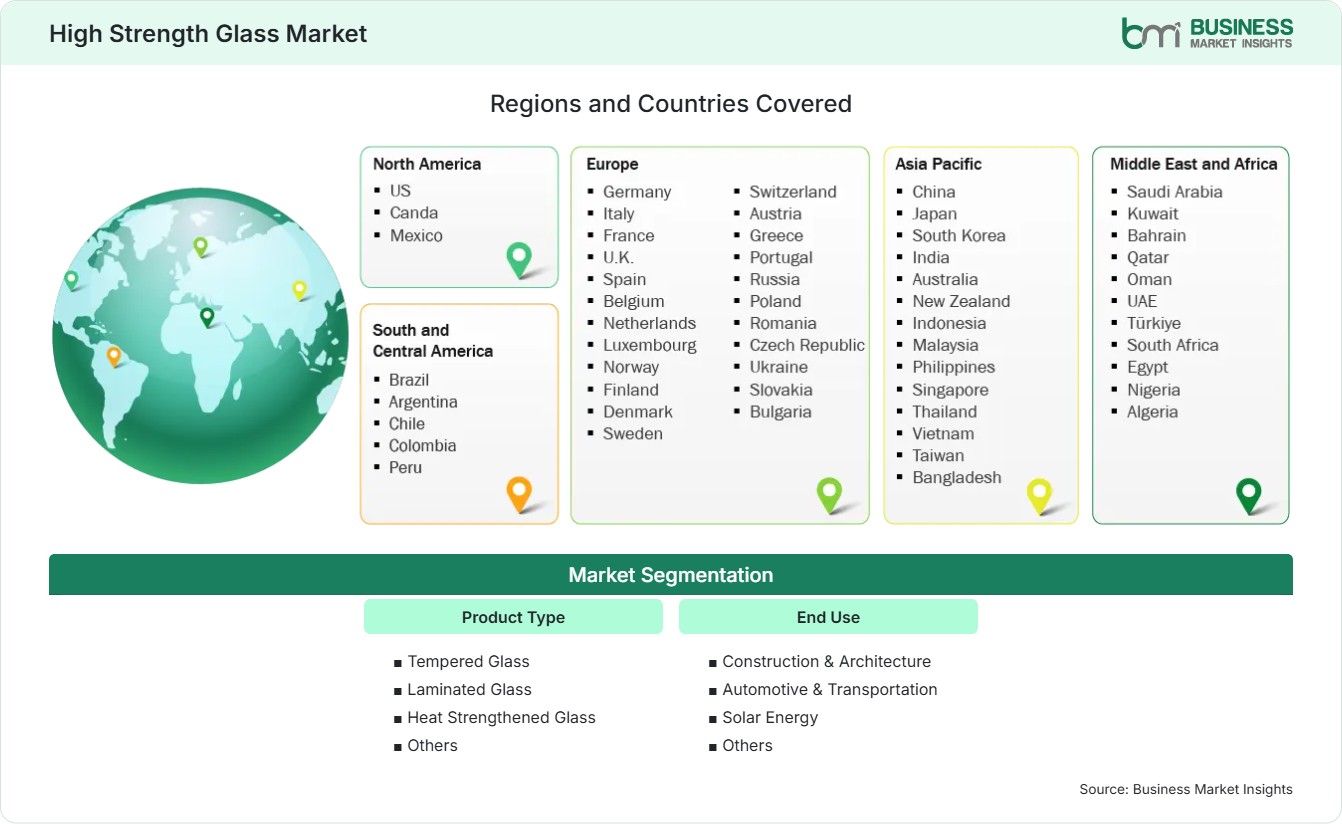
Global Market Geography
FREE PDF
Request your free sample
Request free sample
05 Segment Analysis

High Strength Glass Market Segmentation

Product Type

Product demand is influenced by safety requirements, mechanical strength, thermal performance, and industry-specific application needs. Tempered (Toughened) Glass accounted for 48%–51% share in 2025 and is projected to grow at a CAGR of 7.0%–8.0% through 2033 due to its superior impact resistance, safety characteristics, and widespread adoption across construction, automotive, and consumer applications. Its ability to withstand higher mechanical and thermal stress compared to conventional glass continues to support demand globally.

  • Tempered (Toughened) Glass: The dominant segment owing to high durability, enhanced safety performance, and broad application across architectural, automotive, and industrial sectors.
  • Laminated Glass: Widely used where safety, security, and acoustic insulation are critical requirements, particularly in commercial buildings and transportation applications.
  • Heat Strengthened Glass: Increasingly utilized in facade systems and large architectural installations due to improved thermal resistance and structural performance.
  • Others: Includes chemically strengthened glass and specialty high-performance glass products designed for advanced industrial, electronics, and defense applications.

End Use

End-use demand is driven by urbanization, infrastructure investment, renewable energy expansion, and technological advancements in transportation systems. Construction & Architecture accounted for 54%–57% share in 2025 and is projected to grow at a CAGR of 6.8%–7.8% through 2033 due to increasing deployment of safety glazing, curtain walls, facades, and energy-efficient building materials.

  • Construction & Architecture: The leading segment supported by rising high-rise construction, commercial development projects, smart buildings, and stringent building safety standards.
  • Automotive & Transportation: Demand is growing steadily due to increasing adoption of lightweight, impact-resistant glazing solutions in passenger vehicles, electric vehicles, railways, and public transportation systems.
  • Solar Energy: The fastest-growing segment, holding 16%–19% share in 2025 and projected to expand at a CAGR of 8.5%–9.5% through 2033 as solar installations continue expanding globally.
  • Others: Includes aerospace, defense, consumer electronics, marine, and industrial applications requiring high-performance glass solutions.
06 Market Forces

High Strength Glass Market Dynamics

Key Market Drivers

Rising Demand for Lightweight Automotive Glazing Solutions

Automobile producers have started utilizing lightweight materials in order to boost their energy efficiency, limit their carbon footprint, and maximize the mileage in their electric vehicles. Strong glass is a good material to achieve these goals since it possesses higher resistance, greater safety, and lower weight than conventional glazing materials. Modern automobile production tends to feature advanced windshield units, panoramic roofs, side windows, and other specialty glazing applications that need better mechanical characteristics. In the light of ongoing lightweighting processes and safety improvements, the utilization of advanced glass is expected to grow rapidly. It is also encouraged by the trend towards the development of electric mobility.

Growing Adoption in Consumer Electronics Displays

The increasing demand for durable and high-performance displays in smartphones, tablets, laptops, wearables, and other electronic devices is supporting adoption of high-strength glass technologies. Consumers increasingly expect devices that offer better scratch resistance, durability, and long-term reliability without compromising aesthetics. Manufacturers are investing heavily in advanced glass materials capable of withstanding drops, impacts, and intensive daily usage. Innovations in chemically strengthened and ultra-thin glass solutions are enabling improved display performance while maintaining lightweight designs. As consumer electronics markets continue expanding and device replacement cycles remain active, demand for advanced display protection materials is expected to contribute significantly to high strength glass market growth over the forecast period.

Expanding Use in High-Rise Building Facades

Modern architectural trends increasingly emphasize transparency, natural lighting, energy efficiency, and visually appealing building designs. High-strength glass plays a critical role in achieving these objectives by providing durability, safety, and structural integrity in large facade systems. Commercial towers, mixed-use developments, airports, and institutional facilities are increasingly utilizing advanced glazing solutions to enhance building performance and aesthetics. Regulatory standards related to building safety and energy efficiency are further encouraging adoption of advanced glass materials. Growing urbanization and expansion of high-rise construction projects across major cities worldwide are expected to sustain strong demand for high-strength glass products throughout the forecast period.

Key Market Opportunities

Rising Demand for Foldable Device Display Glass

The development of foldable phones, tablets, and future wearables presents considerable business opportunities for producers of cutting-edge glass products. These products require a specific material that can provide flexibility, durability, scratch resistance, and clarity at the same time. Innovations in the field of ultra-thin glass and chemically strengthened glass production make it possible to produce glass components for foldable electronics. In addition, with increasing consumer demand for sophisticated and innovative devices, electronics manufacturers continue making investments in new technologies for their production. The commercialization of foldable electronics presents a significant business opportunity for manufacturers who will be able to fulfill all the needs of consumers.

Expansion of High-Strength Glass in Solar Applications

Global investments in renewable energy infrastructure continue generating strong demand for durable glazing materials used in photovoltaic modules and solar installations. High-strength glass provides excellent transparency, environmental resistance, and long-term reliability, making it a critical component in solar power systems. Governments across multiple regions are promoting renewable energy deployment through incentives and sustainability initiatives, encouraging rapid growth in solar capacity additions. Utility-scale solar projects, commercial installations, and distributed generation systems are increasingly utilizing advanced glass products to enhance operational performance. This expanding renewable energy ecosystem presents attractive opportunities for glass manufacturers seeking high-growth application segments.

Increasing Adoption in Aerospace and Defense Components

Aerospace and defense industries are increasingly utilizing advanced glass materials that provide high impact resistance, optical clarity, lightweight performance, and durability under demanding operating conditions. Applications include cockpit glazing, observation systems, protective windows, and specialized defense equipment. Manufacturers continue investing in advanced materials that improve performance while reducing overall system weight. Growing defense modernization programs, rising aircraft production, and increasing investment in next-generation aerospace technologies are contributing to demand growth. As performance standards become increasingly stringent, opportunities for specialized high-strength glass products are expected to expand considerably.

Market Restraints and Challenges

High Manufacturing Costs of Specialty Glass Products

Factor: Production of high-strength glass often involves advanced manufacturing processes, specialized raw materials, precision treatment techniques, and quality-control procedures that increase production expenses compared to conventional glass products.

Impact: Elevated production costs can limit adoption in certain price-sensitive applications and create challenges for manufacturers seeking to maintain competitive pricing. High capital investment requirements may also discourage capacity expansion and increase barriers to high strength glass market entry. Companies continue focusing on process optimization and productivity improvements to enhance cost competitiveness.

Energy-Intensive Glass Production Processes

Factor: Manufacturing processes such as tempering, heat strengthening, melting, and specialty treatment require substantial energy consumption. Rising energy prices and increasing pressure to reduce industrial emissions can affect production economics.

Impact: Higher operating expenses may influence product pricing and profitability across the value chain. Environmental regulations and sustainability requirements are encouraging manufacturers to invest in energy-efficient technologies and lower-emission production methods. While these initiatives improve long-term sustainability, they can increase short-term operational and capital costs.

07 Company Analysis

Competitive Landscape

The high strength glass market analysis indicates a highly competitive landscape, with global flat glass manufacturers, specialty glass producers, and advanced materials companies competing through continuous product innovation, technological advancements, and capacity expansion. Industry participants are focusing on lightweight glass development, enhanced safety performance, energy-efficient glazing solutions, and high-performance products for applications in solar energy, electric vehicles, consumer electronics, and smart buildings. Strategic investments in production capacity, advanced coating technologies, and sustainable manufacturing processes continue shaping the competitive landscape. Additionally, companies are expanding their presence in emerging economies to capitalize on rising infrastructure development, urbanization, renewable energy projects, and growing demand for advanced glass solutions.

Company Name

Overview

Products and Services Relevant to this Market

AGC Inc.

Global glass and advanced materials manufacturer.

Tempered glass, laminated glass, architectural glazing, automotive glass, and specialty glass products.

Corning Inc.

Advanced materials and specialty glass technology company.

Chemically strengthened glass, display glass, specialty glass solutions, and electronics applications.

Guardian Glass

International manufacturer of high-performance glass products.

Architectural glass, coated glass, laminated glass, and energy-efficient glazing solutions.

NSG Group

Global glass producer serving multiple industries.

Automotive glazing, architectural glass, safety glass, and specialty high-performance products.

Saint-Gobain

Leading building materials and glass solutions company.

High-strength glazing, construction glass, automotive glass, and sustainable building solutions.

SCHOTT AG

Specialty glass and materials technology company.

High-performance specialty glass, aerospace glass, electronics glass, and industrial applications.

Xinyi Glass

Integrated glass manufacturer with global operations.

Float glass, tempered glass, solar glass, and automotive glazing products.

Cardinal Glass

Manufacturer specializing in residential and commercial glass solutions.

Insulating glass, tempered glass, coated glass, and architectural glazing systems.

Euroglas

European flat glass manufacturer.

Architectural glass, facade glass, solar-control glazing, and high-performance construction glass.

Flat Glass Group

Major glass producer serving construction and industrial sectors.

Tempered glass, laminated glass, solar glass, and large-scale architectural glazing products.

10 Trust & Transparency

Research Methodology

The market analysis combines proprietary research with secondary data from government agencies, company disclosures, regulatory filings, industry databases and expert interviews. Market estimates are validated through data triangulation, cross-market benchmarking and analyst review.

View Full Research Methodology

11 Questions Answered

Frequently Asked Questions

What opportunities exist for high-strength glass manufacturers?

Key opportunities include foldable electronic devices, solar power applications, aerospace and defense components, smart buildings, and next-generation electric vehicle glazing systems.

Why does Asia Pacific lead the market?

Asia Pacific leads due to rapid urbanization, strong infrastructure development, expanding automotive production, growing solar energy installations, and rising investments in modern construction projects.

Which end-use segment is growing the fastest?

Solar Energy is the fastest-growing end-use segment owing to expanding photovoltaic installations, renewable energy investments, and increasing demand for durable solar panel components.

Which product type dominates the market?

Tempered (Toughened) Glass dominates the market due to its superior impact resistance, safety performance, thermal durability, and widespread acceptance across construction and automotive applications.

What is driving growth in the high strength glass market report?

Growth is driven by increasing adoption of lightweight automotive glazing, rising use in consumer electronics displays, expanding high-rise construction activity, and growing demand from renewable energy projects.

Access the Full High Strength Glass Market Report

Get segment-level forecasts, regional estimates, competitive benchmarking, company profiles and downloadable Excel datasets.

Access the full High Strength Glass Market Report
350 pages PDF & Excel | 2026-08-05