
High Purity Alumina Market Outlook: Size, Share, Trends, Growth Analysis, Competitive Landscape & Forecast, 2026-2033

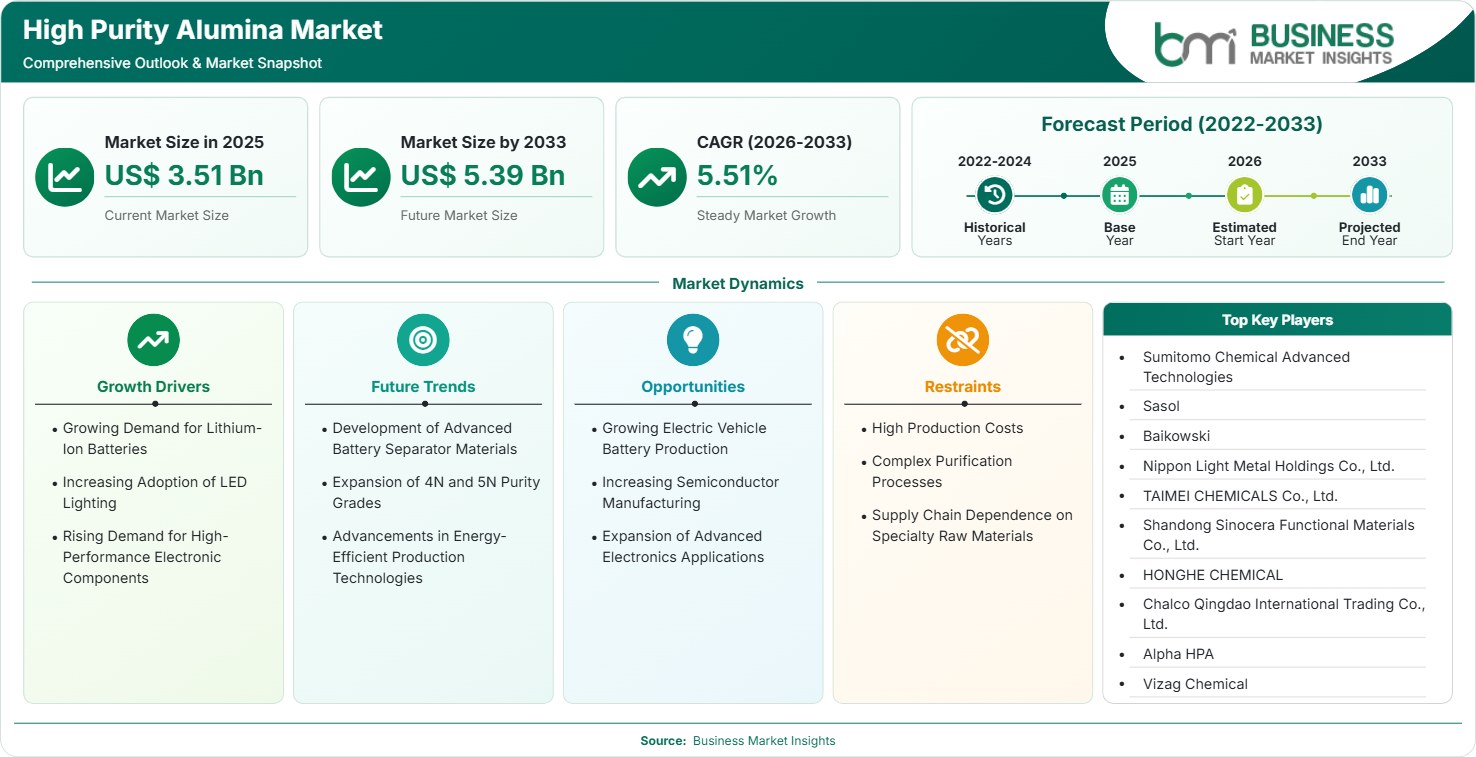
The High Purity Alumina Market size was valued at US$ 3.51 Billion in 2025 and is projected to reach US$ 5.39 Billion by 2033, growing at a CAGR of 5.51% during 2026–2033, driven by expanding lithium-ion battery manufacturing, increasing LED penetration, semiconductor capacity investments, advanced ceramics demand, and rising adoption of high-performance materials across electronics and energy storage applications.

Report Coverage
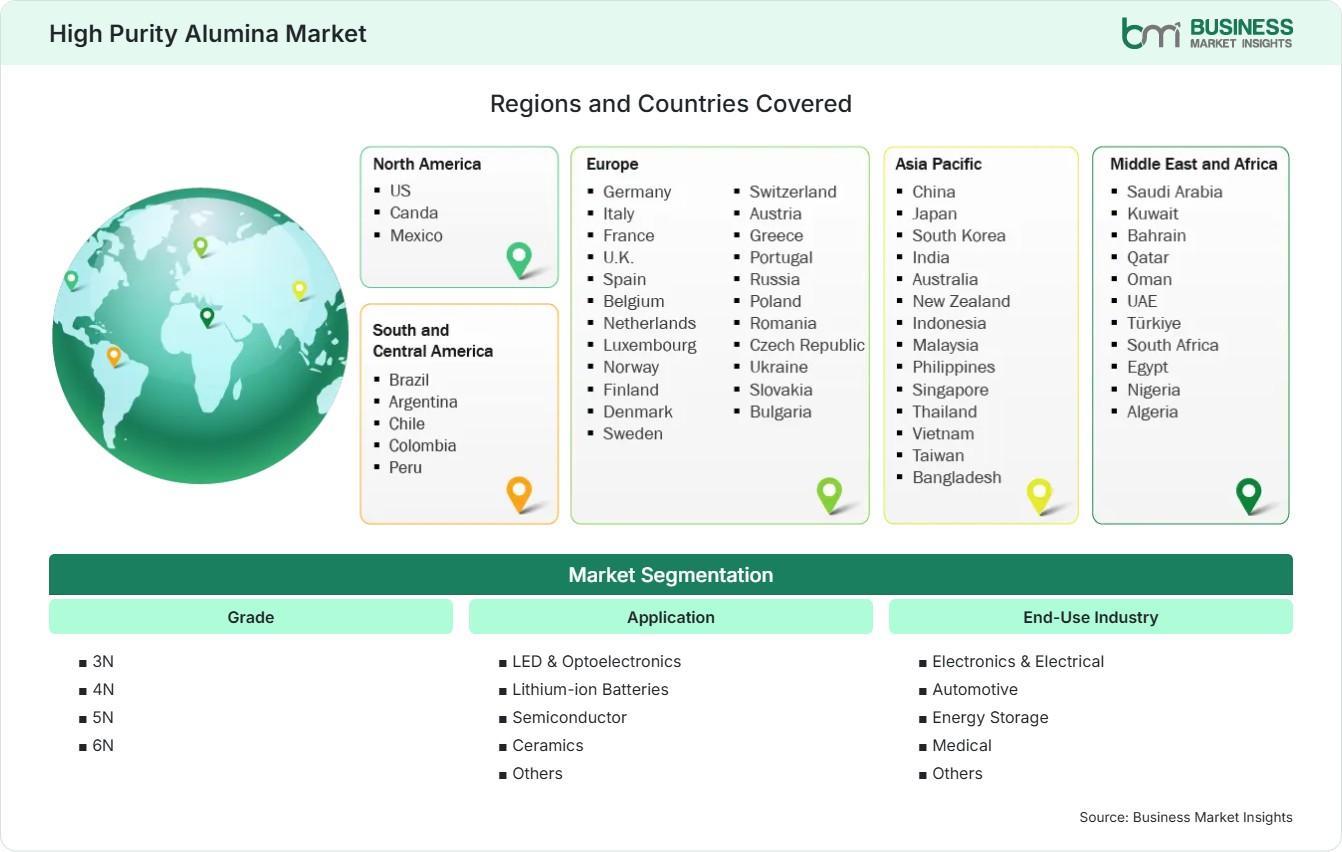
  • Grade: 3N, 4N, 5N, 6N
  • Application: LED & Optoelectronics, Lithium-ion Batteries, Semiconductor, Ceramics, Others
  • End-Use Industry: Electronics & Electrical, Automotive, Energy Storage, Medical, Others
US$ 3.51 Bn Market size in 2025
US$ 5.39 Bn Market Size by 2033
5.51% CAGR, 2026 - 2033
2026-2033 Forecast Period

AI Overview

High Purity Alumina Market Summary

  • North America Region: North America holds a market share of 24%–27% in 2025, growing with a CAGR of 5.0%–5.5% during 2026–2033. Demand is supported by semiconductor investments, battery supply-chain localization, advanced materials development, government incentives, clean-energy projects, specialty manufacturing growth, research activity, and expanding electronics production across the region. The U.S. remains the dominant market, supported by battery projects and semiconductor expansions, with a CAGR of 5.1%–5.6%.
  • Fastest Growing Region: Asia Pacific accounts for 47%–50% share in 2025 and is forecast to expand at a CAGR of 6.2%–6.8% during 2026–2033. Growth is supported by battery manufacturing expansion, LED production leadership, semiconductor investments, electronics exports, industrialization, government incentives, capacity additions, technology upgrades, and rising consumption of advanced materials across key economies.
  • Leading Segment: 4N grade commands 38%–42% share in 2025 and is expected to grow at a CAGR of 5.4%–5.9% through 2033. The segment benefits from broad adoption in LEDs, sapphire substrates, specialty ceramics, cost-effective processing, reliable purity performance, diversified applications, stable supply availability, and increasing electronics production requirements.
  • High Growth Segment: Lithium-ion Batteries account for 22%–26% share in 2025 and are anticipated to achieve a CAGR of 7.2%–7.9% during 2026–2033. Demand is increasing due to EV adoption, energy-storage projects, battery safety requirements, separator coating applications, capacity expansion programs, technological improvements, and accelerating global electrification initiatives.
  • Key Market Opportunity: Accelerating electric vehicle deployment, large-scale battery gigafactory investments, semiconductor manufacturing expansion, and demand for premium engineered materials create attractive opportunities for producers with scalable, high-purity production capabilities.
  • Major Market Players: Sumitomo Chemical Advanced Technologies; Sasol Limited; Baikowski SA; Nippon Light Metal Holdings Co., Ltd.; TAIMEI CHEMICALS Co., Ltd.; Shandong Sinocera Functional Materials Co., Ltd.; Honghe Chemical Co., Ltd.; Chalco Qingdao International Trading Co., Ltd.; Alpha HPA Limited; Vizag Chemical International; Orbite Technologies Inc.
Strategic Insights

High Purity Alumina Market: Strategic Insights

High Purity Alumina Market Strategic Framework
FREE PDF
Request your free sample
Request free sample
Stakeholder View

Key Takeaways

  • The value chain is becoming more integrated, with producers sourcing feedstock, refining capacities, and downstream partners to ensure better supply security and comply with the purity standards of the electronics and batteries industry.
  • Lithium-ion batteries provide the most promising growth opportunity in view of increasing demand for thermal-stable separator coating materials due to growing production of electric vehicles and stationary energy storage systems.
  • These shift towards energy-saving refining techniques, reduced carbon-footprint production processes, and super-high purity products, which will facilitate application of advanced semiconductors, sapphire substrates, and next generation electronic devices.
  • The Asia Pacific region provides the best investment potential because of the presence of well-developed battery manufacturing eco-systems, semiconductor fabrication facilities, and consistent growth in consumer electronics manufacture.
  • The trend in strategic investments like capacity building and partnerships is growing in the industry as producers try to improve their competitive edge in the premium purity market niche.
  • Differentiation of the product portfolio will target purity consistency, trace contamination, and special material formulations meeting strict industrial standards.
Geographic Outlook

High Purity Alumina Market Regional Highlights

North America High Purity Alumina Market

North America accounts for approximately 24%–27% of the High Purity Alumina Market share in 2025 and is expected to expand at a CAGR of 5.0%–5.5% through 2033. Demand is supported by semiconductor investments, battery supply-chain localization efforts, and government-backed advanced manufacturing initiatives. The region continues attracting investments in electric vehicle ecosystems and energy-storage infrastructure.

  • Semiconductor manufacturing investments are increasing consumption of specialty materials with stringent purity requirements, supporting demand for advanced alumina products used throughout electronics production chains.
  • Expansion of battery manufacturing facilities is creating long-term procurement opportunities for suppliers capable of delivering consistent purity specifications and scalable production capacity.
  • Research institutions and industrial laboratories continue developing next-generation applications that require advanced engineered materials with superior thermal and electrical properties.
  • Government incentives focused on clean-energy technologies and strategic manufacturing capabilities support sustained industrial investment and advanced materials adoption.
  • Supply-chain diversification objectives encourage domestic sourcing strategies, reducing dependence on concentrated production regions while improving resilience.

US High Purity Alumina Market

The United States represents approximately 78%–82% of North American demand in 2025 and is projected to grow at a CAGR of 5.1%–5.6% during 2026–2033. Rising requirements for high-performance components across defense, industrial, and consumer technology sectors further support High Purity Alumina Market development and long-term material demand.

  • New battery manufacturing projects continue increasing localized demand for separator-coating materials utilized in lithium-ion cell production.
  • Semiconductor fabrication investments create opportunities for ultra-high-purity grades used in advanced electronic applications requiring strict process consistency.
  • Technological innovation and industrial R&D programs support adoption across specialty ceramics and engineered material segments.
  • Federal industrial policy initiatives continue reinforcing the domestic advanced-materials ecosystem and manufacturing competitiveness.

Europe High Purity Alumina Market

Europe holds approximately 20%–23% High Purity Alumina Market share in 2025 and is forecast to achieve a CAGR of 5.2%–5.8% through 2033. Regional growth is supported by energy-transition initiatives, EV manufacturing expansion, and advanced industrial capabilities. Germany remains the leading market, while Poland is among the fastest-growing opportunities due to battery-sector investments and industrial modernization programs.

  • Germany leads regional demand through its strong automotive, industrial technology, and advanced manufacturing sectors.
  • Poland records one of the highest growth rates due to battery supply-chain investments and expanding industrial production capabilities.
  • European sustainability policies encourage adoption of lower-emission production technologies and resource-efficient refining methods.
  • Advanced ceramics and electronics manufacturers continue increasing demand for materials capable of supporting precision engineering applications.
  • Strategic autonomy initiatives support development of localized advanced-materials supply chains across the region.

Asia Pacific High Purity Alumina Market

Asia Pacific captures approximately 47%–50% of High Purity Alumina Market revenue in 2025 and is expected to record the fastest CAGR of 6.2%–6.8% through 2033. The region benefits from leadership in electronics production, battery manufacturing, LED fabrication, and semiconductor processing. China remains the largest market while India demonstrates the strongest expansion momentum.

  • China maintains leadership through significant battery manufacturing capacity, semiconductor activity, and electronics exports.
  • India emerges as the fastest-growing national opportunity, supported by electronics manufacturing incentives and industrial investment programs.
  • Expanding electric vehicle supply chains continue strengthening demand across battery and energy-storage applications.
  • Producers are increasing refining and processing capacity to address rising regional consumption requirements.
  • Growth in consumer electronics production supports ongoing demand for specialty materials used in high-value component manufacturing.

Rest of World High Purity Alumina Market

The Rest of World region accounts for approximately 7%–10% of global revenue in 2025 and is projected to expand at a CAGR of 5.4%–6.0% through 2033. South and Central America are benefiting from industrial diversification and growing battery-material investments.

Middle East and Africa High Purity Alumina Market are supported by industrial development initiatives, mining-related value addition, and increasing interest in advanced manufacturing.

  • Brazil leads South and Central America through industrial activity and increasing participation in advanced materials processing.
  • Saudi Arabia represents a notable high-growth market due to manufacturing diversification and industrial investment programs.
  • Mining and refining capabilities provide opportunities for enhanced value addition across raw-material supply chains.
  • Infrastructure development and industrial modernization initiatives support gradual expansion of high-value materials demand.
  • Strategic industrial policies encourage investment into technology-intensive manufacturing and advanced material ecosystems.
Global Market Geography
FREE PDF
Request your free sample
Request free sample
Segment Analysis

High Purity Alumina Market Segmentation

Grade

Grade-based differentiation is critical because purity levels directly influence performance across LEDs, batteries, semiconductors, and specialty ceramics. This segment accounts for approximately 35%–38% share in 2025 and is forecast to expand at a CAGR of 5.5%–6.0% through 2033. Increasing demand for advanced electronic materials and battery components is accelerating adoption of premium purity grades. The High Purity Alumina Market scope continues expanding as manufacturers invest in refining technologies capable of producing consistent ultra-high-purity products.

  • 3N: Widely utilized in cost-sensitive industrial applications where standard purity requirements are sufficient. Demand remains supported by established manufacturing processes and broad availability across regional supply chains.
  • 4N: Represents the most commercially adopted grade due to its balance of performance, process efficiency, and suitability for LEDs, ceramics, and several electronic component applications.
  • 5N: Increasingly used in advanced electronics and battery technologies requiring improved purity, enhanced thermal stability, and reduced contaminant concentrations for performance-critical applications.
  • 6N: Supports highly specialized semiconductor and precision electronic applications where exceptional purity standards are essential for maintaining process reliability and product performance.

Application

Application diversification continues to strengthen demand fundamentals as advanced technologies require high-performance alumina materials. This segment captures approximately 30%–34% share in 2025 and is expected to record a CAGR of 5.8%–6.4% through 2033. Growing adoption across electronics, energy storage, and advanced manufacturing sectors supports long-term growth prospects. Emerging High Purity Alumina Market trends indicate increasing penetration into battery-related applications and sophisticated electronic devices.

  • LED & Optoelectronics: Remains a major consumption area due to extensive use in sapphire substrate production and optical performance enhancement within lighting and display technologies.
  • Lithium-ion Batteries: Demand continues rising as separator coating technologies improve battery safety, thermal management, durability, and overall performance within electric mobility and storage systems.
  • Semiconductor: Advanced semiconductor manufacturing increasingly relies on ultra-high-purity materials to maintain stringent quality specifications and process stability requirements.
  • Ceramics: Specialty ceramic applications benefit from superior hardness, thermal resistance, and durability characteristics supporting industrial and technical performance requirements.

End-Use Industry

End-use demand is increasingly driven by electrification, energy transition projects, and digital technology deployment. This segment accounts for approximately 28%–32% share in 2025 and is projected to expand at a CAGR of 5.9%–6.5% through 2033. The growing role of advanced materials in electronics and energy-storage solutions continues creating favorable long-term demand conditions.

  • Electronics & Electrical: Represents the largest customer category due to widespread use in LEDs, semiconductors, displays, and electronic components requiring high thermal and electrical performance.
  • Automotive (EV): Expanding electric vehicle production continues increasing material consumption through lithium-ion battery manufacturing and related energy-storage technologies.
  • Energy Storage: Stationary battery installations and renewable energy integration projects support increasing requirements for advanced performance-enhancing materials.
  • Medical: High-purity materials are utilized in specialized medical devices and healthcare technologies where quality, durability, and reliability are essential performance requirements.
Market Forces

High Purity Alumina Market Dynamics

Key Market Drivers

Growing Demand for Lithium-Ion Batteries

The global expansion of lithium-ion battery production remains a major catalyst for industry development. High purity alumina is widely used as a separator coating material because it improves thermal stability, safety performance, and battery lifespan. Rising electric vehicle adoption across China, Europe, and North America is accelerating gigafactory investments and increasing demand for advanced battery materials, reinforcing High Purity Alumina Market growth across key end-use sectors. Energy storage deployment associated with renewable power integration further strengthens consumption. Manufacturers are investing in high-purity production technologies to meet increasingly stringent battery specifications. Battery producers also prioritize supply-chain diversification, creating opportunities for regional sourcing partnerships and long-term contracts. These dynamics continue supporting sustained consumption across transportation and stationary storage applications globally.

Increasing Adoption of LED Lighting

LED lighting remains a foundational demand driver due to the critical role of high purity alumina in sapphire substrate manufacturing. Energy-efficient lighting solutions have been continuously encouraged by governments around the world in order to lower electricity usage and emission of CO2. There has been an increase in penetration rate of LEDs in commercial and industrial buildings, residential complexes, and public infrastructures which would fuel further demand for materials needed in the process. The improvements in efficiency and durability of LEDs are continuously fueling their production, as well as the High Purity Alumina Market trends which points towards higher use in display and optoelectronics technology. The display industry is contributing to demand through its advanced applications.

Rising Demand for High-Performance Electronic Components

Expanding consumption of advanced electronic devices is increasing demand for materials that can satisfy stringent purity and performance requirements. Semiconductor manufacturing, specialty ceramics, optical elements, and electronic substrates need materials with impeccable contamination and reliability attributes. Development in the infrastructure for artificial intelligence, data centers, consumer electronics, and communication systems boosts continued development in semiconductor manufacturing plants. Moving towards more compact and efficient electronic products also contributes to increasing the material’s performance attributes. With the increasing pace of digitalization around the world, the manufacturers are now emphasizing high value-added applications.

Key Market Opportunities

Growing Electric Vehicle Battery Production

Electric vehicle battery manufacturing represents one of the most promising areas for future investment. Automotive manufacturers and battery companies have increased production capacities to achieve the accelerated electrification goals. There is high purity alumina which is vital for improving the safety and stability of batteries; therefore, there is strategic importance associated with it within the battery materials value chain. Emerging battery manufacturing centers in North America, Europe, and Asia present chances for local suppliers and capacity building initiatives. As per long-term High Purity Alumina Market Forecasts, transportation electrification, energy storage installation, and battery technologies innovation will propel high purity alumina consumption.

Increasing Semiconductor Manufacturing

Global efforts to expand semiconductor production capacity are creating substantial opportunities for advanced material suppliers. Semiconductor producers need a constant source of high-purity materials that help create their products. Semiconductor projects in the U.S., Europe, Japan, South Korea, and India supported by the government are promoting the building of new fabrication plants. Since chip designs are becoming ever more complicated, purity demands become even more stringent. Such an atmosphere is favorable for those manufacturers who are able to ensure quality and stable volumes of production. Domestic semiconductor environments can be considered good options for investment in high-purity materials.

Expansion of Advanced Electronics Applications

The proliferation of advanced electronics across consumer, industrial, healthcare, and telecommunications sectors continues broadening application potential. Emerging technologies such as AI hardware, sensors, wearable devices, and communications infrastructure need advanced materials. Product design is incorporating tighter control of purity as well as better performance features to meet the demands of consumers. Significant electronics innovation will encourage the use of premium materials. Firms that have the ability to support the development of applications via collaboration and customization will enhance their market position. The diversification of end uses will minimize the dependency on any specific application and provide various revenue streams.

Market Restraints and Challenges

High Production Costs

Factor: Producing ultra-high-purity material requires sophisticated refining technologies, significant energy consumption, specialized equipment, and stringent quality-control procedures. Impact: High costs of production may become a constraint in price-sensitive applications and pose difficulties for producers who want to sustain competitive profit margins. High-capital cost facilities usually need considerable investments before becoming commercially viable. Cost pressure may also affect the purchasing choices of industries using the products as inputs, especially during economically uncertain times. Producers have to constantly improve their efficiencies and yields in order to stay competitive.

Complex Purification Processes

Factor: Achieving purity levels ranging from 4N to 6N requires multiple processing stages, advanced technologies, and rigorous contaminant management throughout production. Impact: Increased process complexities will increase risk levels and quality control needs. Minor deviations will have an impact on the usability of products in high-performance applications like semiconductors and electronics. Achieving consistent purity standards will still be quite difficult for mass production processes. The manufacturing companies will require making significant investments in process efficiency and quality control testing among others.

Company Analysis

Competitive Landscape

Industry competition is shaped by purity consistency, process technology, downstream application expertise, and production scalability. Current High Purity Alumina Market analysis indicates increasing competition in battery materials, semiconductor applications, advanced ceramics, and thermal management solutions as manufacturers expand capacity and develop higher-value specialty grades.

Company Name

Overview

Products and Services Relevant to This Market

Sumitomo Chemical Advanced Technologies

Advanced materials supplier with extensive expertise in ultra-high-purity inorganic materials serving semiconductor, battery, and electronics industries globally.

High purity alumina powders, semiconductor-grade materials, thermal conductivity fillers, sapphire-related materials, and battery application products.

Sasol Limited

Global chemicals and advanced materials company with a strong presence in specialty alumina production for industrial and technology-driven applications.

Specialty aluminas, high-purity alumina products, catalyst supports, advanced materials, and engineered industrial solutions.

Baikowski SA

Specialty minerals producer focused on premium alumina-based solutions for electronics, medical, polishing, and advanced ceramic applications.

High-purity alumina powders, ceramic-grade materials, polishing products, electronic materials, and customized particle-engineering solutions.

Nippon Light Metal Holdings Co., Ltd.

Japanese materials company engaged in aluminum-related technologies and advanced industrial material development.

High-purity alumina, specialty aluminum products, functional materials, and industrial-grade advanced material solutions.

TAIMEI CHEMICALS Co., Ltd.

Manufacturer specializing in engineered alumina materials supporting ceramics, electronics, and industrial applications.

High-purity alumina powders, advanced ceramics materials, polishing compounds, and specialty industrial products.

Shandong Sinocera Functional Materials Co., Ltd.

Functional materials producer serving electronic, ceramic, and advanced industrial sectors through specialized product development.

High-purity alumina materials, ceramic components, electronic materials, and engineered advanced formulations.

Honghe Chemical Co., Ltd.

Chemical manufacturer supplying high-purity materials and specialty chemicals to industrial and advanced technology sectors.

High-purity alumina products, industrial chemicals, specialty materials, and customized chemical solutions.

Chalco Qingdao International Trading Co., Ltd.

International trading subsidiary supporting aluminum-related products and advanced material distribution activities.

High-purity alumina products, specialty alumina materials, industrial raw materials, and global supply-chain services.

Alpha HPA Limited

Australian producer commercializing proprietary refining technology for low-carbon high-purity aluminum products.

High-purity alumina, alumina hydrates, aluminum precursors, battery materials, and semiconductor-related products.

Vizag Chemical International

Supplier of specialty chemical materials serving industrial manufacturing and technology-oriented application segments.

High-purity alumina powders, specialty compounds, industrial chemicals, and customized material solutions.

Trust & Transparency

Research Methodology

The market analysis combines proprietary research with secondary data from government agencies, company disclosures, regulatory filings, industry databases and expert interviews. Market estimates are validated through data triangulation, cross-market benchmarking and analyst review.

View Full Research Methodology

Questions Answered

Frequently Asked Questions

What insights does a High Purity Alumina Market Report provide?

A complete report gives you an analysis of the following areas in the market: Size, Demand, Technology, Competition, Applications, and Growth Opportunities.

Why is Asia Pacific the dominant regional market?

It is because the region is home to companies manufacturing batteries, semiconductors, LEDs, and consumer electronics, thus creating a huge requirement for high purity materials.

How does high purity alumina support battery performance?

It is used in lithium-ion battery separators that enhance thermal resistance and battery durability.

Which application segment offers the highest growth potential?

The lithium-ion batteries hold great prospects due to the rising adoption of electric vehicles, construction of battery gigafactories, and rising installations of energy storage globally.

What makes high purity alumina different from conventional alumina?

High-purity alumina consists of more than 99.99% purity, as well as excellent thermal stability, insulation capacity, hardness, and corrosion resistance needed for LEDs, semiconductors, batteries, and other ceramics.

Access the Full High Purity Alumina Market Report

Get segment-level forecasts, regional estimates, competitive benchmarking, company profiles and downloadable Excel datasets.

Access the full High Purity Alumina Market Report
350 pages PDF & Excel | 2026-09-15
Similar Research

Related Market Reports