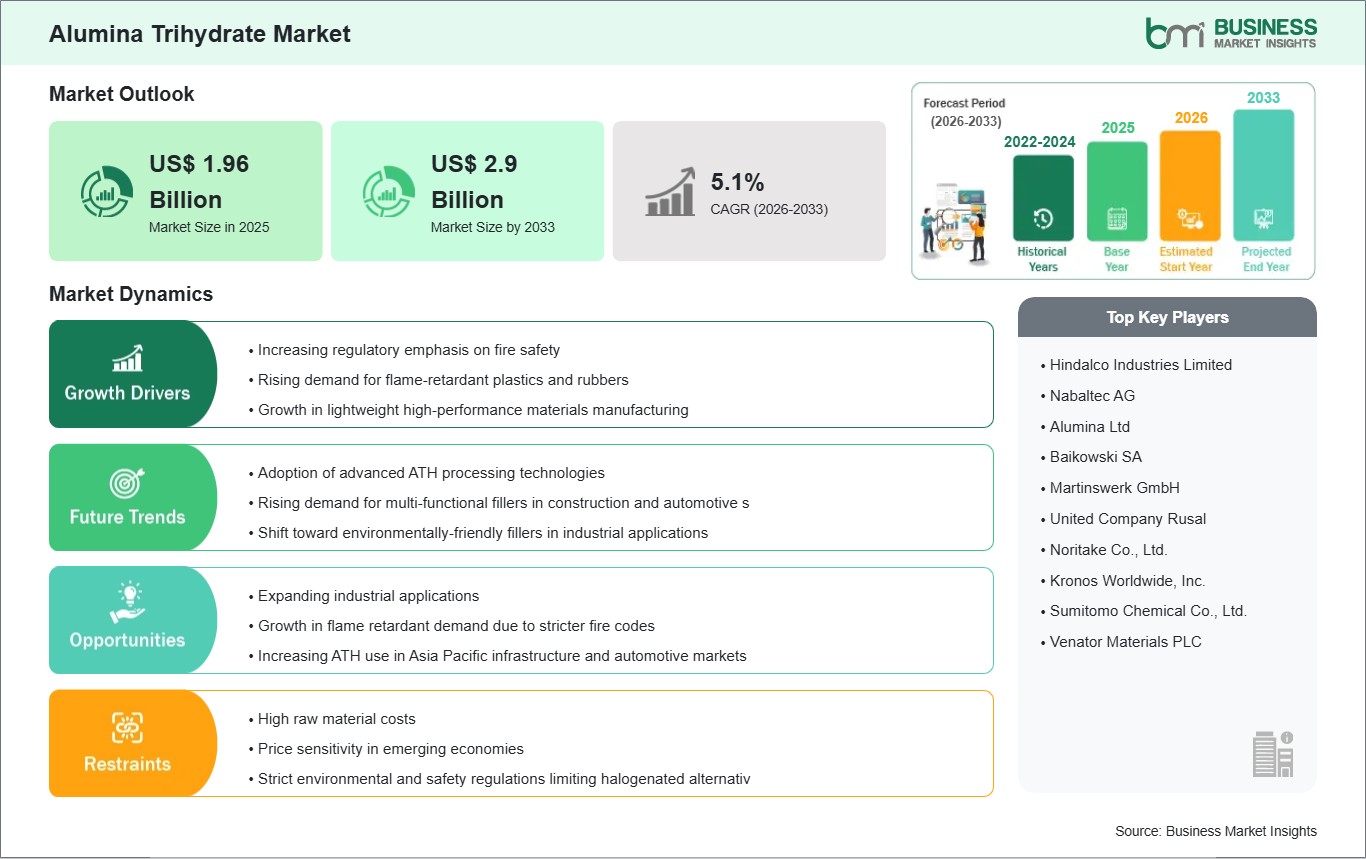
Market Summary
Executive Summary and Global Market Analysis
The global alumina trihydrate (ATH) market growth is shaped by heightened demand for flame retardants and performance fillers across diverse manufacturing sectors. ATH is widely used as an effective flame retardant in plastics and rubber due to its ability to release water during thermal decomposition, supporting compliance with fire safety regulations in automotive, construction, electronics, and other industrial segments. Concurrently, its role as a cost-efficient filler improves mechanical properties and reduces raw material costs, reinforcing its appeal among plastics, paints & coatings, and glass manufacturers.
Increasing safety and performance standards across key manufacturing markets have amplified demand for ATH in both traditional and emerging applications. Industrial growth in Asia Pacific — particularly China, India, and Southeast Asian countries — complements established consumption in North America and Europe, fostering a competitive global landscape that prioritizes innovation in particle morphology, surface treatment, and sustainability of production processes.
Producers are focusing on process optimization and quality differentiation, with investments targeting improved dispersion characteristics, consistency in particle size distribution, and reduced environmental footprint.
Segment Analysis
Alumina Trihydrate Market Segmentation
Key segments that contributed to the derivation of the alumina trihydrate market analysis are type, application, and end-use industry.
- By type, the alumina trihydrate market is segmented into ground alumina trihydrate, wet alumina trihydrate, dry alumina trihydrate, and precipitate alumina trihydrate. The ground alumina trihydrate segment dominated the market in 2025.
- Based on application, the alumina trihydrate market is categorized into flame retardant, filler, antacid, and other applications. The flame retardant segment dominated the market in 2025.
- In terms of end-use industry, the market is classified into plastics, building & construction, paints & coatings, pharmaceuticals, glass, rubber, and other end-use industries. The plastics segment dominated the market in 2025.
Market Forces
Alumina Trihydrate Market Drivers and Opportunities
Increasing Regulatory Emphasis on Fire Safety
The ATH (alumina trihydrate) market is currently being influenced by several key factors and one of the greatest is the increasing focus on fire safety by regulatory bodies around the world. Governments and regulatory agencies are tightening the current regulations on the production and supply of consumer goods, construction products, and automotive interiors, by creating a need for increased levels of fire resistance. Consequently, ATH, due to its non-toxic flame retardant properties, offers manufacturers an additive that will enable them to meet these demands for compliance with hardening regulatory standards. Additionally, unlike halogenated flame retardants, ATH provides a water-based way to cool the burning material when exposed to heat and reduces the generation of harmful smoke and therefore provides both an environmentally friendly and effective means of providing a fire-safe product. As a result of the increased regulatory focus on fire safety, stricter building codes require construction materials to withstand potential fire hazards, which will increase the demand for ATH as an additive in building materials such as insulation, wiring, and structural components. Similarly, the automotive industry requires that all interior materials used in vehicles will meet very strict flammability tests, which has led to increased usage of ATH in plastics and coatings as a means to meet flammability test criteria. Consumer electronics face similar challenges in terms of regulatory scrutiny and ATH has become an additive used to reduce the potential for fire in cases and circuit boards. The regulatory pressure for increased fire resistance is most acute in Europe and North America; regions that place high value on sustainability and safety. However, with rapid industrial growth and an increase in urbanization within the Asia Pacific region, governments in this area are also pursuing the implementation of more stringent measures for fire safety. As these regulations continue to change and grow over time, the value of ATH as a flame retardant additive will continue to grow.
Expanding Industrial Applications
Alumina trihydrate (ATH) has traditionally been known for its flame-retarding properties, but ATH is now being used as a versatile filler for many different industries. Examples of its use are in plastics, paints, rubber products, and glass products where improvements can be made to mechanical strength, thermal resistance, and surface finish. Increasingly, industries are focusing on lightweight/high-performance materials that have both strength and efficiency as the demand for lightweight and high-performing materials continues to grow. ATH meets these criteria by providing enhanced dispersion and performance improvements in composite formulations. In construction, ATH-filled plastics and coatings will provide materials with greater strength and durability and offer improved endurance in durable goods; ATH will also enhance the performance of rubber by improving its mechanical properties and flame resistance; and glass manufacturers will gain benefits from the formulation of specialty products that contain ATH. Advances in ATH processing technologies, such as fine milling and surface modifications, are significantly increasing the ways ATH can be used. These innovative processing technologies provide manufacturers with precise control over the particle size and surface chemistry of ATH, enabling them to customize ATH to meet specific performance needs. As industrial manufacturing transitions to automation and the complexity of the manufacturing process increases, manufacturers are looking for reliable and multi-functional additives such as ATH. Continued demand for sustainable alternatives to traditional manufacturing methods has created a large number of opportunities for manufacturers to provide environmentally-friendly fillers such as ATH to their customers. The combination of high performance, adaptability, and environmentally-friendly properties is allowing ATH to penetrate new market segments.
Size and Share Analysis
Alumina Trihydrate Market Size and Share Analysis
The Alumina Trihydrate Market demonstrates steady growth, with size and share analysis highlighting evolving trends and competitive dynamics among key players. The report examines subsegments categorized within type, application, and end-use industry, offering insights into their contribution to overall market performance.
By type, the ground alumina trihydrate subsegment dominated the market in 2025, driven by its optimized particle size, superior purity, and widespread adoption across plastics, rubber, and paints & coatings applications.
By application, the flame retardant subsegment dominated the market in 2025, driven by stringent fire safety regulations, broad polymer use, and the material’s inherent water-release property that enhances fire resistance.
Based on end-use industry, the plastics subsegment dominated the market in 2025, driven by high-volume usage as both a flame retardant and filler, supporting performance, cost efficiency, and regulatory compliance in automotive, consumer goods, and construction materials.
Report Coverage
Alumina Trihydrate Market Report Coverage and Deliverables
The "Alumina Trihydrate Market Size and Forecast (2022 - 2033)" report provides a detailed analysis of the market covering below areas:
- Alumina Trihydrate Market size and forecast at global, regional, and country levels for all the key market segments covered under the scope
- Alumina Trihydrate Market trends, as well as drivers, restraints, and opportunities
- Alumina Trihydrate Market analysis covering key trends, global and regional framework, major players, regulations, and recent developments
- Industry landscape and competition analysis covering market concentration, heat map analysis, prominent players, and recent developments for the Alumina Trihydrate Market
- Detailed company profiles, including SWOT analysis
Geographic Insights
Alumina Trihydrate Market Geographic Insights
The geographical scope of the Alumina Trihydrate Market report is divided into North America, Asia Pacific, Europe, Middle East & Africa, and South & Central America. North America held the largest share in 2025.
Alumina trihydrate (ATH) is being more widely used in plastics, construction products and coatings in North America due to strict regulations regarding fire safety and environmental compliance. In addition, the R&D capabilities in North America support innovation of new specialized grades.
In Europe, much of the growth in the use of ATH is being driven by strict EU regulations concerning the use of halogen-free flame retardants. In Asia Pacific, rapid urbanization and infrastructure development are driving demand.
The Middle East & Africa and South & Central America are emerging markets with gradual growth driven by construction and industrial development.
Industry Activity
Recent Developments
The Alumina Trihydrate Market is evaluated by gathering qualitative and quantitative data post primary and secondary research, which includes important corporate publications, association data, and databases. A few of the key developments in the alumina trihydrate market are:
- In July 2023, Hindalco, one of the world’s largest producers of alumina, announced the expansion of its specialty alumina portfolio, including alumina trihydrate grades tailored for flame-retardant applications in plastics and rubber. The company emphasized growing demand in Asia Pacific, particularly India and China, where construction and electrical safety regulations are tightening. This expansion was aimed at strengthening Hindalco’s position in the global ATH market.
- In March 2024, Nabaltec AG, a German specialty chemicals company, reported the launch of new fine precipitated alumina trihydrate products designed for high-performance flame retardant applications. The announcement highlighted improved particle size distribution and dispersion properties, enabling better integration into plastics and coatings. Nabaltec positioned these products as part of its strategy to meet stricter European Union fire safety and environmental standards.
Trust & Transparency
Research Methodology
The market analysis combines proprietary research with secondary data from government agencies, company disclosures, regulatory filings, industry databases and expert interviews. Market estimates are validated through data triangulation, cross-market benchmarking and analyst
review.
View Full Research Methodology
Key Sources Referred:
U.S. Environmental Protection Agency (EPA)Occupational Safety and Health Administration (OSHA)European Chemicals Agency (ECHA)European Commission (EC)National Fire Protection Association (NFPA)International Organization for Standardization (ISO)Bureau of Indian Standards (BIS)China National Chemical Information Center (CNCIC)World Health Organization (WHO)United Nations Environment Programme (UNEP)International Trade Administration