Market Summary
Executive Summary and Global Market Analysis
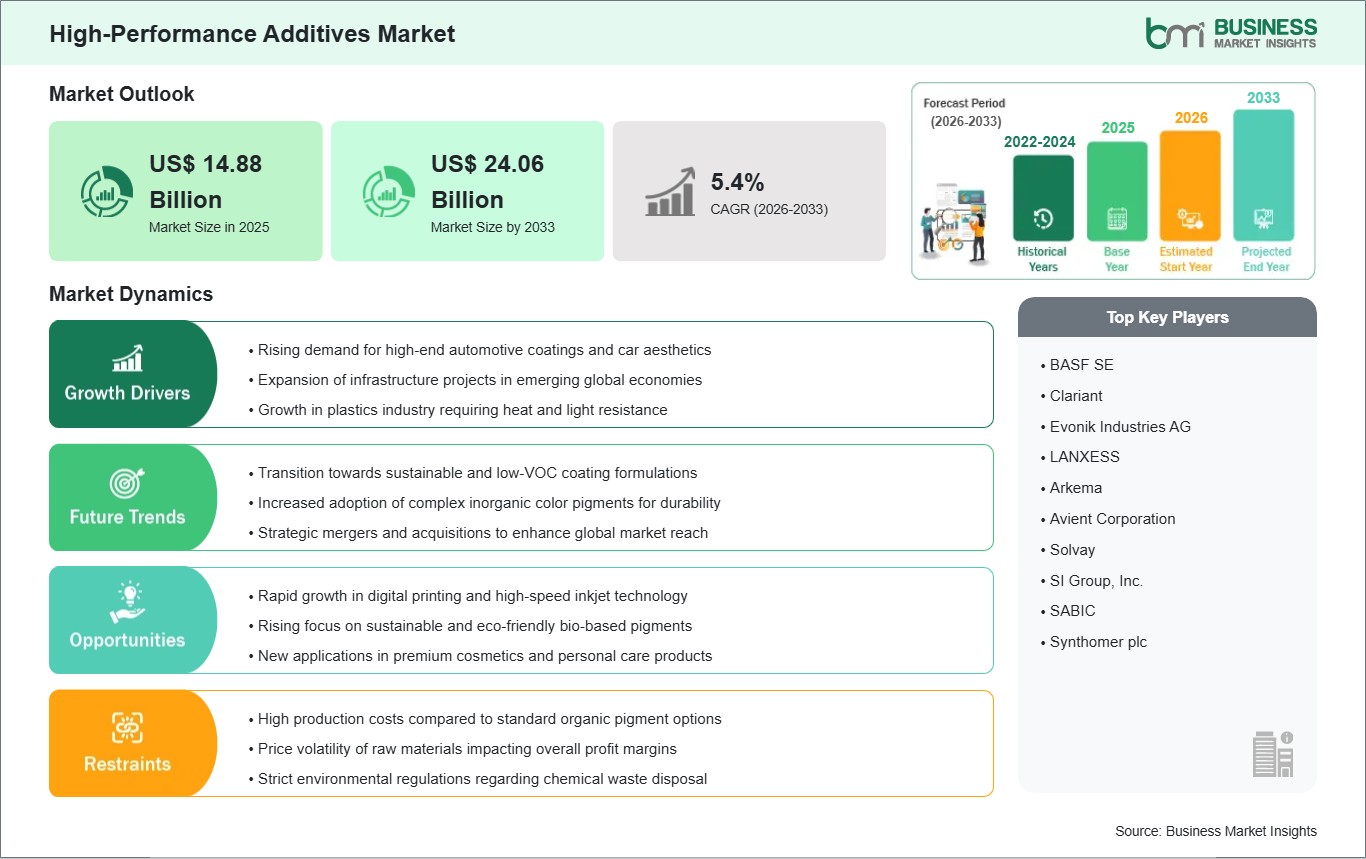
High-performance additives are critical chemical components used to modify and enhance the inherent properties of materials such as polymers, rubbers, and coatings. They are essential for industries that demand superior durability, thermal stability, and mechanical strength, including automotive, medical, and aerospace. These additives serve vital roles by protecting materials from degradation, improving processing efficiency, and ensuring safety through flame retardancy. The market is currently driven by the rising demand for lightweight automotive components to improve fuel efficiency and the surge in high-precision medical-grade plastics. Additionally, innovations in green chemistry and the shift toward bio-based additives are reshaping the market landscape to meet global sustainability targets.
However, several challenges can restrain market growth, such as volatile raw material costs and stringent environmental regulations concerning VOC emissions and chemical toxicity (e.g., PFAS restrictions). The industry is also sensitive to the high R&D costs required for developing multifunctional and non-toxic formulations. Despite these hurdles, the market holds significant opportunities driven by the rapid growth of the Electric Vehicle (EV) sector, the expansion of 3D printing in industrial manufacturing, and the increasing demand for temperature-sensitive medical packaging. Investment in nanotechnology-based fillers and advanced stabilizers is expected to open new avenues for market expansion.
Segment Analysis
High-Performance Additives Market Segmentation
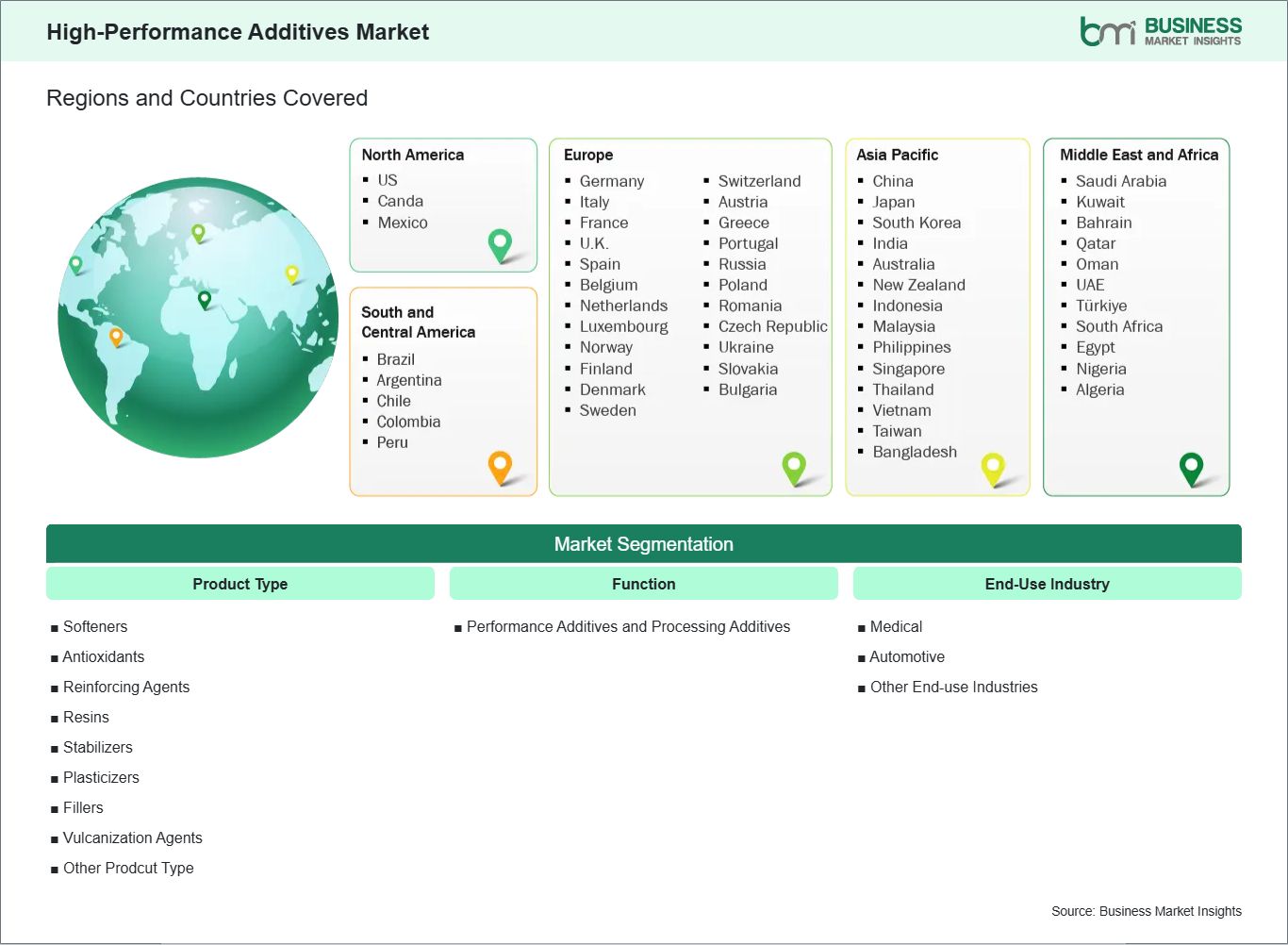
Key segments that contributed to the derivation of the High-Performance Additives market analysis are product type, function, and end-use industry.
- By Product Type, the market is segmented into Softeners, Antioxidants, Reinforcing Agents, Resins, Stabilizers, Plasticizers, Fillers, Vulcanization Agents, and others.
- By Function, the market is divided into Performance Additives and Processing Additives.
- By End-Use Industry, the market is categorized into Medical, Automotive, and Others.
Market Forces
High-Performance Additives Market Drivers and Opportunities
Accelerating Automotive Lightweighting and Global Electric Vehicle Shift
The automotive sector's aggressive pursuit of lightweighting to meet stringent emission standards and enhance fuel efficiency is a primary driver for the high-performance additives market. As manufacturers transition from traditional metal components to high-performance plastics and composites, additives like reinforcing agents, impact modifiers, and heat stabilizers become indispensable. These chemicals ensure that lightweight materials retain structural integrity and safety under extreme mechanical stress and thermal loads.
The global shift toward Electric Vehicles (EVs) has further intensified this demand. EVs require specialized flame retardants for battery housings and performance additives to optimize tire rolling resistance, which directly impacts battery range and overall vehicle efficiency. The automotive segment remained the dominant end-user, with a projected increase in demand as global EV production scales. This trend is particularly evident in North America and Asia-Pacific, where government incentives for green transportation are driving the adoption of advanced polymers. By enabling the creation of durable, lightweight, and safe vehicle parts, high-performance additives have become a cornerstone of the modern automotive supply chain, ensuring that performance and sustainability go hand-in-hand.
Innovation in Sustainable Bio-Based Additives and Green Material Science
The increasing global emphasis on environmental sustainability and the "clean label" movement presents a substantial opportunity for the high-performance additives market. As regulatory bodies like the EPA and European Commission implement stricter limits on hazardous substances and non-recyclable materials, there is a massive opening for bio-based and non-toxic alternatives.
Companies are now investing heavily in R&D to develop additives derived from renewable feedstocks, such as plant-based oils and biodegradable polymers, which offer the same performance as petrochemical-based counterparts. These "green" additives not only improve material properties like UV resistance and thermal stability but also align with corporate carbon-reduction targets.
For instance, the demand for bio-based plasticizers and antioxidants in packaging and medical applications is gathering momentum due to the strong need for safe and environmentally responsible materials among consumers in these industries. Beyond this, the creation of a niche market for 'smart' additives, such as self-healing coatings in the transportation industry, presents additional opportunities for value-creation by responsible chemical suppliers who prioritize the needs of the increasing number of eco-sensitive industrial consumers while staying ahead of the global curve in terms of new environmental regulations.
Size and Share Analysis
High-Performance Additives Market Size and Share Analysis
The high-performance additives market demonstrates steady growth, with size and share analysis revealing evolving trends and competitive positioning among key players. The report further examines subsegments categorized within product type, function, and end-use industry, offering insights into their contribution to overall market performance.
Based on product type, the plasticizers typically hold a significant share of the market, due to their extensive use in flexible PVC for construction and medical tubing.
In terms of function, the performance additives, as a functional segment, are vital for enhancing the end-use characteristics of materials, such as UV resistance and flame retardancy, and are widely utilized in high-stakes sectors like aerospace and automotive.
The Automotive end-use industry remains one of the largest contributors to the market, driven by the need for high-performance tires (requiring vulcanization agents) and interior components that must withstand prolonged UV exposure.
Report Coverage
High-Performance Additives Market Report Coverage and Deliverables
The "High-Performance Additives Market Size and Forecast (2022 - 2033)" report provides a detailed analysis of the market covering below areas:
- High-Performance Additives market size and forecast at global, regional, and country levels for all key market segments.
- High-Performance Additives market trends, as well as market dynamics such as drivers, restraints, and key opportunities.
- High-Performance Additives market analysis covering key market trends, global and regional framework, major players, regulations, and recent developments.
- Industry landscape and competition analysis covering market concentration, heat map analysis, and prominent players.
- Detailed company profiles, including SWOT analysis.
Geographic Insights
High-Performance Additives Market Geographic Insights
The geographical scope of the High-Performance Additives market report is divided into five regions: North America, Asia Pacific, Europe, Middle East & Africa, and South & Central America.
The Asia-Pacific High-Performance Additives market is experiencing robust growth, driven by the rapid expansion of the automotive and electronics manufacturing hubs in China and India. North America is projected to record the fastest growth, fueled by the early adoption of advanced medical-grade additives and high-performance materials for the aerospace sector. The region is also witnessing increased adoption of digital manufacturing technologies and green chemistry initiatives, which are further solidifying its position as a key hub for additive innovation.
Europe is characterized by a strong focus on circular economy principles and stringent environmental mandates such as REACH. These regulations are pushing manufacturers toward bio-based and low-VOC (Volatile Organic Compound) additives, particularly in Germany and France. The Middle East & Africa and South & Central America are also seeing steady growth, supported by expanding construction activities and the rising local production of plastic packaging.
Industry Activity
Recent Developments
The High-Performance Additives market is evaluated by gathering qualitative and quantitative data post-primary and secondary research, which includes important corporate publications, association data, and databases. A few of the key developments in the high-performance additives market are:
- In October 2025, LANXESS now offers its lubricant additive Additin RC 2515 in a new ISCC PLUS-certified version. Here, more than 80 percent of the raw materials used come from sustainable sources and are verified in accordance with the ISCC PLUS (International Sustainability and Carbon Certification) standard. This process makes it possible to integrate renewable raw materials into production. The new additive also carries the Scopeblue label. The company uses this label to identify products consisting of at least 50% recycled or bio-based raw materials and that have a significantly lower carbon footprint compared to conventional products.
- In June 2025, Evonik Coating Additives introduces TEGO® Foamex 8051, the latest addition to its TEGO® Foamex line of defoamers. This new, highly efficient siloxane defoamer is specifically designed for use in waterborne decorative coatings. TEGO® Foamex 8051 offers coating formulators several advantages over other available defoamers. It provides a cost-effective solution for high-performance applications while meeting strict environmental regulations.
Trust & Transparency
Research Methodology
The market analysis combines proprietary research with secondary data from government agencies, company disclosures, regulatory filings, industry databases and expert interviews. Market estimates are validated through data triangulation, cross-market benchmarking and analyst
review.
View Full Research Methodology
Key Sources Referred:
World Bank - Global Trade Indicators World Trade Organization (WTO) International Monetary Fund (IMF) International Trade Administration (ITA) Company website Company annual reports Company investor presentations