Market Summary
Executive Summary and Global Market Analysis
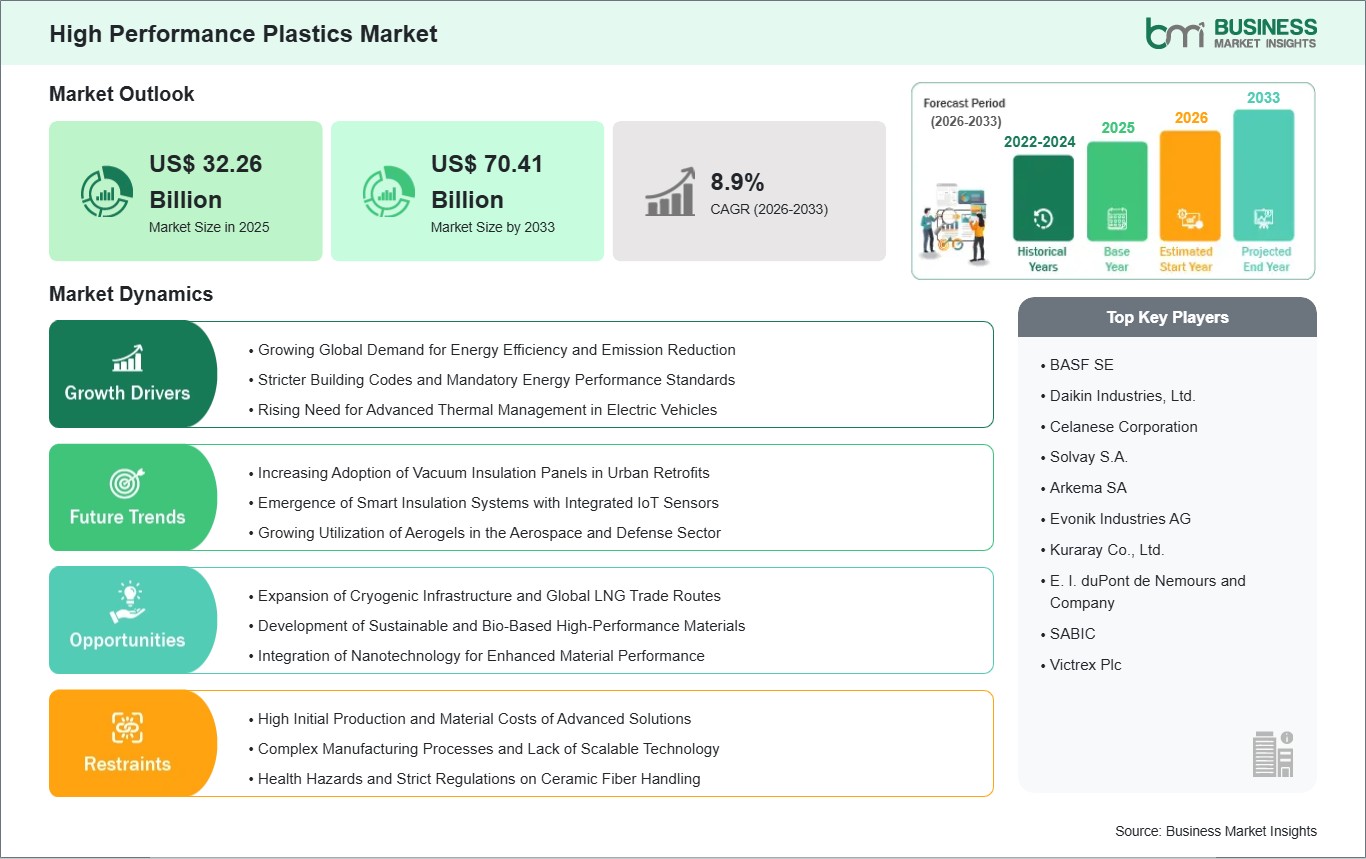
High-performance plastics (HPPs) represent an elite class of polymer materials engineered to maintain exceptional mechanical, chemical, and thermal stability under the most punishing industrial conditions. Unlike standard or engineering-grade plastics, HPPs such as fluoropolymers, polyimides, and liquid crystal polymers are characterized by a continuous service temperature often exceeding 150°C and superior resistance to high-energy radiation and corrosive reagents. These materials act as critical enablers in the "metal-to-plastic" conversion trend, offering a unique combination of high strength-to-weight ratios and design flexibility that traditional alloys cannot match. They are fundamental to the evolution of next-generation hardware, from high-frequency 5G/6G circuit boards and biocompatible surgical implants to ultra-lightweight aerospace structural components and thermal management systems in electric vehicle (EV) batteries.
The market, however, is not without its complexities. The primary restraints include the high price point of raw monomers and the energy-intensive nature of advanced polymerization techniques, which can result in a significantly higher total cost of ownership compared to conventional materials. Furthermore, the specialized processing requirements, such as high-temperature injection molding and complex machining, pose technical barriers to entry for many manufacturers. Regulatory scrutiny regarding the lifecycle environmental impact of certain specialized polymers also necessitates expensive R&D into sustainable alternatives.
Despite these challenges, lucrative opportunities are emerging through the integration of AI in material informatics to accelerate polymer discovery and the rising demand for high-purity materials in semiconductor fabrication. As industries pivot toward decarbonization and miniaturization, high-performance plastics remain at the forefront of the material science revolution.
Segment Analysis
High Performance Plastics Market Segmentation
Key segments that contributed to the derivation of the High Performance Plastics market analysis are type and end-use industry.
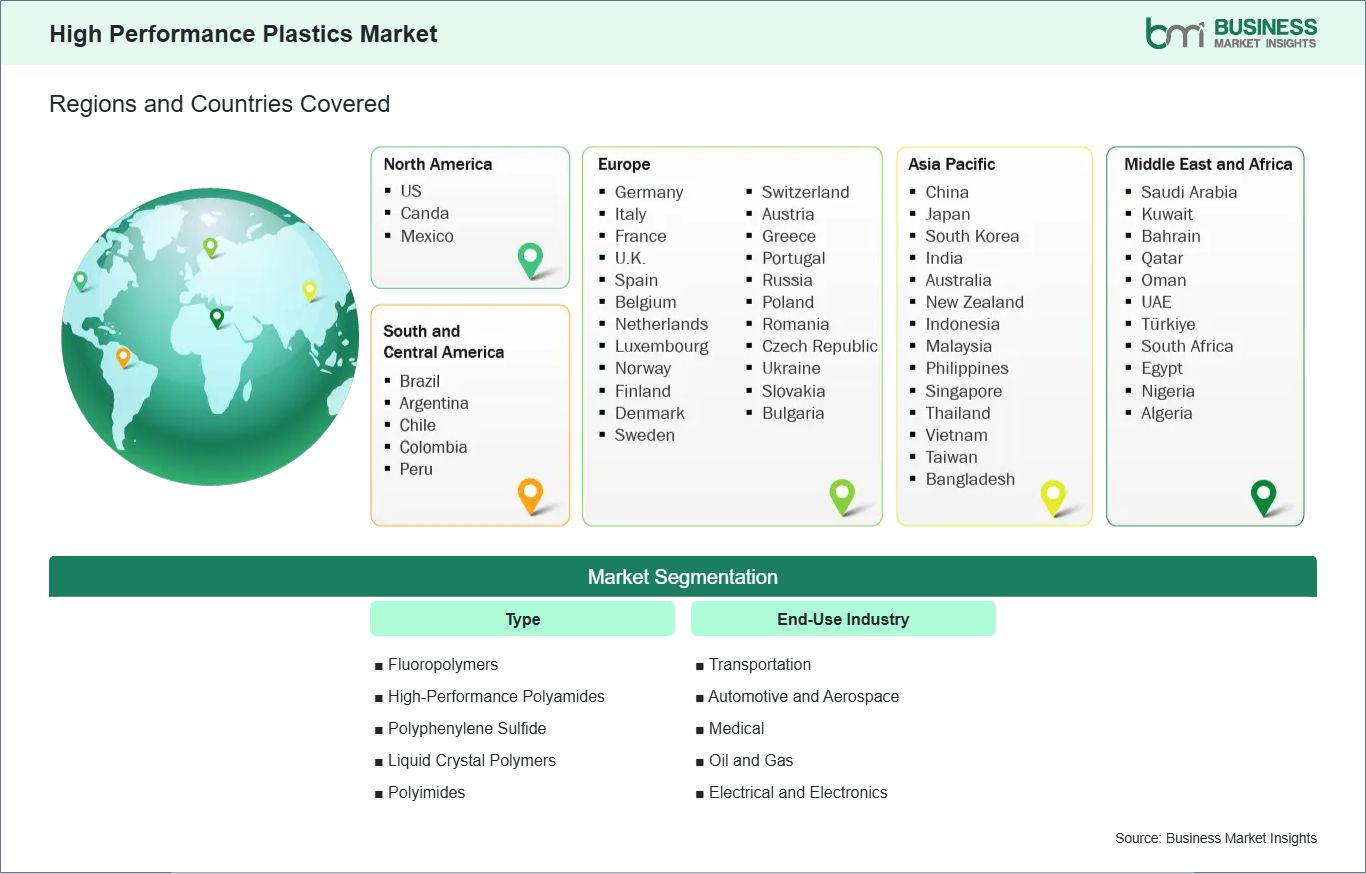
- By Type, the market is segmented into Fluoropolymers, High-Performance Polyamides (HPPA), Polyphenylene Sulfide (PPS), Liquid Crystal Polymers (LCP), and Polyimides.
- By End-Use Industry, the market is categorized into Transportation, Automotive and Aerospace, Medical, Oil and Gas, and Electrical and Electronics.
Market Forces
High Performance Plastics Market Drivers and Opportunities
Aggressive Lightweighting in Aerospace and Automotive Sectors
The primary catalyst propelling the growth of the high-performance plastic market is the intense global focus on structural lightweighting within the transportation sector. As aerospace and automotive manufacturers strive to maximize energy efficiency and comply with rigid environmental standards, they are increasingly replacing traditional metallic components with advanced polymers. High-performance plastics such as polyetheretherketone (PEEK) and carbon-fiber-reinforced composites offer an extraordinary strength-to-weight ratio, allowing for the creation of components that are significantly lighter than their aluminum or titanium counterparts without sacrificing structural integrity.
In the aerospace industry, this transition is critical for next-generation aircraft and urban air mobility vehicles, where every reduction in mass directly translates into extended flight ranges and lower operational costs. Beyond simple weight savings, these plastics provide inherent resistance to fatigue and corrosion, which are common failure points in metal parts subjected to the extreme atmospheric conditions and vibrations of flight. Similarly, the automotive industry utilizes these materials for under-the-hood components and power electronics housings, where they must endure high thermal loads and exposure to aggressive automotive fluids. The move toward electric mobility further amplifies this driver, as reducing the vehicle's base weight is the most effective way to offset the mass of heavy battery packs, thereby enhancing the overall performance and efficiency of the electric powertrain.
Expansion of Biocompatible Polymers in Next-Generation Medical Devices
A major opportunity within the high-performance plastic market lies in the rapidly evolving healthcare landscape, specifically the demand for advanced biocompatible materials. As surgical techniques move toward minimally invasive procedures and personalized medicine, there is an urgent need for polymers that can interface safely with human tissue while offering high mechanical durability. High-performance plastics are uniquely suited for these applications because they can withstand repeated, high-temperature sterilization cycles, such as autoclaving, without undergoing chemical degradation or loss of physical properties.
The rise of additive manufacturing, or 3D printing, has opened a specific avenue for patient-specific implants. Materials like medical-grade PEEK and polyimides are now being used to create custom orthopedic and cranial implants tailored to the exact anatomy of a patient, which significantly improves clinical outcomes and reduces recovery times. Unlike metal implants, these plastics offer radiolucency, allowing surgeons to clearly view surrounding tissue and bone during follow-up imaging without the interference caused by metallic artifacts. Furthermore, the shift toward portable and wearable medical diagnostic devices creates a lucrative niche for lightweight, impact-resistant plastics that protect sensitive internal electronics while remaining comfortable for the user. As healthcare systems in emerging economies modernize, the demand for these high-fidelity, sterilizable materials in everything from robotic surgical instruments to long-term drug delivery systems is expected to surge, representing a sustainable frontier for polymer innovation.
Size and Share Analysis
High Performance Plastics Market Size and Share Analysis
The High Performance Plastics market demonstrates steady growth, with size and share analysis revealing evolving trends and competitive positioning among key players. The report further examines subsegments categorized within type and end-use industry, offering insights into their contribution to overall market performance.
Within the type category, Fluoropolymers sub-segment commands a substantial portion of the market share due to their unrivaled chemical inertness and non-stick properties, which are essential for both industrial chemical processing and high-frequency electronics.
In terms of end-use industry, the Automotive and Aerospace subsegment serves as a primary contributor, where the relentless pursuit of "metal replacement" strategies to enhance energy efficiency ensures a dominant and growing share for high-strength thermoplastic composites.
Report Coverage
High Performance Plastics Market Report Coverage and Deliverables
The "High Performance Plastics Market Size and Forecast (2022 - 2033)" report provides a detailed analysis of the market covering below areas:
- High Performance Plastics market size and forecast at global, regional, and country levels for all the key market segments covered under the scope
- High Performance Plastics market trends, as well as market dynamics such as drivers, restraints, and key opportunities
- High Performance Plastics market analysis covering key market trends, global and regional framework, major players, regulations, and recent market developments
- Industry landscape and competition analysis covering market concentration, heat map analysis, prominent players, and recent developments for the High Performance Plastics market
- Detailed company profiles, including SWOT analysis
Geographic Insights
High Performance Plastics Market Geographic Insights
The geographical scope of the High Performance Plastics market report is divided into five regions: North America, Asia Pacific, Europe, the Middle East & Africa, and South & Central America.
In North America, the market is characterized by a high concentration of research and development in the aerospace and defense sectors, where the demand for advanced, heat-resistant polymers for satellite and next-generation tactical aircraft remains a critical priority. Europe maintains a sophisticated market position through its rigorous focus on sustainable innovation and the "circular economy," leading the way in the development of recyclable high-performance polyamides tailored for the premium automotive industry and specialized medical technologies. The Asia-Pacific region functions as the primary global hub for both manufacturing and consumption, sustained by an expansive electronics production ecosystem and a rapid transition toward large-scale electric vehicle assembly in emerging economies.
In the Middle East & Africa, market activity is predominantly anchored by the oil and gas industry, where high-performance materials are essential for ensuring the integrity of downhole tools and subsea equipment operating under extreme pressure. Meanwhile, South & Central America are experiencing a steady rise in adoption as regional industrial sectors modernize their processing facilities and increasingly integrate advanced polymer solutions into domestic medical and consumer goods manufacturing. This multi-regional expansion ensures a robust and resilient market trajectory as global economies continue to seek out materials that offer superior performance in increasingly demanding environments.
Industry Activity
Recent Developments
The High Performance Plastics market is evaluated by gathering qualitative and quantitative data post-primary and secondary research, which includes important corporate publications, association data, and databases. A few of the key developments in the High Performance Plastics market are:
- In November 2025, Evonik announced the successful trial production of a second polyamide reactor at its Shanghai facility. This milestone paved the way for the company to double its production capacity for long-chain polyamides in Asia, thereby significantly strengthening its market-leading position within the global High Performance Plastic sector. This expansion specifically targeted the increasing demand for advanced materials in the automotive and consumer goods industries.
- In September 2025, Porsche AG and BASF SE, in collaboration with BEST-Bioenergy and Sustainable Technologies GmbH, completed a pilot project focused on recycling mixed waste from end-of-life vehicles. The project demonstrated the effective recyclability of the High Performance Plastic components found within automotive shredder residues (ASR) when processed alongside renewable raw materials. Historically, this complex mixture of plastic, film, paint, and foam residues could only be thermally recycled; however, the pilot proved that these automotive wastes could be recovered through gasification, a specialized form of chemical recycling, and successfully returned to the automotive production cycle.
Trust & Transparency
Research Methodology
The market analysis combines proprietary research with secondary data from government agencies, company disclosures, regulatory filings, industry databases and expert interviews. Market estimates are validated through data triangulation, cross-market benchmarking and analyst
review.
View Full Research Methodology
Key Sources Referred:
World Bank - Global Trade Indicators World Trade Organization (WTO) International Monetary Fund (IMF) International Trade Administration (ITA) Company website Company annual reports Company investor presentations