Market Summary
Executive Summary and Global Market Analysis
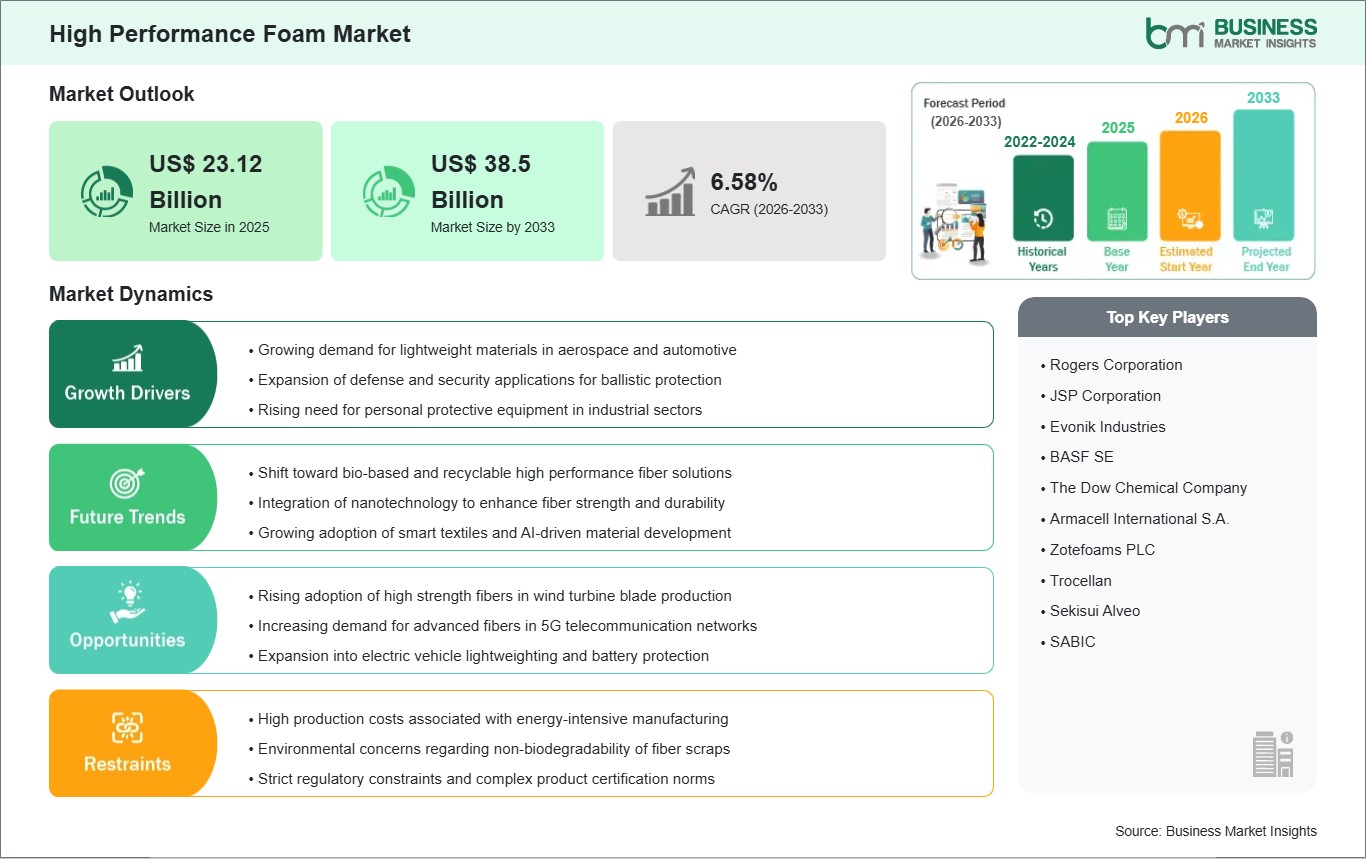
High-performance foams are advanced cellular materials engineered to provide superior mechanical, thermal, and chemical properties compared to standard commodity foams. These technologies deliver significant clinical and economic value by enabling the extreme lightweighting of aerospace structures, offering efficient thermal barriers for electric vehicle (EV) battery packs, and ensuring the protection of delicate microelectronics from both physical impact and heat. Together, they form a critical portfolio that supports high-quality performance outcomes across the transportation, electronics, construction, and healthcare sectors. Market expansion is primarily attributed to the rising global demand for energy-efficient insulation, the rapid electrification of the automotive industry, and the increasing miniaturization of consumer devices. In addition, digital manufacturing and 3D-printing technologies are making it possible to create custom, complex lattice structures with different densities in specific areas, which is making processes much more efficient.
However, several challenges can restrain market growth: high initial procurement and processing costs, particularly for specialty materials like silicone and PMI (polymethacrylimide) foams, can limit adoption in high-volume, cost-sensitive consumer segments. Stringent regulatory hurdles, especially around certain blowing agents and volatile organic compound emissions, lengthen time-to-market for new formulations and increase compliance costs. The industry also faces constraints from technical complexities in material recycling, as the cross-linked nature of many high-performance thermoset foams makes them difficult to reprocess and conflicts with the global emphasis on circular economy mandates.
Despite these hurdles, the market holds immense opportunities in the universal mandate for sustainable and bio-based materials and the accelerating deployment of mycelium-based and CO2-derived foams. The expansion of medical-grade foams for advanced wound care and surgical positioning and the development of smart, phase-change foams that can actively regulate temperature in aerospace and electronics applications are expected to create significant opportunities for market growth.
Segment Analysis
High Performance Foam Market Segmentation
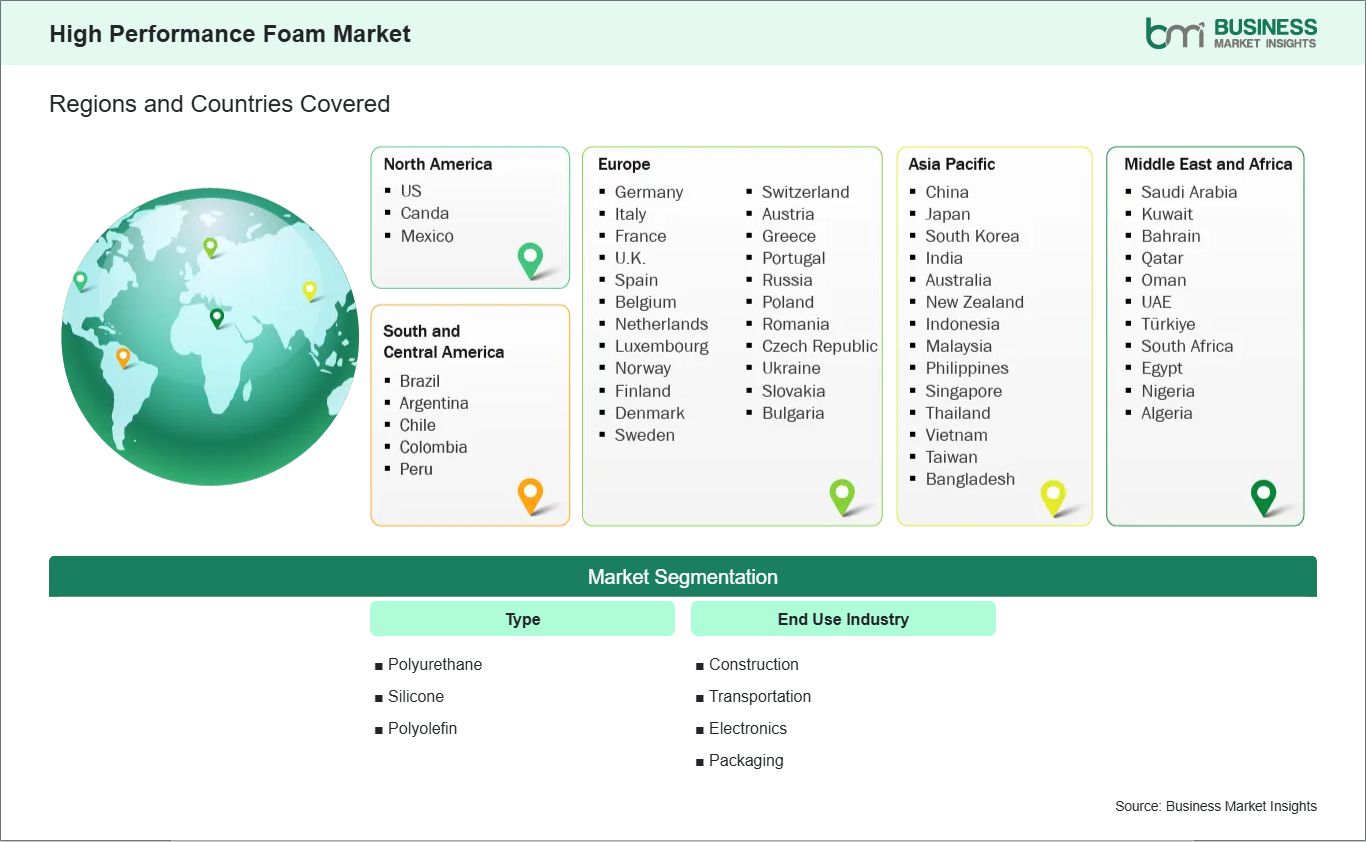
Key segments that contributed to the derivation of the High Performance Foam market analysis are type and end use industry.
- By Type, the market is segmented into Polyurethane, Silicone, and Polyolefin.
- By End Use Industry, the market is divided into Construction, Transportation, Electronics, and Packaging.
Market Forces
High Performance Foam Market Drivers and Opportunities
Advancing Industrial Efficiency and Global Safety Mandates
The primary driver for the High-Performance Foam Market is the growing global demand for materials that offer superior thermal insulation, acoustic dampening, and impact resistance without adding much mass. In the aerospace and automotive sectors, the push for "mass decompression" to improve fuel efficiency and battery range has made high-performance foams like polyetherimide (PEI) and specialized polyurethanes essential. These materials help manufacturers meet strict lightweighting targets and enhance passenger safety through advanced energy absorption.
Demand is also rising as the construction industry quickly shifts toward "Green Building" standards. To meet new energy codes such as the International Building Code (IBC) and net-zero goals, architects are specifying high-performance rigid foams for building envelopes to reduce thermal bridging. These cross-industry needs for energy conservation and structural integrity support steady growth, making high-performance foams a key part of modern industrial design and sustainable infrastructure.
Digital Material Discovery and Circular Economy Transition
Integrating AI-driven material informatics and digital twin technology into foam production represents a significant opportunity for value creation. Machine learning enables the simulation of cellular structures and the prediction of material behavior under extreme conditions, thereby reducing research and development timelines for customized, high-temperature, or chemical-resistant foam grades. The industry is seeing strong growth in the use of bio-based polyols and fully recyclable thermoplastic foams. With increasing pressure from regulations and the market to cut microplastics and lower Scope 3 emissions, making foams from renewable sources like soy, castor oil, or CO2-capture technology is becoming a compelling way for companies to stand out.
The expansion of cold chain logistics and medical packaging sectors presents significant potential for specialized foams engineered to deliver enhanced moisture resistance and temperature stability during the transportation of biologics and pharmaceuticals . Companies that pioneer modular, prefabricated foam insulation kits and those leading in "closed-loop" recycling programs are positioned to capture the highest-margin segments in an increasingly sustainability-focused global landscape.
Size and Share Analysis
High Performance Foam Market Size and Share Analysis
The High Performance Foam market demonstrates steady growth, with size and share analysis revealing evolving trends and competitive positioning among key players. The report further examines subsegments categorized within type and end use industry, offering insights into their contribution to overall market performance.
Based on type, the Polyurethane subsegment holds a significant market share. Polyurethane foams are indispensable for the Construction and Transportation sectors due to their unmatched versatility in both rigid and flexible forms. A notable trend in 2026 is the adoption of AI-driven "molecular modeling" to create hyper-dense closed-cell PU foams that achieve superior R-values for cryo-insulation and cold-chain logistics. These innovations are particularly vital in the renovation of legacy buildings to meet zero-emission standards, where they provide high-performance thermal barriers with minimal thickness.
Report Coverage
High Performance Foam Market Report Coverage and Deliverables
The "High Performance Foam Market Size and Forecast (2022 - 2033)" report provides a detailed analysis of the market covering below areas:
- High Performance Foam market size and forecast at global, regional, and country levels for all the key market segments covered under the scope
- High Performance Foam market trends, as well as market dynamics such as drivers, restraints, and key opportunities
- High Performance Foam market analysis covering key market trends, global and regional framework, major players, regulations, and recent market developments
- Industry landscape and competition analysis covering market concentration, heat map analysis, prominent players, and recent developments for the High Performance Foam market
- Detailed company profiles, including SWOT analysis
Geographic Insights
High Performance Foam Market Geographic Insights
The geographical scope of the High Performance Foam market report is divided into five regions: North America, Asia Pacific, Europe, Middle East &Africa, and South &Central America.
The Asia-Pacific High Performance Foam Market is segmented into China, Japan, South Korea, India, Australia, New Zealand, Indonesia, Malaysia, the Philippines, Singapore, Thailand, Vietnam, Taiwan, Bangladesh, and the Rest of Asia. The market is primarily fueled by rapid industrialization and the presence of major electronics OEMs. China is the leading contributor, supported by its status as the world's largest producer of appliances and vehicles. India is emerging as a high-growth center driven by government initiatives like "Smart Cities" and the expansion of domestic civil aviation and automotive manufacturing.
Growth is further bolstered by a global shift toward specialty polymer foams, such as silicone and polyolefin foams, which offer superior thermal stability and energy absorption. The increasing adoption of electric vehicles (EVs), requiring lightweight battery-pack insulation, and the rapid build-out of cold-chain logistics for pharmaceuticals solidify Asia-Pacific as a central driver for innovation and the future scaling of the high performance foam industry.
Industry Activity
Recent Developments
The High Performance Foam market is evaluated by gathering qualitative and quantitative data post primary and secondary research, which includes important corporate publications, association data, and databases. A few of the key developments in the High Performance Foam market are:
- In September 2025, DSC®, a global leader in high performance foam innovation, announced the launch of DURAPONTEX® L-TAC, a next-generation foam technology that redefines sustainable footwear manufacturing. Engineered to mold at significantly lower temperatures, L-TAC not only reduces energy usage and carbon emissions per pair, but also expands design freedom for brands by enabling compatibility with a broader range of textiles.
- In August 2025, Zotefoams entered into a joint venture with Seoheung Co. Ltd. to support the construction and commissioning of a new high-performance foam manufacturing facility in Vietnam. The collaboration enables Zotefoams to expand beyond traditional foam sheets into 3D foam preforms for athletic footwear applications, leveraging its expertise in supercritical foams and Seoheung's regional manufacturing capabilities. This strategic partnership strengthens Zotefoams' production footprint in Asia and supports the growing demand for advanced, lightweight foam solutions in footwear manufacturing.
Trust & Transparency
Research Methodology
The market analysis combines proprietary research with secondary data from government agencies, company disclosures, regulatory filings, industry databases and expert interviews. Market estimates are validated through data triangulation, cross-market benchmarking and analyst
review.
View Full Research Methodology
Key Sources Referred:
World Bank - Global Trade IndicatorsWorld Trade Organization (WTO)International Monetary Fund (IMF)International Trade Administration (ITA)Company websiteCompany annual reportsCompany investor presentations