
Spherical Alumina Market Outlook: Size, Share, Trends, Growth Analysis, Competitive Landscape & Forecast, 2026-2033

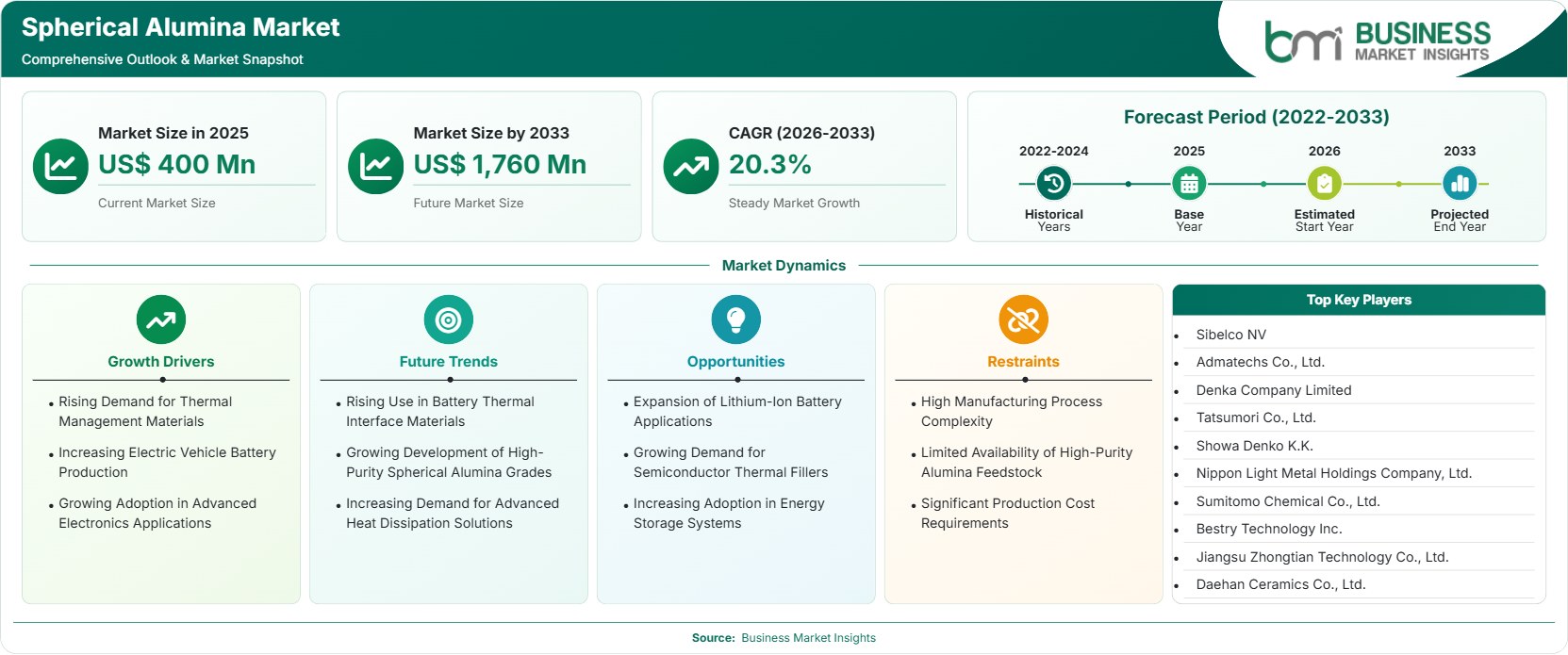
The Spherical Alumina Market size was valued at US$ 0.40 Billion in 2025 and is projected to reach US$ 1.76 Billion by 2033, growing at a CAGR of 20.3% during 2026–2033. Rising demand for thermal management materials, increasing electric vehicle battery production, and expanding adoption across advanced electronics are driving market growth, while lithium-ion batteries, semiconductor thermal fillers, and energy storage systems continue creating significant long-term opportunities.

Report Coverage
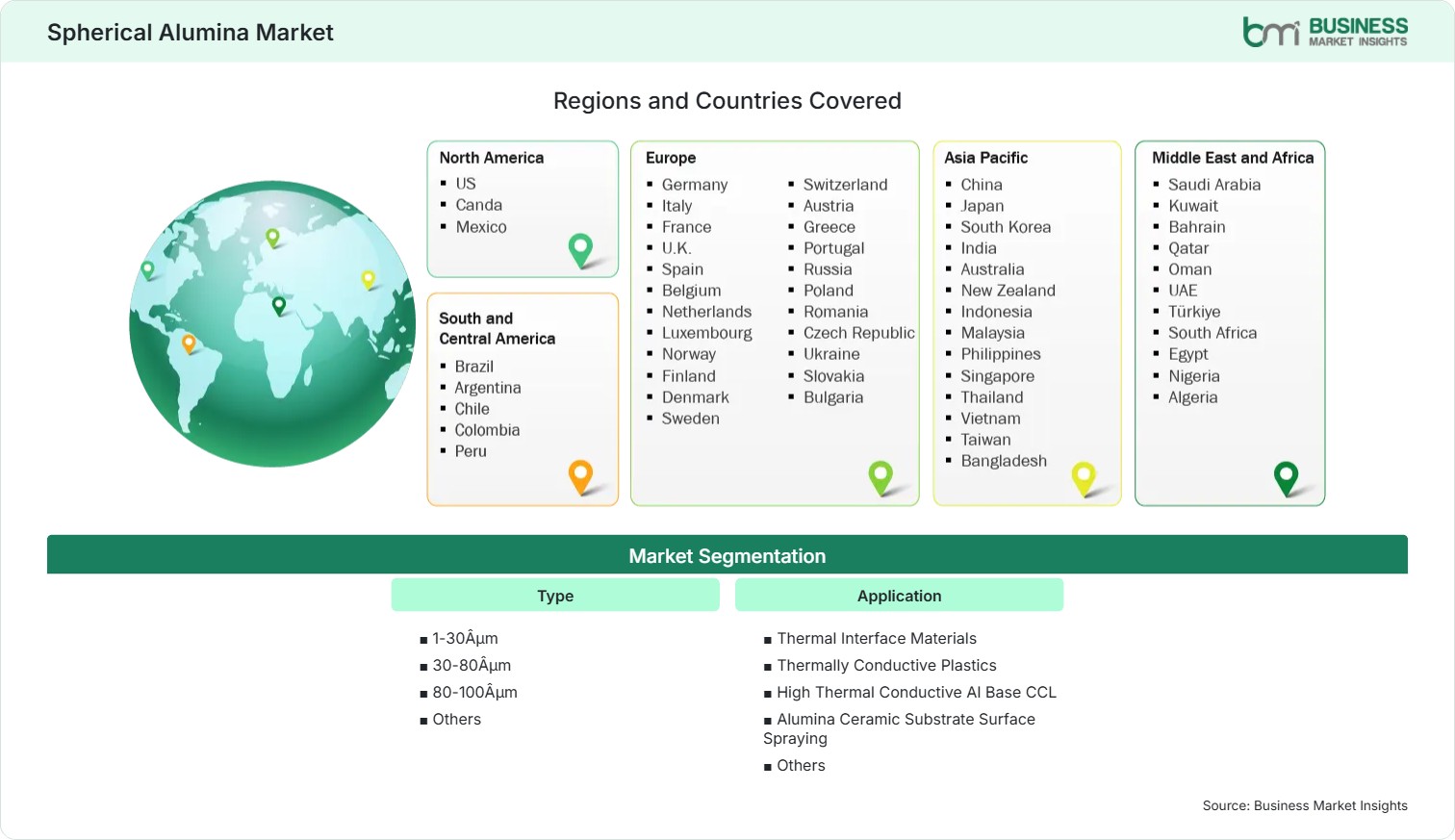
  • Type: 1-30µm, 30-80µm, 80-100µm, Others
  • Application: Thermal Interface Materials, Thermally Conductive Plastics, High Thermal Conductive AI Base CCL, Alumina Ceramic Substrate Surface Spraying, Others
US$ 400 Mn Market size in 2025
US$ 1,760 Mn Market Size by 2033
20.3% CAGR, 2026 - 2033
2026-2033 Forecast Period

01 AI Overview

Spherical Alumina Market Summary

  • North America Region: North America holds a market share of 20%–23% in 2025 and is projected to grow at a CAGR of 19.4%–19.9% during 2026–2033, supported by expanding semiconductor manufacturing, electric vehicle investments, and growing adoption of advanced thermal management materials. The U.S. market is expected to expand at a CAGR of 19.6%–20.1%, driven by increasing demand for high-performance electronics and battery technologies.
  • Fastest Growing Region: Asia Pacific accounts for 56%–59% of the market in 2025 and is expected to register a CAGR of 21.0%–21.5% through 2026–2033, supported by strong semiconductor manufacturing, EV battery production, and electronics manufacturing across China, Japan, South Korea, and Taiwan.
  • Leading Segment: 1–30 µm accounts for 38%–41% of market revenue in 2025 while growing at a CAGR of 20.5%–21.0%, driven by its extensive utilization in thermal interface materials and semiconductor packaging applications.
  • High Growth Segment: Thermal Interface Materials hold 36%–39% of the market in 2025 and are anticipated to expand at a CAGR of 20.8%–21.3%, supported by increasing demand for efficient heat dissipation in EV batteries, power electronics, and advanced semiconductor devices.
  • Key Market Opportunity: Rapid expansion of lithium-ion battery manufacturing, advanced semiconductor packaging, and next-generation energy storage systems continues creating substantial growth opportunities for spherical alumina manufacturers.
  • Major Market Players: Sibelco NV, Admatechs Co., Ltd., Denka Company Limited, Tatsumori Co., Ltd., Showa Denko K.K., Nippon Light Metal Holdings Company, Ltd., Sumitomo Chemical Co., Ltd., Bestry Technology Inc., Jiangsu Zhongtian Technology Co., Ltd., Daehan Ceramics Co., Ltd.
02 Strategic Insights

Spherical Alumina Market: Strategic Insights

spherical-alumina-market-market-strategic-framework
FREE PDF
Request your free sample
Request free sample
03 Stakeholder View

Key Takeaways

  • Expanding EV battery manufacturing and advanced semiconductor packaging continue representing the strongest long-term demand drivers for spherical alumina.
  • Thermal interface materials remain the largest application owing to increasing heat dissipation requirements in high-performance electronic devices.
  • Manufacturers continue investing in ultra-high-purity spherical alumina production technologies to support next-generation electronics and battery applications.
  • Asia Pacific remains the dominant regional market due to its integrated semiconductor ecosystem, electronics manufacturing, and battery production capacity.
  • Strategic investments in production capacity expansion, material purity improvement, and advanced particle engineering continue strengthening competitive positioning among leading manufacturers.
04 Geographic Outlook

Spherical Alumina Market Regional Highlights

North America Spherical Alumina Market

North America accounted for 20%–23% of the global market in 2025 and is projected to expand at a CAGR of 19.4%–19.9% during 2026–2033. Strong investments in semiconductor fabrication, electric vehicle battery production, and high-performance electronics continue supporting regional growth. The Spherical Alumina Market share remains significant due to increasing demand for advanced thermal management materials across electronics, automotive, aerospace, and energy storage industries.

  • The United States continues leading regional demand through expanding semiconductor manufacturing, electric vehicle production, and AI computing infrastructure investments.
  • Battery manufacturers increasingly utilize spherical alumina in thermal interface materials to improve heat dissipation and enhance battery safety.
  • Growing investments in advanced packaging technologies continue driving demand for ultra-high-purity thermal filler materials.
  • Electronics manufacturers continue adopting spherical alumina to improve thermal conductivity and electrical insulation in high-performance devices.
  • Manufacturers continue investing in advanced material processing technologies to improve product purity and particle uniformity.

US Spherical Alumina Market

The United States represented 17%–19% of the global market in 2025 and is anticipated to grow at a CAGR of 19.6%–20.1% through 2026–2033. Expanding domestic semiconductor manufacturing, battery production, and advanced electronics industries continue driving Spherical Alumina Market growth while increasing adoption of premium thermal interface materials.

  • Semiconductor manufacturing investments continue strengthening demand for high-purity spherical alumina used in advanced chip packaging.
  • Electric vehicle battery manufacturers increasingly adopt spherical alumina to improve thermal conductivity and battery reliability.
  • AI data centers and high-performance computing applications continue supporting demand for advanced thermal management materials.
  • Government support for domestic semiconductor and battery manufacturing further accelerates market expansion.

Europe Spherical Alumina Market

Europe held 18%–21% of global revenue in 2025 and is expected to register a CAGR of 19.5%–20.0% during 2026–2033. Regional growth is supported by expanding electric vehicle manufacturing, renewable energy investments, and increasing semiconductor research activities. Germany remains the leading regional market, while Poland is projected to register the fastest growth.

  • Germany dominates regional demand through its strong automotive, battery manufacturing, and industrial electronics sectors.
  • Poland is projected to register a CAGR of 20.3%–20.8%, supported by increasing electronics manufacturing and battery supply chain investments.
  • France and the Netherlands continue expanding utilization of thermal management materials across industrial electronics and renewable energy applications.
  • Sustainability initiatives continue encouraging development of advanced materials supporting energy-efficient electronic systems.
  • Increasing investments in EV battery production continue strengthening regional demand for spherical alumina.

Asia Pacific Spherical Alumina Market

Asia Pacific accounted for 56%–59% of global market revenue in 2025 and is projected to register the fastest CAGR of 21.0%–21.5% during 2026–2033. The region benefits from large-scale semiconductor manufacturing, electric vehicle battery production, electronics exports, and advanced materials innovation. China remains the largest regional market, while India is projected to witness the fastest growth.

  • China dominates regional demand owing to its extensive lithium-ion battery manufacturing ecosystem and semiconductor production capacity.
  • India is projected to register a CAGR of 21.6%–22.1%, supported by expanding electronics manufacturing, government semiconductor initiatives, and EV production investments.
  • Japan and South Korea continue leading innovation in advanced ceramic materials and semiconductor packaging technologies.
  • Taiwan remains a major consumer through its world-leading semiconductor fabrication industry.
  • Manufacturers continue expanding production capacity across Asia Pacific to meet increasing global demand for high-purity spherical alumina.

Rest of World Spherical Alumina Market

The Rest of the World accounted for 3%–5% of global market revenue in 2025 and is expected to expand at a CAGR of 18.7%–19.2% during 2026–2033. Market growth is supported by increasing renewable energy investments, expanding battery manufacturing activities, and industrial diversification across the Middle East and South America.

Growing adoption of energy storage systems, electric mobility, and advanced industrial electronics continues creating opportunities for spherical alumina manufacturers seeking expansion into emerging markets.

  • Brazil continues increasing adoption of advanced thermal materials through expanding electronics and renewable energy industries.
  • Saudi Arabia supports market growth through industrial diversification and investments in advanced manufacturing.
  • The United Arab Emirates continues strengthening electronics manufacturing and energy storage infrastructure.
  • Emerging battery manufacturing projects across developing economies continue supporting long-term demand.
  • Increasing localization of advanced materials production creates new opportunities for global spherical alumina suppliers.
global-market-geography
FREE PDF
Request your free sample
Request free sample
05 Segment Analysis

Spherical Alumina Market Segmentation

Type

The 1–30 µm segment accounted for 38%–41% of the market in 2025 and is projected to expand at a CAGR of 20.5%–21.0% during 2026–2034. Fine particle size, high packing density, superior thermal conductivity, and excellent dispersion characteristics continue driving demand across thermal interface materials, semiconductor packaging, and electronic encapsulation applications. The Spherical Alumina Market scope continues expanding as manufacturers develop ultra-high-purity spherical alumina powders capable of meeting increasingly stringent thermal management requirements.

  • 1–30 µm: This segment dominates the market owing to its widespread utilization in thermal interface materials, semiconductor packaging compounds, and electronic adhesives requiring high thermal conductivity and electrical insulation.
  • 30–80 µm: Medium-sized spherical alumina particles continue witnessing strong demand in thermally conductive plastics, electronic encapsulation, and advanced polymer composites where balanced thermal performance and mechanical strength are required.
  • 80–100 µm: Larger particle grades are increasingly utilized in ceramic substrates, surface spraying, and specialized industrial thermal management applications requiring enhanced packing density and wear resistance.
  • Others: Other particle size grades serve customized industrial applications including aerospace components, advanced ceramics, specialty coatings, and next-generation electronic materials.

Application

The Thermal Interface Materials segment accounted for 36%–39% of global revenue in 2025 and is projected to register the fastest CAGR of 20.8%–21.3% during 2026–2034. Increasing heat generation in electric vehicle batteries, AI processors, semiconductor devices, and power electronics continues driving strong demand for highly efficient thermal interface materials utilizing spherical alumina as a premium thermally conductive filler.

  • Thermal Interface Materials: This segment remains the largest application owing to increasing deployment in EV battery packs, CPUs, GPUs, semiconductor modules, telecommunications equipment, and industrial electronics requiring efficient heat dissipation.
  • Thermally Conductive Plastics: Spherical alumina is extensively utilized in engineering plastics to improve thermal conductivity while maintaining electrical insulation across automotive electronics and consumer devices.
  • High Thermal Conductive Al Base CCL: Copper clad laminates increasingly utilize spherical alumina fillers to improve thermal conductivity and electrical reliability in printed circuit board manufacturing.
  • Alumina Ceramic Substrate Surface Spraying: Advanced ceramic coatings and substrate spraying applications continue adopting spherical alumina to improve thermal resistance, surface durability, and insulation performance.
  • Others: Other applications include LED packaging, electronic adhesives, potting compounds, encapsulation materials, aerospace electronics, industrial sensors, and renewable energy systems.
06 Market Forces

Spherical Alumina Market Dynamics

Key Market Drivers

Rising Demand for Thermal Management Materials

The increasing power density of electric vehicles, AI processors, high-performance computing systems, and advanced consumer electronics continues driving demand for efficient thermal management materials. Spherical alumina offers superior thermal conductivity, excellent electrical insulation, high purity, and uniform particle morphology, making it an ideal filler for thermal interface materials and thermally conductive polymers. These developments continue supporting market growth, while evolving Spherical Alumina Market trends indicate growing investments in advanced thermal management technologies for next-generation electronic devices.

Increasing Electric Vehicle Battery Production

Rapid expansion of global electric vehicle manufacturing is significantly increasing demand for spherical alumina used in battery thermal interface materials, insulating fillers, battery modules, and power electronics. Effective thermal management plays a critical role in improving battery safety, charging efficiency, lifespan, and overall vehicle performance. Continuous investments in lithium-ion battery gigafactories worldwide continue strengthening long-term market demand.

Growing Adoption in Advanced Electronics Applications

Semiconductor packaging, AI computing, telecommunications equipment, LED lighting, and high-performance consumer electronics increasingly require advanced thermally conductive materials capable of dissipating heat efficiently while maintaining electrical insulation. Spherical alumina enables manufacturers to improve device reliability, operational efficiency, and miniaturization, making it an essential material for advanced electronics manufacturing.

Key Market Opportunities

Expansion of Lithium-Ion Battery Applications

The rapid expansion of lithium-ion battery manufacturing for electric vehicles, energy storage systems, and consumer electronics is creating significant opportunities for spherical alumina manufacturers. Spherical alumina is increasingly utilized in battery thermal interface materials, insulating fillers, and battery modules to enhance heat dissipation, improve operational safety, and extend battery lifespan. Favorable Spherical Alumina Market Forecasts continue encouraging manufacturers to expand production capacity and develop ultra-high-purity spherical alumina grades capable of meeting the demanding thermal management requirements of next-generation battery technologies.

Growing Demand for Semiconductor Thermal Fillers

The increasing complexity and power density of semiconductor devices, AI processors, advanced packaging technologies, and high-performance computing systems are accelerating demand for high-performance thermal fillers. Spherical alumina provides excellent thermal conductivity, electrical insulation, and uniform particle morphology, making it an ideal material for semiconductor encapsulation, underfill compounds, and thermal interface materials. Expanding global investments in semiconductor fabrication and advanced chip packaging continue creating long-term growth opportunities for specialty ceramic material manufacturers.

Increasing Adoption in Energy Storage Systems

Growing deployment of renewable energy storage systems, grid-scale batteries, industrial energy storage, and residential backup power solutions is increasing demand for advanced thermal management materials. Spherical alumina enables efficient heat transfer while maintaining electrical insulation, improving battery safety, operational stability, and system reliability. Continuous investments in clean energy infrastructure and energy storage technologies continue supporting wider adoption of spherical alumina across diverse energy applications.

Market Restraints and Challenges

High Manufacturing Process Complexity

Factor: Manufacturing high-quality spherical alumina requires sophisticated production technologies, precision particle spheroidization processes, strict purity control, and advanced classification systems to achieve consistent particle morphology and thermal performance. Complex manufacturing processes increase production costs, capital investment requirements, and technical barriers for new entrants, limiting overall market expansion. Consequently, manufacturers continue investing in advanced processing technologies and production optimization to improve manufacturing efficiency and product quality.

Limited Availability of High-Purity Alumina Feedstock

Factor: Production of premium spherical alumina depends on the consistent availability of high-purity alumina feedstock with extremely low impurity levels. Supply constraints, raw material quality variations, and increasing global demand for high-purity alumina can create sourcing challenges for manufacturers. Feedstock limitations increase production costs, create supply chain uncertainties, and may restrict manufacturing capacity expansion, encouraging companies to diversify raw material sourcing, improve purification technologies, and establish long-term supply agreements to ensure stable production.

07 Company Analysis

Competitive Landscape

The competitive landscape is characterized by continuous investments in ultra-high-purity alumina production, particle engineering technologies, capacity expansion, and advanced thermal management materials. The Spherical Alumina Market analysis indicates that leading manufacturers are strengthening their positions through technological innovation, strategic partnerships, and production expansion to meet the rapidly increasing demand from electric vehicles, semiconductor packaging, AI computing, and energy storage industries.

Company Name

Overview

Products and Services Relevant to this Market

Sibelco NV

Global minerals company specializing in industrial minerals and advanced material solutions.

Spherical alumina, specialty alumina materials, ceramic fillers, industrial minerals, and thermal management materials.

Admatechs Co., Ltd.

Japanese advanced materials manufacturer specializing in high-performance ceramic powders.

High-purity spherical alumina, ceramic fillers, thermal conductive materials, and electronic packaging powders.

Denka Company Limited

Global chemical manufacturer serving electronics, semiconductor, and advanced materials industries.

Spherical alumina, electronic materials, ceramic fillers, semiconductor packaging materials, and specialty chemicals.

Tatsumori Co., Ltd.

Manufacturer of precision ceramic powders and advanced functional materials.

Spherical alumina powders, ceramic materials, thermal fillers, and electronic material solutions.

Showa Denko K.K.

Leading producer of advanced functional materials for semiconductor and electronics industries.

High-purity alumina, spherical alumina, electronic materials, semiconductor materials, and advanced ceramics.

Nippon Light Metal Holdings Company, Ltd.

Diversified aluminum manufacturer producing advanced alumina and specialty materials.

High-purity alumina, specialty alumina powders, thermal conductive fillers, and advanced ceramic materials.

Sumitomo Chemical Co., Ltd.

Global chemical company supplying specialty materials for electronics and automotive industries.

Electronic materials, advanced ceramics, specialty chemicals, thermal interface materials, and battery materials.

Bestry Technology Inc.

Advanced materials company focused on high-performance thermal conductive fillers.

Spherical alumina, thermal conductive fillers, electronic packaging materials, and battery thermal management materials.

Jiangsu Zhongtian Technology Co., Ltd.

Manufacturer of advanced industrial materials supporting electronics and energy applications.

Spherical alumina, specialty ceramic powders, industrial materials, and thermal conductive products.

Daehan Ceramics Co., Ltd.

South Korean manufacturer specializing in advanced ceramic materials.

High-purity alumina powders, spherical alumina, ceramic fillers, and electronic ceramic materials.

08 Industry Activity

Recent Developments

June 2026

Sasol International Chemicals announced a US$ 70.2 million investment at its Brunsbuttel site to expand its advanced materials and specialty chemicals capabilities, reinforcing the company’s position as a supplier of high-performance aluminas and related specialty materials.

May 2026

Sumitomo Chemical Co., Ltd. launched the ELA series of low alpha radiation, high-purity fine spherical alumina products through its subsidiary Dongwoo Fine-Chem Co., Ltd., targeting advanced semiconductor encapsulation applications requiring improved heat dissipation and reliability.

October 2025

Resonac Corporation decided to further decarbonize its ammonia business at the Kawasaki Plant by using only hydrogen derived from used plastics as feedstock for ammonia production.

May 2025

Denka Company Limited announced expansion of production capacity for spherical alumina and other advanced electronic materials to support growing demand from AI semiconductor applications, thermal conductive molding compounds, and next-generation electronic packaging solutions.

10 Trust & Transparency

Research Methodology

The market analysis combines proprietary research with secondary data from government agencies, company disclosures, regulatory filings, industry databases and expert interviews. Market estimates are validated through data triangulation, cross-market benchmarking and analyst review.

View Full Research Methodology

11 Questions Answered

Frequently Asked Questions

Why is the Spherical Alumina Market Report valuable for stakeholders?

The Market Report provides detailed insights into market size, technological trends, competitive landscape, regional analysis, growth opportunities, and strategic developments, enabling stakeholders to make informed investment and business decisions.

Which application is expected to witness the fastest growth?

Thermal Interface Materials (TIMs) are expected to witness the fastest growth due to increasing heat management requirements in EV batteries, AI processors, high-performance computing systems, and advanced semiconductor devices.

Which type holds the largest market share?

The 1–30 µm segment holds the largest market share owing to its superior thermal conductivity, excellent dispersion characteristics, and extensive use in thermal interface materials and semiconductor packaging.

Which region dominates the Spherical Alumina Market?

Asia Pacific dominates the market due to its strong semiconductor manufacturing base, expanding EV battery production, advanced electronics industry, and extensive investments in high-performance materials.

What is driving the Market?

The market is driven by rising demand for thermal management materials, expanding electric vehicle battery production, increasing semiconductor manufacturing, and growing adoption of advanced electronic devices requiring efficient heat dissipation.

Access the Full Spherical Alumina Market Report

Get segment-level forecasts, regional estimates, competitive benchmarking, company profiles and downloadable Excel datasets.

Access the full Spherical Alumina Market Report
350 pages PDF & Excel | 2026-07-28