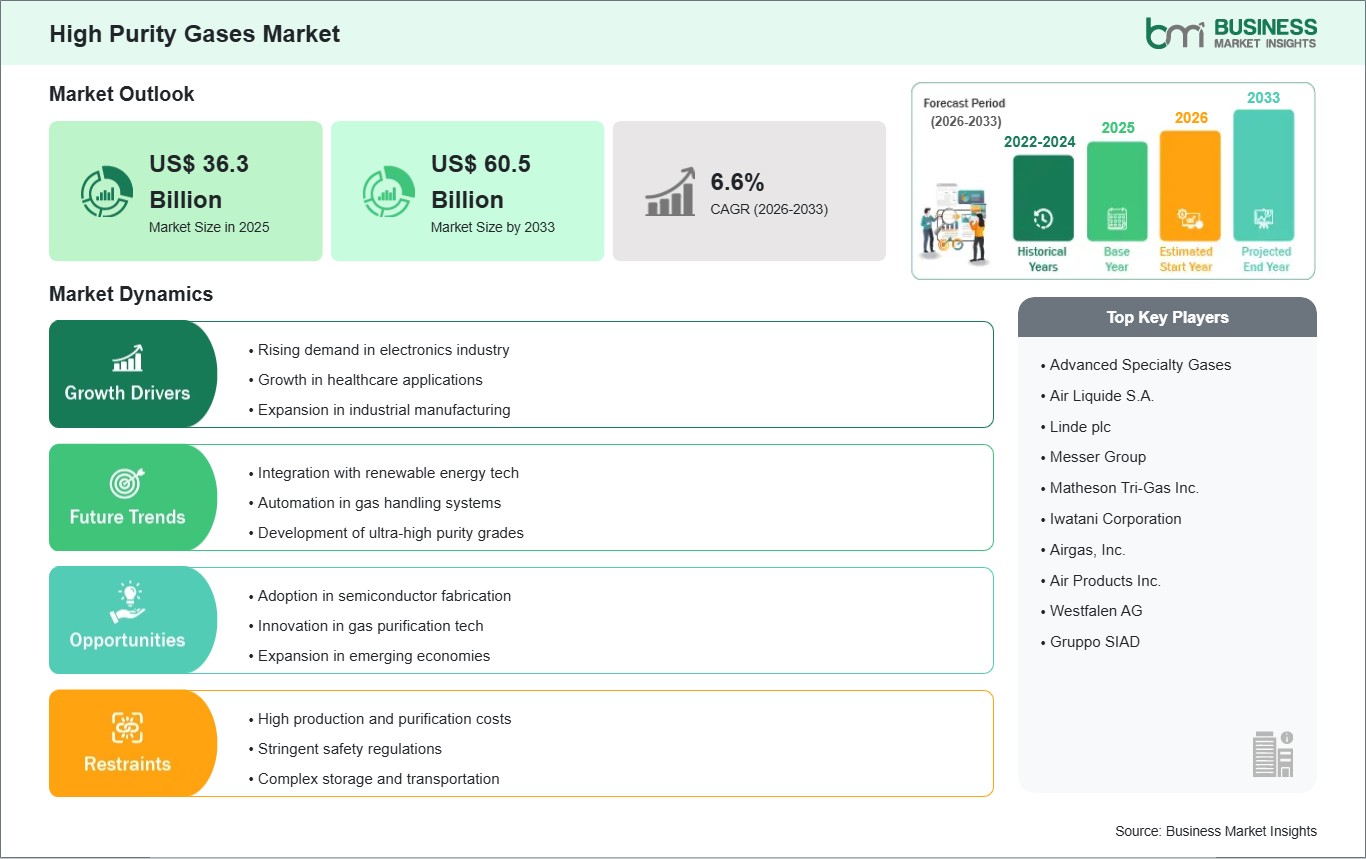
The High Purity Gases Market size is expected to reach US$ 60.5 billion by 2033 from US$ 36.3 billion in 2025. The market is estimated to record a CAGR of 6.6% from 2026 to 2033.
High-purity gases encompass atmospheric gases such as nitrogen and oxygen, noble gases including argon and neon, and a range of specialty gases engineered for advanced industrial applications. These gases are essential across sectors where precision, reliability, and contamination control are non-negotiable — including semiconductor manufacturing, medical diagnostics, aerospace, and emerging clean-energy technologies such as hydrogen fuel cells.
The market, however, continues to navigate several structural challenges. Producing ultra-high-purity gases demands sophisticated and capital-intensive technologies such as cryogenic distillation, pressure swing adsorption (PSA), and membrane-based separation. Supply constraints for noble gases, particularly helium and neon, heighten exposure to pricing volatility and geopolitical risks. At the same time, stringent regulatory requirements increase safety and compliance costs, while the energy-intensive nature of gas purification raises environmental and sustainability concerns.
Despite these headwinds, the sector is poised for strong growth. The accelerating expansion of semiconductor fabrication — fueled by rising demand for consumer electronics and supported by initiatives such as the U.S. CHIPS Act — is driving sustained consumption of ultra-pure gases. Concurrently, the global shift toward clean energy and the rapid development of the green hydrogen economy are unlocking new opportunities for suppliers invested in advanced purification techniques and low-carbon production methods. Companies that innovate in on-site generation solutions and customized gas formulations will be well-positioned to capture value in this evolving landscape.

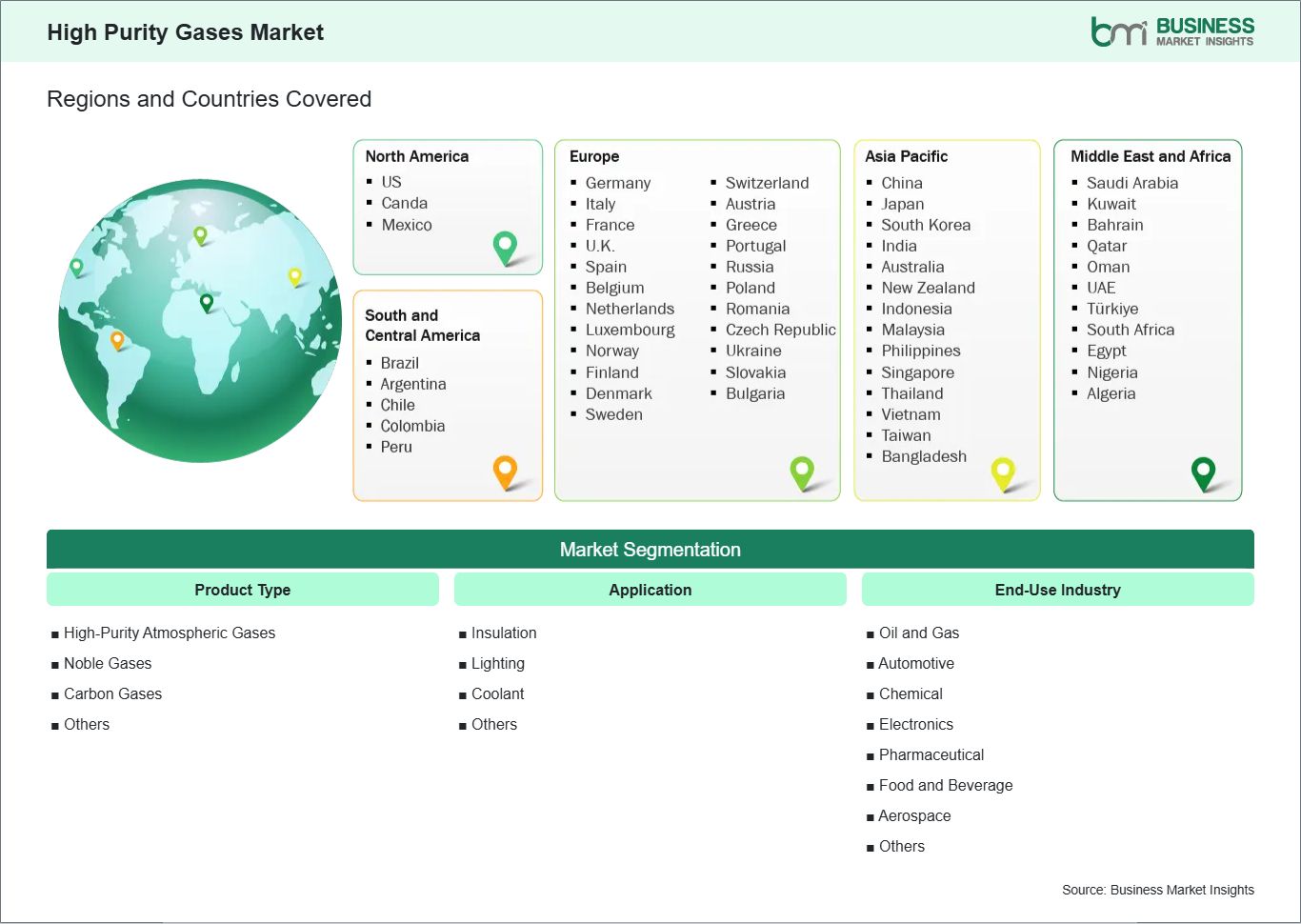
Key segments that contributed to the derivation of the High Purity Gases market analysis are product type, application, and end-use industry.
The continued miniaturization and increasing functional complexity of semiconductor chips are driving a sharp rise in demand for ultra-high-purity (UHP) gases, particularly nitrogen and fluorine-chlorine–based process gases. As chip geometries shrink and device architectures become more intricate, even trace contaminants can compromise yield and reliability. This makes UHP gases essential for critical steps such as etching, cleaning, deposition, and inerting within advanced fabrication environments. The growing adoption of technologies like EUV lithography, 3D NAND, and gate-all-around (GAA) transistors further amplifies the need for gases with extremely stringent purity specifications.
Government-led semiconductor revitalization programs are reinforcing this demand. Initiatives such as the U.S. CHIPS and Science Act are catalyzing massive fab expansions and securing long-term procurement commitments for UHP gases to support domestic supply chain resilience. These policy measures ensure predictable, high-volume consumption, encouraging suppliers to invest in capacity upgrades and advanced purification systems.
Beyond semiconductors, high-purity gases are indispensable in the manufacturing of OLED and LCD panels, where precise process control is essential for achieving high display resolution, color accuracy, and long product lifecycles. Similarly, the production of high-efficiency photovoltaic (PV) panels relies heavily on gases used for plasma etching, doping, and thin-film deposition. As consumer electronics adoption accelerates and renewable energy deployment surges globally, demand for high-purity gases grows in tandem, creating a robust, multi-sector growth outlook for the industry.
The global transition toward hydrogen as a clean energy source is creating substantial demand for ultra-pure hydrogen, particularly for use in Proton Exchange Membrane (PEM) fuel cells. These fuel cells are highly sensitive to impurities, as trace contaminants such as carbon monoxide, sulfur compounds, or moisture can significantly degrade membrane performance and shorten system lifespan. As deployment of hydrogen-powered vehicles, industrial fuel cell systems, and distributed energy solutions accelerates, ensuring a reliable supply of ultra-pure hydrogen has become a strategic priority. This shift is prompting gas suppliers to intensify investments in advanced purification technologies, including pressure swing adsorption (PSA) systems and next-generation membrane separation processes. These technologies enable the consistent production of hydrogen at purity levels exceeding 99.9%, aligning with stringent fuel cell requirements.
Beyond hydrogen energy applications, high-purity gases are also critical inputs in the production of solar collector glass, where precise atmospheric control is required to achieve optimal thermal and optical properties. Similarly, the manufacture of high-performance battery components—such as anodes, cathodes, and electrolyte materials—relies on controlled environments and ultra-pure process gases to maintain product quality and enhance energy density, cycle life, and safety. As renewable energy systems and advanced energy storage technologies scale globally, the demand for high-purity gases is expected to grow in parallel, reinforcing their role as essential enablers of the clean energy economy.

The High Purity Gases Market demonstrates steady growth, with size and share analysis revealing evolving trends and competitive positioning among key players. The report further examines subsegments categorized within product type, application, and end-use industry, offering insights into their contribution to overall market performance.
For instance, within product segmentation, noble gases such as argon and neon remain indispensable for semiconductor fabrication and specialized lighting, commanding a notable niche in the market. On the application front, coolant usage, notably helium in cryogenic and cooling systems, drives consistent demand across aerospace and research sectors. Among end-use industries, the electronics segment, propelled by ongoing semiconductor and PV panel manufacturing, continues to be a primary growth engine for high-purity gases.
| Report Attribute | Details |
|---|---|
| Market size in 2025 | US$ 36.3 Billion |
| Market Size by 2033 | US$ 60.5 Billion |
| Global CAGR (2026 - 2033) | 6.6% |
| Historical Data | 2022-2024 |
| Forecast period | 2026-2033 |
| Segments Covered | By Product Type
|
| Regions and Countries Covered | North America
|
| Market leaders and key company profiles |
|
The "High Purity Gases Market Size and Forecast (2022–2033)" report provides a detailed analysis of the market covering below areas:
The geographical scope of the High Purity Gases market report is divided into five regions: North America, Europe, Asia Pacific, the Middle East & Africa, and South & Central America.
Asia Pacific continues to see strong demand for high-purity gases, driven by semiconductor and display manufacturing investments in countries like China and South Korea. North America benefits from expanding semiconductor fabs and clean energy initiatives, particularly in hydrogen infrastructure. Europe's focus on automotive decarbonization and green hydrogen programs sustains its need for ultra-pure gases. The Middle East & Africa are witnessing incremental demand through petrochemical and infrastructure projects, while South & Central America are gradually increasing consumption in chemical processing and energy sectors.

The High Purity Gases market is evaluated by gathering qualitative and quantitative data post-primary and secondary research, which includes important corporate publications, association data, and databases. A few of the key developments in the High Purity Gases market are:
The High Purity Gases Market is valued at US$ 36.3 Billion in 2025, it is projected to reach US$ 60.5 Billion by 2033.
As per our report High Purity Gases Market, the market size is valued at US$ 36.3 Billion in 2025, projecting it to reach US$ 60.5 Billion by 2033. This translates to a CAGR of approximately 6.6% during the forecast period.
The High Purity Gases Market report typically cover these key segments-
The historic period, base year, and forecast period can vary slightly depending on the specific market research report. However, for the High Purity Gases Market report:
The High Purity Gases Market is populated by several key players, each contributing to its growth and innovation. Some of the major players include:
The High Purity Gases Market report is valuable for diverse stakeholders, including:
Essentially, anyone involved in or considering involvement in the High Purity Gases Market value chain can benefit from the information contained in a comprehensive market report.
Please tell us your area of interest
(Market Segments/ Regions and Countries/ Companies)