Market Summary
Executive Summary and Global Market Analysis
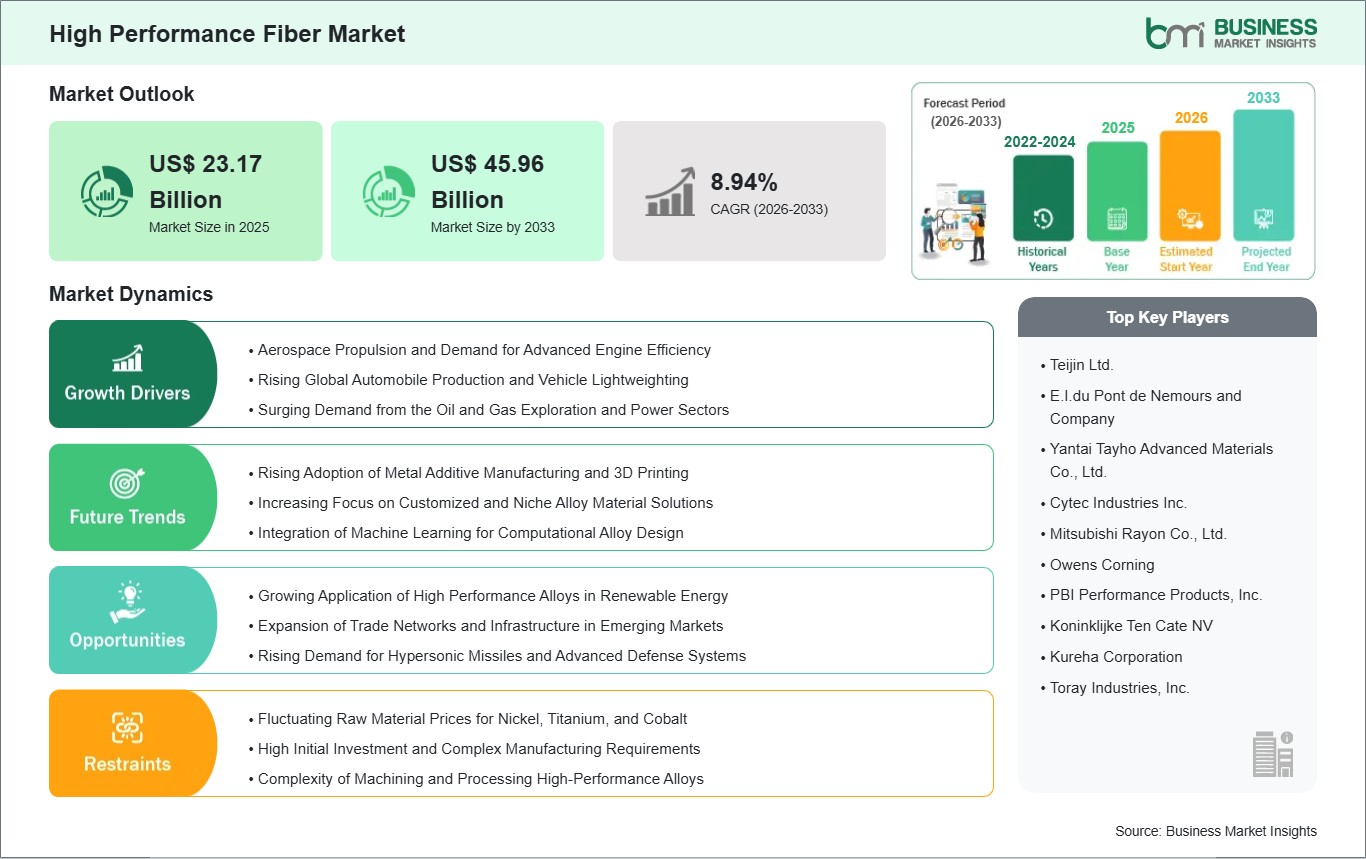
High performance fibers play a critical role in the manufacturing of advanced materials, offering exceptional tensile strength, thermal stability, and chemical resistance. They are essential for industries such as electronics & communication, textiles, aerospace & defense, and automotive. These fibers provide several advantages, including superior strength-to-weight ratios, extreme durability under harsh conditions, and the ability to replace heavier materials like steel and aluminum. Increasing demand for lightweight, fuel-efficient vehicles, the expansion of the aerospace sector, and the rising need for high-speed telecommunications infrastructure are fueling the market. Additionally, innovations in material science, such as the development of bio-based fibers and smart textiles, are enhancing material performance and sustainability.
However, several challenges can restrain market growth, such as high manufacturing costs, energy-intensive production processes, and the technical complexity of recycling composite materials. The industry is also sensitive to fluctuations in raw material prices and stringent regulatory standards regarding industrial safety and environmental impact. Despite these hurdles, the market holds significant opportunities driven by rising investments in 5G infrastructure, the global shift toward electric vehicles (EVs), and the increased adoption of personal protective equipment (PPE). Investment in circular economy initiatives and sustainable production methods is also expected to open new avenues for market expansion.
Segment Analysis
High Performance Fiber Market Segmentation
Key segments that contributed to the derivation of the high performance fiber market analysis are type and application.
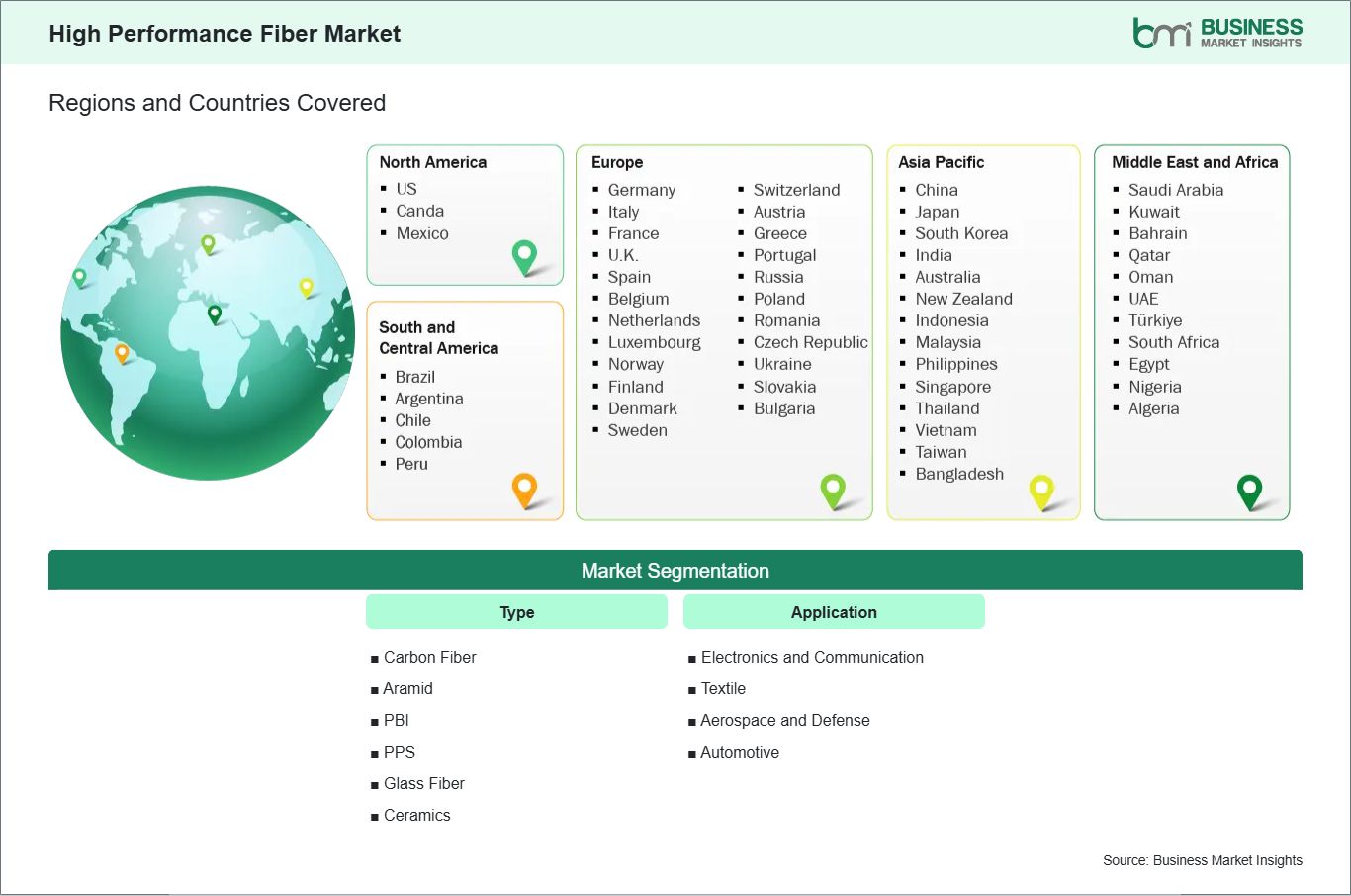
- By Type, the market is segmented into Carbon Fiber, Aramid, PBI, PPS, Glass Fiber, and Ceramics.
- By Application, the market is categorized into Electronics and Communication, Textile, Aerospace and Defense, and Automotive.
Market Forces
High Performance Fiber Market Drivers and Opportunities
Advancing Lightweight Tech and Rising Safety Needs Boost Market Growth
The rapid growth of the global aerospace and defense industry has emerged as a pivotal factor positively driving the high performance fiber market. With the modernization of aircraft fleets and the increasing production of military hardware, manufacturers prioritize materials that offer high strength at a reduced weight to improve fuel efficiency and payload capacity.
The growth in aerospace &defense is associated with the increasing demand for advanced commercial aircraft and military applications. High performance fibers, such as carbon fiber and ceramics, are essential for constructing structural parts, engine components, and ballistic armor. This robust sector expansion directly supports the growth of the high performance fiber market, as the need for materials capable of withstanding extreme mechanical and thermal stress continues to increase to meet defense and aviation requirements worldwide.
Green Energy Shift and 5G Infrastructure Offer Key Growth Avenues
The ongoing digital transformation and the rollout of 5G technology have become powerful drivers of growth in the high performance fiber market. As global telecommunications networks expand, businesses are more reliant on materials that offer superior dielectric properties and thermal management to support high-speed data transmission and durable hardware.
The demand for high performance fibers like PPS and PBI has surged in the electronics sector due to their chemical resistance and ability to operate in wide temperature ranges. These fibers are frequently used in the manufacturing of durable semiconductors, optical fibers, and antennas. Moreover, as consumer electronics become more compact and powerful, the need for lightweight, high-strength insulation materials becomes critical. This shift often involves the need for advanced fiber solutions that can support complex, time-critical supply chains in the tech industry. As companies adapt to demand-driven production models, the demand for high performance fibers in electronics is expected to grow steadily.
Size and Share Analysis
High Performance Fiber Market Size and Share Analysis
The high performance fiber market demonstrates steady growth, with size and share analysis revealing evolving trends and competitive positioning among key players. The report further examines subsegments categorized within type and application, offering insights into their contribution to overall market performance.
For instance, carbon fiber is a sub-segment expected to remain the most popular type, widely utilized in aerospace and automotive body panels due to its rigidity and weight-saving properties. The aramid fibers sub-segment maintains a strong presence in the textile application, particularly for protective clothing and ballistic vests, due to their exceptional heat resistance.
The ceramic fibers sub-segment is seeing increased adoption in high-temperature applications within the aerospace and energy sectors, serving as critical insulation for turbines and furnaces. In the automotive sub-segment, high performance fibers are increasingly used to reduce vehicle curb weight, directly contributing to lower emissions and enhanced electric vehicle range.
Report Coverage
High Performance Fiber Market Report Coverage and Deliverables
The "High Performance Fiber Market Size and Forecast (2022 - 2033)" report provides a detailed analysis of the market covering below areas:
- High performance fiber market size and forecast at global, regional, and country levels for all the key market segments covered under the scope.
- High performance fiber market trends, as well as market dynamics such as drivers, restraints, and key opportunities.
- High performance fiber market analysis covering key market trends, global and regional framework, major players, regulations, and recent market developments.
- Industry landscape and competition analysis covering market concentration, heat map analysis, prominent players, and recent developments for the high performance fiber market.
- Detailed company profiles, including SWOT analysis.
Geographic Insights
High Performance Fiber Market Geographic Insights
The geographical scope of the high performance fiber market report is divided into five regions: North America, Asia Pacific, Europe, Middle East & Africa, and South & Central America.
The Asia-Pacific high performance fiber market is experiencing robust growth, driven by the rapid expansion of industrial manufacturing, growing international trade volumes, and rising defense expenditures. Major economies like China and India are leading the way, fueled by increasing industrial output, strategic logistics investments, and the development of high-tech manufacturing zones.
The region is also witnessing increased adoption of advanced materials in the automotive and electronics sectors, particularly for electric vehicle components and telecommunications infrastructure. Capacity expansion by regional manufacturers, alongside the shifting of production bases from the U.S. and Europe to the Asia-Pacific region, is enhancing operational efficiency. Additionally, the rise of regional trade agreements and strong infrastructure development across major industrial corridors further solidifies the region's dominant market position.
North America is expected to grow, driven by a mature aerospace manufacturing sector and high defense spending in the U.S. and Canada. Europe remains a prominent market with a strong emphasis on sustainability and automotive lightweighting. Countries like Germany, France, and the UK are leading the adoption of high performance fibers in the automotive sector to meet strict EU carbon emission targets.
Industry Activity
Recent Developments
The high performance fiber market is evaluated by gathering qualitative and quantitative data post primary and secondary research. A few of the key developments in the high performance fiber market are:
- In November 2025, Exail launched a new erbium/ytterbium (Er:Yb) co-doped fiber, setting new performance standards for single-mode fiber lasers operating at 1.5 µm. This innovation expands the potential of ultrafast laser communication between ground stations and space, while driving advancements in LiDAR and quantum technologies.
- In October 2025, Teijin Frontier launched THERMOFRONTTM Family as a new brand of Sustainable, High-Performance Sheet Insulation Products Offering Superior Warmth. Teijin Frontier's recycled polyester fiber incorporates hollow cross-sectional fibers and functional raw materials to deliver outstanding warmth. THERMOFRONTTM insulation is designed for a wide range of applications, from sports and outdoor wear to casual apparel.
Trust & Transparency
Research Methodology
The market analysis combines proprietary research with secondary data from government agencies, company disclosures, regulatory filings, industry databases and expert interviews. Market estimates are validated through data triangulation, cross-market benchmarking and analyst
review.
View Full Research Methodology
Key Sources Referred:
World Bank - Global Trade Indicators World Trade Organization (WTO) International Monetary Fund (IMF) International Trade Administration (ITA) Company website Company annual reports Company investor presentations