
High Intensity Sweeteners Market Outlook: Size, Share, Trends, Growth Analysis, Competitive Landscape & Forecast, 2026-2033

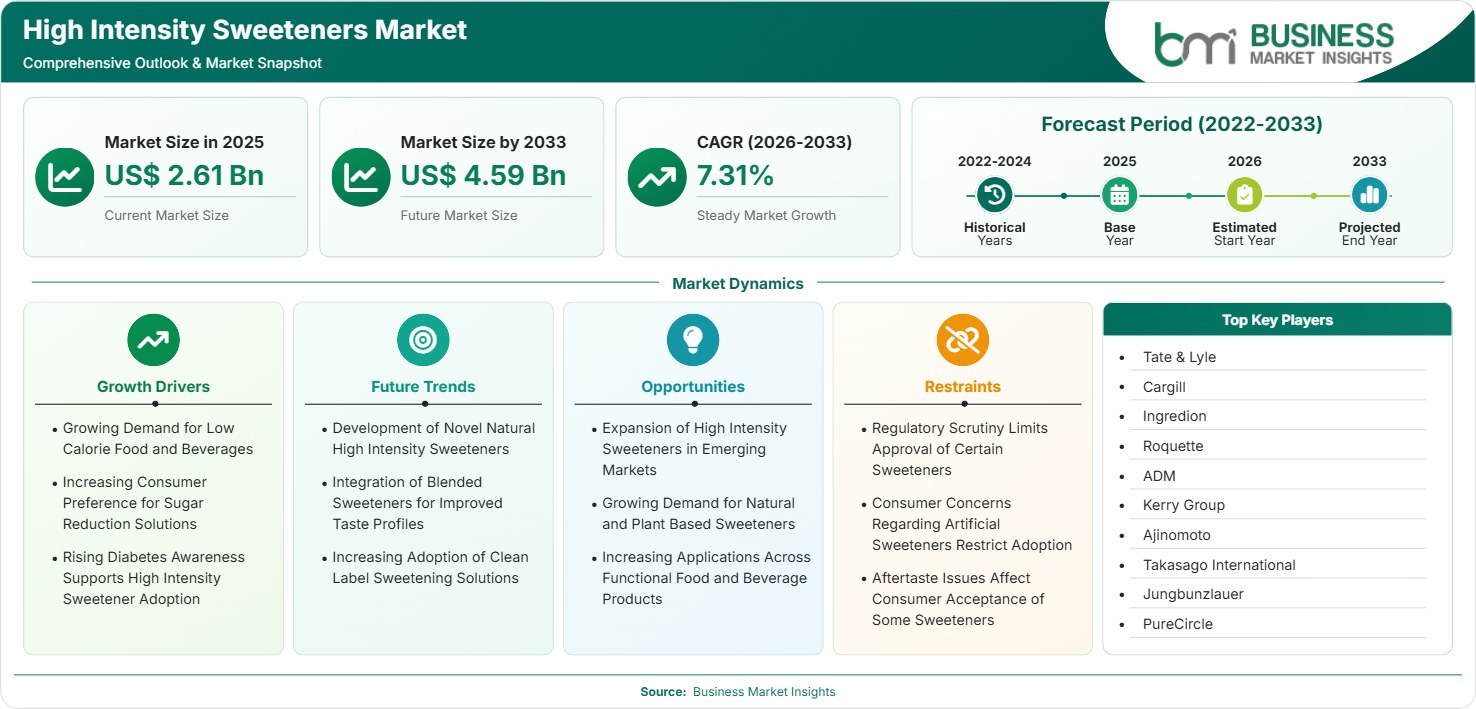
The High Intensity Sweeteners Market size was valued at US$ 2.61 billion in 2025 and is projected to reach US$ 4.59 billion by 2033, growing at a CAGR of 7.31% during 2026–2033, driven by sugar reduction, low-calorie product demand, diabetes awareness, natural sweetener innovation, and broader applications across beverages and processed foods.

Report Coverage
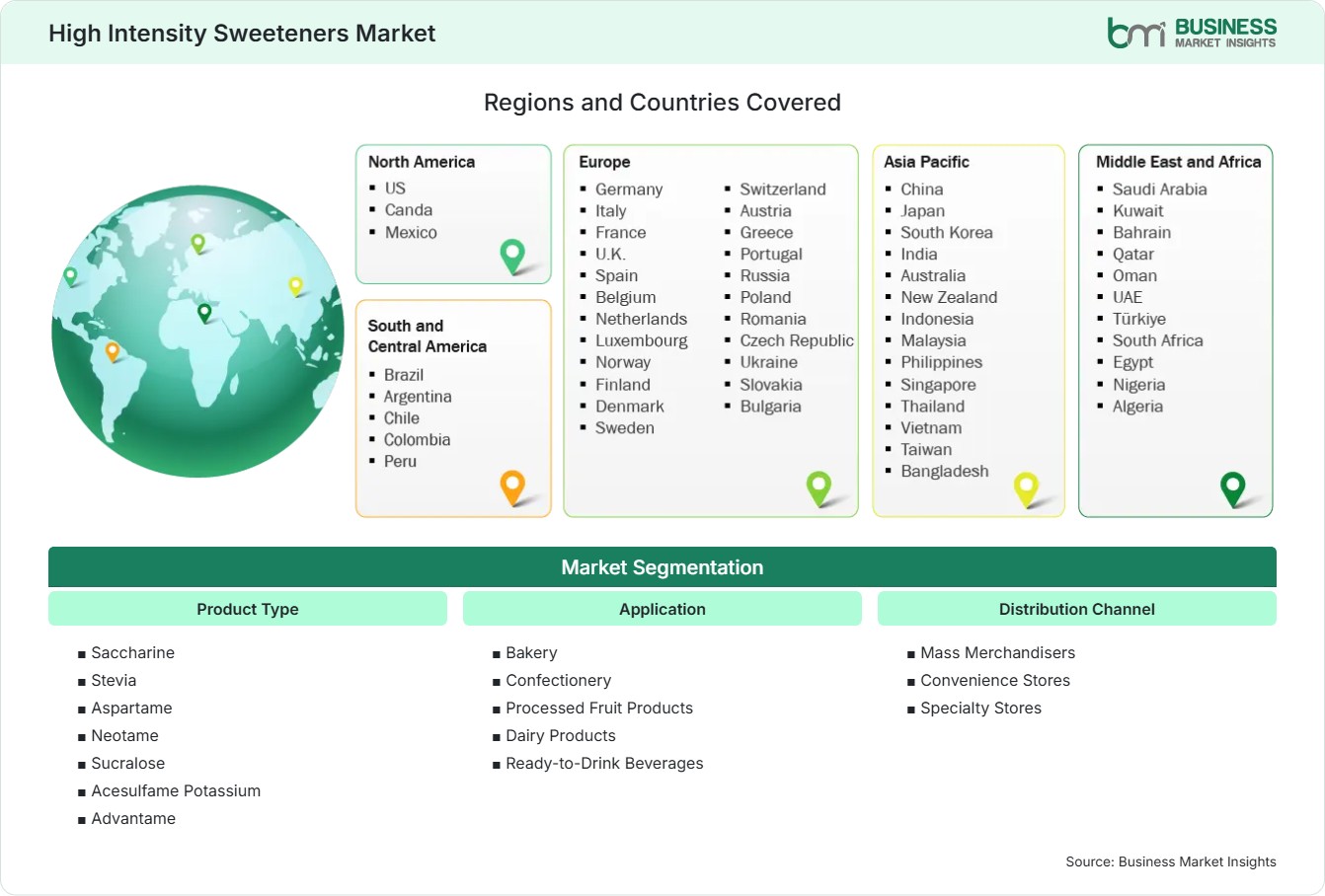
  • Product Type: Saccharine, Stevia, Aspartame, Neotame, Sucralose, Acesulfame Potassium, Advantame
  • Application: Bakery, Confectionery, Processed Fruit Products, Dairy Products, Ready-to-Drink Beverages
  • Distribution Channel: Mass Merchandisers, Convenience Stores, Specialty Stores
US$ 2.61 Bn Market size in 2025
US$ 4.59 Bn Market Size by 2033
7.31% CAGR, 2026 - 2033
2026-2033 Forecast Period

01 AI Overview

High Intensity Sweeteners Market Summary

  • North America Region: North America held an estimated 32%–36% share in 2025 and is projected to grow at a 6.8%–7.2% CAGR, supported by sugar reduction initiatives, demand for low-calorie products, reformulation activity, and expanding applications across beverages, dairy, bakery, and functional foods. The U.S. High Intensity Sweeteners Market is projected to grow at a 6.9%–7.3% CAGR, supported by reformulation and consumer demand for reduced-sugar products.
  • Fastest Growing Region: Asia Pacific held an estimated 27%–31% share in 2025 and is projected to grow at a 8.2%–8.6% CAGR, supported by rising processed food consumption, urbanization, expanding beverage markets, growing health awareness, and increasing adoption of stevia and other plant-derived sweetening solutions.
  • Leading Segment: Stevia held an estimated 22%–26% share in 2025 and is projected to grow at a 8.4%–8.8% CAGR, supported by consumer preference for plant-based ingredients, sugar reduction strategies, clean-label positioning, and increasing use in beverages and functional food formulations.
  • High Growth Segment: Ready-to-Drink (RTD) Beverages held an estimated 25%–29% share in 2025 and is projected to grow at a 8.8%–9.2% CAGR, driven by demand for reduced-sugar drinks, functional beverages, flavored waters, and convenient consumption formats.
  • Key Market Opportunity: Natural sweetener innovation offers strong opportunities as food and beverage manufacturers seek effective sugar reduction solutions that address calorie concerns while meeting evolving clean-label and plant-based consumer preferences.
  • Major Market Players: Tate & Lyle PLC, Cargill, Incorporated, Ingredion Incorporated, Roquette Frères, Archer-Daniels-Midland Company, Kerry Group plc, Ajinomoto Co., Inc., Takasago International Corporation, Jungbunzlauer Suisse AG, PureCircle.
02 Strategic Insights

High Intensity Sweeteners Market: Strategic Insights

High Intensity Sweeteners Market Strategic Framework
FREE PDF
Request your free sample
Request free sample
03 Stakeholder View

Key Takeaways

  • The sweetener value chain is shifting toward integrated ingredient portfolios combining high-intensity sweeteners, bulking agents, flavor systems, and formulation expertise, allowing suppliers to provide more complete sugar reduction solutions.
  • Beverage applications offer strong upside because manufacturers are reformulating carbonated drinks, flavored waters, energy products, and functional beverages to reduce sugar while preserving taste and consumer appeal.
  • Stevia and other plant-derived ingredients are gaining strategic importance, although manufacturers continue investing in blending technologies that improve sweetness profiles and minimize undesirable aftertaste.
  • Asia Pacific offers a compelling investment case as rising processed food consumption, expanding beverage production, and health awareness create new demand for sugar reduction ingredients.
  • Ingredient suppliers are strengthening capabilities through formulation partnerships, product innovation, and portfolio expansion, increasing competition around natural sweeteners and customized solutions for food manufacturers.
  • Regulatory compliance and consumer perception are becoming key competitive differentiators, making transparent labeling, scientific substantiation, and clear communication increasingly important for brand acceptance.
04 Geographic Outlook

High Intensity Sweeteners Market Regional Highlights

North America High Intensity Sweeteners Market

North America held an estimated 32%–36% share in 2025 and is projected to grow at a 6.8%–7.2% CAGR through 2033. The region benefits from mature packaged food industries, extensive beverage manufacturing, and widespread sugar reduction initiatives. The U.S. remains the dominant market, while Canada contributes through growing demand for reduced-sugar products and clean-label formulations. Reformulation activity continues to support ingredient innovation.

  • U.S. beverage manufacturers are expanding reduced-sugar product portfolios, creating demand for sweetening systems that deliver sweetness while maintaining familiar flavor profiles.
  • Consumer interest in calorie reduction is encouraging brands to reformulate bakery, dairy, confectionery, and beverage products using high-intensity sweetener blends.
  • Natural sweeteners are receiving increased attention as manufacturers respond to clean-label preferences and demand for recognizable plant-derived ingredients.
  • Established ingredient suppliers are investing in formulation support and customized solutions to help food manufacturers overcome taste, stability, and regulatory challenges.

US High Intensity Sweeteners Market

The U.S. represented an estimated 29%–33% share in 2025 and is projected to grow at a 6.9%–7.3% CAGR through 2033. Strong demand for reduced-sugar beverages, functional foods, sports nutrition, and packaged products supports adoption. Manufacturers are increasingly using blends to improve taste and performance, while regulatory compliance and consumer perceptions continue influencing ingredient selection.

  • Beverage reformulation remains a major demand generator as brands introduce lower-sugar sodas, flavored waters, energy drinks, and functional beverages for health-conscious consumers.
  • Stevia and other natural options are gaining visibility as manufacturers seek plant-based positioning while maintaining sweetness intensity and acceptable sensory performance.
  • Functional food innovation is expanding sweetener applications in products targeting weight management, sports nutrition, and healthier everyday consumption patterns.
  • Ingredient suppliers are emphasizing technical support and formulation expertise to help brands optimize sweetness, mouthfeel, stability, and consumer acceptance.

Europe High Intensity Sweeteners Market

Europe held an estimated 24%–28% share in 2025 and is projected to grow at a 6.4%–6.8% CAGR through 2033. Germany, the UK, France, and Italy represent leading High Intensity Sweeteners Markets, supported by mature food industries and established sugar reduction initiatives. Germany is projected to grow at a 6.7%–7.1% CAGR, while the UK benefits from continued reformulation across beverages and packaged foods.

  • Germany’s existing food processing sector aids the consumption of sweetening agents in drinks, dairy products, baking, and candy products.
  • The United Kingdom offers growth potential because of product reformulation efforts and the consumer trend towards reducing sugar intake in packaged drinks and convenience foods.
  • France benefits from strong premium food and beverage industries where natural and plant-based ingredient positioning can support differentiated reduced-sugar product development.
  • European manufacturers increasingly require transparent ingredient sourcing and regulatory compliance, encouraging suppliers to strengthen documentation and formulation support.

Asia Pacific High Intensity Sweeteners Market

Asia Pacific represented an estimated 27%–31% High Intensity Sweeteners Market share in 2025 and is projected to grow at a 8.2%–8.6% CAGR through 2033. China, Japan, India, and South Korea are important markets, with India projected to grow at a 9.0%–9.4% CAGR. Rising packaged food consumption, expanding beverage production, urbanization, and health awareness are supporting regional adoption.

  • China offers substantial potential because its large food and beverage industry is increasingly developing reduced-sugar products across beverages, dairy, confectionery, and processed foods.
  • India is experiencing rising demand for low-calorie and reduced-sugar products as urban consumers become more health conscious and packaged food consumption expands.
  • Japan benefits from sophisticated food innovation and established demand for functional beverages, supporting applications for high-intensity sweeteners across specialized product categories.
  • South Korea's advanced beverage and convenience food industries are creating opportunities for innovative sweetening systems that support lower sugar content and differentiated product positioning.

Rest of World High Intensity Sweeteners Market

South and Central America accounted for an estimated 7%–9% share in 2025 and are projected to grow at a 7.0%–7.4% CAGR through 2033. Brazil and Mexico lead opportunities. The Middle East and Africa represented an estimated 6%–8% share and are projected to grow at a 7.4%–7.8% CAGR, supported by expanding packaged food and beverage production.

  • Brazil offers opportunities through its large beverage and processed food industries, where manufacturers are increasingly exploring reduced-sugar formulations and alternative sweetening systems.
  • Mexico benefits from demand for lower-calorie beverages and packaged foods, creating opportunities for ingredient suppliers supporting product reformulation and new product development.
  • The UAE is developing as a regional food and beverage hub, supporting demand for innovative sweeteners across functional drinks, dairy products, and processed foods.
  • Saudi Arabia's evolving food industry and health-focused consumption trends are creating opportunities for sugar reduction ingredients in beverages and convenience-oriented food applications.
Global Market Geography
FREE PDF
Request your free sample
Request free sample
05 Segment Analysis

High Intensity Sweeteners Market Segmentation

Product Type

Stevia held an estimated 22%–26% share in 2025 and is projected to grow at a 8.4%–8.8% CAGR between 2026–2034. The High Intensity Sweeteners Market scope spans natural and synthetic sweetening solutions used across diverse food and beverage applications. Its plant-based positioning supports demand among manufacturers seeking natural alternatives. Saccharine, aspartame, sucralose, and acesulfame potassium remain important for established applications, while neotame and advantame offer high sweetness intensity for specialized formulations and blending strategies.

  • Saccharine: Saccharine provides intense sweetness at low usage levels, supporting applications requiring cost-effective sugar reduction across beverages, confectionery, and processed food formulations.
  • Stevia: Stevia offers plant-derived sweetness and supports clean-label positioning, with growing applications in beverages, dairy, functional foods, and reduced-sugar product formulations.
  • Aspartame: Aspartame remains established in low-calorie food and beverage applications, although manufacturers continue evaluating alternatives amid changing consumer perceptions and regulatory considerations.
  • Neotame: Neotame delivers very high sweetness intensity, enabling manufacturers to use small quantities while developing specialized low-sugar formulations with improved cost efficiency.
  • Sucralose: Sucralose provides strong sweetness and stability across multiple processing conditions, supporting broad applications in beverages, dairy, bakery, and packaged food products.
  • Acesulfame Potassium: Acesulfame potassium is frequently blended with other sweeteners to enhance taste profiles, supporting applications in beverages, confectionery, dairy, and processed foods.
  • Advantame: Advantame offers exceptionally high sweetness intensity, creating opportunities for specialized formulations where manufacturers seek significant sugar reduction with very low ingredient inclusion levels.

Application

Ready-to-Drink (RTD) Beverages held an estimated 25%–29% share in 2025 and are projected to grow at a 8.8%–9.2% CAGR between 2026–2034. Demand is supported by reduced-sugar soft drinks, functional beverages, flavored waters, and energy products. Bakery, confectionery, dairy, and processed fruit products also offer opportunities as manufacturers reformulate products to reduce added sugar.

  • Bakery: High-intensity sweeteners support reduced-sugar bakery formulations, although manufacturers often combine them with bulking ingredients to maintain texture, moisture, and product structure.
  • Confectionery: Sweeteners enable sugar reduction in candies and confectionery products, with blending strategies helping manufacturers manage sweetness intensity, flavor balance, and consumer expectations.
  • Processed Fruit Products: Reduced-sugar fruit products use high-intensity sweeteners to maintain desirable sweetness while lowering added sugar content across packaged fruit applications.
  • Dairy Products: Yogurts, flavored milk, and other dairy products use sweeteners to develop lower-sugar options while maintaining acceptable taste profiles and nutritional positioning.
  • Ready-to-Drink (RTD) Beverages: RTD beverages represent a major opportunity as manufacturers develop lower-calorie drinks, functional beverages, flavored waters, and convenient products with reduced sugar content.

Distribution Channel

Mass Merchandisers held an estimated 44%–48% share in 2025 and are projected to grow at a 6.9%–7.3% CAGR between 2026–2034. Broad retail access supports product availability across consumer food and beverage categories. Convenience stores remain important for impulse-oriented consumption, while specialty stores provide opportunities for health-focused products and premium natural sweetener formulations.

  • Mass Merchandisers: Mass merchandisers provide broad consumer reach and support distribution of packaged food and beverage products containing high-intensity sweetening systems.
  • Convenience Stores: Convenience stores support high-frequency purchases of beverages and snacks, creating opportunities for reduced-sugar and low-calorie products in accessible formats.
  • Specialty Stores: Specialty stores provide channels for premium, natural, plant-based, and health-oriented products where alternative sweetening solutions can support differentiated product positioning.
06 Market Forces

High Intensity Sweeteners Market Dynamics

Key Market Drivers

Growing Demand for Low Calorie Food and Beverages

There is a growing trend among consumers towards products that offer sweetness with minimal calories, which has driven manufacturers to modify drinks, snacks, dairy items, baked foods, and candies. It is more obvious in products where sugar plays an important role in determining the product's total calories. The High Intensity Sweeteners Market growth will be driven by manufacturers’ efforts to develop sweetening agents that deliver strong sweetness in small quantities. The technology to blend the sweeteners in an appropriate way is assisting them in meeting their objective, and the natural options like stevia are also on the rise.

Increasing Consumer Preference for Sugar Reduction Solutions

Cutting down on sugar content in products has become one of the key strategies for product development because more and more people are starting to pay attention to nutritional information and make healthy food choices. This way, food companies reduce the amount of added sugars in beverages, dairy products, bakery products, and other processed foods. The use of high-intensity sweeteners allows for maintaining the sweetness and cutting down the sugar content, but there are still many issues with formulations associated with the taste and mouthfeel. Suppliers are meeting such demands with different mixes of ingredients.

Rising Diabetes Awareness Supports High Intensity Sweetener Adoption

With increased knowledge about diabetes and control of blood sugar, consumers and manufacturers are being drawn towards foods and beverages with reduced sugar content. High-intensity sweeteners can provide sweetness with minimal caloric contribution, making them useful in some reduced-sugar formulations. The trend is helping in the development of products in the areas of beverages, dairy, confectionery, and functional nutrition. The use of the High Intensity Sweeteners Market trend is highly influenced by consumer attitudes, regulation, and the fitness of the particular ingredient in the formulation.

Key Market Opportunities

Expansion of High Intensity Sweeteners in Emerging Markets

Developing nations present great possibilities due to the increase in the consumption of packaged foods, urbanization trends, and improvements in retail facilities. Increased disposable income levels are making it possible for people to consume more brands of beverages, dairy products, chocolates, and processed foods, whereas consumer awareness regarding health issues is leading to a demand for lower sugar products. Manufacturers are launching products based on changing dietary habits, thus creating chances for companies that can develop sweeteners specific to the region. Companies can gain from setting up regional partnerships and providing technical support to the local manufacturers. All these are likely to have an effect on the High Intensity Sweeteners Market forecast due to increasing demand for sugar substitutes.

Growing Demand for Natural and Plant Based Sweeteners

In terms of natural and plant-based sweeteners, there is a very good chance that this area will provide significant opportunities, as consumers are now more inclined towards natural ingredients. Stevia is gaining from this trend, but the food industry is still searching for ways to optimize its processing techniques. This area provides suppliers with an excellent chance to come up with products that would help overcome the sensory deficiencies of natural sweeteners. A combination of plant ingredients with other sweetener systems would make it easier to enhance the taste profile of the product and expand its applications.

Increasing Applications Across Functional Food and Beverage Products

The functional food & beverage market is growing due to the desire for products linked to a certain nutritional or health benefit. Products that could be made to contain reduced levels of sugar include sports drinks, fortifying beverages, protein beverages, and specialized nutrition products. High-intensity sweeteners would help companies make products with good taste, but with controlled sugar levels and calories. Companies that understand how functional food components should be formulated can develop a custom solution. This would enhance stability, taste, and overall sensory performance.

Market Restraints and Challenges

Regulatory Scrutiny Limits Approval of Certain Sweeteners

Factor: High-intensity sweeteners are subject to regulatory review covering safety, permitted applications, labeling, and acceptable intake levels, with requirements differing across jurisdictions. Impact: Regulatory uncertainty will cause delays in the launch of new products, raise compliance costs, and limit the use of some ingredients in certain countries. The producers need to constantly track regulatory updates as well as keep scientific data on the safety of ingredients. Ingredient suppliers with wide portfolios can mitigate this risk by offering a variety of sweeteners, both natural and artificial. But even small changes in permissible amounts or labeling requirements can cause problems for food producers in various international markets.

Consumer Concerns Regarding Artificial Sweeteners Restrict Adoption

Factor: Some consumers associate artificial sweeteners with health concerns or prefer products perceived as natural, even when individual ingredients have undergone regulatory safety assessments. Impact: Such perceptions may also affect purchasing behavior and prompt brands to make changes to their formulations by switching from synthetic ingredients to plant-based ingredients. The manufacturer must thus carefully consider performance, cost, regulation, and consumer acceptability when making decisions regarding which sweeteners to use. Proper communication can address uncertainty, while innovation in stevia and other natural sweeteners provides alternatives. However, taste, stability, and formulation cost may hinder such transitions.

07 Company Analysis

Competitive Landscape

The competitive environment includes global ingredient companies, specialty sweetener suppliers, biotechnology-oriented producers, and flavor and formulation specialists. The High Intensity Sweeteners Market analysis indicates that competition increasingly focuses on natural ingredient portfolios, taste optimization, regulatory support, supply reliability, and customized formulation services.

Company Name

Overview

Products and Services relevant to this market

Tate & Lyle PLC

Global food ingredient company supplying sweetening and texture solutions to food and beverage manufacturers.

Sucralose, stevia solutions, sweetener blends, sugar reduction systems, and formulation support.

Cargill, Incorporated

Major food ingredient supplier with broad sweetener capabilities and global manufacturing reach.

Stevia, erythritol, sweetener systems, sugar reduction solutions, and application development services.

Ingredion Incorporated

Ingredient solutions provider serving food, beverage, nutrition, and specialty formulation markets.

Stevia, sweetener blends, specialty ingredients, sugar reduction systems, and technical formulation support.

Roquette Frères

Global plant-based ingredient company offering sweetening and nutrition solutions for food manufacturers.

Plant-based sweeteners, polyols, specialty carbohydrates, and formulation solutions for reduced-sugar products.

Archer-Daniels-Midland Company

Global agricultural processor and ingredient supplier serving food, beverage, and nutrition applications.

Sweeteners, specialty ingredients, formulation systems, and solutions supporting sugar reduction and functional foods.

Kerry Group plc

Taste and nutrition company providing ingredient solutions and sensory technologies to global manufacturers.

Sweetening systems, taste modulation, flavor solutions, and customized reduced-sugar formulation technologies.

Ajinomoto Co., Inc.

Global food ingredient and biotechnology company with expertise in taste and formulation technologies.

Sweetener solutions, amino acid-based ingredients, taste modulation, and food formulation technologies.

Takasago International Corporation

Global flavor and fragrance company providing taste solutions for food and beverage manufacturers.

Flavor systems, taste modulation, sensory solutions, and formulation support for reduced-sugar products.

Jungbunzlauer Suisse AG

Specialty ingredient producer focused on naturally derived ingredients and functional food applications.

Sweetening ingredients, organic acids, specialty carbohydrates, and natural formulation solutions.

PureCircle

Stevia-focused ingredient company specializing in plant-based sweetener innovation and product development.

Steviol glycosides, stevia extracts, natural sweetener systems, and sugar reduction solutions.

10 Trust & Transparency

Research Methodology

The market analysis combines proprietary research with secondary data from government agencies, company disclosures, regulatory filings, industry databases and expert interviews. Market estimates are validated through data triangulation, cross-market benchmarking and analyst review.

View Full Research Methodology

11 Questions Answered

Frequently Asked Questions

What is the outlook for natural sweeteners?

Natural sweeteners are positioned for continued expansion as manufacturers respond to consumer interest in plant-based ingredients and cleaner product positioning. Innovation in taste modulation and blending should improve their suitability across applications.

How do regulations affect sweetener manufacturers?

Regulations influence which ingredients can be used, permitted application levels, labeling requirements, and acceptable intake limits. Differences between countries can increase compliance requirements for companies operating across international markets.

Which application has strong growth potential in the High Intensity Sweeteners Market?

Ready-to-Drink beverages offer strong potential because manufacturers are introducing lower-sugar soft drinks, flavored waters, energy products, and functional beverages that require effective sweetness solutions.

Why is stevia gaining market attention?

Stevia is gaining attention because it offers plant-derived sweetness and supports brands seeking natural ingredient positioning. Improved extraction and flavor technologies are also helping address sensory challenges and expand its applications.

What is driving demand for high-intensity sweeteners?

The High Intensity Sweeteners Market report highlights demand for low-calorie products, sugar reduction, health-conscious consumption, functional beverages, and reformulation across packaged foods as key factors supporting adoption.

Access the Full High Intensity Sweeteners Market Report

Get segment-level forecasts, regional estimates, competitive benchmarking, company profiles and downloadable Excel datasets.

Access the full High Intensity Sweeteners Market Report
350 pages PDF & Excel | 2026-08-04