Market Summary
Executive Summary and Global Market Analysis
Biological wastewater treatment refers to the use of microorganisms, bacteria, fungi, and other biological agents to decompose organic pollutants and contaminants present in wastewater. These treatment systems are widely used across municipal and industrial facilities to reduce biochemical oxygen demand (BOD), chemical oxygen demand (COD), suspended solids, nutrients, and harmful pathogens before water discharge or reuse. Technologies such as activated sludge systems, membrane bioreactors (MBR), moving bed biofilm reactors (MBBR), anaerobic digestion, and sequencing batch reactors (SBR) are increasingly adopted to improve treatment efficiency and support environmental sustainability goals.
The market is witnessing significant growth due to rising urban populations and increasing pressure on freshwater resources. Governments and environmental agencies across developed and emerging economies are strengthening wastewater discharge standards to reduce pollution in rivers, lakes, and coastal ecosystems. Industrial sectors such as pulp and paper, chemicals, pharmaceuticals, food and beverage, meat and poultry, textile, and dairy are increasingly investing in advanced biological treatment systems to comply with regulatory frameworks and improve operational sustainability.
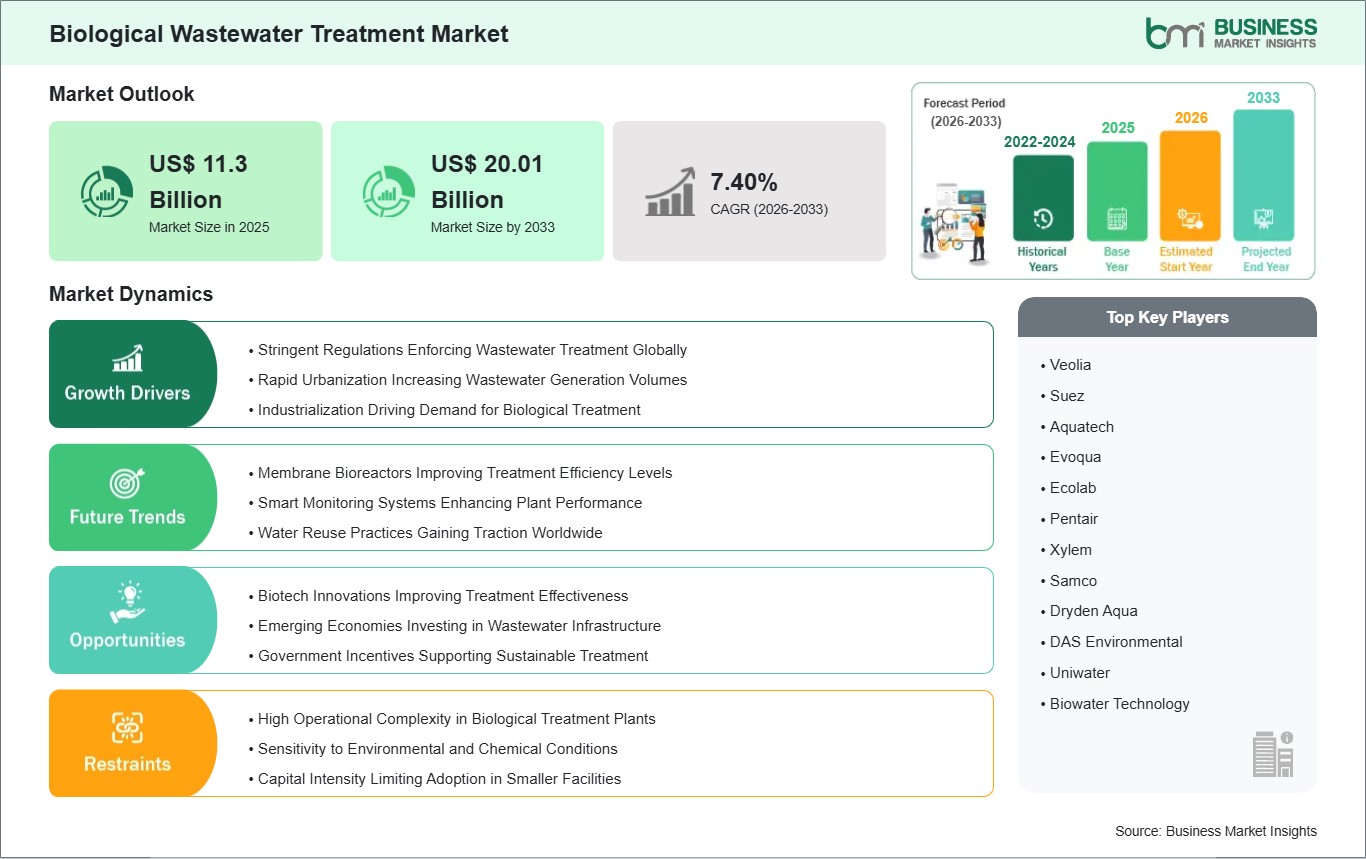
However, several challenges may hinder market progression. High installation and operational costs associated with advanced biological treatment systems remain a major restraint, especially for small and medium-sized industries. Biological treatment processes also require continuous monitoring, skilled operators, and stable environmental conditions to ensure effective microbial activity. Variations in wastewater composition, toxic shock loads, and membrane fouling issues in advanced systems can affect efficiency and increase maintenance requirements.
Despite these restraints, the market outlook remains favorable due to technological advancements and the growing adoption of sustainable water treatment practices. Opportunities are emerging through the integration of artificial intelligence, IoT-enabled monitoring systems, and energy-efficient biological treatment technologies. Increasing focus on water reuse and circular economy initiatives is supporting demand for decentralized wastewater treatment systems and resource recovery solutions such as biogas generation and nutrient recovery.
Segment Analysis
Biological Wastewater Treatment Market Segmentation
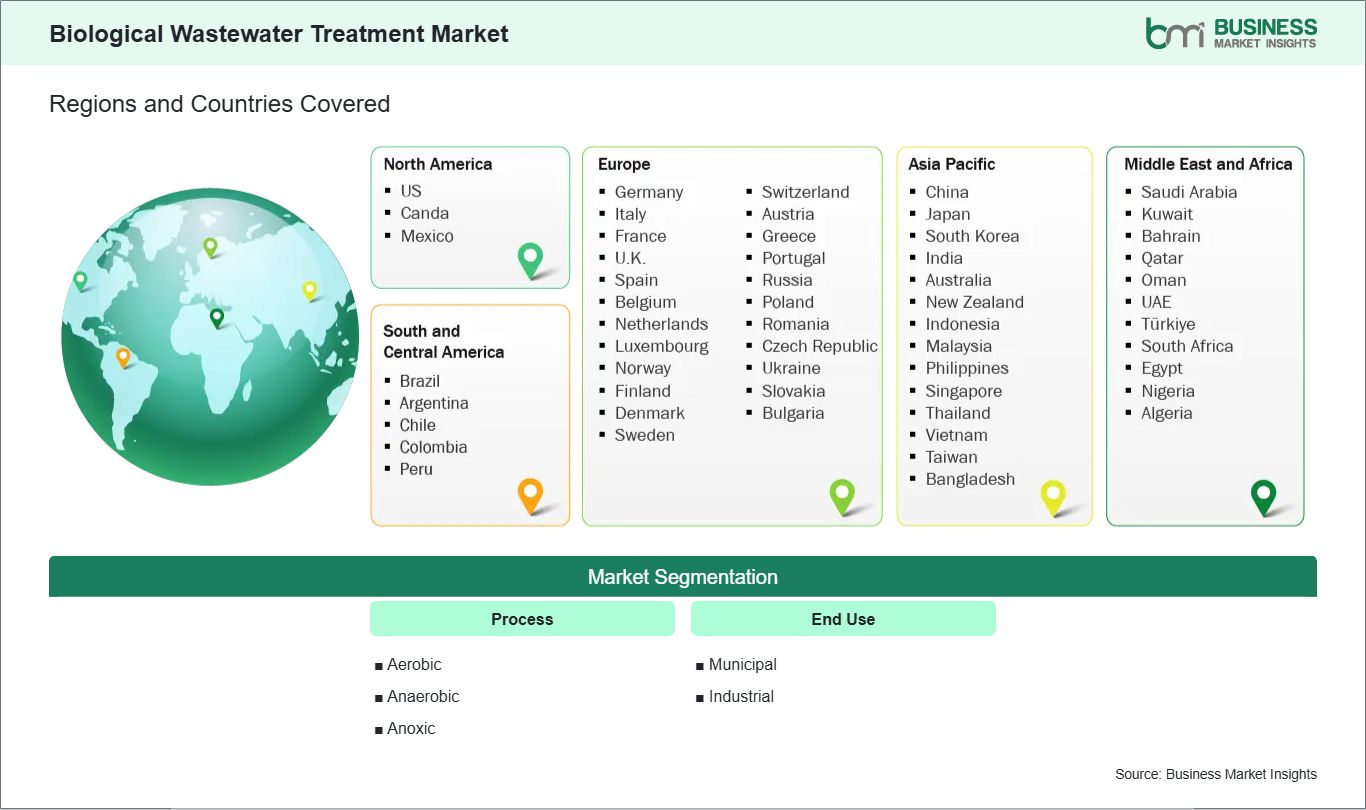
The biological wastewater treatment market is segmented based on process, and end use, reflecting the increasing demand for sustainable and efficient water treatment technologies across industries.
By Process
- Aerobic: Uses oxygen-dependent microorganisms to break down organic contaminants efficiently
- Anaerobic: Treats wastewater in oxygen-free conditions while generating biogas and reducing sludge production
- Anoxic: Supports nitrogen removal through denitrification processes under low oxygen conditions
By End Use
- Municipal: Applied in urban sewage treatment and public wastewater management systems
- Industrial: Includes treatment applications across multiple industries such as:
o Pulp and Paper
o Meat and Poultry
o Chemicals
o Pharma
o Textile
o Dairy
o Oil and Gas
Market Forces
Biological Wastewater Treatment Market Drivers and Opportunities
Stringent Regulations Enforcing Wastewater Treatment Globally
Regulatory bodies across the globe are enforcing stricter regulations on the treatment of wastewater, leading to increased demand for biological treatment systems. Governments and environmental agencies have increased the stringency of wastewater treatment discharge standards in an effort to reduce the impacts of water pollution. As a result, authorities have mandated the use of advanced wastewater treatment processes in both municipal and industrial facilities in order to achieve compliance with environmental sustainability goals. The rapid expansion of cities has led to an increase in the amount of wastewater that must be treated, resulting in an increased need for efficient treatment technologies and upgraded infrastructure.
Additionally, the growth of industrialization has further contributed to an increased need for biological treatment systems, particularly industries such as Chemicals, Pulp and Paper, Dairy, Meat and Poultry, Textiles, and Pharmaceuticals which generate large amounts of wastewater with high levels of organic load and complex contaminants. Municipal authorities are also investing in the development of sewage treatment facilities to accommodate the increasing population and need for public sanitation. As a result, the combination of regulatory pressure, urban growth, and industrial growth will assist in the continuing development of the global biological wastewater treatment market.
Membrane Bioreactors Improving Treatment Efficiency Levels
New opportunities can be found with membrane bioreactors which improve the efficiency of wastewater treatment and have more effective methods for completing advanced wastewater purification. The growth of advanced membrane technology allows for smaller footprints of plants, the potential for higher quantities of sludge to be retained in the system, and improved removal of solids and other microorganisms from the wastewater being treated. These benefits are making these technologies more attractive for use in municipal and industrial settings. Smart monitoring technologies are providing additional enhancements to plant performance through the use of automation, remote monitoring, AI-based analytics, and preemptive maintenance solutions that all contribute to greater operational reliability and more efficient energy use.
In addition, water reuse strategies are becoming increasingly prevalent throughout the globe as industries and municipalities are looking for ways to reduce their dependence on, and lastly, their usage of freshwater. The continued increase in the use of reclaimed (treated) wastewater for various non-potable uses, including irrigation and during industrial processes, is creating more demand for advanced biological treatment technologies. Biotech innovations that allow for improved treatment efficiency are creating opportunities to increase the recovery of nutrients, make less sludge, and create energy value through anaerobic digestion. Thus, with many developing nations investing in wastewater infrastructure and having governments provide financial assistance for sustainable treatment options, these factors will create significant long-term growth opportunities for technology suppliers and infrastructure developers.
Size and Share Analysis
Biological Wastewater Treatment Market Size and Share Analysis
The Biological Wastewater Treatment Market is projected to grow from US$ 11.3 Billion in 2025 to US$ 20.01 Billion by 2033 , registering a CAGR of 7.40% from 2026 to 2033.
By process, aerobic treatment systems account for a significant market share due to their widespread adoption in municipal sewage treatment and industrial effluent management applications. These systems are highly effective in reducing organic pollutants and are commonly used across large-scale treatment plants. Anaerobic treatment technologies are witnessing steady growth due to their capability to generate renewable biogas, reduce sludge production, and efficiently treat high-strength industrial wastewater streams. Anoxic processes are gaining traction as industries and municipalities increasingly focus on advanced nitrogen removal and nutrient management strategies to comply with stringent environmental regulations.
By end use, the municipal sector dominates the market owing to increasing urban wastewater generation and substantial investments in sewage treatment infrastructure globally. Industrial applications are also expanding significantly, particularly across pulp and paper, chemicals, pharmaceutical, textile, dairy, meat and poultry, and oil and gas industries where wastewater treatment compliance remains critical. Industrial facilities are increasingly adopting biological treatment systems to improve sustainability, reduce environmental impact, and support water reuse initiatives.
Report Coverage
Biological Wastewater Treatment Market Report Coverage and Deliverables
The "Biological Wastewater Treatment Market Size and Forecast (2022 - 2033)" report provides a detailed analysis of the market covering below areas:
- The market size and forecast at global, regional, and country levels for all market segments covered under the scope
- The market trends, as well as drivers, restraints, and opportunities
- The market analysis covering key trends, global and regional framework, major players, regulations, and recent developments
- Industry landscape and competition analysis covering market concentration, heat map analysis, prominent players, and recent developments for the market
- Detailed company profiles, including SWOT analysis
Geographic Insights
Biological Wastewater Treatment Market Geographic Insights
Growth trends in the Global Biological Wastewater Treatment Market differ greatly from region to region based on different factors such as levels of industrialization, environmental regulations, urbanization, and investment in water infrastructures.
North America has a large percent of its global market share due to having advanced wastewater treatment infrastructure already in place and having a great deal of legislation surrounding the proper handling of wastewater. Both the United States and Canada are making considerable investments to upgrade municipal wastewater treatment systems, improve industrial effluent management processes, and implement smart water systems. Efforts to improve water reuse and minimize environmental pollution with advanced biological processes have begun to take shape as a result of these investments. Numerous industrial facilities are also investing in upgrading their processes to be more environmentally friendly. For example, making significant investments into biological wastewater treatment process upgrades in 2025, the U.S. Environmental Protection Agency (EPA) has increased its Clean Water State Revolving Fund program by billions of dollars for use by municipalities.
Similarly to North America, Europe is a strong contributor to the Global Biological Wastewater Treatment Market because of its stringent environmental policies and focus on supporting and promoting circular economy initiatives. Germany, France, and the United Kingdom are examples of locations with government support of efforts such as wastewater recycling efforts, energy from sludge programs, and nutrient recovery programs. The European market will also continue to observe a relatively rapid growth pattern, due in part to the increased use of membrane bioreactor and energy-efficient wastewater treatment technology. As one of the largest emerging markets, Asia Pacific is growing rapidly due to the industrialization happening through the entire region.
Industry Activity
Recent Developments
The biological wastewater treatment market is evaluated by gathering qualitative and quantitative data post primary and secondary research, which includes important corporate publications, association data, and databases. A few of the key developments in the biological wastewater treatment market are:
- In August 2025, Axius Water announced its strategic acquisition of SandN Airoflo, Inc., a top-tier supplier of surface aeration systems used extensively in oxidation ditches and biological lagoons for both municipal and industrial wastewater. SandN Airoflo’s specialized floating brush rotors enhance biological treatment efficiency by drastically improving oxygen transfer while slashing overall power consumption by up to 60%.
- In May 2025, environmental services leader Veolia announced the successful execution of its GreenUp strategic program, highlighted by the acquisition of CDPQ’s 30% stake in Water Technologies and Solutions (WTS). This move gave Veolia full ownership of WTS, strengthening its U.S. presence in water technologies and supporting its growth trajectory under GreenUp.
Trust & Transparency
Research Methodology
The market analysis combines proprietary research with secondary data from government agencies, company disclosures, regulatory filings, industry databases and expert interviews. Market estimates are validated through data triangulation, cross-market benchmarking and analyst
review.
View Full Research Methodology
Key Sources Referred:
World Bank - Global Water and Wastewater Indicators
World Health Organization (WHO)
United Nations Environment Programme (UNEP)
International Water Association (IWA)
Environmental Protection Agency (EPA)