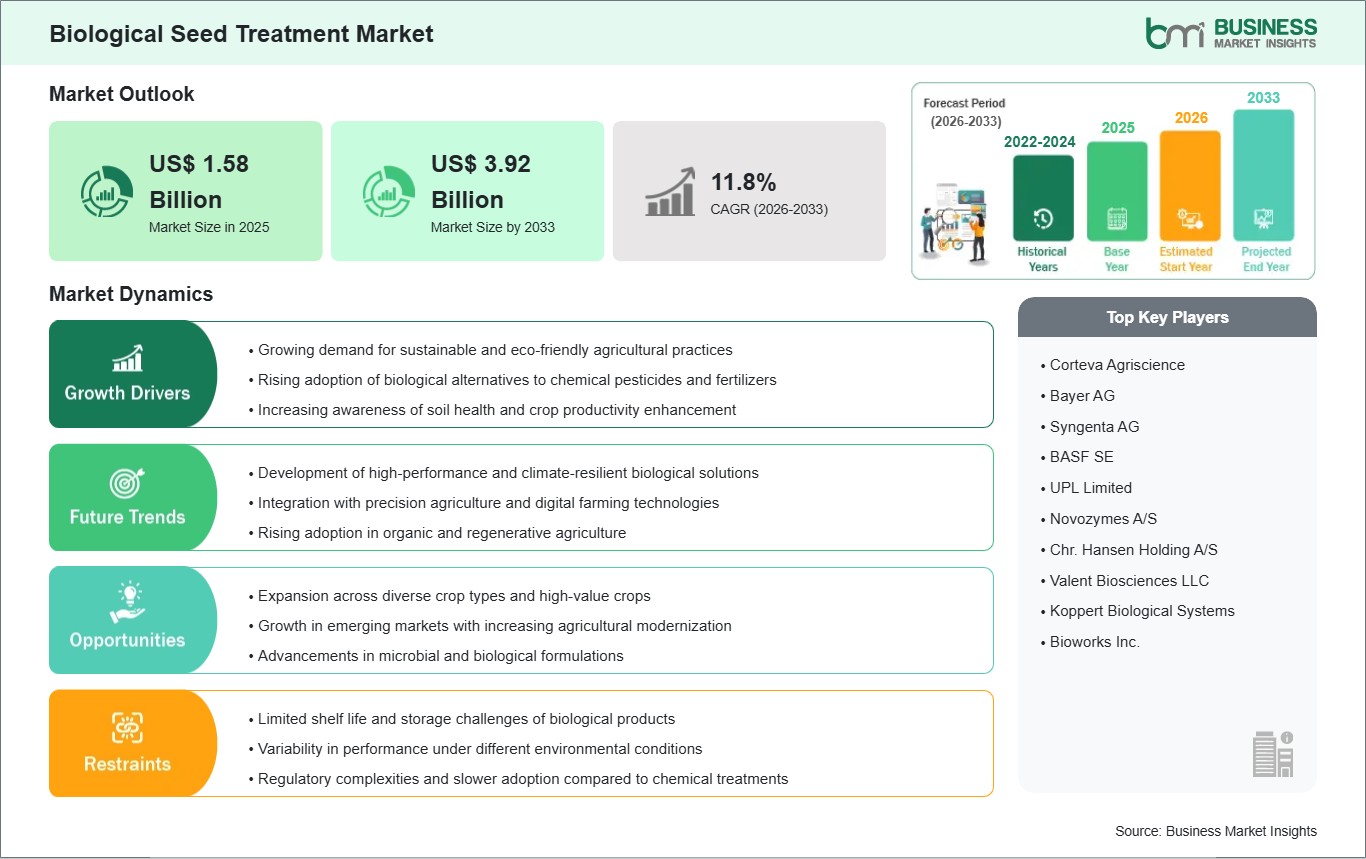
The Biological Seed Treatment Market size is expected to reach US$ 3.92 billion by 2033 from US$ 1.58 billion in 2025. The market is estimated to record a CAGR of 11.8% from 2026 to 2033.
The global biological seed treatment market is experiencing strong growth due to increasing demand for sustainable agricultural practices and reduced reliance on chemical inputs. Biological seed treatments involve the use of naturally derived organisms or substances to enhance seed performance, protect crops from pests and diseases, and improve nutrient uptake. These treatments are gaining traction as farmers and agricultural stakeholders prioritize eco-friendly and cost-effective solutions.
The market is driven by rising awareness of environmental sustainability, soil health, and the long-term impact of chemical pesticides and fertilizers. Biological treatments such as microbial inoculants, botanical extracts, and beneficial fungi are being widely adopted to improve crop yield and resilience. Additionally, government support for organic farming and integrated pest management practices is encouraging the use of biological seed treatments.
Competitive dynamics are centered on innovation in microbial formulations, product efficacy, and ease of application. Companies are investing in research to develop advanced biological solutions with improved shelf life, compatibility with seeds, and adaptability to diverse climatic conditions. Strategic partnerships with seed companies and agricultural distributors are enhancing market penetration and product accessibility.

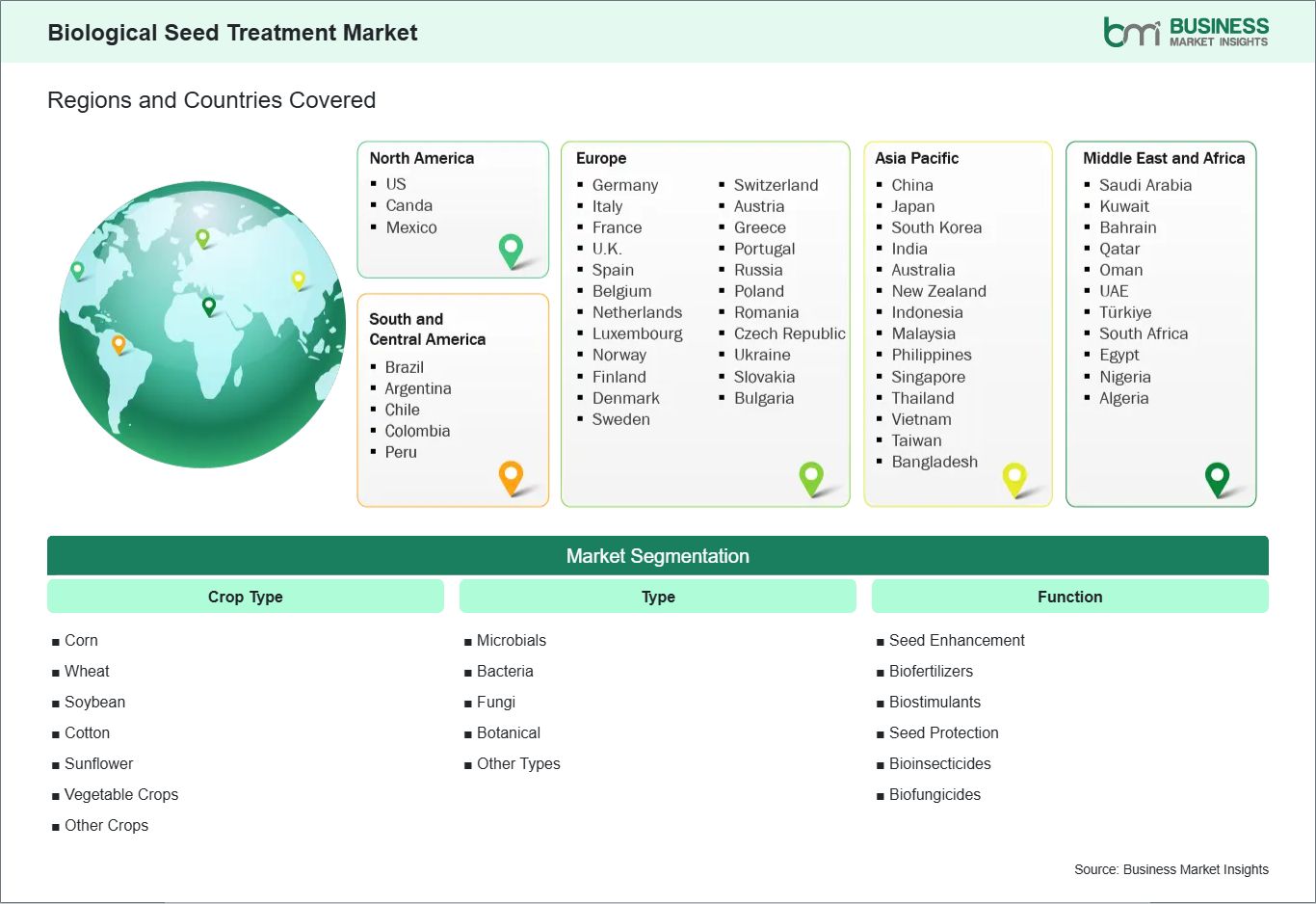
Key segments that contributed to the derivation of the biological seed treatment market analysis are crop type, type, and function.
Sustainable agriculture is driving the growth of the biological seed treatment market, and as a result, farmers are increasingly using biological solutions to reduce their environmental impacts from the use of chemical pesticides and fertilizers while continuing to produce food at an effective rate through sustainable agricultural methods. Some potential benefits of biological seed treatments include improved germination rates, greater availability of nutrients for plant growth, and protection from soil-borne pathogens, making them an attractive option compared to traditional chemical-based seed treatments.
Additionally, the growing demand for organic food products continues to provide momentum for the biological seed treatment market because organic farming relies heavily on biological inputs. Government and regulatory agencies are promoting the use of more environmentally friendly agricultural inputs through subsidies and educational initiatives. The issue of soil degradation and resistance to chemical pesticides is also motivating many farmers to utilize biological seed treatments as part of an integrated approach to pest management.
Technological innovations in the development of microbial formulations and advancements in seed coating technologies have also helped to improve the performance and reliability of biological treatments. As increasing numbers of people become aware of sustainable farming practices, it is anticipated that the use of biological seed treatments will continue to grow significantly.
There is a lot of research going on to develop new types of biological seed treatments using advanced microbial technology, and the biological seed treatment market will take advantage of these new technologies. Many of these new technologies will help companies identify and develop new types of microorganisms that are very good at helping plants grow and protecting plants from insects and diseases. These new technologies will also improve the consistency and performance of the biological seed treatments, regardless of the environment in which they are used.
More specifically, the market for biological seed treatment will continue to grow because there are so many ways in which these products can be applied to crops like cereals, oilseed crops, fruit crops, and vegetable crops. The biology seed treatment companies continue to develop biological seed treatments that are unique for the type of crop that they were created for, and this will have a significant impact on how effective and widely these products are used. The integration of biological seed treatments with precision agriculture practices and digital agriculture technologies will enhance the efficiency in which biological seed treatments can be applied to most crops and how they can be monitored once they are applied.
With many emerging markets located in Asia-Pacific, Latin America, and Africa where people are becoming more aware of sustainable farming practices and agricultural production is rapidly increasing, these markets present a tremendous opportunity for the biological seed treatment market as R&D efforts continue to advance and more products will be produced. Therefore, the biological seed treatment market will continue to grow as a result of the continued development and introduction of new biological seed treatments to the market.
The Biological Seed Treatment Market demonstrates steady growth, with size and share analysis highlighting evolving trends and competitive dynamics among key players. The report examines subsegments categorized within crop type, type, and function, offering insights into their contribution to overall market performance.
By crop type, the corn subsegment dominated the market in 2025, driven by its high global cultivation and demand for yield improvement.
Based on type, the microbials subsegment dominated the market in 2025, driven by their effectiveness in enhancing plant growth and protection.
In terms of function, the seed protection subsegment dominated the market in 2025, driven by increasing need to safeguard crops from pests and diseases.
| Report Attribute | Details |
|---|---|
| Market size in 2025 | US$ 1.58 Billion |
| Market Size by 2033 | US$ 3.92 Billion |
| Global CAGR (2026 - 2033) | 11.8% |
| Historical Data | 2022-2024 |
| Forecast period | 2026-2033 |
| Segments Covered | By Crop Type
|
|
Regions and Countries Covered
| |
| North America | US, Canada, Mexico |
| Europe | Belgium, Austria, Finland, Denmark, Greece, Poland, Romania, Russia, Ukraine, Czech Republic, Slovakia, Bulgaria, Italy, Luxembourg, Germany, Switzerland, France, Netherlands, Norway, Portugal, Spain, Sweden, United Kingdom |
| Asia-Pacific | Australia, China, India, Japan, South Korea, Indonesia, Malaysia, Philippines, Singapore, Thailand, Vietnam, Bangladesh, New Zealand, Taiwan |
| South and Central America | Brazil, Argentina, Peru, Chile, Colombia |
| Middle East and Africa | Bahrain, Kuwait, Oman, Qatar, Saudi Arabia, United Arab Emirates, Turkiye, South Africa, Egypt, Algeria, Nigeria |
| Market leaders and key company profiles |
|
The "Biological Seed Treatment Market Size and Forecast (2022 - 2033)" report provides a detailed analysis of the market covering below areas:
The geographical scope of the Biological Seed Treatment Market report is divided into North America, Asia Pacific, Europe, Middle East & Africa, and South & Central America. North America held the largest share in 2025.
The adoption of biological seed treatments varies significantly across regions, shaped by agricultural practices, regulatory frameworks, and awareness levels. North America leads the global market, driven by strong adoption of sustainable farming practices and advanced agricultural technologies. Farmers in the U.S. and Canada are increasingly turning to biological inputs to enhance crop yields, reduce reliance on chemical pesticides, and meet consumer demand for eco-friendly agricultural products. The region’s robust research ecosystem and supportive government policies further reinforce its leadership position.
Europe is another major market, supported by strict regulations on chemical pesticide usage and a growing emphasis on organic farming. Countries such as Germany, France, and the Netherlands are at the forefront of integrating biological seed treatments into mainstream agriculture. The European Union’s sustainability initiatives and focus on reducing chemical residues in food have accelerated the adoption of biological solutions.
Asia Pacific is the fastest-growing region, fueled by expanding agricultural activities, rising population, and increasing demand for food security. Countries like India and China are witnessing rapid adoption of biological inputs as farmers seek cost-effective and environmentally friendly solutions to improve productivity. Government initiatives aimed at reducing chemical usage and promoting sustainable farming practices are further driving growth in this region.
Emerging regions such as Latin America and Africa hold significant growth potential. Rising awareness of sustainable agriculture, coupled with government support and improving distribution networks, is encouraging farmers to adopt biological seed treatments.
Across all regions, environmental concerns, regulatory developments, and the global push toward sustainability continue to shape market dynamics, with North America expected to remain the largest regional market while Asia Pacific drives future expansion.

The Biological Seed Treatment Market is evaluated by gathering qualitative and quantitative data post primary and secondary research, which includes important corporate publications, association data, and databases. A few of the key developments in the biological seed treatment market are:
The Biological Seed Treatment Market is valued at US$ 1.58 Billion in 2025, it is projected to reach US$ 3.92 Billion by 2033.
As per our report Biological Seed Treatment Market, the market size is valued at US$ 1.58 Billion in 2025, projecting it to reach US$ 3.92 Billion by 2033. This translates to a CAGR of approximately 11.8% during the forecast period.
The Biological Seed Treatment Market report typically cover these key segments-
The historic period, base year, and forecast period can vary slightly depending on the specific market research report. However, for the Biological Seed Treatment Market report:
The Biological Seed Treatment Market is populated by several key players, each contributing to its growth and innovation. Some of the major players include:
The Biological Seed Treatment Market report is valuable for diverse stakeholders, including:
Essentially, anyone involved in or considering involvement in the Biological Seed Treatment Market value chain can benefit from the information contained in a comprehensive market report.
Please tell us your area of interest
(Market Segments/ Regions and Countries/ Companies)