Market Summary
Executive Summary and Global Market Analysis
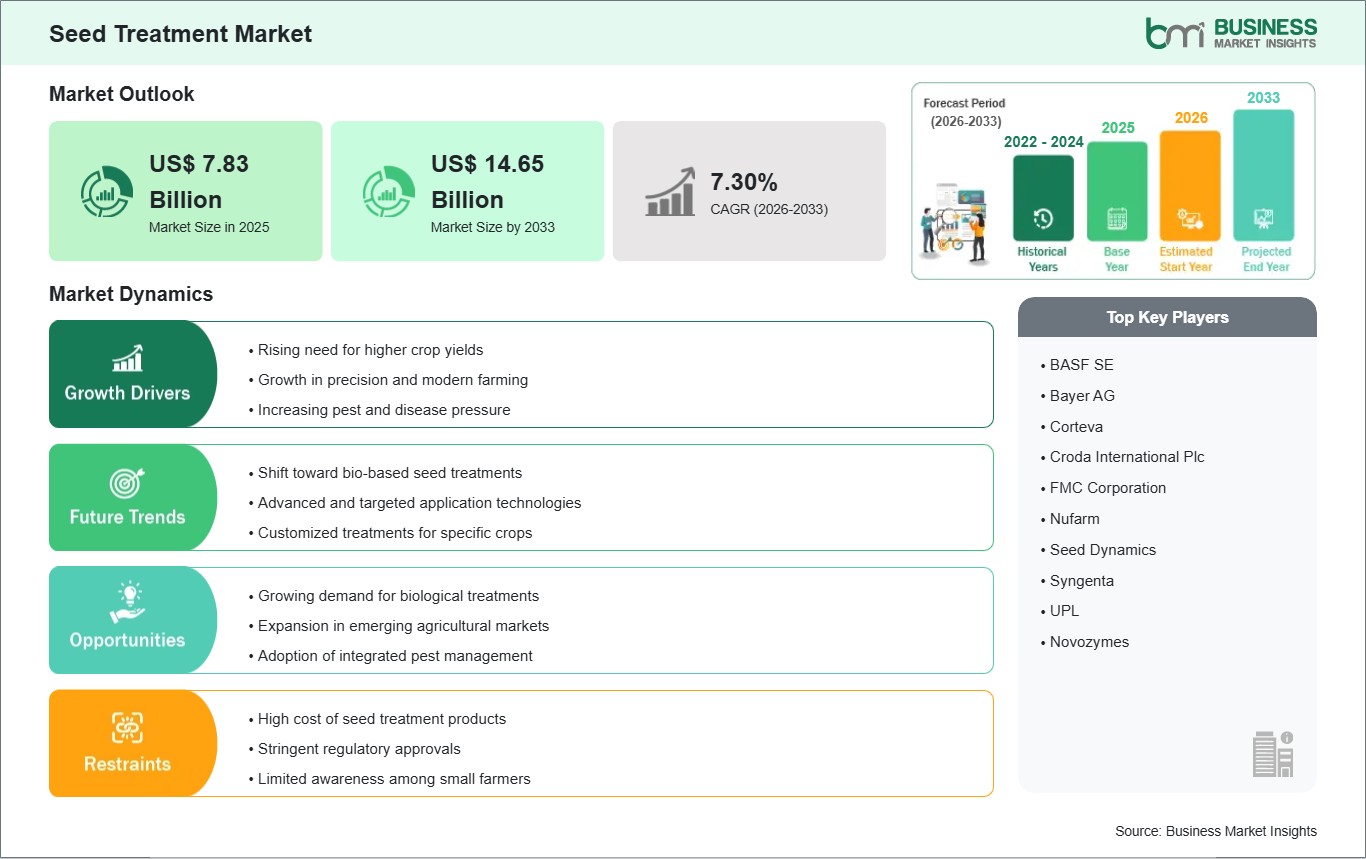
Seed treatment is the process of applying biological or chemical substances to seeds before planting. This protects seeds from pests, diseases, and harsh environmental conditions, while also encouraging healthy germination and early plant growth. Treatments can include fungicides, insecticides, nematicides, micronutrients, and beneficial microorganisms. All these are meant to improve seed vigor and ensure consistent crop establishment. By protecting seeds during critical early stages, seed treatments help lower crop losses and boost overall yield potential.
The need for seed treatment is increasing steadily for several reasons. Global food demand is rising, and the need for higher agricultural productivity is pushing farmers to use technologies that improve crop performance. Seed treatment offers a cost-effective way to manage pests and diseases. It reduces the need for extensive field-applied pesticides and lessens environmental impact. Additionally, the shift in modern agriculture towards precision farming and sustainable practices is driving the use of treated seeds that enhance resource efficiency and decrease chemical use. Regulatory support and growing awareness of the benefits of early-stage crop protection also play a role in this growth. Emerging markets, along with advancements in treatment technologies and formulations, are expanding the market overall. This makes seed treatment an increasingly important part of modern crop production strategies.
Segment Analysis
Seed Treatment Market Segmentation
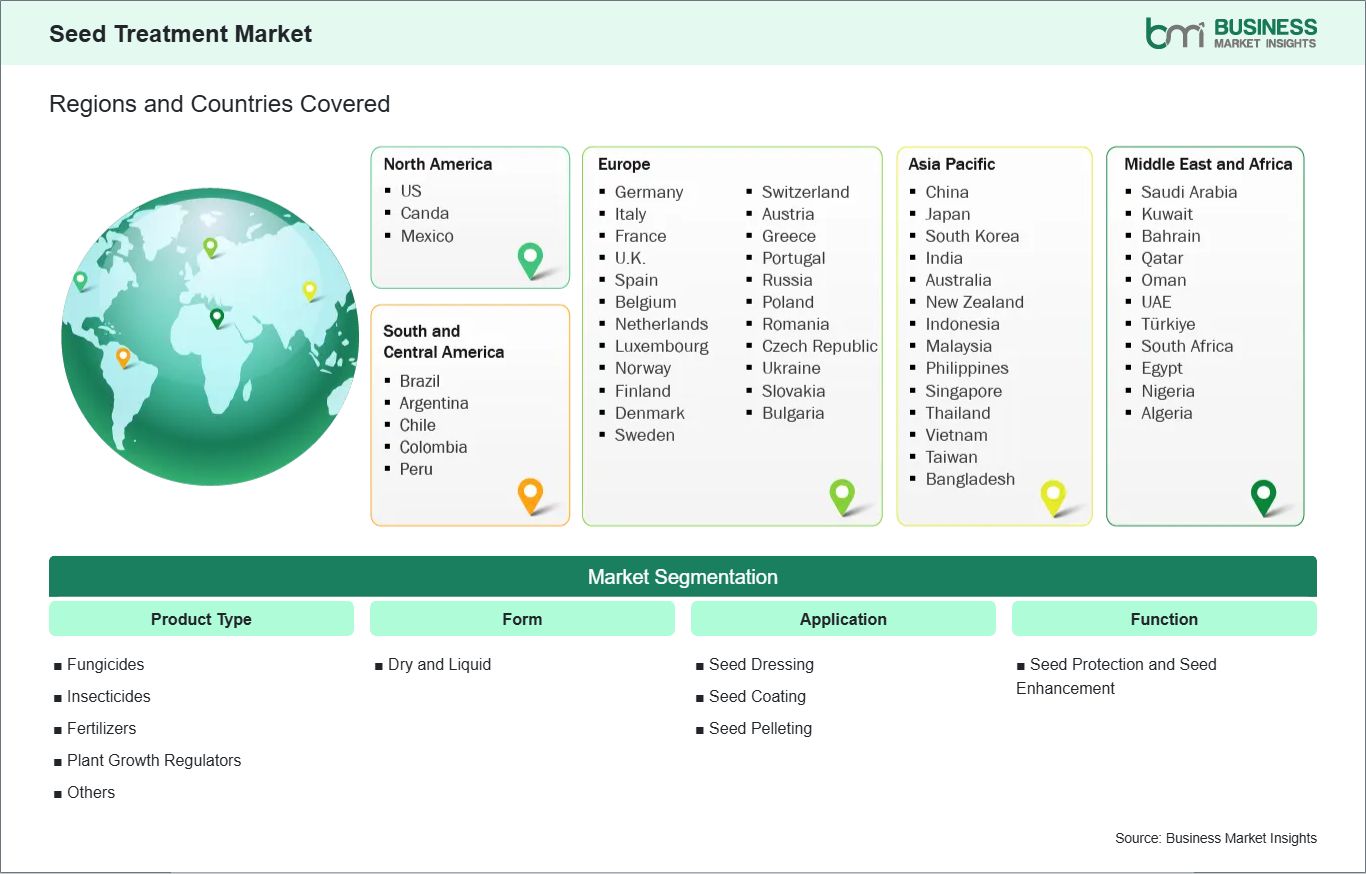
Key segments that contributed to the derivation of the seed treatment market analysis are product type, form, application, function, category, and crop type.
- By product Type, the market is segmented into fungicides, insecticides, fertilizers, plant growth regulators, and others. The fungicides segment accounted for the largest market share in 2025.
- By form, the market is segmented into dry and liquid formulations. The liquid segment accounted for the largest market share in 2025.
- By application, the market is segmented into seed dressing, seed coating, and seed pelleting. The seed coating segment accounted for the largest market share in 2025.
- By function, the market is segmented into seed protection and seed enhancement. The seed protection segment accounted for the largest market share in 2025.
- By category, the market is segmented into biological, chemical, and physical treatments. The chemical segment accounted for the largest market share in 2025.
- By crop type, the market is segmented into cereals and grains, oilseeds and pulses, fruits and vegetables, and others. The cereals and grains segment accounted for the largest market share in 2025.
Market Forces
Seed Treatment Market Drivers and Opportunities
Increasing Demand for Higher Crop Yields and Sustainable Agriculture
The significant driver of the seed treatment market is the growing need to boost agricultural productivity while using sustainable farming practices. With the global population steadily increasing, the demand for food also rises. This pushes farmers to implement better crop protection measures to maximize yield. Seed treatments offer an effective and affordable way to protect seeds from pathogens, pests, and environmental stress during the crucial early stages of germination. This results in healthier seedlings, higher germination rates, and more uniform crop establishment, which leads to better productivity.
Furthermore, modern farming practices focus on sustainability, which includes reducing excessive chemical use and lowering environmental impact. Seed treatments enable the precise application of active ingredients directly onto the seed, reducing the need for widespread pesticide sprays. This combination of improved efficiency, productivity, and adherence to sustainability goals is a key factor in the steady growth of the global seed treatment market.
Development and Adoption of Biological Seed Treatments
A major growth opportunity in the seed treatment market is the development and adoption of biological seed treatment products. These formulations use naturally occurring microorganisms, bio-stimulants, and other non-chemical compounds to improve seed health, promote germination, and stimulate early plant growth. Unlike traditional chemical treatments, biological seed treatments provide environmentally friendly options that meet rising regulatory requirements and consumer demand for sustainable farming.
The emphasis on reducing chemical residues in food and minimizing soil and water pollution is encouraging farmers and agribusinesses to choose eco-friendly alternatives. In addition, advancements in biotechnology and microbial research have enhanced the effectiveness and reliability of biological treatments, making them more competitive with conventional chemical options. Europe, in particular, is seeing increased interest in bio-based solutions due to strict environmental regulations and supportive government programs. This trend offers manufacturers a significant chance to broaden their product offerings and gain a larger market share in the growing sustainable crop protection sector.
Report Coverage
Seed Treatment Market Report Coverage and Deliverables
The Seed Treatment Market Size and Forecast (2022-2033) report provides a detailed analysis of the market covering below areas:
- Seed treatment market size and forecast at global, regional, and country levels for all the key market segments covered under the scope
- Seed treatment market trends, as well as market dynamics such as drivers, restraints, and key opportunities
- Seed treatment market analysis covering key market trends, global and regional framework, major players, regulations, and recent market developments
- Industry landscape and competition analysis covering market concentration, heat map analysis, prominent players, and recent developments for the seed treatment market
- Detailed company profiles, including SWOT analysis
Geographic Insights
Seed Treatment Market Geographic Insights
The geographical scope of the seed treatment market report is divided into five regions: North America, Asia Pacific, Europe, the Middle East & Africa, and South & Central America. The seed treatment market in the Asia Pacific is expected to grow significantly during the forecast period.
This growth is due to a mix of high agricultural activity, population growth, and increasing food demand. Countries like China, India, and Indonesia have large areas of arable land. They depend on cereals, oilseeds, and pulses to ensure food security, which creates strong demand for crop protection solutions, including seed treatments. The region focuses on improving crop productivity and reducing losses after sowing. This has led to more farmers using treated seeds that improve germination rates, protect against pests and diseases, and boost early plant growth.
Government programs that promote modern and sustainable farming practices, along with a growing awareness among farmers about the advantages of seed treatment, have further spurred market growth. Rapid advancements in technology, the availability of affordable products, and expanding distribution networks also play a role in making this region the largest and fastest-growing market for seed treatment globally.
Industry Activity
Recent Developments
The seed treatment market is evaluated by gathering qualitative and quantitative data post-primary and secondary research, which includes important corporate publications, association data, and databases. A few of the key developments in the seed treatment market are:
- In July 2025, Bayer CropScience launched the Yoalo biostimulant seed treatment for corn. This new product aims to improve early crop performance by stimulating root development and nutrient use. It supports a move toward more sustainable seed treatments with less reliance on conventional agrochemicals.
- In 2025, BASF announced that Integral Pro received EU registration for sunflowers. This new fungicide seed treatment will be available in the European Union starting the 2026 sowing season. It offers better protection against key fungal diseases and strengthens crop resilience.
Trust & Transparency
Research Methodology
The market analysis combines proprietary research with secondary data from government agencies, company disclosures, regulatory filings, industry databases and expert interviews. Market estimates are validated through data triangulation, cross-market benchmarking and analyst
review.
View Full Research Methodology
Key Sources Referred:
World Bank – Global Trade Indicators
European Chemicals Agency
International Council of Chemical Associations
(International Monetary Fund )IMF
World Trade Organization (WTO)
International Trade Administration (ITA)
Company website
Company annual reports
Company investor presentations