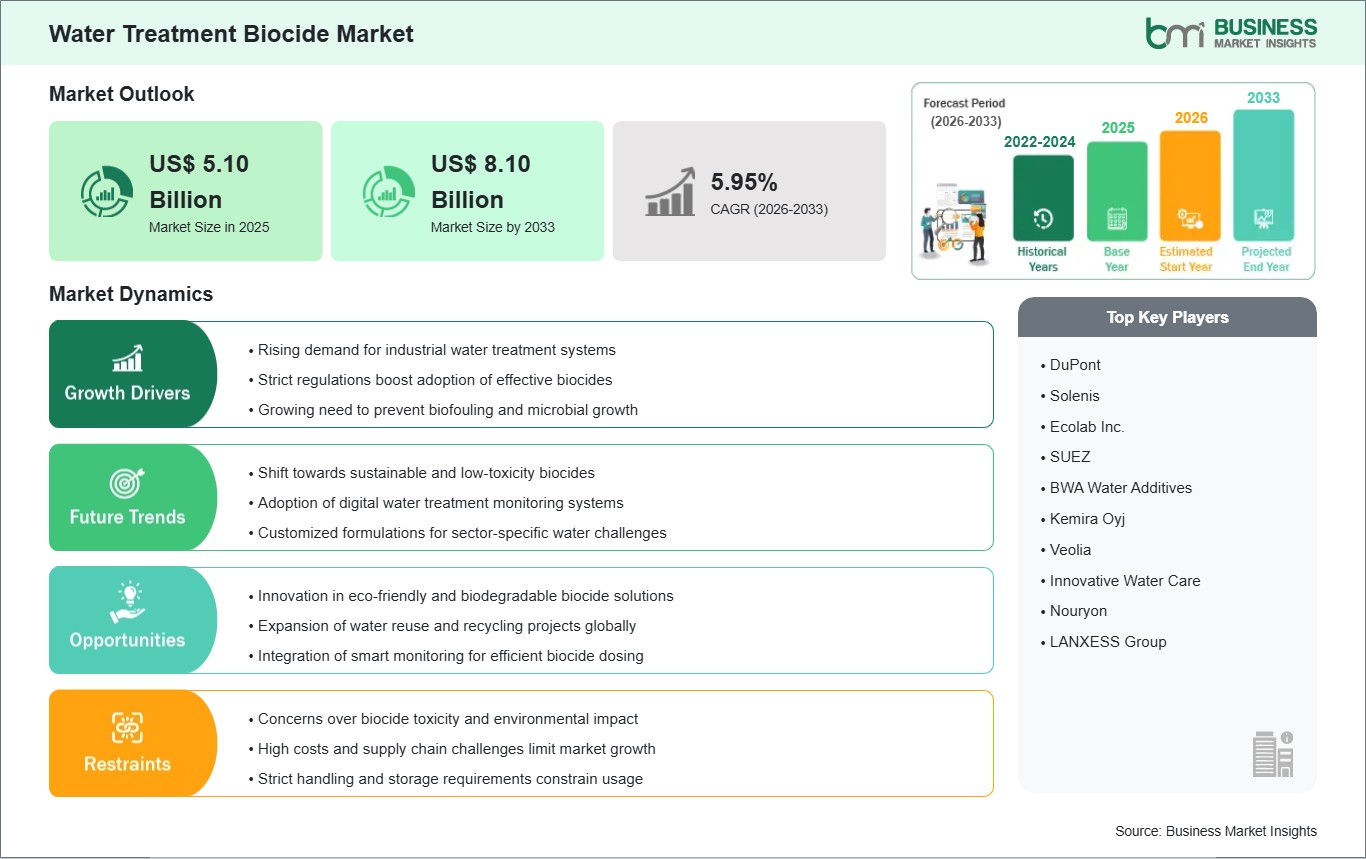
The Water Treatment Biocide Market size is expected to reach US$ 8.1 billion by 2033 from US$ 5.1 billion in 2025. The market is estimated to record a CAGR of 5.95% from 2026 to 2033.
The global Water Treatment Biocide Market has expanded to become an essential element of industrial and municipal water treatment systems, which operate throughout the world, because of the essential need to manage microbial growth, biofouling and corrosion within all water-based systems. Industrial processes require advanced biocidal solutions for equipment maintenance, regulatory compliance and public health protection according to rising environmental regulations, which restrict water quality standards. Water treatment biocides function as chemical agents that stop bacteria, algae, fungi and other microorganisms from growing to protect water systems against operational problems and safety hazards. Developing economies and developed economies both drive market growth through their increasing commitment to sustainable water management, together with their need for improved water treatment methods. Businesses now need advanced treatment chemicals because of strict discharge regulations and environmental protection programs, which require them to achieve water reuse standards and effluent quality requirements.
The growing knowledge about how biofilm formation affects industrial heat exchangers, pipelines and membranes has resulted in increased demand for specific biocidal products which include both oxidizing and non-oxidizing solutions. Market expansion encounters specific limitations, even though the outlook appears positive. Traditional biocides contain toxic components that create safety hazards for workers and establish handling needs, while their residual chemicals pose environmental risks to natural water systems. Manufacturers face pressure to develop new, environmentally safe products that maintain effective performance standards. Supply chain difficulties, together with fluctuations in raw material prices, create obstacles for businesses that need to maintain product availability and control expenses.
The Water Treatment Biocide Market operates at a worldwide scale because its demand increases through regulatory and operational requirements, while the industry shifts toward sustainable practices that use safer chemicals to solve environmental problems.

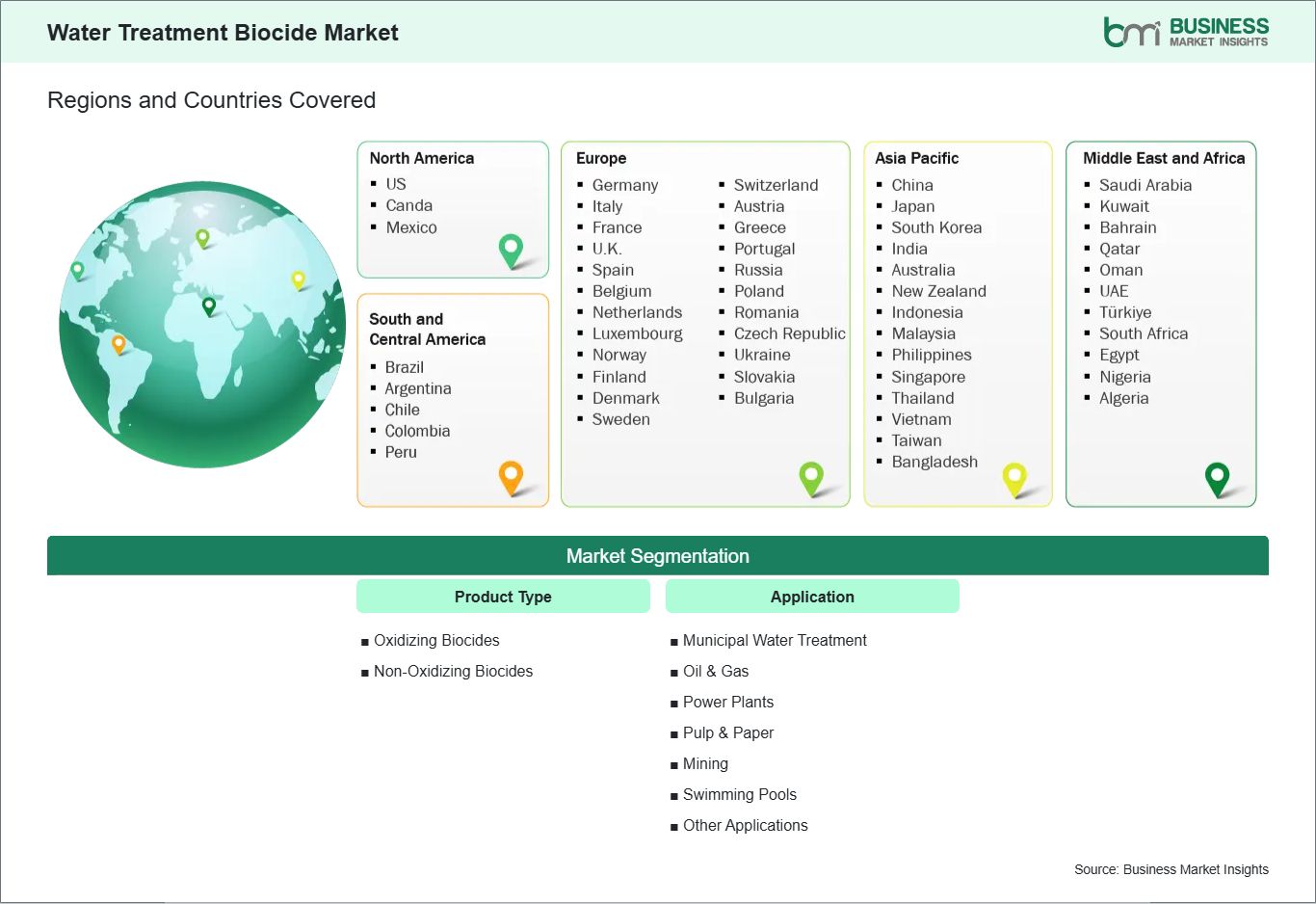
Key segments that contributed to the derivation of the water treatment biocide market analysis are product type and application.
The global water treatment biocide market is experiencing robust momentum because industrial sectors that use water as their primary processing material need to control their water usage. The power generation, chemicals, oil and gas, paper and pulp and food and beverage industries use biocides to control three main problems, which include microbial contamination, biofilm growth and system corrosion. Water‑intensive operations need biocidal treatment because bacteria and algae cause three major problems, which include decreased heat transfer efficiency, piping network blockages and equipment system failures.
Industrial demand has increased because global manufacturing operations are expanding while advanced economies and developing economies establish stricter water quality standards. East Asian facilities are enhancing treatment systems to match their rapid industrial growth, while North American and Western European facilities implement biocide dosing methods that support their energy efficiency objectives. Cooling water systems in energy production use biocides to ensure operational continuity while preventing expensive shutdowns that result from microbial blockage.
Industrial water management practices are undergoing transformation worldwide because organizations increasingly focus on water reuse and recovery. Reuse initiatives require companies to establish effective treatment systems that use biocides to protect the quality of recycled water because many regions experience water scarcity issues. The comprehensive method uses water treatment biocides as essential elements that support industrial ecosystems to achieve operational stability, environmental regulations and sustainable development.
As environmental stewardship becomes a strategic imperative, the water treatment biocide market is shifting toward more eco‑friendly and biodegradable solutions. Traditional biocides, while effective at controlling microbes, have raised concerns about downstream ecological effects when residual chemicals enter natural water bodies. This has prompted manufacturers and chemical innovators to rethink formulation strategies, prioritizing chemistries that break down into benign byproducts without compromising antimicrobial efficacy, particularly in sensitive ecosystems.
Leading chemical developers in Europe and North America are pioneering next‑generation biocides infused with novel active components derived from renewable feedstocks or engineered for rapid environmental degradation. These innovations address the dual challenge of delivering reliable microbial control while minimizing long‑term persistence in aquatic environments, aligning with stricter effluent regulations and corporate sustainability commitments. In markets such as Scandinavia and Japan, where environmental performance standards are especially high, eco‑friendly biocides are increasingly integrated into municipal and industrial water treatment frameworks.
In parallel, research collaborations between academic institutions and industry stakeholders are expanding understanding of microbial ecology in treatment systems, enabling smarter targeting of biocide action with reduced overall chemical load. Such advancements not only support regulatory compliance but also help water managers mitigate public concerns about chemical footprints. As eco‑design principles continue to influence product roadmaps, innovations in biodegradable biocides are becoming essential levers for global water treatment strategies that balance performance, safety, and sustainability.

The water treatment biocide market demonstrates steady growth, with size and share analysis highlighting evolving trends and competitive dynamics among key players. The report examines subsegments categorized within product type and application, offering insights into their contribution to overall market performance.
By product type, the non‑oxidizing biocides subsegment dominated the market in 2025, driven by their effectiveness in controlling microbial growth while minimizing corrosion and chemical reactivity.
Based on application, the oil & gas subsegment dominated the market in 2025, driven by the high demand for water treatment biocides in upstream and downstream operations to maintain equipment efficiency and safety.
| Report Attribute | Details |
|---|---|
| Market size in 2025 | US$ 5.10 Billion |
| Market Size by 2033 | US$ 8.10 Billion |
| Global CAGR (2026 - 2033) | 5.95% |
| Historical Data | 2022-2024 |
| Forecast period | 2026-2033 |
| Segments Covered | By Product Type
|
|
Regions and Countries Covered
| |
| North America | US, Canada, Mexico |
| Europe | Belgium, Austria, Finland, Denmark, Greece, Poland, Romania, Russia, Ukraine, Czech Republic, Slovakia, Bulgaria, Italy, Luxembourg, Germany, Switzerland, France, Netherlands, Norway, Portugal, Spain, Sweden, United Kingdom |
| Asia-Pacific | Australia, China, India, Japan, South Korea, Indonesia, Malaysia, Philippines, Singapore, Thailand, Vietnam, Bangladesh, New Zealand, Taiwan |
| South and Central America | Brazil, Argentina, Peru, Chile, Colombia |
| Middle East and Africa | Bahrain, Kuwait, Oman, Qatar, Saudi Arabia, United Arab Emirates, Turkiye, South Africa, Egypt, Algeria, Nigeria |
| Market leaders and key company profiles |
|
The "Water Treatment Biocide Market Size and Forecast (2022 - 2033)" report provides a detailed analysis of the market covering below areas:
The geographical scope of the Water Treatment Biocide Market report is divided into North America, Asia Pacific, Europe, Middle East & Africa, and South & Central America. North America held the largest share in 2025.
North America leads the global Water Treatment Biocide Market because its industrial base has reached full development, combined with strict water quality regulations, power generation operations and oil and gas sector and municipal utility sector and the chemical industry sectors using advanced treatment technologies.
The U.S. and Canada implement regulatory frameworks that establish strict requirements for microbial control and effluent discharge standards, thus requiring facilities to use biocide solutions that combine high performance with minimal environmental impact. This requirement is met because facilities possess technical expertise and they maintain ongoing product development activities.
The Asia Pacific market grows because industrialization, urbanization and water infrastructure investments drive demand, with China, India, Japan and Southeast Asian nations investing to modernize their outdated water treatment facilities while using anti-biofouling methods in their manufacturing and cooling systems to satisfy increasing public health and environmental standards.
The European market maintains equilibrium because environmental regulations, chemical usage restrictions and sustainability practices dictate market operations. European stakeholders increasingly prioritize reduced‑toxicity and biodegradable biocides to meet both regulatory requirements and social expectations for environmental stewardship, with well‑established water reuse and recycling initiatives further amplifying the need for effective microbial control.
The Middle East and Africa face water scarcity challenges which necessitate desalination technology expansion, while desalination operations use biocides to stop microbial growth in their plants and industrial cooling systems and municipal distribution networks. The market environment exhibits distinct characteristics because of economic differences between countries and the existence of multiple regulatory frameworks in South and Central America, which shows increasing understanding of water infrastructure modernization and industrial water management through its wastewater treatment improvements and process efficiency enhancements.

The Water Treatment Biocide Market is evaluated by gathering qualitative and quantitative data post primary and secondary research, which includes important corporate publications, association data, and databases. A few of the key developments in the water treatment biocide market are:
The Water Treatment Biocide Market is valued at US$ 5.10 Billion in 2025, it is projected to reach US$ 8.10 Billion by 2033.
As per our report Water Treatment Biocide Market, the market size is valued at US$ 5.10 Billion in 2025, projecting it to reach US$ 8.10 Billion by 2033. This translates to a CAGR of approximately 5.95% during the forecast period.
The Water Treatment Biocide Market report typically cover these key segments-
The historic period, base year, and forecast period can vary slightly depending on the specific market research report. However, for the Water Treatment Biocide Market report:
The Water Treatment Biocide Market is populated by several key players, each contributing to its growth and innovation. Some of the major players include:
The Water Treatment Biocide Market report is valuable for diverse stakeholders, including:
Essentially, anyone involved in or considering involvement in the Water Treatment Biocide Market value chain can benefit from the information contained in a comprehensive market report.
Please tell us your area of interest
(Market Segments/ Regions and Countries/ Companies)