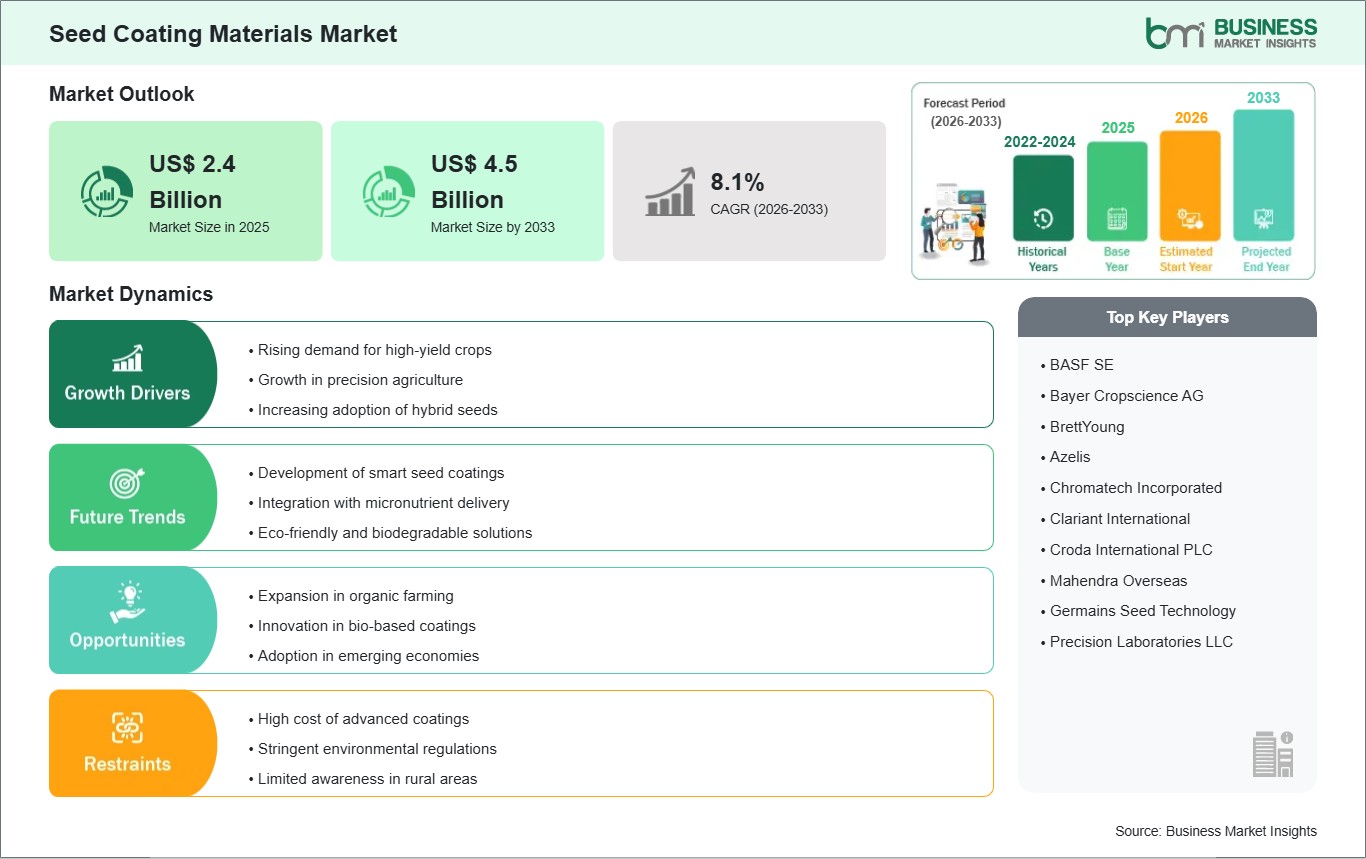
The Seed Coating Materials Market size is expected to reach US$ 4.5 billion by 2033 from US$ 2.4 billion in 2025. The market is estimated to record a CAGR of 8.1% from 2026 to 2033.
Seed coating materials are specialized chemical or biological substances applied to the surface of seeds to enhance their physical properties, protect them from stressors, and improve overall delivery during planting. These materials, which include polymers, colorants, binders, and active ingredients like fungicides or nutrients, are designed to create a uniform layer that facilitates precise mechanical sowing, ensures better germination, and provides early-stage protection for the developing seedling. Market expansion is primarily attributed to the rising global demand for high-yield and disease-resistant seeds, the increasing adoption of precision farming techniques, and the shift toward sustainable and bio-based agricultural inputs. Furthermore, the integration of microplastic-free, biodegradable polymers and nanocoating technologies, which allow for the controlled release of nutrients and biologicals, is substantially improving procedural efficiency.
However, regulatory restrictions, particularly in Europe, are accelerating the phase-out of non-biodegradable polymers and microplastics, creating compliance hurdles for manufacturers. Technical complexities in integrating biological agents, such as microbial inoculants, into coatings without compromising seed viability add another layer of difficulty. Additionally, cost pressures and the need for uniform application across diverse seed types remain significant operational constraints.
Despite these restraints, the market offers lucrative opportunities. The transition toward bio-based, microplastic-free coatings derived from cellulose, starch, and plant extracts is opening new growth avenues. Controlled-release technologies and encapsulation systems are enabling precise, timed delivery of active ingredients, improving efficiency and reducing environmental impact. Furthermore, the integration of biostimulants and microbial inoculants into coatings aligns with the growing trend toward regenerative and organic farming. Emerging technologies, such as AI-powered imaging systems for quality control, are enhancing coating uniformity and performance. Collectively, these innovations position seed coating materials as a cornerstone of sustainable agriculture and a high-potential investment area for the coming decade.

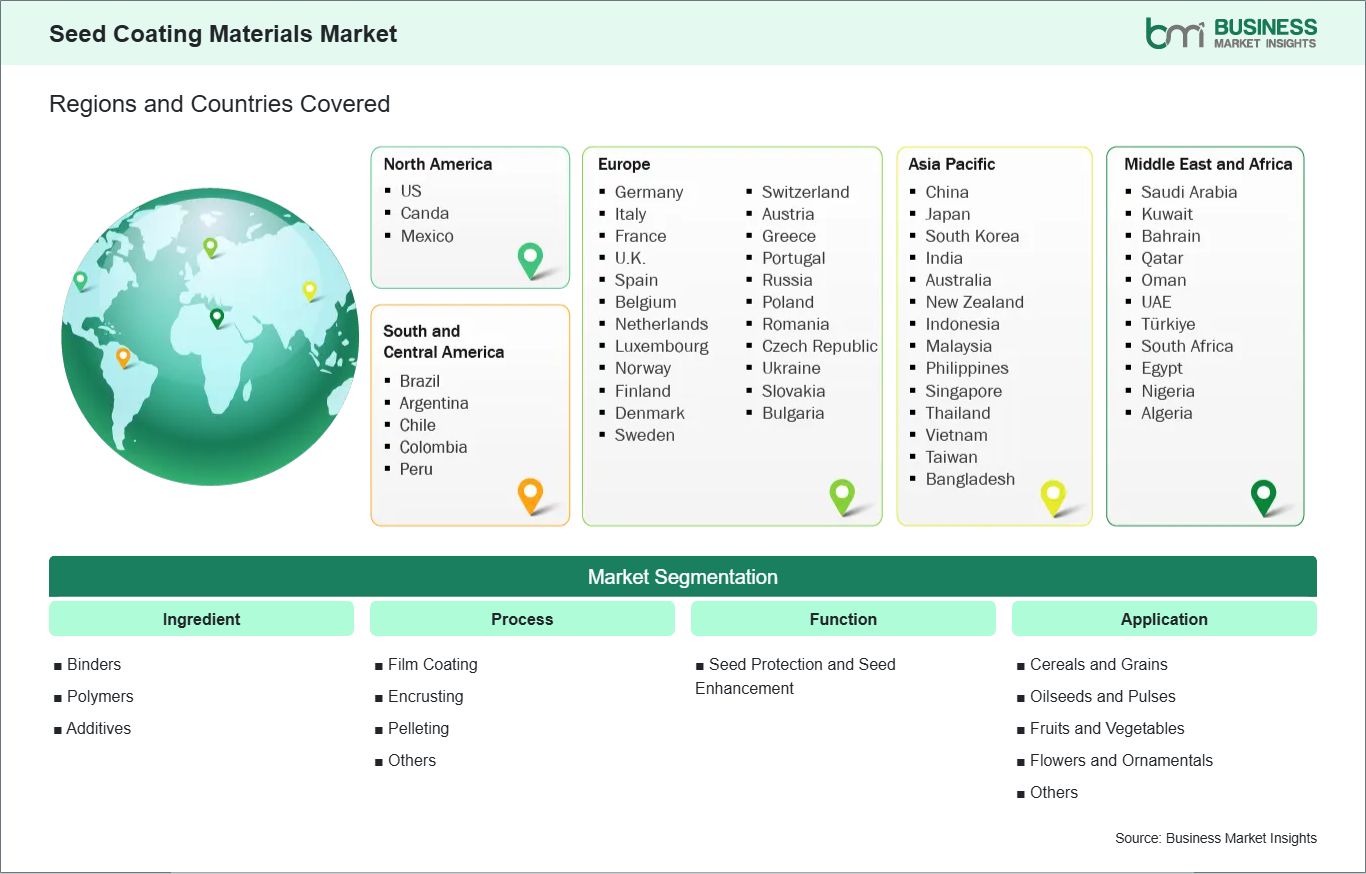
Key segments that contributed to the derivation of the Seed Coating Materials market analysis are ingredient, process, function, and application.
The agricultural sector is facing mounting pressure to produce more food on limited arable land while coping with unpredictable climate conditions. Farmers are increasingly turning to advanced technologies that can enhance crop performance and ensure reliable yields under challenging circumstances. One such innovation is seed coating, which has become an essential tool for modern farming practices.
Seed coatings serve as a protective layer during the critical early stages of crop development, shielding seeds from pests, soil-borne diseases, and environmental stressors. Beyond protection, coatings enable precise delivery of nutrients, growth regulators, and crop protectants directly to the seed, reducing waste and minimizing environmental impact compared to traditional broadcasting or spraying methods. Recent advancements in coating technology are designed to help crops withstand drought, salinity, and extreme temperatures, ensuring better establishment and growth in marginal conditions. As farmers seek solutions to improve germination rates, achieve uniform stand establishment, and safeguard high-value genetic inputs, the demand for seed coatings continues to rise, driving significant growth in the market.
Regulatory pressure, combined with rapid technological innovation, is reshaping the agricultural inputs industry and creating high-value opportunities centered on sustainability. The mandated shift away from non-biodegradable synthetic polymers is driving demand for eco-friendly alternatives, opening significant prospects for manufacturers capable of developing cost-competitive, microplastic-free, bio-based polymer systems. These advanced polymers, often derived from renewable sources such as cellulose, starches, and specialized plant extracts, align with global sustainability goals and consumer preferences for greener solutions.
A major growth avenue lies in the integration of biologically active ingredients, such as microbial inoculants, nitrogen-fixing bacteria, and biostimulants, into seed coatings. These enhanced coatings not only improve germination but also promote soil health, optimize nutrient use efficiency, and bolster plant resilience against environmental stress, supporting the surge in organic and regenerative farming practices. Furthermore, cutting-edge technologies like AI-powered imaging systems at seed treatment facilities ensure superior coating uniformity and quality. Complementing this, controlled-release microencapsulation techniques enable precise, timed delivery of active ingredients, maximizing efficacy while minimizing ecological impact. Together, these innovations position the industry for sustainable, technology-driven growth.

The Seed Coating Materials Market demonstrates steady growth, with size and share analysis revealing evolving trends and competitive positioning among key players. The report further examines subsegments categorized within ingredient, process, function, and application, offering insights into their contribution to overall market performance.
For instance, the Polymers subsegment holds a significant market share. Polymers, specifically when utilized in Film Coating, are indispensable for modern Cereals and Grains production, where they provide a durable yet thin protective layer that improves seed flowability in mechanical planters. A notable trend in 2025 is the transition toward microplastic-free and biodegradable polymers to comply with tightening environmental regulations in Europe and North America. These innovations are particularly vital in precision agriculture, where they allow for the micro-dosing of active ingredients while preventing "dust-off" during handling and sowing.
| Report Attribute | Details |
|---|---|
| Market size in 2025 | US$ 2.4 Billion |
| Market Size by 2033 | US$ 4.5 Billion |
| Global CAGR (2026 - 2033) | 8.1% |
| Historical Data | 2022-2024 |
| Forecast period | 2026-2033 |
| Segments Covered | By Ingredient
|
| Regions and Countries Covered | North America
|
| Market leaders and key company profiles |
|
The "Seed Coating Materials Market Size and Forecast (2022–2033)" report provides a detailed analysis of the market covering below areas:
The geographical scope of the Seed Coating Materials Market report is divided into five regions: North America, Europe, Asia Pacific, the Middle East & Africa, and South & Central America.
North America continues to advance with precision farming and high-tech seed treatments, driving innovation in coating technologies. Europe emphasizes sustainability, with stringent regulations accelerating the adoption of biodegradable and microplastic-free coatings. Asia Pacific is witnessing rapid modernization in agriculture, particularly in China and India, creating strong demand for high-performance coatings. South & Central America leverage coatings for large-scale commodity crops like soybeans and corn, ensuring consistency in challenging environments. Meanwhile, the Middle East and Africa prioritize coatings that enhance resilience against drought and salinity, supporting crop establishment in arid regions.

The Seed Coating Materials Market is evaluated by gathering qualitative and quantitative data post-primary and secondary research, which includes important corporate publications, association data, and databases. A few of the key developments in the Seed Coating Materials Market are:
The Seed Coating Materials Market is valued at US$ 2.4 Billion in 2025, it is projected to reach US$ 4.5 Billion by 2033.
As per our report Seed Coating Materials Market, the market size is valued at US$ 2.4 Billion in 2025, projecting it to reach US$ 4.5 Billion by 2033. This translates to a CAGR of approximately 8.1% during the forecast period.
The Seed Coating Materials Market report typically cover these key segments-
The historic period, base year, and forecast period can vary slightly depending on the specific market research report. However, for the Seed Coating Materials Market report:
The Seed Coating Materials Market is populated by several key players, each contributing to its growth and innovation. Some of the major players include:
The Seed Coating Materials Market report is valuable for diverse stakeholders, including:
Essentially, anyone involved in or considering involvement in the Seed Coating Materials Market value chain can benefit from the information contained in a comprehensive market report.
Please tell us your area of interest
(Market Segments/ Regions and Countries/ Companies)