Market Summary
Executive Summary and Global Market Analysis
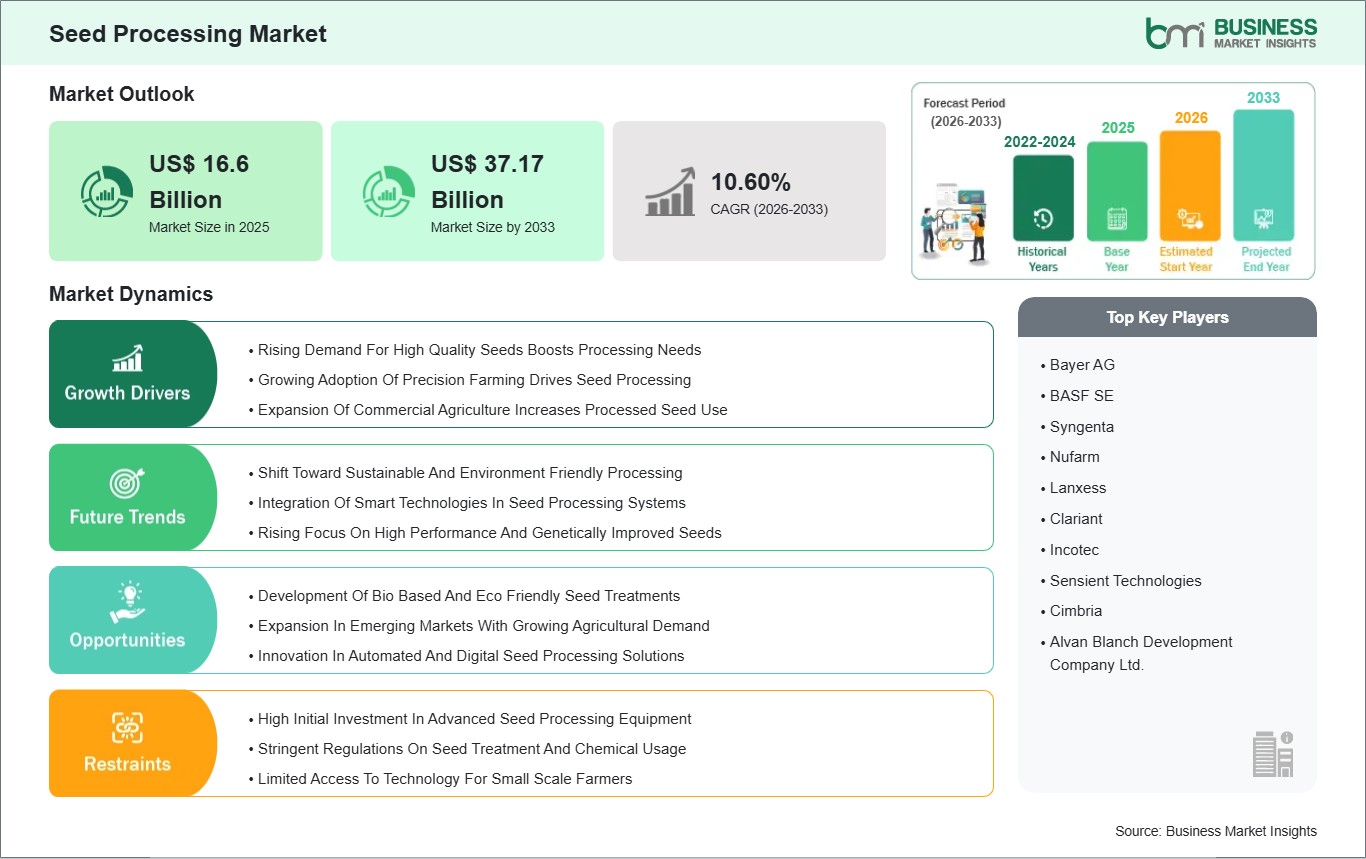
The worldwide seed processing industry functions as a vital element for current agricultural practices because it produces superior seeds which enable farmers to cultivate better crops that exhibit consistent growth patterns and strong resistance to diseases. The seed processing procedure consists of multiple steps which include cleaning and grading and sorting and treating and coating to achieve better seed quality before the seeds reach farmers. The agricultural industry requires processed seeds today because farmers need them for their main cereal and oilseed and horticultural crop operations.
The increasing focus on yield optimization for each hectare of agricultural land in areas with limited land availability has established seed quality as an essential requirement which drives the adoption of seed processing technologies throughout the worldwide agricultural value chain. The market experiences its primary growth driver from the rising implementation of commercial farming and precision agricultural techniques which farmers adopt throughout the world. Farmers now recognize that treated seeds which provide uniformity together with better germination ability and pest resistance benefits their farming operations because these seeds decrease crop losses while increasing their overall productivity.
The development of seed treatment technologies which involve coating with nutrients and biological agents and protective chemicals has raised the significance of processing. The government and agricultural organizations throughout different regions promote certified seeds together with quality standards which create an indirect demand for advanced processing systems. The market encounters two major constraints which include the need for high capital investment to acquire advanced processing equipment and the limited technology access experienced by small-scale farmers. Manufacturers and processors face difficulties because of two main issues which include environmental concerns related to chemical seed treatments and strict regulatory requirements that exist in certain areas.
Segment Analysis
Seed Processing Market Segmentation
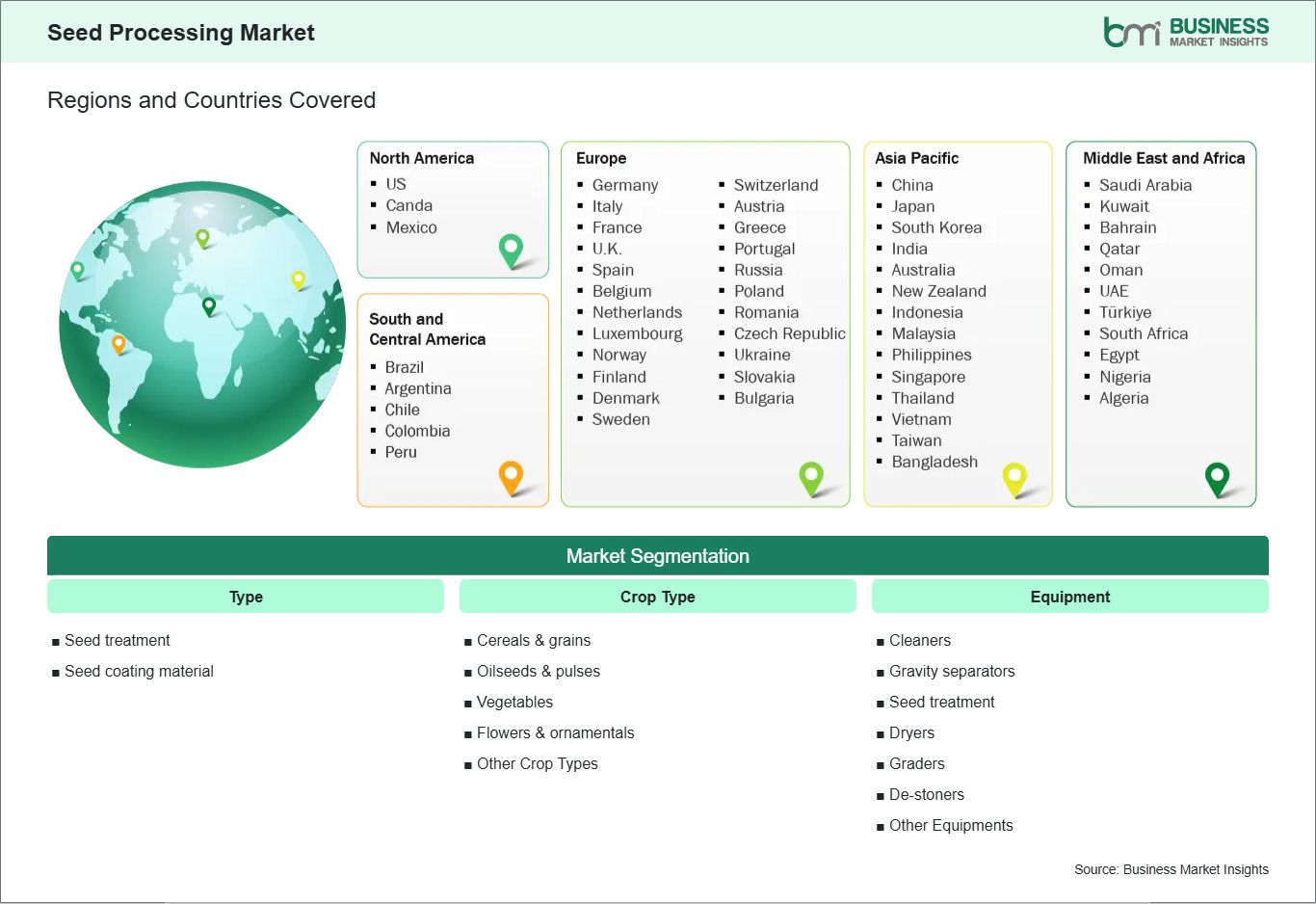
Key segments that contributed to the derivation of the seed processing market analysis are type, crop type, and equipment.
- By type, the seed processing market is segmented into seed treatment and seed coating material. The seed treatment segment dominated the market in 2025.
- Based on crop type, the seed processing market is categorized into cereals & grains, oilseeds & pulses, vegetables, flowers & ornamentals, other crop types. The cereals & grains segment dominated the market in 2025.
- On the basis of equipment, the seed processing market is categorized into cleaners, gravity separators, seed treatment, dryers, graders, de-stoners, other equipment. The cleaners segment dominated the market in 2025.
Market Forces
Seed Processing Market Drivers and Opportunities
Rising Demand For High Quality Seeds Boosts Processing Needs
The global seed processing market is being driven by increasing demand for high-quality seeds across cereals, oilseeds, vegetables, and specialty crops. Farmers across all continents use processed seeds because these seeds provide uniform germination together with improved crop performance and disease protection. North America and Europe developed regions show increasing adoption of precision farming methods by commercial farms which require continuous seed quality maintenance to achieve optimal production results and operational performance. High-quality processed seeds provide solutions for both climate change challenges and soil condition problems. The processes of seed treatment together with grading and coating develop better seed viability and germination rates which enable crops to thrive in multiple environmental settings. The usage of processed seeds has now evolved into a basic requirement for large-scale commercial operations instead of remaining an additional benefit.
Development Of Bio Based And Eco Friendly Seed Treatments
The seed processing market develops new methods because eco-friendly and bio-based seed treatments acquire international recognition. The application of chemical-based coatings and treatments creates environmental hazards which make seed disposal and recycling operations more difficult. Manufacturers develop treatments which use biodegradable polymers and natural protective agents and microbial coatings to improve germination results while minimizing environmental damage. The transition occurs mostly through Europe and North America because their environmental rules are strict and people have become more environmentally conscious. Companies are focusing on water-based adhesives and bioactive coatings and nutrient-enriched treatments which keep seed performance intact while avoiding toxic residue conflicts. The solutions decrease chemical usage during cultivation which supports sustainable agricultural practices.
Size and Share Analysis
Seed Processing Market Size and Share Analysis
The seed processing market demonstrates steady growth, with size and share analysis highlighting evolving trends and competitive dynamics among key players. The report examines subsegments categorized within type, crop type, and equipment, offering insights into their contribution to overall market performance.
By type, the seed treatment subsegment dominated the market in 2025, driven by increasing seed replacement rates and rising adoption of advanced treated seeds for improved germination and crop protection.
Based on crop type, the cereals & grains subsegment dominated the market in 2025, driven by their role as staple crops globally and high demand for processed seeds to ensure productivity and food security.
On the basis of equipment, the cleaners subsegment dominated the market in 2025, driven by their essential role as the primary step in seed processing for removing impurities and ensuring seed quality.
Report Coverage
Seed Processing Market Report Coverage and Deliverables
The "Seed Processing Market Size and Forecast (2022 - 2033)" report provides a detailed analysis of the market covering below areas:
- Seed Processing Market size and forecast at global, regional, and country levels for all the key market segments covered under the scope
- Seed Processing Market trends, as well as drivers, restraints, and opportunities
- Seed Processing Market analysis covering key trends, global and regional framework, major players, regulations, and recent developments
- Industry landscape and competition analysis covering market concentration, heat map analysis, prominent players, and recent developments for the Seed Processing Market
- Detailed company profiles, including SWOT analysis
Geographic Insights
Seed Processing Market Geographic Insights
The geographical scope of the Seed Processing Market report is divided into North America, Asia Pacific, Europe, Middle East & Africa, and South & Central America. North America held the largest share in 2025.
The global seed processing market shows North America as its leading region because the area possesses an advanced farming system which benefits from precision agriculture technology and active agricultural research institutions and major agribusiness companies.
The United States and Canada farmers use processed and treated seeds for their main operations because these seeds deliver regular germination rates and higher crop production and protection against insects and plant diseases.
Europe operates as a developed and innovation-focused market, which drives the adoption of superior processed seeds and sustainable treatment methods through its strict regulatory requirements and environmental sustainability objectives. Advanced seed processing systems gain adoption in Germany France and the Netherlands because these countries prioritize seed quality assessment and environmental protection compliance and product traceability.
The Asia Pacific region experiences rapid growth because its population increases and food demand rises and agricultural practices shift from traditional methods to commercial farming in China India and Japan. The region's governments established seed quality improvement programs which led to increased adoption of contemporary seed processing technologies and equipment.
The Middle East and Africa market shows steady growth because agricultural productivity improvements in arid and semi-arid areas depend on processed seeds, which improve crop resistance to climatic challenges.
Brazil and Argentina experience increased adoption of agricultural practices because their countries depend on their extensive agricultural systems and export-focused farming activities to create a need for advanced seed technologies.
The global seed processing market experiences continuous growth because all regions require better crop production results and environmentally friendly farming methods and new agricultural technologies. North America leads the global seed processing market because it has advanced technology and developed infrastructure and people understand the advantages of seed quality.
Industry Activity
Recent Developments
The Seed Processing Market is evaluated by gathering qualitative and quantitative data post primary and secondary research, which includes important corporate publications, association data, and databases. A few of the key developments in the seed processing market are:
- In August 2025, Origin Agritech Ltd. announced that it had commenced full‑scale seed processing operations at its Xinjiang production facility, activating a fully automated line that integrates cleaning, drying, sorting, coating, and packaging to meet demand for high‑quality corn seeds across China`s agricultural markets.
- In April 2025, Westrup A/S announced that it had completed the acquisition of Premium Seeds Machines (PSM), merging engineering teams and expanding its global seed processing solutions portfolio and manufacturing capabilities to better serve customers worldwide.
Trust & Transparency
Research Methodology
The market analysis combines proprietary research with secondary data from government agencies, company disclosures, regulatory filings, industry databases and expert interviews. Market estimates are validated through data triangulation, cross-market benchmarking and analyst
review.
View Full Research Methodology
Key Sources Referred:
World Health Organization (WHO) Organisation for Economic Cooperation and Development (OECD) The World Bank Group Worldometer The Lancet International Bar Association International Trade Administration