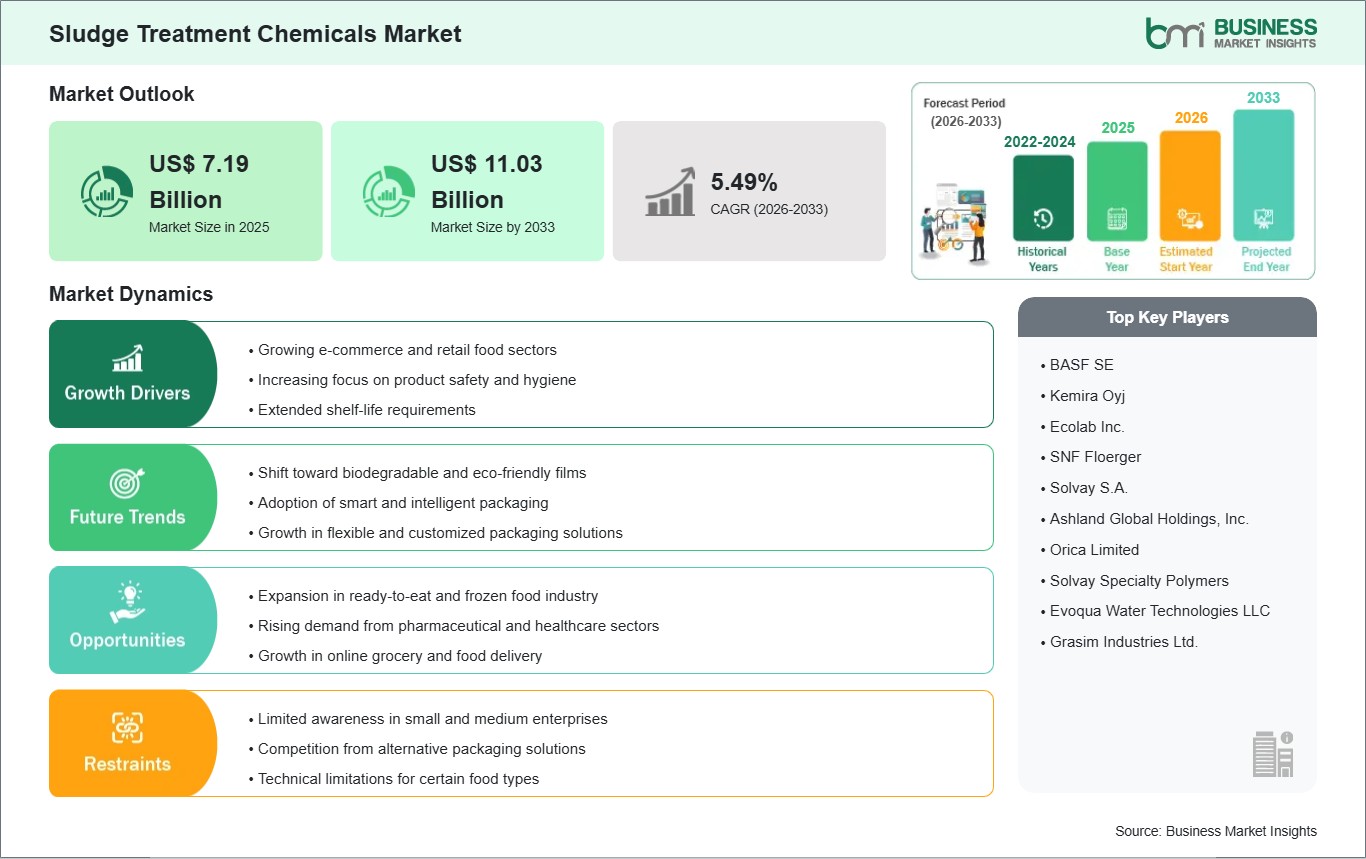
The Sludge Treatment Chemicals Market size is expected to reach US$ 11.03 billion by 2033 from US$ 7.19 billion in 2025. The market is estimated to record a CAGR of 5.49% from 2026 to 2033.
The global sludge treatment chemicals market is witnessing steady growth, driven by increasing urbanization, industrialization, and stricter environmental regulations regarding wastewater management. Sludge treatment chemicals—including coagulants, flocculants, dewatering agents, and stabilizers—play a critical role in enhancing sludge handling efficiency, reducing volume, and minimizing environmental impact. Rising investments in wastewater treatment plants, coupled with the need to recover valuable by-products such as biogas and fertilizers, are fueling demand for advanced chemical solutions. Industries such as municipal wastewater, pulp and paper, food and beverage, and chemicals are increasingly prioritizing efficient sludge management to reduce operational costs and ensure compliance with environmental standards.
The market is witnessing innovation with multifunctional chemicals that combine coagulation, flocculation, and odor control, improving operational efficiency and reducing chemical consumption. Sustainability trends are encouraging the development of bio-based and low-toxicity formulations, aligning with global environmental policies. However, the market faces challenges, including the high cost of specialty chemicals, variability in sludge characteristics, and strict regulatory approvals for chemical use in different regions. Additionally, handling and storage complexities for certain chemical types can limit adoption in smaller treatment facilities. Despite these restraints, growing environmental awareness, technological advancement, and the drive for resource recovery position the global sludge treatment chemicals market for consistent expansion.

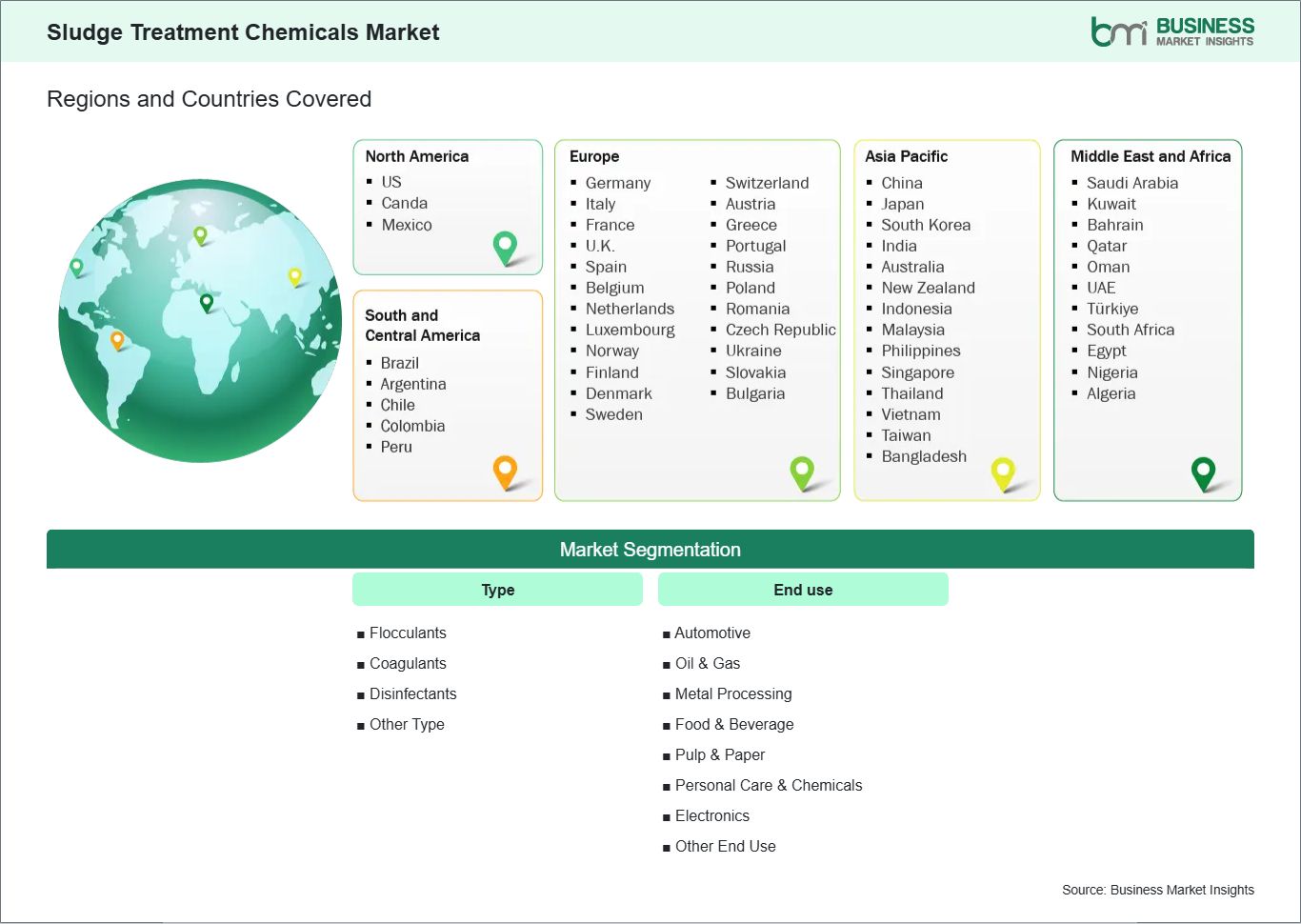
Key segments that contributed to the derivation of the sludge treatment chemicals market analysis are type and end use.
Improvements in packaging machinery in Western Europe are significantly changing the profile of wastewater streams and creating a greater need for specific chemicals to treat the sludges produced during treatment of these wastewaters. New packaging machinery in Germany, France, and the Netherlands now operates at ultrahigh speeds and includes washing and rinsing stages in the process. This has created a wastewater stream with high concentrations of solids, lubricating materials, and leftover packaging materials such as starch and adhesives. To deal with these increased demands before they enter the public treatment systems, food and consumer product manufacturers are looking to highly active coagulants and flocculants to quickly combine finely divided solids in these difficult-to-treat wastewater streams.
In the industrial centers of Germany, including Bavaria and Baden-Württemberg, the move to servo-drive, automated packaging machines has led to a decrease in human interaction but an increase in rinse water volumes, thereby creating a situation of high sludge generation. To address these issues, wastewater treatment plants in the region are increasingly turning to specialized polymeric conditioners to improve dewaterability, thereby decreasing drying costs. In the French dairy and beverage industry, including those in the Lyon and Paris areas, bio-enzyme blends are being utilized to improve the degradation of residues from cleaning-in-place operations associated with high-speed filling equipment.
In addition, the Benelux region is witnessing the adoption of innovations in packaging machinery, including sensors and automated dosing systems, which are designed to provide an effective dosing system of sludge treatment chemicals in line with changing turbidity and conductivity patterns in the wastewater stream. As Western European manufacturers continue to drive the adoption of smarter, faster equipment to support sustainability and productivity objectives, sludge treatment chemicals are being innovated to match the changing wastewater landscape in the region.
The growth of the ready-to-eat (RTE) and frozen food production sector in Western Europe is one major factor driving the sludge treatment chemical market. The increasing urban population, changing eating patterns, and desire for convenience foods have fueled production in France, Spain, and the UK, where massive production facilities operate around the clock, manufacturing RTE products and frozen meals. These facilities have high-fat, protein, and starch concentrations in their wastewater, especially after blanching, cooling, and IQF treatment. The treatment plants use specific sludge treatment chemicals, including grease-specific coagulants and polymeric flocculants, to treat such high-strength wastewater.
In the French food processing centers in Lille and Nantes, the rising production levels of RTE salads, marinated proteins, and frozen bakery products have resulted in an increase in the cost of handling sludge. To address this issue, operators have turned to multi-stage conditioning chemicals to pre-treat the varying levels of influent. This has reduced the need to frequently desludge the wastewater treatment plants. Similarly, in the Valencia and Barcelona regions of Spain, frozen seafood processing centers have turned to enzymatic sludge breakers to address the seasonal peaks in wastewater treatment plant influent due to export cycles.
In the UK, the increasing number of frozen meal brands, especially those being promoted through retail and internet campaigns, is also having an impact on wastewater treatment. Operators in North West England and Scotland have turned to acid-base balancing agents to address the pH level fluctuations due to intermittent production peaks. With the rising levels of RTE and frozen food production, the need for high-performance sludge treatment chemicals to address the varying levels of influent will continue to rise.

The sludge treatment chemicals market is experiencing steady growth, with market size and share analysis reflecting evolving treatment preferences and competitive dynamics among key players. The report evaluates important subsegments categorized within type and end use, highlighting their respective contributions to overall market performance.
By type, the flocculant subsegment dominated the Sludge treatment chemicals market in 2025 because because they are essential in nearly every sludge treatment process sthey help particles aggregate so water can be separated efficiently. Across industries like wastewater, industrial effluents, and municipal treatment, flocculants reduce processing time and improve dewatering outcomes.
Based on end use, the oil & gas subsegment dominated the sludge treatment chemicals market in 2025 because because operations produce large volumes of oily sludges and wastewater that require extensive chemical treatment before disposal or reuse. Drilling, refining, and pipeline maintenance generate persistent waste streams that must be conditioned, dewatered, and stabilized.
| Report Attribute | Details |
|---|---|
| Market size in 2025 | US$ 7.19 Billion |
| Market Size by 2033 | US$ 11.03 Billion |
| Global CAGR (2026 - 2033) | 5.49% |
| Historical Data | 2022-2024 |
| Forecast period | 2026-2033 |
| Segments Covered | By Type
|
|
Regions and Countries Covered
| |
| North America | US, Canada, Mexico |
| Europe | Belgium, Austria, Finland, Denmark, Greece, Poland, Romania, Russia, Ukraine, Czech Republic, Slovakia, Bulgaria, Italy, Luxembourg, Germany, Switzerland, France, Netherlands, Norway, Portugal, Spain, Sweden, United Kingdom |
| Asia-Pacific | Australia, China, India, Japan, South Korea, Indonesia, Malaysia, Philippines, Singapore, Thailand, Vietnam, Bangladesh, New Zealand, Taiwan |
| South and Central America | Brazil, Argentina, Peru, Chile, Colombia |
| Middle East and Africa | Bahrain, Kuwait, Oman, Qatar, Saudi Arabia, United Arab Emirates, Turkiye, South Africa, Egypt, Algeria, Nigeria |
| Market leaders and key company profiles |
|
The "Sludge Treatment Chemicals Market Size and Forecast (2022 - 2033)" report provides a detailed analysis of the market covering below areas:
The geographical scope of the Sludge treatment chemicals market report is divided into five regions: North America, Asia Pacific, Europe, Middle East & Africa, and South & Central America. The Sludge treatment chemicals market in North America is expected to grow during the forecast period.
Geographically, the global sludge treatment chemicals market is dominated by North America, considering its developed wastewater management infrastructure, regulatory framework, and industrial base. The United States, in particular, plays a vital role in contributing to regional demand, considering its focus on developing and upgrading its wastewater management and industrial effluent management practices. For instance, the United States Environmental Protection Agency has implemented stricter regulations concerning wastewater disposal, pollutant removal, and nutrient recovery, thereby encouraging the use of superior quality chemicals for coagulation, flocculation, and dewatering processes.
Canada also plays a vital role in contributing to regional demand, considering its investments in developing sustainable wastewater management and industrial effluent management practices. The dominance of the North American market can also be attributed to technological innovation, considering the development and use of tailored chemicals for treating different types and compositions of sludge, dewatering processes, and minimizing chemical consumption.
The market also focuses on sustainable practices, such as using biodegradable and low-toxicity chemicals, to comply with stricter environmental regulations, thereby ensuring a sustainable environment. Thus, the dominance of the North American market can be attributed to its regulatory framework, industrial practices, and focus on sustainability, thereby playing a vital role in developing and adoption of sludge treatment chemical solutions globally.

The sludge treatment chemicals market is evaluated by gathering qualitative and quantitative data post primary and secondary research, which includes important corporate publications, association data, and databases. A few of the key developments in the sludge treatment chemicals market are:
The Sludge Treatment Chemicals Market is valued at US$ 7.19 Billion in 2025, it is projected to reach US$ 11.03 Billion by 2033.
As per our report Sludge Treatment Chemicals Market, the market size is valued at US$ 7.19 Billion in 2025, projecting it to reach US$ 11.03 Billion by 2033. This translates to a CAGR of approximately 5.49% during the forecast period.
The Sludge Treatment Chemicals Market report typically cover these key segments-
The historic period, base year, and forecast period can vary slightly depending on the specific market research report. However, for the Sludge Treatment Chemicals Market report:
The Sludge Treatment Chemicals Market is populated by several key players, each contributing to its growth and innovation. Some of the major players include:
The Sludge Treatment Chemicals Market report is valuable for diverse stakeholders, including:
Essentially, anyone involved in or considering involvement in the Sludge Treatment Chemicals Market value chain can benefit from the information contained in a comprehensive market report.
Please tell us your area of interest
(Market Segments/ Regions and Countries/ Companies)